
By Bethlehem Mengistu (Agenda for Change), Catherine McManus (The Water Project), Kerstin Danert (Ask for Water)
BACKGROUND
Whether the starting point is a broken pump or a fragmented WASH system, one truth connects Stop the Rot and Agenda for Change: you cannot deliver safe, sustainable water services without both construction quality and resilient systems. Both platforms involve partners in government, civil society, funding agencies, the private sector and academia; both are striving to improve rural water supply services, and yet they are different.
Agenda for Change is rooted in systems strengthening
Stop the Rot is concerned about the quality of infrastructure.
This blog brings us together – one social scientist, Bethlehem (Agenda for Change) and two engineers, Catherine (The Water Project) and Kerstin (Ask for Water Ltd) from Stop the Rot. It explores where our work converges, where it differs, and what practitioners across the sector can learn from this intersection.
INTRODUCING AGENDA FOR CHANGE AND STOP THE ROT
Kerstin: So Bethlehem, can you explain what Agenda for Change is trying to achieve, and how it works?
Bethlehem: Thanks, Kerstin! I appreciate that we are having this conversation because while broken pumps are easy to spot, broken systems are not. That’s where Agenda for Change comes in.
Think of us as the people behind the scenes, making sure the whole rural water “machine” works-not just today, but five, ten, twenty or even thirty years from now. That means working with governments, utilities and communities to strengthen everything from planning and policy to budgeting and monitoring. And we achieve this by incentivising collaboration and supporting collective action. Our members and partners work together in countries, sharing tools, aligning around government-led plans, and learning from one another. We believe that when organisations coordinate and work in harmony, lasting change occurs.
Right now, Agenda for Change has 20+ members working across more than 60 countries with local and national governments to build strong, resilient WASH systems that can withstand the test of time and climate shocks.
Whether it’s helping a district government to develop a realistic water budget, supporting a utility to track service levels, or training local technicians to maintain infrastructure, our goal remains the same: to ensure everyone, everywhere, has access to sustainable water and sanitation services.
Bethlehem: So Kerstin, can you tell me about Stop the Rot?
Kerstin: Stop the Rot and its members are concerned about the flaws and gaps that lead to poor quality boreholes and pumps – which in turn contribute to poor performance and even failure of water supplies.
A core component of Stop the Rot is its Action Group, currently comprising over 90 members from all stakeholder groups. We meet online every quarter, share experiences, challenges, successes and – especially learnings. The meetings provide a safe and supportive space for dialogue on ways and means of ensuring quality infrastructure. Our geographic focus is sub-Saharan Africa, with our technical focus being services that rely on boreholes and handpumps.
MORE THAN TECHNOLOGY
Bethlehem: OK – so Stop the Rot is really interested in technical questions – as in about the technology?
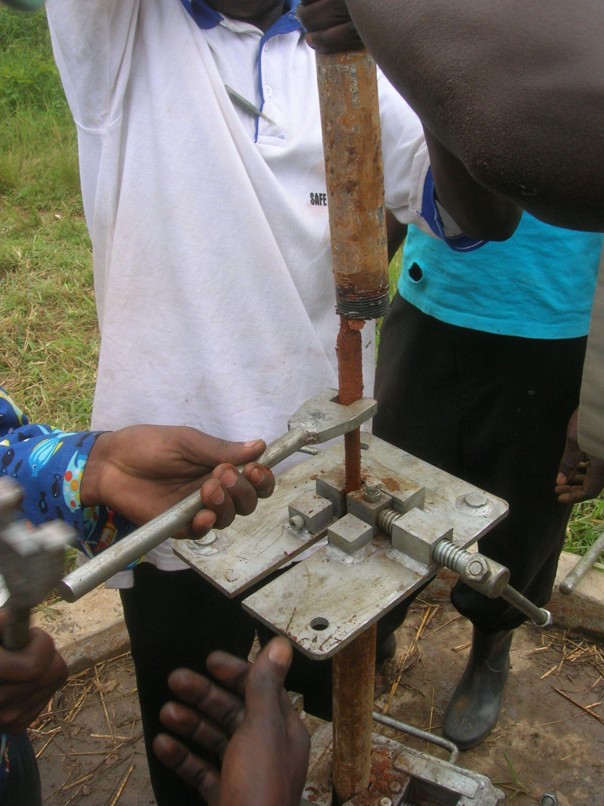
Catherine: We do often start there, but it’s not where we end. It is tempting to think that an engineer will just focus on one broken pipe in one well. But as an engineer, I am asking if that broken pipe is corroding, and if so, is it because the material is not suitable for the groundwater (in technical terms – galvanized iron (GI) installed in aggressively low pH water, or stainless steel of the wrong grade)? Or is a pump seal wearing because there are fine particles in the water (typically a problem of a poorly constructed borehole). These are examples of a technical diagnosis.
And then, beyond this technical diagnosis, I am asking: why did that happen? Were high-quality materials not available in local supply chains, or were they considered too expensive; was oversight of the borehole construction process lacking? And the real question – what can I do about any of that?
Sure, at Stop the Rot we are concerned that repairs or rehabilitation to get water flowing are done, but we are also aware of systems approaches. I think the problem is that we need to better wrestle with those issues – or connect to those who can! That’s why I am so glad to be more connected to Agenda for Change. It can feel really difficult to focus on contextual issues when faced with a broken piece of infrastructure, but we must do just that – and we’re thrilled to be embarking on this exchange with Agenda for Change.
Bethlehem: I am also excited that we are exchanging on this, because right now, system strengthening is more urgent than ever. With global aid budgets under pressure and climate risks rising, we can’t afford to hold on to silos. Systems strengthening isn’t just a nice idea, it’s essential. It can support countries to build resilient water services that don’t rely forever on external funding or quick fixes.
And here’s where I think Agenda for Change and Stop the Rot intersect: infrastructure is not separate from the system, it is part of it. But infrastructure alone won’t deliver services. It must be supported by financing, regulation, monitoring, skilled personnel, and local ownership. We need to look at infrastructure through the lens of the whole system, the interplay of all the other parts. That’s how we move from short-term fixes to lasting solutions.
THE INTERCONNECTIONS BETWEEN SYSTEMS AND INFRASTUCTURE
Continue reading “Change our views, Blog 1: Fixing pumps and perceptions – a systems love story” Rural Water Supply Network - blog