
“Financing WASH that lasts”
Financing and Incentives for Rural WASH
21 Oct. 2026 · Author: Mirja Michalscheck, Skat Foundation, Rural Water Supply Network (RWSN).
Access the slides and recording of the session on the RWSN website.
What Bangladesh, Peru and Zambia teach us about financing that keeps rural WASH services running.
Rural water and sanitation services do not fail for lack of infrastructure. They fail because nobody pays for operation and maintenance once the hardware is in. Can financing and incentives change that? That was the question behind the second SIRWASH 2 webinar on 21 October 2026, which drew 270 participants. The second phase of SIRWASH (Sustainable and Innovative Rural Water and Sanitation and Hygiene Services), funded by the Swiss Agency for Development and Cooperation (SDC), implemented by the Inter-American Development Bank (IDB), with technical support from Skat Foundation, aims to strengthen sustainable rural WASH services through innovation, knowledge exchange and collaboration. Its webinar series, facilitated by RWSN, brings together IDB, ADB, AfDB and the World Bank in a Community of Practice on Rural WASH for multilateral development banks (MDBs).
Opening the session, Francisco González Medina (IDB) set the tone: financing is not only about building infrastructure. In rural areas it must come with mechanisms that leverage public investment, mobilise additional resources and reward the providers who keep services running. Meleesa Naughton (Uptime) reported that in many rural areas, what users can pay does not cover the cost of professional operation and maintenance. Without public finance to bridge that gap, the familiar cycle follows: build, neglect, rebuild.
Three cases showed how financing can close such gaps: helping households pay for their own toilets (Bangladesh), rewarding municipalities for systems that work (Peru), and paying service providers for water that flows (Bangladesh and Zambia). One common thread: in every case, public finance anchors the approach.
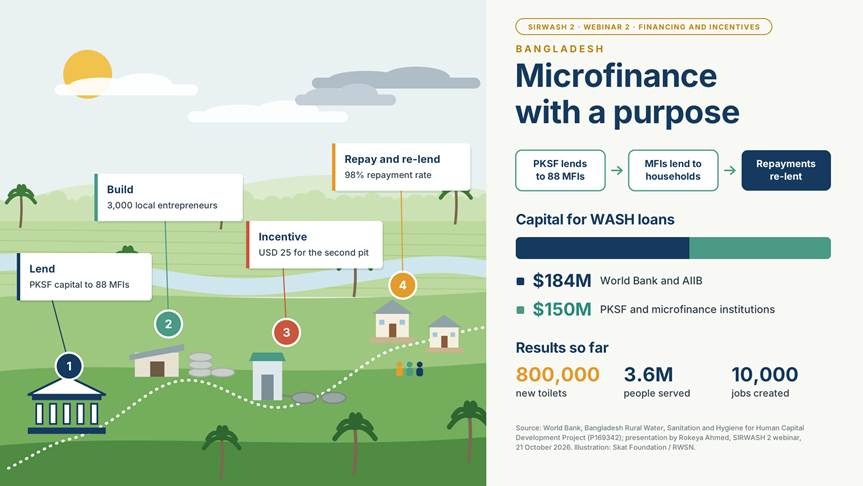
Bangladesh: Microfinance with a purpose. Generated with Claude.ai
Bangladesh: microfinance with a purpose
Presentation by Rokeya Ahmed (World Bank)
Bangladesh ended open defecation by around 2015, yet only 42% of its 103 million rural people have safely managed sanitation. The gap is financial. A durable, safely managed toilet costs about USD 200. The Department of Public Health Engineering (DPHE) pays 85–100% of that for the poorest households, roughly the bottom 10%. Everyone else must pay for their own toilet, and many moderately poor and lower-middle-income households cannot pay the USD 200 upfront. Subsidising all of them would be far beyond the government’s budget. However, for many households, the problem is not the price but paying it all at once.
The Bangladesh Rural WASH for Human Capital Development Project (USD 550.5 million, financed by IDA, AIIB and the government) uses an innovative microfinance model to finance two sides of the WASH market: on the supply side, 3,000 local entrepreneurs were trained and received business loans to build and sell improved toilets. On the other side, the government’s wholesale lender, the Palli Karma-Sahayak Foundation (PKSF), channels USD 334 million to 88 microfinance institutions, which borrow at 5–6% and lend to households for sanitation facilities at 9% over 18 months. Sanitation loans range from USD 115 to 500. On top of the loan, households are offered a USD 25 incentive for building a second pit to manage faecal sludge, reimbursed by PKSF once construction is verified. Instead of a separate hygiene campaign, 5,000 microcredit field staff carry handwashing and menstrual hygiene messages to 20 million people. A 2016 pilot and its evaluation shaped the design; PKSF agreed to extend loan tenure from 12 to 18 months and lower interest on sanitation loans. The results so far: 800,000 new toilets serving 3.6 million people, around 10,000 jobs, a 98% repayment rate and a USD 260 million revolving fund that can lend again and again, even in remote areas where commercial banks do not offer WASH loans. The caveat: the model reaches moderately poor and lower-middle-income households. Households in extreme poverty still need higher subsidies.

Peru: Rewarding results. Generated with Claude.ai
Peru: a national budget that rewards results
Presentation by Alexander Pintado Reyes (National Rural Sanitation Programme, Ministry of Housing, Construction and Sanitation)
Peru has linked public budgets to measurable results for years. One of its tools is the Municipal Incentive Programme, run by the Ministry of Economy and Finance (MEF). Sector ministries propose commitments, indicators and targets; MEF approves and publishes them; municipalities implement and report; the ministries provide technical assistance and verify; MEF then transfers the funds. One cycle takes three years: design, implementation, verification. As Alexander stressed, the transfer is not a refund of costs. It is an extra performance-based reward on top of the municipal budget.
For rural water and sanitation in Peru, the gap lies in quality more than coverage: 81% of the population has water coverage, but only 42% of households in concentrated rural settlements receive quality water, and only 10% of rural households have access to safely managed sanitation. The Municipal Incentive Programme thus rewards municipalities based on three indicators in 2025:
- share of households with access to quality water (1,640 municipalities taking part);
- number of water systems in good condition after maintenance (356 municipalities);
- number of households whose sanitation systems receive maintenance (883 municipalities).
Municipalities report in the national rural water and sanitation information system DATASS. The PNSR checks data consistency, cross-checks water quality with the Ministry of Health’s surveillance system SIVICA, and visits random sites. A result counts only if quantity, quality of evidence and timeliness all hold.
With the incentive and other support from the ministry, the share of rural water systems in good condition in Peru rose from 22% in 2018 to 60% in 2025, out of 34,709 systems. Households in concentrated settlements receiving water of good quality went from 14% in 2022 to 42% in 2025. What remains: municipal technical units lack staff, budget and equipment; the incentive reaches only about 30% of systems; household fees do not yet cover the cost of operation and maintenance; and chlorination must become continuous and verified on time.

Bangladesh and Zambia: Paying for uptime. Generated with Claude.ai
Bangladesh and Zambia: governments co-fund reliable drinking water in schools and clinics
Presentations by Meleesa Naughton (Uptime) and Eng. Kabwe Mweenda (Ministry of Water Development and Sanitation, Central Province, Zambia)
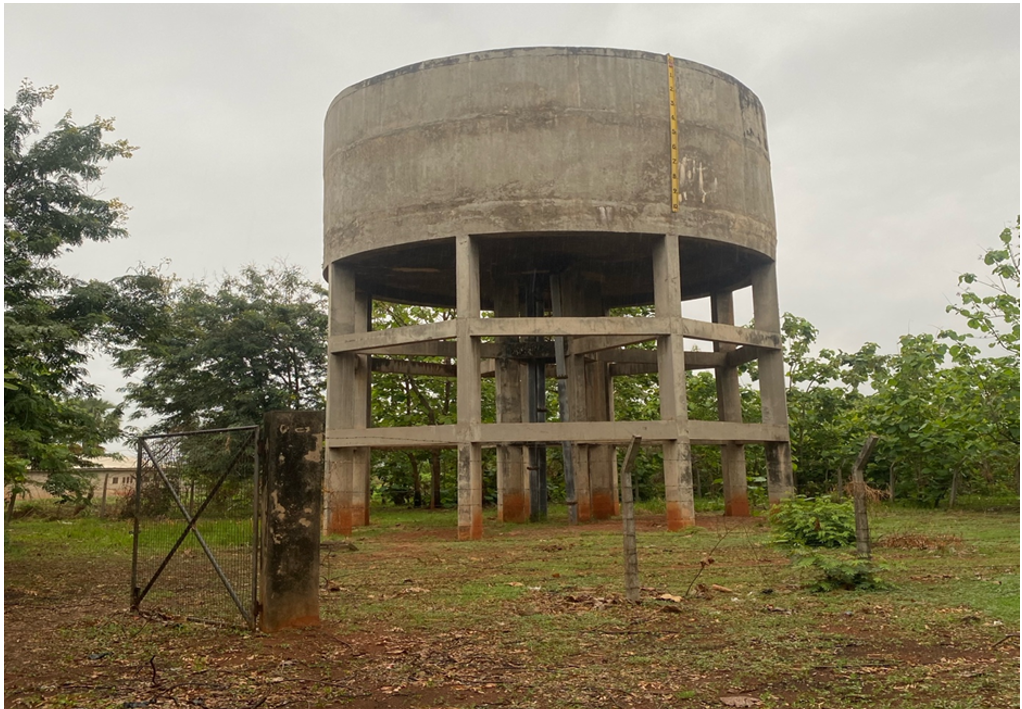
Meleesa Naughton showed a photo of a primary school in Chongwe, Zambia: two water towers, solar panels and a handpump. None of them worked. The problem is not the infrastructure but that nobody is paid to keep it running. SafePani in Bangladesh and SafeManzi in Zambia close this gap with the same model, developed with Uptime: a professional service provider maintains the water points and is paid only for verified results: water flowing at least 96% of the time (less than three days of interruption each quarter) and safe water (sanitary inspections, water quality testing, no E. coli – see Results-based funding for safe drinking water services for more details). Results are checked through quarterly data reviews, site visits and audits; The Data Dividend explains the method. According to Uptime, the operating subsidy stays below USD 1 per person per year.
But a results-based subsidy is only as sustainable as its funding source. Uptime piloted this approach thanks to philanthropic funding; the aim now is for governments and development banks to adopt and fund the approach. Meleesa named three conditions for that: governments acknowledge, and ideally quantify, the financial gap between the cost of professional service delivery and what users pay; trusted data systems let them verify service performance; and leadership puts rural services high on the agenda and coordinates across sectors such as water, local government, education and health. Bangladesh and Zambia show what that looks like.
In Bangladesh, the SafePani pilot, led by the University of Oxford under the UK-funded REACH programme, showed that a local provider could be held accountable for reliable, safe water in schools and health facilities. In 2024 the government signed a partnership with Uptime to scale the model and co-fund it. To Uptime’s knowledge, it is the first time a government has put public budget into a results-based contract for safe drinking water in public facilities; Uptime covers around 50% of the annual operating costs. A results-based contract now covers about 1,200 institutions in Khulna district (2025–2030). The government has announced plans to expand the model to a second coastal district, bringing the total to more than 2,000 institutions. Talks are under way to extend it to primary schools nationwide (more on SafePani).
Zambia’s SafeManzi followed the same path. A 2024–25 pilot in Mumbwa district covered 101 schools and health facilities, reaching about 70,000 pupils and patients, with the objective of providing reliable drinkingwater (available 96% of the time or more) that met water safety standards. In early 2026 the government committed to co-funding the contract. Four more districts in Central Province (about 400 institutions) are now being added, with two service providers, and the plan is to expand to national scale by 2030.
Why did the Zambian government invest? Eng. Kabwe Mweenda pointed to a presidential mandate for water and sanitation in all public institutions, and to the Grow Zambia agenda, which treats water as economic infrastructure for agriculture, jobs, human capital and mining. Making it work requires coordination between the ministries of water, health, education and local government, utilities, communities and cooperating partners, with partners strengthening government systems rather than building parallel ones. The next step is Central Province’s 11 districts, with 1,766 schools and 319 health facilities. That requires reliable asset data to prioritise the most underserved, co-funding from the Ministry of Education, transparent contracts, measurable service standards and a plan for when external support ends. In her words: “Our ambition is not to simply scale a project, it is to scale reliable water services.”
What we learned
🧩 The tool is not the innovation; the design is. Microfinance, fiscal transfers to municipalities and service contracts all existed before. What made them work is how they were tied to incentives, verification and clear roles. As Sean Furey noted, the same logic works for a USD 25 incentive per household, a business loan to a small entrepreneur, a whole municipality or a service provider.
🏛️ Governments in the driver’s seat. In all three countries a public institution co-finances and steers the approach: PKSF in Bangladesh, the Ministry of Economy and Finance in Peru, line ministries in Bangladesh and Zambia. Pilots provide the proof; public budgets make it last.
📊 Data is the backbone: plan, do, verify. Every case rests on data that helps plan, act and check what was done. Keep payment indicators few and simple. And keep verification independent of the provider – as Meleesa Naughton stressed, whether or not a results-based contract is in place.
💧 Pay for working services, not built assets. Peru rewards systems in good condition, Uptime pays for water that flows and is safe, and Zambia measures success by reliability rather than infrastructure built.
⚖️ No single instrument reaches everyone. Microfinance misses the extreme poor; Peru’s incentive focuses on concentrated settlements and covers a third of systems; household fees rarely cover full costs. The viability gap has to be named and financed, through what the OECD calls the “3Ts”: tariffs, taxes and transfers.
Is it transferable?
Rokeya Ahmed warned against copy-and-paste. Microfinance for WASH is not standard microfinance: it brings together lenders, local businesses and households, and does not work without behaviour change. That takes time and money to set up, and what succeeded in Bangladesh needs adapting to local affordability elsewhere. Each case also rests on its own foundations: Peru’s incentives on years of results-based budgeting and a national data system, Bangladesh’s on a mature microfinance sector, Zambia’s on a political mandate.
Webinar participants also asked about resilience: can these instruments reward services that withstand El Niño, or unreliable electricity for pumping? Meleesa explained that monitoring reliability already rewards resilience indirectly: frequent, verified data show which communities lose service, how often and why, so governments can act. Results-based contracts can also include provisions for force majeure events to ensure service providers are not bearing the risks disproportionately. Alexander added that Peru’s 2025 universal rural water and sanitation law introduces a principle of reliability: protecting sources and aquifers, and securing alternative sources in a country facing floods in the north and drought in the south.
Cross-regional learning is already happening. Eng. Kabwe Mweenda saw Peru’s sanitation commitment as relevant for Zambia’s goal of universal sanitation access by 2030. Sean Furey’s closing reflection: none of these mechanisms solves everything, but each works as an organising principle that helps actors work together efficiently.
| Approach | What it needs | Where it fits | Limits |
| Household loans with incentives (Bangladesh) | A mature microfinance sector; a public wholesale lender; trained local entrepreneurs; behaviour change | Household toilets and water connections for moderately poor and lower-middle-income households | Extreme poor; construction quality; slower to set up than standard microfinance |
| Performance incentives for municipalities (Peru) | Results-based budgeting led by the finance ministry; a national monitoring system; capacity to verify | Countries where municipalities are responsible for rural services | Weak municipal technical units; partial reach; fees still below operating costs |
| Results-based contracts with service providers (Bangladesh, Zambia) | Professional service providers; independent verification; government co-funding and cross-sector coordination | Schools and health facilities as an entry point, then community systems | Few professional providers in some contexts ; events beyond the provider’s control |
Table 1: What it takes to transfer each approach, and where its limits lie.
What’s next
- IDB virtual workshop on networks and partnerships for financing rural WASH, 11 November 2026, 9:00 (Colombia time), building on this session. Register here.
- Capacities and Institutions for Rural WASH Service Delivery, 18 November 2026, 15:00 CET, hosted by the World Bank.
- Water-Energy-Food Nexus: What Really Works and Why, 20 January 2027, 15:00 CET, hosted by the African Development Bank.
Register and find all materials on the RWSN webinar page.
Annex: two more rural sanitation financing cases
These cases were not presented in the webinar. They add two further examples of financing household sanitation.
Ethiopia: markets reach many, subsidies reach the poorest. USAID Transform WASH (2017–2024, USD 47.5 million, led by PSI with SNV, IRC and Plan International) built a market for low-cost toilet upgrades in 63 districts. More than 500 local businesses sold over 226,000 sanitation products, reaching more than a million people. Door-to-door sales by trained masons convinced 25–30% of the households they visited, compared with under 5% for awareness visits by health extension workers. But the gains went mainly to better-off households; the poorest saw almost no progress. Revolving funds placed with three microfinance institutions produced only 45 business loans. The government responded with a national protocol for smart, targeted sanitation subsidies (2022, revised 2023). Source: USAID Transform WASH (2024), Eight Years in Review.
Liberia: safer household loans and a first budget line. The Countywide Sanitation Activity (USAID, USD 30 million, 2022–2027, led by PSI) works in five counties where donors provide about 98% of WASH funding and sanitation receives less than 1% of the national budget. In a pilot, the Foundation for Women Liberia disbursed 467 household sanitation loans through 44 village savings groups, with full repayment. To limit diversion, 60% of each loan is now paid in toilet products rather than cash, and a guarantee fund covers 70% of the lender’s risk. County councils in all five counties have committed 2–5% of their budgets to sanitation. Source: CWSA Annual Work Plan FY2025.
Both cases echo Rokeya Ahmed’s message: household finance works when lenders, local businesses and demand creation come together, but the poorest still need public support.
Credits: Presentations by Rokeya Ahmed (World Bank), Meleesa Naughton (Uptime), Alexander Pintado Reyes (PNSR, Ministry of Housing, Construction and Sanitation, Peru) and Eng. Kabwe Mweenda (Ministry of Water Development and Sanitation, Central Province, Zambia). Opening remarks by Francisco González Medina (IDB). Moderation by Sean Furey (Skat Foundation/RWSN). Session design and organisation: Beatriz Giraldo (IDB), Cristina Mercerreyes (IDB), Dr Aline Saraiva Okello (Skat Foundation/RWSN), Batima Tleulinova (Skat Foundation/RWSN), Sean Furey (Skat Foundation/RWSN).
Sustainable and Innovative Water, Sanitation and Hygiene Services in Rural Areas (SIRWASH) Phase 2 is driven by the Inter-American Development Bank (IDB) and funded by the Swiss Agency for Development and Cooperation (SDC). It aims to increase access to and quality of water, sanitation and hygiene services in rural communities, with an emphasis on gender, diversity and climate change, for an inclusive, resilient and sustainable rural sector. Through the exchange of experiences and the promotion of scalable good practices, SIRWASH strengthens strategic alliances and fosters collaborative learning among sector actors. The SIRWASH 2 webinar series is a partnership between IDB, ADB, AfDB and the World Bank, supported by Skat Foundation through the Rural Water Supply Network (RWSN).



Leave a Reply