
By Euphresia Luseka In Celebration of Africa Women’s Day 2026
KENYA, JULY 31, 2026
Featured photo: Gilda Giza Rede an Angolan Electromechanical maintenance technician. Rede also represents a new generation of women entering highly technical engineering roles in large-scale water infrastructure. Source, African Development Bank (AfDB).
As the African Union declares 2026 the Year of Water and Sanitation, the continent’s most persistent social burden is being reframed as a productive economic asset; driven by policy innovation, institutional partnerships, and female-led advances in infrastructure, science, and enterprise.
For decades, global development policy viewed African water through the lens of charity and endurance; measuring the billions of unpaid hours women spent carrying water rather than the economic value lost through reduced productivity, constrained livelihoods, and foregone opportunity[i].
As the African Union declares 2026 the Year of Water and Sanitation, that narrative is beginning to shift[ii]. Governments, investors, and Development Finance Institutions (DFIs) are increasingly recognising what many African women leaders have long understood: water is not simply a welfare issue. It is productive infrastructure that underpins agriculture, manufacturing, energy security, public health, and, ultimately, economic growth.
This structural transition is reshaping the sector. The traditional model, centred on public expenditure and development assistance, is giving way to a diversified water economy in which governments, DFIs, commercial investors, technology firms, utilities, and local enterprises collectively finance, deliver, and scale water solutions as illustrated on the figure below.[iii] Within this emerging ecosystem, women are no longer positioned primarily as beneficiaries of water services but as scientists, engineers, entrepreneurs, utility leaders, policymakers, and investors shaping how water is governed, financed, and deployed.

The implications extend well beyond the water sector. Reliable water systems determine agricultural productivity, industrial competitiveness, urban resilience, and countries’ capacity to adapt to climate change.[iv] Investment in water is therefore increasingly recognised not only as a social imperative but as a strategic economic investment.
The women shaping this transition are helping to build a new African water economy where science, policy, entrepreneurship, and finance converge to transform water from a development necessity into a catalyst for inclusive growth.
Some of the Women Building Africa’s Water Economy
This transformation is already visible across the continent through a new generation of scientists, entrepreneurs, and institutional leaders who are changing how water resources are measured, governed, financed, and delivered. As profiled in the 1st African Women in Water and Sanitation Compendium,[v] their work demonstrates that the future of Africa’s water economy will depend not only on physical infrastructure, but on the systems of knowledge, innovation, and governance that make investment possible.[vi]
From satellite-based groundwater mapping in the Sahel to community-led watershed management in The Gambia, circular sanitation enterprises in Senegal, and digital water distribution models in Rwanda, women are building the capabilities required to convert water and sanitation challenges into economic opportunities as elaborated below:
1. Science: Turning Uncertainty into Investable Assets:
Investment follows information. Nowhere is this more evident than in the Sahel, where advances in satellite hydrology are transforming how groundwater resources are identified, valued, and managed. Among the pioneers is Dr. Fadji Zaouna Maina, a Nigerien Earth scientist and hydrologist at NASA’s Goddard Space Flight Center. Using satellite remote sensing, artificial intelligence, and high-performance computing, she maps deep aquifers across one of the world’s most climate-vulnerable regions. Her work enables governments, utilities, and investors to make more informed decisions on irrigation, water infrastructure, and long-term resource management.
“Without empirical precision, subterranean water remains an un-bankable risk. By applying high-resolution satellite hydro-analytics to Sahelian aquifers, we provide sovereign funds with the data required to de-risk large-scale irrigation and utility investments, converting hidden underground water into investable, climate-resilient assets.”
In capital markets, uncertainty carries a cost. By reducing uncertainty, scientific evidence strengthens project bankability, improves municipal planning, and lowers the risk premium attached to long-term infrastructure investment.[vii]
2. Governance: Building Institutions That Secure Water
Infrastructure alone cannot guarantee water security. Durable systems depend on institutions capable of managing competing demands, protecting ecosystems, and building public trust. The TRY Oyster Women’s Association in The Gambia demonstrates how community leadership can strengthen both environmental stewardship and economic resilience. After securing statutory co-management rights over the Tanbi Wetland National Park, the association introduced seasonal harvesting rules, restored mangrove ecosystems that protect coastal aquifers from saltwater intrusion, and established community savings and microfinance schemes. Their experience challenges the assumption that effective water governance must be driven from the centre. Instead, it shows that secure resource rights, local accountability, and community stewardship can deliver stronger ecological outcomes while improving household livelihoods.
3. Enterprise: Creating Value from Waste
The transition to a water economy also requires rethinking what constitutes value. In Dakar, Mme Léna Tall Faye, Chair of DELVIC Sanitation Initiatives, is demonstrating that sanitation can operate as a commercially viable industry rather than a perpetual public expenditure. Using waste-to-resource technologies, including the Janicki Omni Processor, DELVIC converts untreated faecal sludge into purified water, electricity, and organic fertiliser, transforming waste into multiple revenue streams. In Ethiopia, entrepreneur and CNN Hero Freweini Mebrahtu has shown that sanitation also generates economic value by protecting human capital. Through the Mariam Seba Sanitary Products Factory, she combines reusable menstrual health products with improved school sanitation, reducing girls’ absenteeism and strengthening future workforce participation. Together, these enterprises demonstrate that sanitation is not a cost to be managed, but an economic asset capable of generating commercial returns while improving health, education, and productivity.
4. Digital Innovation: Reinventing Utility Economics
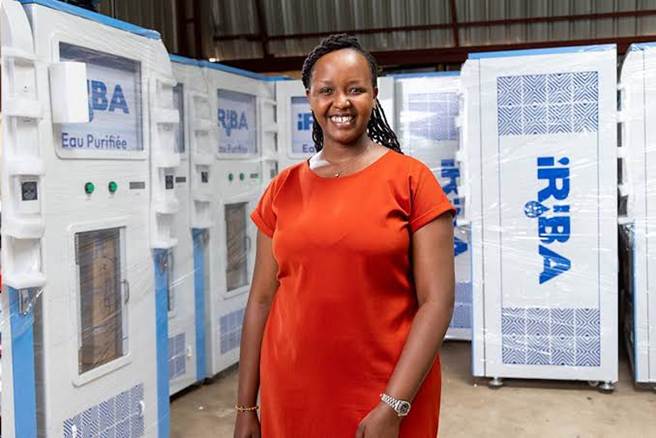
Technology is equally transforming the economics of service delivery. In Rwanda, Yvette Ishimwe, Founder and CEO of IRIBA Water Group, has reimagined last-mile distribution through solar-powered water kiosks, automated water ATMs, and digital payment platforms.Rather than relying exclusively on expensive network expansion, IRIBA has developed decentralised systems that reduce capital requirements while extending reliable and affordable access.By reducing operational costs, improving revenue collection, and strengthening utility performance, digital technologies demonstrate that innovation can improve both financial sustainability and service delivery.
These women are indeed changing the Investment Equation.
Although they operate in different countries and disciplines, they are addressing the same structural challenge: making Africa’s water sector more investable.
Scientific evidence reduces information risk. Strong institutions improve regulatory confidence. Circular business models generate predictable revenue streams. Digital technologies strengthen operational performance. Together, these are the foundations upon which long-term infrastructure finance depends.
Financing water infrastructure has historically been constrained not by a global shortage of capital, but by weak project preparation, regulatory uncertainty, operational risk, and limited institutional capacity.[viii] Investors commit capital where long-term risks can be understood and managed. By strengthening these foundations, the women profiled here are narrowing the gap between development ambition and commercial investment, demonstrating that the future of Africa’s water economy will be shaped as much by innovation, governance, and enterprise as by engineering alone.
Why Women’s Leadership Changes the Investment Case
The women profiled are doing more than expanding access to water and sanitation. By improving data, strengthening governance, developing commercially viable enterprises, and deploying digital technologies, they are changing the conditions under which investors evaluate water infrastructure. The paradox is that, despite generating some of the highest social and economic returns in emerging markets, water remains one of the least investable asset classes. The challenge is not the absence of value, but the difficulty of capturing, measuring, and financing that value.[ix]
For decades, water was treated primarily as a humanitarian obligation rather than an economic asset. While this approach expanded access, it often failed to build the financial, operational, and institutional foundations required to sustain infrastructure over the long term. As illustrated in the Table below, the emerging market-enabled model does not replace public responsibility for water provision. Rather, it strengthens it through better governance, stronger data, commercial discipline, and risk-sharing mechanisms that improve project bankability.
| Dimension | Traditional Humanitarian Approach | Market-Enabled and Female-Led Model |
| Primary funding source | Grants, donor assistance, philanthropic capital | Blended finance, green bonds, private investment, sustainable tariffs |
| Core objective | Expanding access and reducing immediate vulnerability | Building financially sustainable and scalable systems |
| Operational model | Infrastructure delivery with limited lifecycle focus | Asset management, digital monitoring, maintenance, and resource recovery |
| Data and governance | Fragmented information and reactive decision-making | Satellite intelligence, real-time data, and institutional accountability |
| Value creation | Social benefits that are difficult to monetise | Productivity gains, efficiency savings, revenue generation, and investment returns |
| Risk profile | Dependence on recurring external financing | Risk-sharing structures, stronger institutions, and predictable cash flows |
The distinction is not between public and private provision. It is between systems that consume resources and those that preserve, recover, and multiply value. By strengthening the conditions that investors value most, reliable data, effective governance, operational performance, and predictable cash flows, women are helping reposition water infrastructure as an investable asset rather than a perpetual development cost.
Water’s investment case lies in its multiplier effect. Reliable water systems increase agricultural productivity, reduce healthcare costs, release unpaid labour into education and formal employment, and strengthen industrial and urban productivity.[x]
Yet many of these returns accrue across society rather than directly to the asset owner, making them difficult to capture through conventional investment models. This mismatch between public value and private returns has historically constrained commercial investment.
The African Continental Free Trade Area (AfCFTA) is beginning to change this equation by creating larger regional markets for water technologies and services. As technical standards become more harmonised, women-led enterprises developing solar-powered pumping systems, membrane filtration technologies, smart metering solutions, and circular sanitation businesses are increasingly able to scale beyond national boundaries and participate in regional value chains.[xi]
The Remaining Investment Challenge
Some also ask, if women are increasingly strengthening the investment case for Africa’s water economy, why has commercial capital remained cautious?
The answer lies less in the value of water itself than in the risks associated with financing it. Critics argue that greater commercial participation could compromise affordability and the human right to water. Investors, meanwhile, continue to cite weak utility balance sheets, regulatory uncertainty, and limited project bankability as barriers to long-term investment.
Neither concern should be dismissed. Rather, both are driving new financing approaches that combine commercial discipline with public accountability. Blended finance structures, political risk guarantees, digital payment systems, and decentralised service models demonstrate that commercial investment and universal access need not be competing objectives. Instead, they distribute risk more effectively while preserving affordability and strengthening the financial sustainability of water systems.
For women-led enterprises, this evolution creates opportunities that extend beyond access to finance. As African markets become more integrated through the African Continental Free Trade Area, innovations in solar pumping, smart metering, circular sanitation, and digital water services are increasingly able to grow from local solutions into regional businesses, creating wider spillovers in employment, technology adoption, and industrial development.
Mobilising Capital for Africa’s Water Economy
Closing Africa’s water infrastructure gap requires more than additional finance. It requires projects capable of attracting long-term capital. The African Development Bank estimates that achieving continental water security will require around US$64 billion in annual investment, while current financing remains between US$10 billion and US$19 billion, leaving an annual funding gap exceeding US$30 billion.[xii]
Women are increasingly helping close this gap not simply by delivering projects, but by improving the qualities that make projects investable. Better hydrological data reduce information risk. Stronger community governance improves institutional credibility. Digital technologies enhance operational performance, while circular business models create new revenue streams. Together, these innovations strengthen project bankability and expand the range of financing instruments available, from sovereign green bonds and blended finance to venture capital and micro-infrastructure debt.
Investment & Financing Mechanisms Matrix
| Asset Class / Instrument | Primary Target | Typical Investors | De-risking Mechanism |
| Sovereign & Sub-Sovereign Green Bonds | Large-scale urban desalination, bulk water supply | Pension funds, asset managers, sovereign funds | State guarantees, multilateral credit enhancement |
| Blended Finance Funds | Rural digital distribution, solar irrigation networks | DFIs, philanthropic foundations, impact funds | First-loss equity tranche, technical assistance grants |
| Corporate Venture Capital & Private Equity | Ag-Tech, circular sanitation, IoT water analytics | Venture funds, strategic corporate investors | AfCFTA market expansion, commercial off-take contracts |
| Micro-Infrastructure Debt | Community-level water kiosks, pay-as-you-go systems | Local commercial banks, microfinance institutions | Cash-flow-backed mobile money revenue streams |
The significance extends beyond finance itself. By strengthening the technical, institutional, and commercial foundations of Africa’s water sector, women are helping reposition water infrastructure from a donor-dependent public service to an investable asset aligned with climate resilience, environmental, social and governance (ESG) priorities, and Africa’s long-term industrial transformation.
Conclusion, Redefining the Value of Water
Africa’s emerging water story is not simply about addressing scarcity. It is about changing how the continent recognises, measures, and invests in one of its most fundamental economic assets.
For generations, water insecurity constrained livelihoods, limited productivity, and placed a disproportionate burden on women through unpaid labour. Yet the same challenge that once represented vulnerability is now becoming a catalyst for scientific innovation, enterprise creation, institutional reform, and new models of investment.
The women leading this transformation demonstrate that Africa’s water future will not be built by infrastructure alone. It will depend on the convergence of data, governance, technology, finance, and leadership. From satellite hydrology and circular sanitation to digital utilities and policy reform, their work is reshaping water from a development obligation into productive infrastructure capable of generating economic value.
The next phase of Africa’s water transformation will require governments to strengthen regulatory systems, investors to rethink traditional risk assumptions, and development finance institutions to use catalytic capital to unlock private investment at scale. The challenge is no longer proving that water matters. It is building the systems that allow its value to be recognised, financed, and multiplied.
As Africa advances through the African Union’s Year of Water and Sanitation, one lesson is becoming increasingly clear: the continent’s water future will be shaped not only by the resources beneath its soil or the infrastructure above it, but by the people transforming how those resources are understood and managed.
The women building Africa’s water economy are demonstrating that water is not merely a challenge to overcome. It is an opportunity to unlock prosperity, resilience, and inclusive growth.
[i] UNDP (2024). Gender Dynamics in Unpaid Care and Water Collection: Quantifying Lost GDP Across Sub-Saharan Africa. United Nations Development Programme, New York.
[ii] African Union Commission (2026). Declaration on 2026 as the Year of Water and Sanitation: Accelerating Climate-Resilient Infrastructure. AU Assembly Resolution 842 (XXXVII), Addis Ababa.
[iii] African Water Facility (AWF) (2025). Project Preparation and Bankability Assessment for Female-Led Water Enterprises. AfDB Operational Report, Abidjan.
[iv] UNESCO & Sub-Saharan Hydrology Network (2024). Satellite Remote Sensing for Transboundary Aquifer Mapping in the Sahelian Belt. UNESCO Publishing, Paris.
[v] Luseka, E. (2026). 100 African Women Leading Africa’s Water and Sanitation Future. Rural Water Supply Network (RWSN) & African Water and Sanitation Association (AfWASA).
[vi] African Water Facility (AWF) (2025). Project Preparation and Bankability Assessment for Female-Led Water Enterprises. AfDB Operational Report, Abidjan.
[vii] Moody’s Ratings (2025). Sub-Saharan Africa Sovereign Infrastructure Risk Assessment: Water Asset Securitization. Credit Strategy Report, London.
[viii] Harvard Business School (2025). Gender-Inclusive Governance and Operational Risk in Emerging Market Infrastructure. HBS Working Paper No. 25-041, Cambridge, MA.
[ix] McKinsey & Company (2025). The African Water Catalyst: Building Market-Enabled Infrastructure Models. McKinsey Infrastructure & Capital Projects Practice, Johannesburg.
[x] Wharton Infrastructure Finance Initiative (2024). The Multiplier Effect of Water Security on Agricultural and Manufacturing Output in Sub-Saharan Africa. University of Pennsylvania
[xi] AfCFTA Secretariat (2025). Unlocking Trade in Clean Water Technologies and Equipment Across the African Free Trade Area. AfCFTA Sectoral Guidance Document 14-B, Accra.
[xii] African Water Facility (AWF). (2025). African Water Facility Strategy 2026–2030: A Call to Action. African Development Bank Group




One response to “How Women Are Turning Africa’s Water Crisis into an Economic Engine”
[…] How Women Are Turning Africa’s Water Crisis into an Economic Engine […]