
Blog by Euphresia Luseka, RWSN Leave No One Behind theme co-Lead
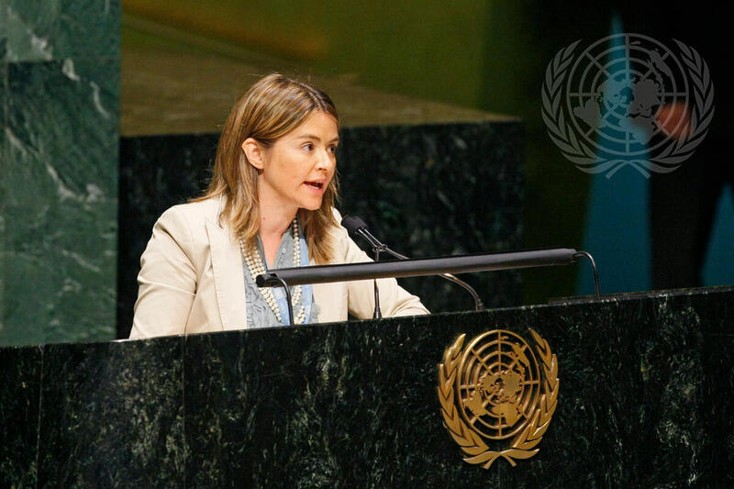
Featured photo: Catarina de Albuquerque, then United Nations Special Rapporteur on Human Right to Safe Drinking Water and Sanitation, addressing the United Nations General Assembly on 27 July 2011. Source: United Nations.
On July 28, 2010, the United Nations General Assembly adopted Resolution 64/292[i], recognising access to safe drinking water and sanitation as a fundamental human right. More than a symbolic declaration, the resolution marked a significant shift in global development policy, affirming that water and sanitation are not simply public services or economic commodities, but essential prerequisites for human dignity, public health, gender equality, and sustainable development.[ii]
16 years later, the Human Right to Water and Sanitation (HRWS) stands at a pivotal moment. Progress toward SDG6 has slowed, Official Development Assistance (ODA) is under pressure, and climate change is intensifying water insecurity across regions already struggling with fragile infrastructure[iii]. Against this backdrop, a growing narrative suggests that the promise of the right has failed to translate into meaningful change.[iv]
That conclusion overlooks an important reality.
The strongest argument for the Human Right to Water and Sanitation is not found in international declarations, but in the measurable progress achieved since its recognition in 2010.
The past 16 years have produced measurable progress in expanding access to safe water and sanitation, strengthening legal protections, and improving public service delivery.[v] While universal access remains out of reach, the evidence demonstrates that where governments have embedded the right in domestic law, invested in resilient infrastructure, and strengthened public institutions, the results have been transformative.[vi]
Building on 16 years of Progress
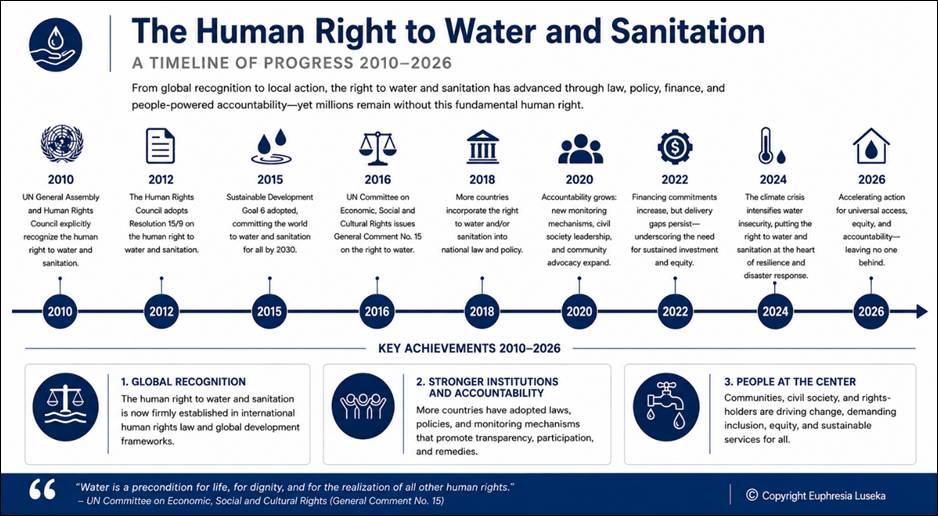
As illustrated in the figure below, the record since 2010 offers compelling evidence that rights-based governance can deliver tangible development outcomes when supported by political commitment, sound institutions, and sustained investment. Across countries and regions, the recognition of water and sanitation as a human right has influenced constitutional reforms, shaped public policy, strengthened accountability, and accelerated investments in essential services.
The expansion of water and sanitation services over the past two decades is unprecedented in scale. According to the WHO/UNICEF Joint Monitoring Programme (JMP), more than 2.2 billion people have gained access to safely managed drinking water services, while 2.8 billion people have gained access to safely managed sanitation. 5 During the same period, the number of people practicing open defecation declined dramatically; from more than 1.3 billion at the turn of the century to an estimated 350 million today.5 These gains have contributed to lower rates of waterborne disease, improved child survival, and better health and education outcomes, particularly for women and girls.
While these advances cannot be attributed to Resolution 64/292 alone, the recognition of water and sanitation as a human right helped reshape the global policy landscape.1 It reinforced political commitments, informed national legislation, and strengthened accountability by establishing access to water and sanitation as a public obligation rather than a discretionary service.
The influence of the resolution is perhaps most evident in domestic legal reform. Although the resolution itself is not legally binding, it has served as an important normative foundation for constitutional and legislative change in many countries. Kenya’s, Uruguay’s, Ecuador’s, Bolivia’s and South Africa’s Constitution explicitly guarantees the right to sufficient water, providing citizens with a legal basis to challenge unjustified service disconnections and demand government accountability.7 In India, the Supreme Court has interpreted the constitutional right to life to encompass access to safe drinking water, expanding legal protections for vulnerable communities.8 Across Latin America, countries including Costa Rica, Colombia, Mexico, Paraguay, Peru and Brazil have strengthened constitutional and statutory provisions that prioritise water for domestic use over competing commercial interests.6 Similar developments have occurred in Europe. Slovenia amended its Constitution in 2016 to recognise access to drinking water as a fundamental right, while the European Union’s revised Drinking Water Directive requires Member States to improve access to water, particularly for vulnerable and marginalised groups.
Legal recognition, however, has proven most effective when accompanied by capable public institutions.
The experience of the Phnom Penh Water Supply Authority in Cambodia illustrates what is possible when governance reforms accompany infrastructure investment. Once characterised by high water losses, weak financial management, and widespread corruption, the utility transformed itself into one of the world’s leading public water providers through universal metering, improved operational efficiency, transparent management, and progressive tariff structures.6 Today, Phnom Penh enjoys near-universal urban water coverage while protecting affordability for low-income households.
A similarly instructive example comes from eThekwini Municipality in Durban, South Africa.[vii] Through its Free Basic Water policy, the municipality guarantees vulnerable households a minimum allocation of water free of charge, financed through increasing block tariffs that require higher-volume consumers to pay proportionately more.8 The model demonstrates that equity and financial sustainability need not be competing objectives. Well-designed pricing systems can simultaneously protect vulnerable households, recover operating costs, and expand access.
Taken together, these experiences underscore an important lesson. The Human Right to Water and Sanitation does not deliver results simply because it exists as an international norm; its true value lies in its ability to shape domestic institutions, guide public investment, and strengthen accountability. The unfinished nature of the global agenda should therefore not obscure the considerable progress already achieved or the practical lessons it offers for accelerating universal access.
The Unfinished Agenda
Recognising progress is not the same as declaring victory. Despite significant advances over the past 16 years, universal access to safe water and sanitation remains one of the world’s most pressing development challenges. More than 2.1 billion people still lack safely managed drinking water at home, while 3.4 billion do not have access to safely managed sanitation.5 These gaps are not simply the result of technical constraints; they reflect persistent weaknesses in law, finance, infrastructure, and governance.
- Legal Gaps: Although the Human Right to Water and Sanitation enjoys broad international recognition, its domestic implementation remains uneven. More than half of UN member states have yet to explicitly recognise the right in their constitutions or national legislation.6 As a result, communities affected by unsafe water, arbitrary service disconnections, or unaffordable tariffs often have limited legal recourse to hold governments or service providers accountable.
- Financing Constraints: Water insecurity is one of the most visible consequences of climate change, yet investment has failed to keep pace with growing need. Water-specific ODA has declined in recent years, while water and sanitation receive only a small share of global climate adaptation finance.[viii] At the same time, many low-income countries face mounting debt burdens that limit their ability to finance long-term infrastructure investments.
- Infrastructure deficits: National coverage statistics often mask profound inequalities in service quality and access. Inadequate infrastructure forces millions of women and girls especially in rural communities, informal urban settlements, and marginalised populations to spend an estimated 200 million hours every day collecting water.[ix] The opportunity costs are immense, affecting education, employment, health, and personal safety.
- Affordability and the Poverty Premium: Ironically, the poorest households often pay the highest prices for water because they remain beyond the reach of formal utility networks. In many informal settlements, residents rely on private vendors or water tankers, paying 10-20 times more per litre than households connected to municipal system.6 This frequently exceeds the United Nations’ affordability benchmark of 3% of household income turning safe water a daily financial trade-off between drinking, eating, seeking healthcare, or paying school fees.
These challenges should not be interpreted as evidence that the Human Right to Water and Sanitation has fallen short. Rather, they highlight where implementation has lagged ambition. The remaining gaps therefore point less to the limits of the rights-based approach than to the need for stronger governance and sustained political commitment.
From Recognition to Realisation
As the world enters the final stretch toward the 2030 Sustainable Development Goals, the priority should not be to reinvent the Human Right to Water and Sanitation but to strengthen the conditions that enable it to deliver universal access. The past 16 years offer clear lessons about what works. The challenge now is to scale those lessons through law, finance, and governance.
First, governments should move beyond international commitments by embedding the Human Right to Water and Sanitation in domestic legal and regulatory frameworks. International recognition has established an important normative standard, but durable progress depends on translating that standard into enforceable national legislation that gives citizens the ability to hold governments and service providers accountable while providing greater policy certainty for long-term public investment.
Second, the international financing architecture must begin treating water and sanitation as essential climate adaptation infrastructure.9 Climate change is increasingly experienced through water; whether in the form of prolonged droughts, destructive floods, declining groundwater reserves, or saltwater intrusion. Multilateral development banks and climate funds should therefore integrate water security more explicitly into adaptation financing and provide concessional resources that enable countries to invest in resilient water systems without exacerbating debt vulnerabilities.
Third, governments must eliminate the poverty premium that continues to characterise water and sanitation access in many low-income communities. No household should pay significantly more for water simply because it lives beyond the reach of formal utility networks. Extending public water systems into informal settlements, strengthening the regulation of informal providers, and adopting progressive tariff structures that protect basic household consumption can substantially reduce inequalities while maintaining the financial sustainability of utilities. The experience of cities such as Phnom Penh and eThekwini demonstrates that universal access and sound utility management are mutually reinforcing rather than competing objectives.
These priorities reflect many of the lessons that have emerged since the recognition of the Human Right to Water and Sanitation in 2010. What has changed is the urgency. Climate change, rapid urbanisation, population growth, and tightening public finances are placing unprecedented pressure on water and sanitation systems worldwide. Meeting these challenges will require expanding infrastructure, strengthening the institutions and governance arrangements that ensure services remain equitable, affordable, and resilient over time. The challenge is not that the rights-based framework has failed; it is that its implementation remains incomplete and uneven. The more useful question is not whether the right has delivered, but what its successes reveal about the policies and institutions needed to reach those still left behind. Rather than abandoning a framework that has demonstrably improved millions of lives, policymakers should focus on scaling the legal, financial, and governance approaches that have proven effective
Conclusion
16 years after the United Nations recognised the Human Right to Water and Sanitation, the evidence offers a clear message: rights matter, but implementation matters even more.
The global community has good reason to celebrate the progress achieved since 2010. Billions of people have gained access to safer water and sanitation services, countries have strengthened legal protections, and innovative public utilities have demonstrated that equitable, financially sustainable service delivery is possible. These achievements should not be overshadowed by the undeniable challenges that remain.
At the same time, the unfinished agenda is substantial. Billions of people continue to live without safely managed water and sanitation, while climate change, declining development assistance, and fiscal constraints threaten to widen existing inequalities. These challenges are a reminder that international recognition alone is insufficient without sustained political commitment, effective institutions, and adequate investment.
As policymakers reflect on the 16th anniversary of this landmark resolution, the choice is not between preserving the right and pursuing practical solutions. The experience of the past 16 years shows that the two are inseparable. The task ahead is not to discard a framework that has already improved the lives of billions, but to strengthen the legal, financial, and governance foundations that will enable it to reach everyone left behind.
[i] United Nations General Assembly. (2010, August 3). Resolution 64/292: The human right to water and sanitation (UN Doc. A/RES/64/292). UN Digital Library.
[ii] Office of the United Nations High Commissioner for Human Rights (OHCHR) & UN-Habitat. (2010). The Right to Water: Fact Sheet No. 35. United Nations Publications.
[iii] UN-Water. (2024/2025). SDG 6 Data Portal: Global Status and Progress on Sustainable Development Goal 6. United Nations.
[iv] UN Special Rapporteur on the Human Rights to Safe Drinking Water and Sanitation. (2021/2024). Reports on the Realisation of the Human Rights to Water and Sanitation. Office of the High Commissioner for Human Rights (OHCHR).
[v] WHO & UNICEF Joint Monitoring Programme (JMP) for Water Supply, Sanitation and Hygiene. (2025). Progress on Household Drinking Water, Sanitation and Hygiene 2000–2024: Special Focus on Inequalities. UNICEF & World Health Organisation.
[vi] UN-Water. (2023). Human Rights to Safe Drinking Water and Sanitation: Frameworks, Domestic Legislation, and Policy. United Nations Water.
[vii] eThekwini Municipality. (2024). Free Basic Water (FBW) Policy and Indigent Tariff Framework. Public Interest Legal Services.
[viii] OECD & UN-Water. (2024). GLAAS 2024 Report: Financing Universal WASH and Climate Adaptation. World Health Organisation.
[ix] UNICEF. (2016/2022). Girls and Women Spend 200 Million Hours Every Day Collecting Water. UNICEF Press Release.

 Rural Water Supply Network - blog
Great article and I agree with about everything. However, I would word this differently: “16 years after the United Nations recognised the Human Right to Water and Sanitation, the evidence offers a clear message: rights matter, but implementation matters even more.”
I would make the point that the recognition of the Human Right to Water and Sanitation in the constitution of a country is the best and often only way to hold a government accountable and provides the ground for claiming a proper allocation of money and implementation to realize these rights.
See our article and the global call for the Human Right to Water and Sanitation ahead of the 2026 UN Water Conference: https://blue-community.net/2026/07/hr-to-water-and-sanitation-turns-16/