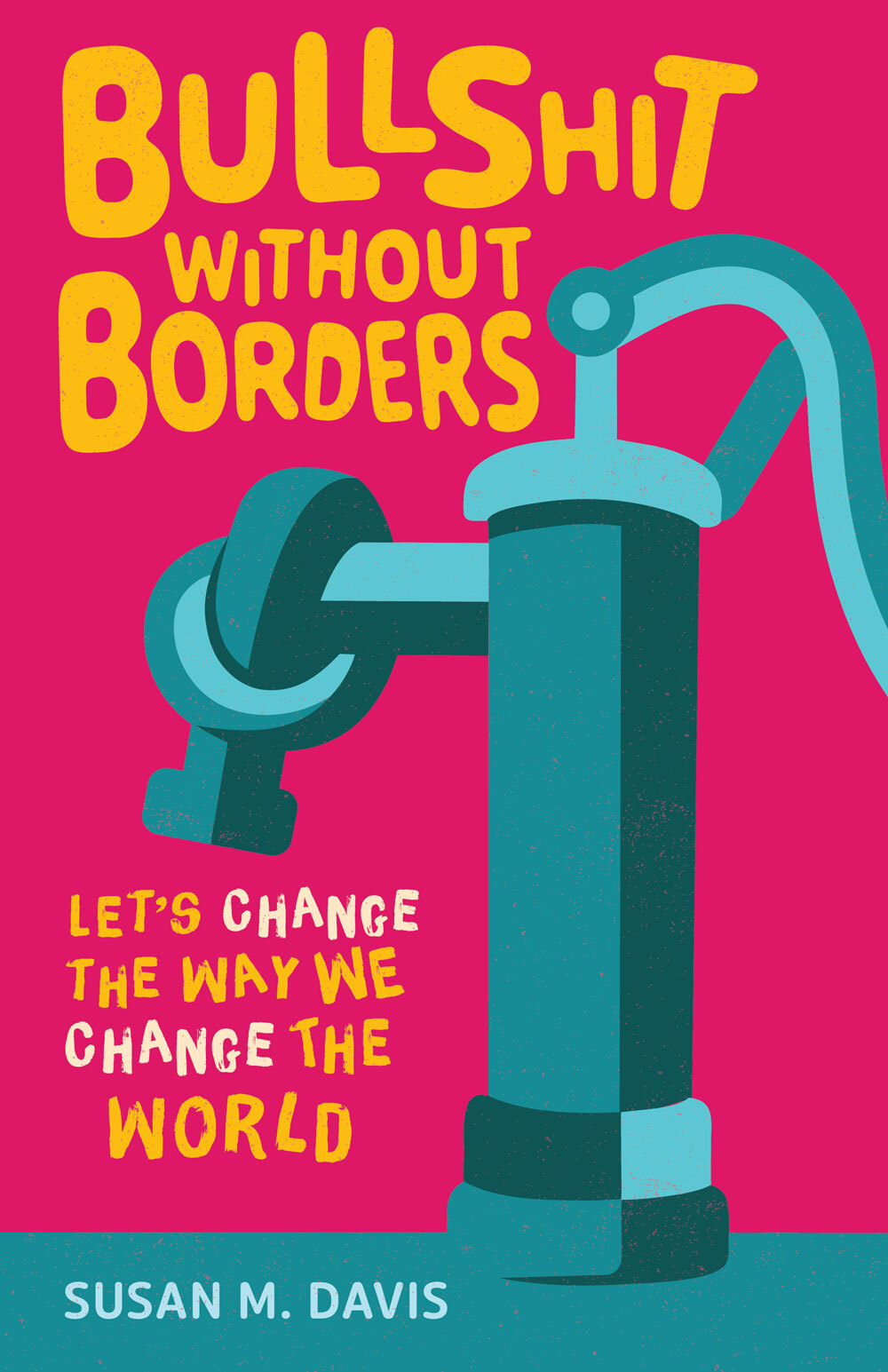
Book Review by Sean Furey, RWSN Secretariat Director @ Skat Foundation
It is easy to point to Bad People doing Bad Things and feel that everything going on in our societies now is due to them, but reality is way more complicated, and the bigger villains can sometimes be Unintended Consequence and Egotist Altruism. This road to hell, which is paved with (mostly) good intentions, is the one explored by Susan Davis in her book “Bullshit without Borders” (Ripples Media, 2026).
Davis draws on her career working across all manner of aid organisations, mainly across the Water, Sanitation and Hygiene (WASH) sector. She has deliberately and hilariously changed the names of organisations (Water for All Y’All is perhaps my favourite, although Water You Waiting For? is close second) and the names of the dramatis personae (although because I’ve known Susan for many years, I know exactly who K.A.Oss is…and it doesn’t take a genius to guess who the Hollywood co-founder of L’Eau.org might be). This writing device highlights the often ridiculous anecdotes of aid mismanagement, misunderstanding, or misalignment that turn ideas, both good and bad, into a pile of crap.
Speaking of crap, which Davis does a lot because we WASH folk like a good poo pun, each chapter comes equipped with a broad point, a personal experience (one involving a bin), a parable of failure, a pivot to a spark of hope and then ending with a Curious Reflection And Provocation (CRAP) box with questions that can guide your own journey through the hazardous terrain.
By turn, she takes on groups of aid actors, from Volun-Tourists, to Big NGOs (BINGOs), Celebrities, Corporates, the UN, Visionaries and “Heropreneurs”. Davis also takes on ways of working, from the curse of donated stuff being shipped and dumped to the whole nature of aid projects and site visits.
This could have so easily slipped into a mean-spirited hatchet job, but it is more of a frustrated love letter from a passionate practitioner who has seen many failures and is not above admitting her own missteps. So there is real integrity and honesty in her writing.
There are some well-worn failure cases, like the PlayPump, which attracted a vast chunk of philanthropy cash until the blindingly obvious flaws of relying on school children using play equipment to pump water for a community were realised and broken lumps of metal were left strewn across Malawi. There are also the cases of the arsenic-laced boreholes in Bangladesh and the disastrous disaster response to the 2010 Haiti Earthquake that resulted, among other things, in an UN-induce cholera outbreak. However, among the old chestnuts there are some newer, less well-known failures, there are some newer ones, such as the Evidence Action chlorine dispensers. Davis also shares her own experience of being behind the curtain of corporate and celebrity philanthropy, government aid and serving in the retinue of a toxic Visionary Heropreneur.
The one thing I felt could be strengthened was the aid recipient perspective, so maybe a sequel could be co-written, perhaps with our mutual friend, Muthi Nhlema, whose satirical short story, Piss Corpse, is also highly recommended.
Anyone involved in aid from the donor/Global North side of the table needs to read this and take a good look at themselves. I certainly did, and I’m still reflecting on how to turn the book’s sound advice into solid action.

3 responses to “Wanted: Good Doers not Do-Gooders”
Thank you so much for your review, Sean. On the strength of your review I have ordered a copy and will read it with great interest. As I do so I will be asking myself just how many of the project failures that are highlighted were predicted to fail BEFORE they were implemented – as opposed to being condemned with that wonderful sixth sense, HINDSIGHT. What’s your view on that?
Hi Richard, glad you liked it. I had another interesting bit of feedback via LinkedIn regarding the Evidence Action chlorine dispensers that “As you know all too well, chlorination is behaviour change and to have 2M people adopting it is significant, it’s just not 5M people. So I do worry the baby has been thrown out with the bath water.” and I think that’s a fair point because what is the ‘failure’?
Something like the PlayPump is easy to categorise because a ton of money was spent on it, the concept was flawed, it barely worked and you don’t see them any more and nor should we. However, the chlorine dispensers did work in some ways, just not as much as was hoped, but maybe that doesn’t mean we should write it off as a technology.
So the failure here is more to do with the incentives and the approach taken in the innovation and scaling process rather than the technology itself and that’s an important nuance that I think I missed. I went back to Kevin Starr’s post from 6 months ago on his and I see that he is hammering the innovation and scaling approach, not the product itself https://lnkd.in/p/emPhh34n and in the book, Susan criticises them for installing 52,000 chlorine dispenser across 7 countries and they are made of plastic that will not biodegrade and “that the approach was inexpensive because Evidence Action also built free labor into its model: 37,000 community-elected volunteers in Kenya alone. Volunteers were tasked with encouraging (or shaming) women and children into using chlorine, refilling the dispensers, and documenting their utilization. Many women stopped chlorinating the water after their husbands complained. “The taste of chlorine has made me hate water, but I have to drink it to quench my thirst,” according to a transcript of an interview with a man from erstwhile Kenya. Some users poisoned themselves by overapplying chlorine, which caused nausea and vomiting. Those who wanted to treat their water regularly often found empty dispensers. Like the ancient fairy tale of Goldilocks, it was hard to get just right. After a push to double the number of installed dispensers in 2022, Evidence Action admitted in 2025 that 40 percent fewer people used their chlorine dispensers than previously believed. They attributed this mistake in the evidence to using volunteers to collect it, reminding us of the elders’ saying: “You get what you pay for.”
So to your point – the failure of something like a PlayPump or Drinkable Book could probably be anticipated because the idea was flawed, other failures highlighted in the book are because of the incentives – who is really benefiting from this aid and this charity? And she highlights many cases where it is the giver rather than the receiver. Others though are definitely potentially good ideas that were implemented badly.
It’s an interesting topic!
Sean
Thanks Sean – you say that the flaws in the playpump could or should have been anticipated. Interesting though that the invention was endorsed at the time by the World Bank and also by Nelson Mandela! Clearly there’s lots of room for humility in this work. I wonder how we’ll look back with hindsight on the Systems Strengthening movement and attempts to roll out solar pumping – we may think we’re at the cutting edge, but that edge can easily become blunted!