
By Bethlehem Mengistu (Agenda for Change), Catherine McManus (The Water Project), Kerstin Danert (Ask for Water)
Bethlehem: Handpumps stand at the centre of a larger debate in the WASH sector. Some people see them as outdated and associated with low service levels, while others view them as a practical choice when other options are hard to maintain.
Looking at the bigger picture, I believe the real question goes beyond handpumps alone. It is less about whether a technology is good or bad, and more about whether the systems supporting it can provide reliable, fair, and lasting services.
Too often, what we call a technology failure is really a failure of the system that supports it.
EFFECTIVE SUPPORT SYSTEMS
Catherine: I think that’s a great point, Bethlehem, and connects to something I struggle with. Increasingly, I hear the idea that handpumps need to be left in the 20th century – at least partly because they fail. Is that because handpumps are flawed beyond value, or because we don’t acknowledge that even though they’re not motorized, they still need (and their users still deserve) funds for regular maintenance, proper supervision, and institutions that support those activities? If I could wave a magic wand and everyone in the world would have a piped service to their household, I would. But that magic doesn’t exist – it will require a combination of resources including money, time, and water – and while we use those resources to incrementally increase access to higher levels of service, we can’t ignore the intermediate value of handpumps.
I also note that none of the ingredients necessary for a healthy handpump are specific to handpumps in boreholes. Other rural water supply sources and distribution systems, such as protected springs and piped systems to tap stands or homes, need maintenance, supervision, finances, and support as well! Can systems that support one type of technology also be used to support the transition to and operation of other technologies? I would hope so.
PLANNED TRANSITIONS
Bethlehem: I worry that debates about handpumps can sometimes become too polarised, with people either defending them completely or dismissing them entirely.
But maybe a better question is: what level of service is realistic, sustainable, and suitable for each situation? In some areas, higher service levels may be possible and even needed. In other places, the main challenge could be ensuring that existing services, regardless of the technology used, work reliably and safely over time.
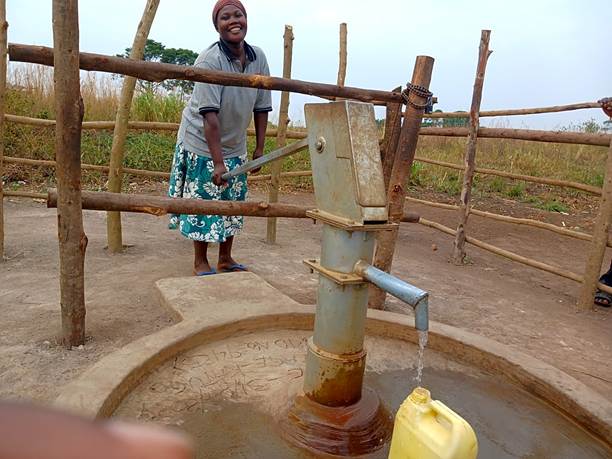
Kerstin: As someone who is working a lot on handpump services (with a focus on sub-saharan Africa), and recognises their value, I also find the polarised debates frustrating. The reality is that in 2021 about one in five people in Africa rely on a handpump and that I don’t believe that this is going to change in the immediate future (see my 2022 report for the statistics). And let’s not forget that in 2021 almost one in five dwellers in sub-Saharan Africa were relying on an unimproved source or surface water! I am sorry that I don’t have the statistics for Asia, although I clearly recognise that in India there is a huge political (and investment) shift away from handpumps to piped water supplies. Getting safe and reliable water supplies closer to people’s homes is a very good thing to strive for.
| Estimates not detailed on the map: Benin – 26% Burundi –2% Djibouti – 5% Eritrea – 9% Eswatini – 11% The Gambia – 11% Lesotho – 12% Liberia – 39% Malawi – 60% Rwanda – 37% São Tomé and Príncipe – 2% Sierra Leone – 34% Togo – 30% |
What I also am hearing anecdotally in some African countries, is a desire to shift away from handpumps – with some organisations no longer investing in handpump services, and some governments really focussing their attention on other technologies. However, the handpumps are still there, and if the shift in attention is away from them, is there not a danger that handpump services, and even more important, handpump users are forgotten about. Is there a danger of them being left behind? I am yet to see explicit policies or plans for a systematic transition from handpumps, or even other basic services to higher level services. This concerns me.
Catherine: Me too. Bethlehem, from a systems perspective, what might such a policy or plan need to look like in order to effectively protect existing handpump users while supporting a transition to higher levels of service?
AN INCLUSIVE VISION
Bethlehem: What interests me most in debates like this is not the technology itself, but what it reveals about how we think about progress. We often assume that achieving higher service levels only requires new infrastructure. However, from a systems perspective, progress means delivering reliable, equitable, and sustainable services over time.
The real risk is not the continued use of handpumps, but pursuing future visions without a clear plan for those who depend on current services.
An effective transition policy should follow three principles
- First, it should recognize existing users and assets as integral, not temporary.
- Second, it should align infrastructure investments with the institutions, financing, and capacities required to sustain improved services.
- Third, it should address equity by considering who benefits first, who waits longest, and who may be left behind.
Ultimately, we should move beyond technology debates and focus on effective transition management. The key question is not the future of handpumps, but whether we have a credible, ambitious, and inclusive pathway to better services.
Good systems do not just build the future; they manage the journey toward it.



Leave a Reply