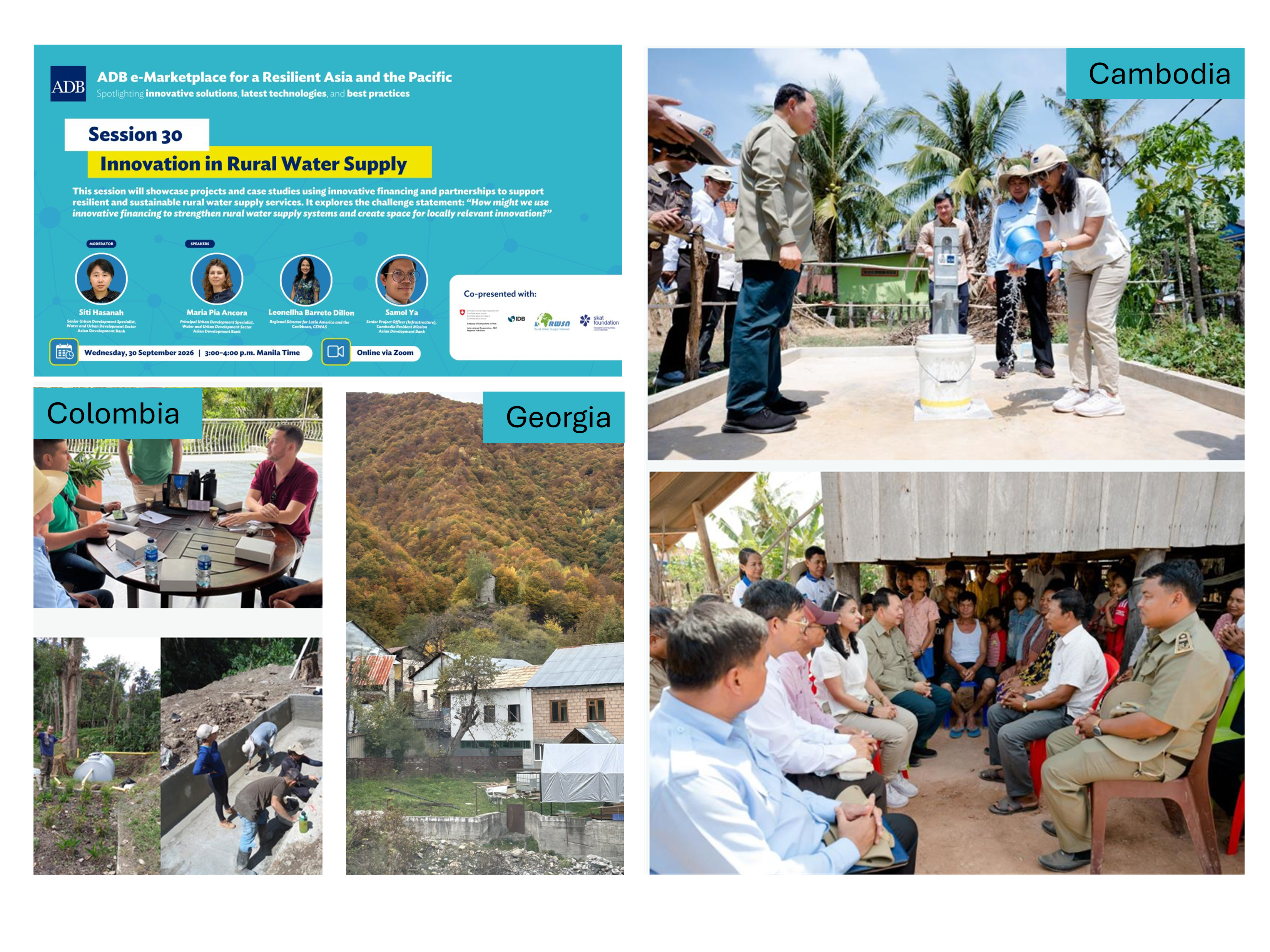
Innovation in Rural Water Supply
12. Oct. 2026 · Author: Mirja Michalscheck, Skat Foundation, Rural Water Supply Network (RWSN).
Access the recording and materials from the session on-demand through the Asia and the Pacific Resilience Hub (HUB4R).
What Georgia, Cambodia and Colombia teach us about financing innovation in rural water supply.
Can development bank financing do more than fund infrastructure; can it fund innovation in service delivery and sustainability? How can development bank financing be better adapted to rural contexts, including support for enabling environments, innovative service delivery models and long-term sustainability? That was the question behind an ADB e-Marketplace session on 30 September 2026, jointly organized by ADB and SIRWASH (Sustainable Innovations in Rural Water and Sanitation) as part of the broader collaboration among the Multilateral Development Banks (MDB) on rural WASH. The second phase of SIRWASH, funded by the Swiss Agency for Development and Cooperation, implemented by the Inter-American Development Bank (IDB), with technical support from Skat Foundation, aims to strengthen sustainable rural WASH services through innovation, knowledge, exchange and collaboration. Its webinar series, facilitated by RWSN, brings together IDB, ADB, AfDB and the World Bank to strengthen the MDB Community of Practice on Rural WASH, promoting knowledge sharing, peer learning and collaboration on approaches to improving rural service delivery.
Three different experiences offered answers:

Georgia: paying for results
Presentation by Maria Pia Ancora (ADB)
Only about a quarter of rural households in Georgia have a piped connection, and most of those face intermittent supply. The CLEAR Water Program (€400 million, shared equally by ADB and the government) is ADB’s first results-based loan. For the first time in Georgia’s water sector, ADB disburses for verified results rather than contracts, and more than a third of the money depends on the institutional changes that improve country systems and keep water flowing rather than on pipes being built.
Over a third of the financing depends on institutional change: maintenance rules with a realistic minimum of 250 operating days a year, a financed national strategy beyond 2030, and affordable instalment plans for connection fees. Inclusion extends to the utility itself, where internships bring women into technical roles. Before designs start, at least 20% of households in each village must confirm they want to connect. Lessons so far (10 months into implementation): plan technical assistance for the utility’s system upgrades, and set baselines on women and health from the start to track progress.

Cambodia: reform first
Presentation by Samol Ya (ADB)
In Cambodia, the rural WASH programme combines a policy loan, an investment loan, a grant for poor households and technical assistance (USD 93.6 million in total). The policy loan was released only after nine reforms were adopted: a law obliging public and private water operators to test and report water quality, binding rules on climate-proofing new systems, user fees that cover maintenance, and annual accounts and women’s participation in community user groups. The investment then applies those rules in 400 villages, using a mix of wells, rainwater tanks, small treatment plants and piped systems chosen with communities. The government has made the rules binding for all rural WASH investments nationwide, so this project has catalysed system-level change.

Colombia: operator-led innovation
Presentation by Leonellha Barreto-Dillon (Cewas)
In Antioquia, Cewas worked with two community water operators, serving about 4,500 people, to define their own challenges: securing a steady flow from source to treatment plant, and stopping hillside homes from polluting the water source. A hackathon with the University of Antioquia brought in students, researchers and entrepreneurs; winners received USD 5,000 to pilot their solution with the operators, plus business support. The method is now captured in an open innovation handbook. The key message for funders: finance the whole journey, from co-creation and field testing to incubation and adoption, not just the technology.
What we learned
🔧 The instrument shapes the institution. Results-based loans, policy loans and seed grants each reward different behaviour. Decide what institutional change you want, then choose the instrument that supports it.
✅ Make the “soft” parts non-optional. Maintenance, tariffs and accountability are usually the first things cut. Linking them to disbursement keeps them on the agenda.
💬 Test demand before you build. Low connection rates sink many rural schemes. Checking willingness to connect, or letting operators set the problem, avoids building what nobody uses.
⚙️ Maintenance financing remains unsolved. None of the three cases recovers full costs from users. Long-term maintenance still depends on a deliberate mix of tariffs, taxes and transfers, what the OECD calls the “3Ts”.
Is it transferable?
Webinar participants asked: Georgia is an upper-middle-income country with one national utility, so can its approach work elsewhere? The answer: Results-based lending needs a capable implementing agency and trusted public finance systems; where hundreds of small operators deliver services, performance grants or output-based subsidies may fit better. Policy reforms need genuine ownership and local capacity to enforce them. Open innovation needs organised operators and a local pool of innovators.
Participants’ questions also showed where none of these models has yet proven itself: very dispersed households, where supported self-supply may work better; fragile and arid settings; local governments with small budgets; and financing repairs after floods and other disasters. These questions will shape the rest of the SIRWASH series.
As Leonellha Barreto Dillon (cewas) put it, innovation does not replace the state or community management. It builds bridges between public, community and entrepreneurial capacities. Whether it scales depends far more on that environment than on the innovation itself.
| Approach | What it needs | Where it fits | Limits |
| Paying for results (Georgia) | A capable utility or agency; trusted public finance systems; independent checking of results | Countries with a national or regional water provider | Settings with many small providers; results that are costly to verify |
| Reform first, then invest (Cambodia) | Government ownership; a lead ministry able to issue binding rules; local staff to enforce them | Countries with fragmented mandates and many community-run systems | Reforms on paper can outpace local capacity; affordability for the poorest |
| Operator-led innovation (Antioquia) | Organised community operators; a facilitator; local innovators; funding for pilots | Regions with universities, start-ups and operator associations | Very low-capacity communities; pilots that never find a buyer |
Credits: Presentations by Maria Pia Ancora (ADB), Samol Ya (ADB), Leonellha Barreto-Dillon (Cewas). Session moderation by Siti Hasanah (ADB), Opening remarks by Dr Bruce Campbell (SDC). E-marketplace/SIRWASH session design and organisation: Vivek Raman (ADB), Jihan Al-Shdifat (ADB), Beatriz Giraldo (IDB), Cristina Merrcereyes (IDB), Dr Aline Saraiva Okello (Skat Foundation/RWSN), Batima Tleulinova (Skat Foundation/RWSN), Sean Furey (Skat Foundation/RWSN)
Thank you to ADB for hosting the first SIRWASH 2 webinar through their e-Marketplace platform.
Sustainable and Innovative Water, Sanitation and Hygiene Services in Rural Areas (SIRWASH) Phase 2 is driven by the Inter-American Development Bank (IDB) and funded by the Swiss Agency for Development and Cooperation (SDC), aims to contribute to increase access and quality of water, sanitation, and hygiene services in rural communities, with an emphasis on gender, diversity, and climate change for an inclusive, resilient, and sustainable rural sector, through the exchange of experiences and the promotion of scalable best practices, SIRWASH strengthens strategic alliances and fosters collaborative learning among sector actors, facilitating continuous improvement of services and contributing to sustainable development in rural communities. The SIRWASH 2 webinar series is a partnership between IDB, ADB, AfDB and the World Bank, supported by Skat Foundation through the Rural Water Supply Network (RWSN).



Leave a Reply