
Innovation 1: Village Savings for Water
This blog post is part of a series that summarizes the REAL-Water report, “Financial Innovations for Rural Water Supply in Low-Resource Settings,” which was developed by The Aquaya Institute and REAL-Water consortium members with support from the United States Agency for International Development (USAID). The report specifically focuses on identifying innovative financing mechanisms to tackle the significant challenge of providing safe and sustainable water supply in low-resource rural communities. These communities are characterized by smaller populations, dispersed settlements, and economic disadvantages, which create obstacles for cost recovery and hinder the realization of economies of scale.
Financial innovations have emerged as viable solutions to improve access to water supply services in low-resource settings. The REAL-Water report identifies seven financing or funding concepts that have the potential to address water supply challenges in rural communities:
- Village Savings for Water
- Digital Financial Services
- Water Quality Assurance Funds
- Performance-Based Funding
- Development Impact Bonds
- Standardized Life-Cycle Costing
- Blending Public/Private Finance
Understanding Village Savings for Water
Community-based savings and credit associations offer rural dwellers in low-income settings an opportunity for member-only access to loans, emergency support, and small annual investment returns. With abundant existing savings groups in sub-Saharan Africa and India, the mechanism has been leveraged in some cases to improve financial management of rural water systems. They offer a framework for creating dedicated, affordable, and transparent savings funds to pay for high-quality maintenance and repairs. Groups may dissolve over time, though, and require periodic external support. Field results from limited-scale water initiatives in several African countries have maintained an above-average reserve fund to support water point maintenance, repairs, or upgrades (The Water Trust 2022).
How does it work?
One low-barrier approach to improve funding for water system maintenance shifts financial management duties from volunteer water committees to new or existing community-based savings and credit associations. These self-selected, self-governed groups offer rural residents informal yet structured financial services with several built-in accountability mechanisms. Groups made up of 5–40 members usually operate on a 12-month cycle (VSL Associates 2022; Orr et al. 2019; Allen and Panetta 2010; Swinderen et al. 2020). At the beginning of each cycle, the group develops a constitution, defining savings and borrowing terms along with group bylaws (Figure 1). At weekly or monthly meetings, each member deposits the agreed amount of money into a common fund. Members can then take small, low-interest loans from this internally-generated capital. At the end of the cycle, each member receives their savings plus a portion of the overall interest earned from loans. Many savings groups offer a small mutual insurance scheme as well, using funds to provide allowances or no-interest loans in the case of unexpected member hardships (e.g., family illness or death).

Figure 1. Typical community savings group approach (Source: Vanessa Guenther, The Aquaya Institute)
The saving group model offers several advantages, including transparency, accountability, and trust-building among members. Successful implementation examples in sub-Saharan Africa, particularly in Uganda, have demonstrated their positive impact on water point management. By integrating savings groups, water user committees have reinforced accountability and improved the community’s commitment to paying for water services.
However, this model also faces challenges, such as limited capacity and technical expertise, the potential disintegration of savings groups, and the need for ongoing subsidization of maintenance services. While there may be initial costs associated with establishing savings groups, the return on investment can be significant. For instance, external support costs for savings group startup could exceed $1,000 per system, with a longer time frame needed to observe returns in the form of a sustained water fund (The Aquaya Institute, in press); however, the return on investment considering all-purpose savings can reach up to 20:1 (Krause 2022).
Examples
In sub-Saharan Africa, savings groups have been utilized to support water point management. In the Lira district of Northern Uganda, existing water user committees began offering small loans for personal needs, which reinforced their record-keeping accountability as well as the community’s commitment to paying monthly for water services (Nabunnya et al. 2012). Challenges included some refusal to pay for water and the informal process and money handling approach (by the local volunteer treasurer). In the Kamwenge district of southwestern Uganda, Water for People trained communities on financial planning for water point breakdowns, with savings groups as one of the strategy options (Muhangi 2018). Additional Ugandan examples come from Link to Progress (Piracel 2021), The Aquaya Institute (Marshall, Guenther, and Delaire 2021), WE Consult and Charity Water, Lifewater International, and Amref (Teo 2016). SEND has supported savings groups in Sierra Leone (SEND 2020), while the USAID West Africa Water, Sanitation, and Hygiene Program (USAID ND) and the nongovernmental organization WaSaDev have supported savings groups in Ghana.
In Malawian “borehole banking,” a central account is established at a water point and contributions are made through monthly water user fees. Then, community members who contribute can access loans, to be paid back with interest to the water point account (Mbewe 2018).
A pilot of 175 water points with “borehole banks” achieved an average savings of approximately $80 for operation and maintenance, about ten times higher than the average savings reported for water points without borehole banks. The rate of functionality increased from 64% to 94% between 2015 and 2017.
In another program from Uganda, The Water Trust worked with VSLAs to set aside an agreed-upon fraction of members’ payments earmarked as a “water point reserve fund,” which can only be used for handpump maintenance. Monitoring results have been encouraging: in the 2017 pilot, 32 water points with VSLA-based water funds had collected an annual average fund about four times greater than 28 communities relying on coached water user committees or a maintenance contract approach alone (Prottas, Dioguardi, and Aguti 2018). By 2020, The Water Trust invested training resources to extend the approach to more than 200 communities, with annual reserve funds continuing to meet or exceed target amounts (The Water Trust 2020). The approach has expanded to cover more than 700 water points, documenting higher measures of water point functionality and active water point management for water points with an associated VSLA (The Water Trust 2022).
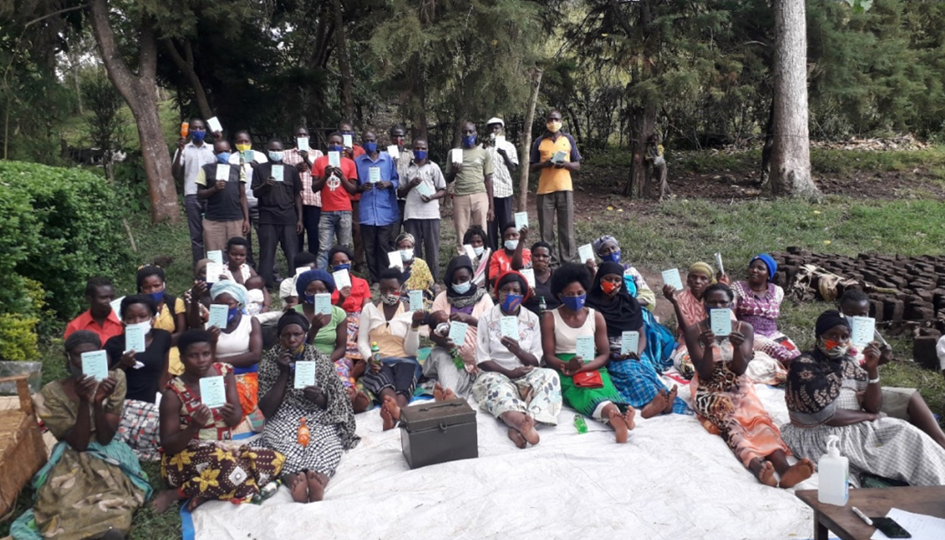
Figure 2. Village Savings and Loan Association members in the Kabarole district, Uganda, holding up their passbooks (Source: Katherine Marshall, The Aquaya Institute)
Although the concept of using savings groups to mobilize and manage water point funds has existed for several years (Agbenorheri and Fonseca 2005), this approach is not yet common and remains in the early stages of evaluation research (e.g., by The Water Trust and The Aquaya Institute). Despite compelling examples, its application to serve rural water supply services is globally limited. The knowledge base comes almost exclusively from implementation experience, with fewer examples of rigorous evaluation at scale. Improved documentation would improve the sector’s understanding of how to most effectively leverage community savings groups to improve rural water services.
Savings groups supporting water point management are of interest to government service providers and NGOs offering subsidies. Rural service providers facing challenges with inconsistent user payments should consider experimenting with community savings groups, particularly in areas where pay-as-you-fetch systems are underperforming, such as communities served by public handpumps (Marshall, Guenther, and Delaire 2021). Danert (2022) estimates that approximately 20% (ranging from 1%–60%, by country) of sub-Saharan
Africa’s population relies on handpumps. Additional opportunities arise in communities with gravity flow schemes and mechanized boreholes that have regularly struggled to collect revenue.
To access further information on financial innovations for rural water supply in low-resource settings, you can download the complete report HERE.
The information provided on this website is not official U.S. government information and does not represent the views or positions of the U.S. Agency for International Development or the U.S. Government.
References:
The Water Trust. 2022. “Improving Water Point Functionality in Rural Uganda through Self-Help Groups: A Cross-Sectional Study.” The Water Trust.
VSL Associates. 2022. “VSL Associates – Who We Are.” VSLA. 2022.

 Rural Water Supply Network - blog
One thought on ““Financial Innovations for Rural Water Supply in Low-Resource Settings” Innovation 1 – Village Savings for Water”
Comments are closed.