
This blog post is part of a series that summarizes the REAL-Water report, “Financial Innovations for Rural Water Supply in Low-Resource Settings,” which was developed by The Aquaya Institute and REAL-Water consortium members with support from the United States Agency for International Development (USAID). The report specifically focuses on identifying innovative financing mechanisms to tackle the significant challenge of providing safe and sustainable water supply in low-resource rural communities. These communities are characterized by smaller populations, dispersed settlements, and economic disadvantages, which create obstacles to cost recovery and hinder the realization of economies of scale.
Financial innovations have emerged as viable solutions to improve access to water supply services in low-resource settings. The REAL-Water report identifies seven financing or funding concepts that have the potential to address water supply challenges in rural communities:
- Village Savings for Water
- Digital Financial Services
- Water Quality Assurance Funds
- Performance-Based Funding
- Development Impact Bonds
- Standardized Life-Cycle Costing
- Blending Public/Private Finance
Understanding Digital financial services
Digital financial services have penetrated many aspects of daily life, including water services.
One strategy to address the gap in rural water funding is to increase the financial sustainability of water systems through improved water revenue collection and management (Waldron and Sotiriou 2017). In low-income countries, the collection of service fees primarily relies on cash, which can be labor-intensive, difficult to track, prone to miscalculations, and susceptible to theft or loss (Sharma, 2019). However, by implementing automated digital recording of time-stamped water usage and payment data, the planning, projection, and delivery of water services can be significantly improved (Waldron et al., 2019).Good record-keeping aids water service providers in tracking performance changes over time, as well as supporting financial sustainability, water conservation, and climate adaptation.
How does it work?
“Digital financial services” encompasses two concepts: financial services (e.g., payments,
savings, credit, insurance, user suport) and the technologies that deliver them to end users (Waldron et al. 2019). Services such as online savings or credit accounts mainly benefit adults who work outside the home and have bank accounts (Coulibaly 2021). The digital technologies accessible to users who rely on cash may include mobile money (electronic wallets using a mobile phone), water sale kiosks or “ATMs,” and prepaid token technologies (REAL-Water 2022).
Customers can use digital mechanisms to conveniently purchase water, reducing waiting times and operational downtimes when live vendors or caretakers are unavailable (Waldron et al., 2019). With prepaid digital services, the efficiency of water fee collection can reach nearly 100% (with the exception of targeted subsidies or discounts). “Postpaid” digital financial services, which collect fees retrospectively for prior water usage, enable service providers to automatically track outstanding payments and initiate billing. Digitization may enable better payment compliance, as those with seasonal or inconsistent income are able to deposit a sum of money and draw on it over time (Sharma 2019).
Moreover, the implementation of prepaid metering for automated water dispensing devices and postpaid digital water service accounting brings benefits to both water system operators and customers, improving fee collection consistency as well as convenience. They may likewise simplify subsidy delivery to vulnerable customer segments.
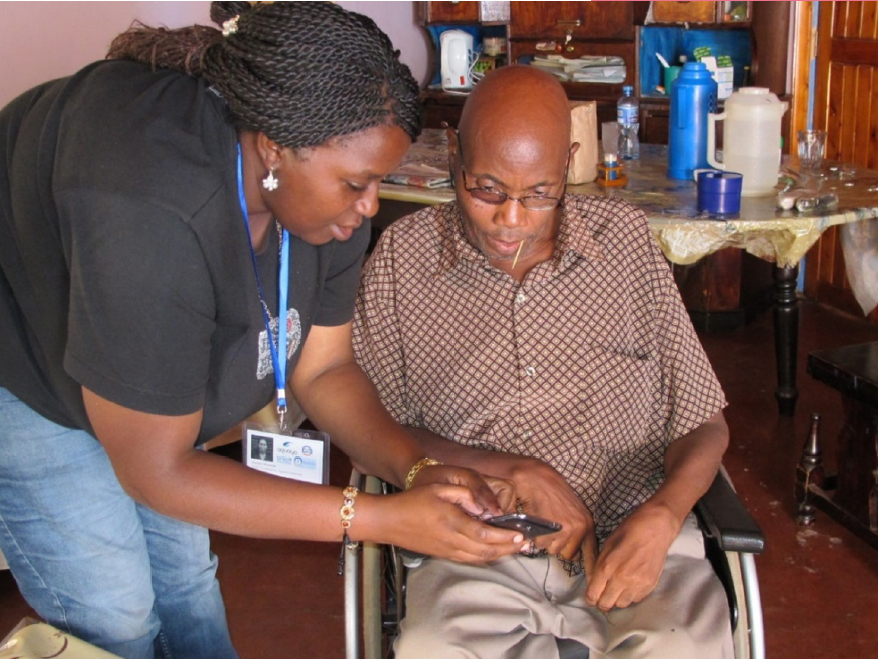
Figure 1. Training a customer in Ruiru, Kenya on how to use his phone for making
water payments (Source: Joyce Kisiangani, The Aquaya Institute)
Examples
Technology provider Grundfos partnered with the nongovernmental organization World Vision and Safaricom, the leading telecommunications provider in Kenya, to install 32 self-service water kiosks (called LifeLink systems) in locations that lacked water infrastructure, serving both
homes and businesses (Waldron et al. 2019). Initial uptake was high and interviews documented user benefits from reduced favoritism in water distribution as well as being able to track and review spending. Collecting mobile payments cost less than collecting cash payments, a savings that could be reinvested to upgrade services or passed onto consumers (Sharma 2019). The World Bank and others have likewise been working to scale affordable water installations in Tanzania using prepaid Grundfos card kiosks combined with solar pumping, which vastly reduces water transportation time and stabilizes high prices offered by private sellers (World Bank 2017). Recognized downsides of this and other digital payment examples have included questions of who requires data access, remote monitoring needs, labor cuts, reduced customer service capabilities, and difficulty paying among the ultra-poor (Waldron et al. 2019).
The nonprofit organization Safe Water Network uses Hangzhou LAISON Technology digital household prepaid meters in their piped connection program in Ghana. Customers receive a device to input a token purchased through mobile money. New users joined quickly following customer workshops to explain the payment system, and the enhanced cost recovery shifted the operation from a net loss to a net surplus (Waldron et al. 2019). Ensuring proper use will likely require sustained engagement. Safe Water Network has continued expanding the household connection metering program to serve several thousand households in small rural towns in Ghana’s Ashanti Region.
Transitioning to digital payments comes with certain challenges, such as additional transaction fees, costly startup infrastructure, poor telecommunications technology, skepticism towards technology, and the belief that water services should be cheaper or free, as well as income loss for traditional vendors who primarily handle cash transactions. Local training support and outreach efforts for social inclusion can be beneficial for expanding digital services. However, digital financial services do not represent a fix-all solution. Their successful implementation requires substantial training and effective governance to transition service providers and communities to new processes that increase collection efficiency, while minimizing the impact on customers’ water usage (Heymans, Eales, and Franceys, 2014).
Digital financial service innovations have made inroads globally in urban areas and are rapidly expanding to serve rural residents in Africa, Asia, and Latin America. As use expands, social inclusion efforts may be needed to ensure the services benefit vulnerable populations (Coulibaly 2021).
To access further information on financial innovations for rural water supply in low-resource settings, you can download the complete report HERE.
The information provided on this website is not official U.S. government information and does not represent the views or positions of the U.S. Agency for International Development or the U.S. Government.
References:

 Rural Water Supply Network - blog