
Innovation 3: Water Quality Assurance Funds
This blog post is part of a series that summarizes the REAL-Water report, “Financial Innovations for Rural Water Supply in Low-Resource Settings,” which was developed by The Aquaya Institute and REAL-Water consortium members with support from the United States Agency for International Development (USAID). The report specifically focuses on identifying innovative financing mechanisms to tackle the significant challenge of providing safe and sustainable water supply in low-resource rural communities. These communities are characterized by smaller populations, dispersed settlements, and economic disadvantages, which create obstacles for cost recovery and hinder the realization of economies of scale.
Financial innovations have emerged as viable solutions to improve access to water supply services in low-resource settings. The REAL-Water report identifies seven financing or funding concepts that have the potential to address water supply challenges in rural communities:
- Village Savings for Water
- Digital Financial Services
- Water Quality Assurance Funds
- Performance-Based Funding
- Development Impact Bonds
- Standardized Life-Cycle Costing
- Blending Public/Private Finance
Understanding Water Quality Assurance Funds
In rural areas, community-managed water supplies are increasingly recognized as unsustainable, in part because communities with small water systems (e.g., handpumps, mechanized boreholes, and small piped systems) often struggle to collect enough money to maintain water infrastructure (Whaley et al. 2019). As a result, they typically must neglect critical aspects of professional water management, such as water quality testing to verify its safety for human consumption. Rural agricultural communities, situated far from public or private laboratories, struggle to access testing services due to distance and irregular income patterns. However, a viable solution comes in the form of introducing a third-party guarantor to distribute the risks associated with unpaid water testing fees among various stakeholders (Halvorson-Quevedo and Mirabile 2014). The third party can help to facilitate testing arrangements and provide indirect financial support, wherein stand-by funds are only accessed when the local fee-for-service exchange is disrupted.
How does it work?
“Assurance funds” provide liquid assets (e.g., a savings account) that can be quickly mobilized if a liability arises. Water quality assurance funds are held by a third party (e.g., a nongovernmental organization) to guarantee payment for to the beneficiary (e.g., a centrally located water quality laboratory) if a rural community is unable to pay for water testing services on time (Press-Williams et al. 2021).
By employing this innovative model, larger professional laboratories can extend low-cost centralized monitoring services to smaller rural water systems, fostering efficiency and incentivizing wider-scale testing. As a result, laboratories gain a new market for their services while rural communities gain a reliable means of verifying their drinking water safety with greater certainty and lower startup cost than establishing onsite laboratory capacity.The assurance fund accounting is managed by the third party and can be drawn down
slowly, leveraging donor aid, or replenished if the rural community is able to pay back service fees at a later date (Figure 1). Contract enforcement is managed through the local government authorities.
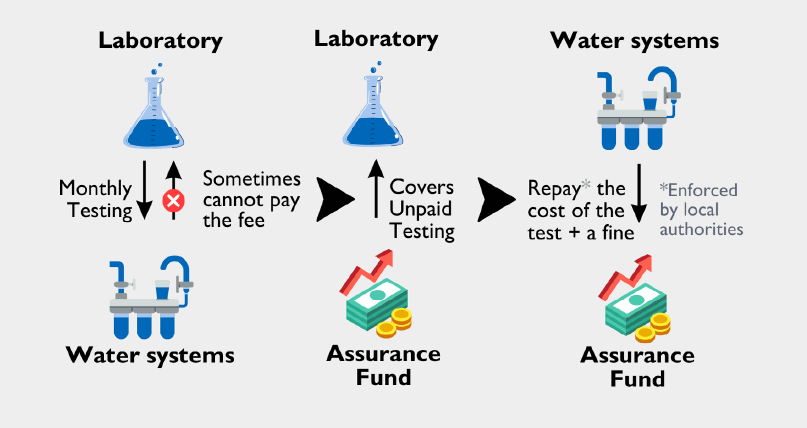
Figure 1. Simplified illustration of a water quality assurance fund mechanism (Source: Vanessa Guenther, The Aquaya Institute)
Implementation of assurance funds requires diligent management to ensure accountability. Skilled staff must manage the fund as long as it exists.For water quality assurance funds, field and laboratory staff must adhere to good protocols to ensure water quality data are accurate and address decision-making needs in a timely manner.
Examples
Pilot examples come from a few African countries:
With funding support from the Hilton Foundation, The Aquaya Institute (a nonprofit research and consulting organization) developed an assurance fund in 2020 to encourage an existing laboratory to provide water quality monitoring services to small rural water systems in the Asutifi North District of Ghana (Figure 2; Press-Williams et al. 2021). The water systems mobilized community-collected water fees to pay Ghana Water Company Limited’s (GWCL’s) central laboratory (Figure 3) for monthly services. If they defaulted on payments, then GWCL could file a claim against the assurance fund. This centralized testing approach cost an average of $67 per test, or approximately 60% of what it would have cost to provide training and testing equipment for each separate water system.
Between March 2020 and January 2021, GWCL testing revealed microbial contamination in more than half of the 134 water samples across nine water systems, raising awareness among water system managers about issues with chlorination procedures (Press-Williams et al. 2021). In most cases, water systems were able to pay GWCL within one month of receiving testing services. Despite payments being delayed for approximately one third of testing services, GWCL filed only one claim against the assurance fund, instead negotiating directly with the defaulting water systems to allow more time. Extension of the same concept to other districts in
Ghana as well as in Kenya, Uganda, and Tanzania is underway with additional funding support from USAID REAL Water, the Hilton Foundation, and the Helmsley Charitable Trust. Another use of the assurance fund was to deliver targeted subsidies for specific communities during times of need (e.g., Covid-19 pandemic, fuel price inflation).
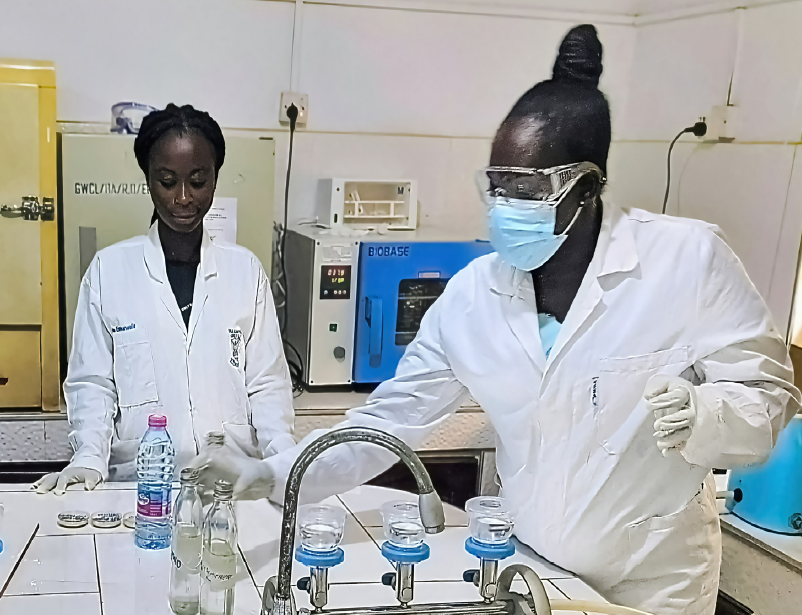
Figure 2. Ghana Water Company Limited analyzes bacteria in drinking water samples from small water systems in the nearby rural district of Asutifi North. (Source: Bashiru Yachori, Aquaya Institute).

Figure 3. A Ghana Water Company Limited technician collects a sample from a water point in Asutifi North, Ghana, as part of the Water Quality Assurance Fund agreement (Source: Bashiru Yachori, Aquaya Institute).
To access further information on financial innovations for rural water supply in low-resource settings, you can download the complete report HERE.
The information provided on this website is not official U.S. government information and does not represent the views or positions of the U.S. Agency for International Development or the U.S. Government.
References:
Halvorson-Quevedo, Raundi, and Mariana Mirabile. 2014. “Guarantees for Development.”
Whaley, Luke, Donald John MacAllister, Helen Bonsor, Evance Mwathunga, Sembeyawo Banda, Felece Katusiime, Yehualaeshet Tadesse, Frances Cleaver, and Alan MacDonald. 2019. “Evidence, Ideology, and the Policy of Community Management in Africa.” Environmental Research Letters 14 (8): 085013. https://doi.org/10.1088/1748-9326/ab35be

 Rural Water Supply Network - blog