

Image credit: © 2011 IRC International Water and Sanitation Centre. Enumerator from WASHCost Mozambique team collects costs data from community. (taken by Jeske Verhoeven)
This blog post is part of a series that summarizes the REAL-Water report, “Financial Innovations for Rural Water Supply in Low-Resource Settings,” which was developed by The Aquaya Institute and REAL-Water consortium members with support from the United States Agency for International Development (USAID). The report specifically focuses on identifying innovative financing mechanisms to tackle the significant challenge of providing safe and sustainable water supply in low-resource rural communities. These communities are characterized by smaller populations, dispersed settlements, and economic disadvantages, which create obstacles for cost recovery and hinder the realization of economies of scale.
Financial innovations have emerged as viable solutions to improve access to water supply services in low-resource settings. The REAL-Water report identifies seven financing or funding concepts that have the potential to address water supply challenges in rural communities:
- Village Savings for Water
- Digital Financial Services
- Water Quality Assurance Funds
- Performance-Based Funding
- Development Impact Bonds
- Standardized Life-Cycle Costing
- Blending Public/Private Finance
Understanding standardized life-cycle costing
One tool of asset management, life-cycle costing, has been used for many years to account for all costs of a product, system, or program from its inception to disposal (Sherif and Kolarik 1981). “Life-cycle” costs represent the aggregate financial expense of ensuring delivery of adequate, equitable, and sustainable water services to a specified population (Fonseca et al. 2010). Beyond calculations, the approach seeks to mainstream life-cycle considerations into institutional processes. It covers all expenditures, such as hardware, software, operation, maintenance, source water protection, training and planning support, replacement costs, and shifts needed to meet water demand. To accurately assess financing needs, service providers should categorize different types of expenses and quantify the total requirement, as well as when costs and revenues accrue.
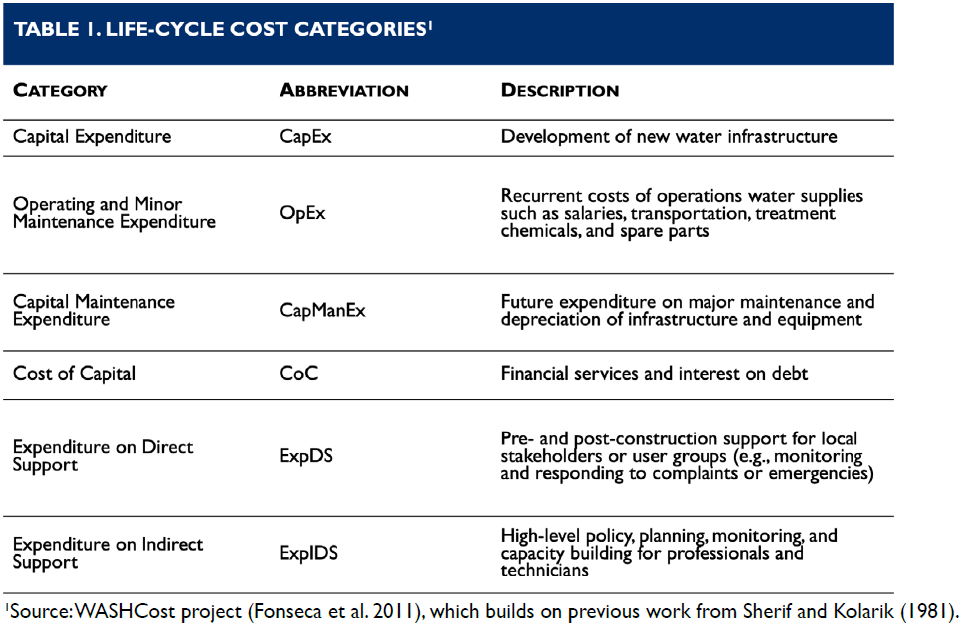
In low-income rural areas, standardizing approaches to life-cycle costing could help to clarify how much and what type of funding might be needed to sustain water supply operations. The WASHCost project from 2008–2013 (Fonseca et al. 2011; 2010) and the State of the Safe Water Enterprises Market study (Dalberg 2017) found that carefully quantifying and ensuring funding for full life-cycle costs (particularly capital maintenance expenditures) is critical to maintaining sustainability. A common framework and step-by-step approach were proposed to quantify and categorize life-cycle costs (Table 1).
Examples
IRC developed and piloted a rural water life-cycle costing approach under the WASHCost project (Veenkant and Fonseca 2019; Table 1), which aimed to capture the full costs of providing adequate services (rather than just the initial cost of infrastructure). The approach can be used to assess water services in rural communities as well as refugee and emergency settlements. Cost categories include construction, implementation, maintenance, and replacement.
The Rural Water Supply Network (RWSN) Directory applies the same life-cycle costing approach to profile a number of rural water service providers, such as 4Ward Development (formerly called Access Development) in Ghana; AguaClara in Honduras, Nicaragua, and India; and the BESIK Programme in Timor-Leste (Deal, Furey, and Naughton 2021). It encourages further discussion on financial analyses that would inform decision-making for public services investment.
An application of the life-cycle costing approach to 14 privately run water schemes in Vietnam highlighted its ability to discern long-term profitability of rural piped water systems, particularly with respect to asset depreciation and capital maintenance (Grant et al. 2020). The analysis pointed to options for improving the schemes’ viability, such as subsidy and tariff adjustments. Another study in rural Andhra Pradesh, India, used life-cycle cost analysis to illustrate how gaps in upfront public investments in 43 villages led to service slippage due to poor operation and maintenance as well as water quality and source sustainability (Reddy et al. 2012). Infrastructure costs were overrepresented at project outset, and actual unit costs were found to be substantially higher than the official norms. In two districts of Amhara, Ethiopia, a 10-year study found that emergency water trucking and treatment costs greatly exceeded pre-planned costs of providing piped water, highlighting the importance of considering climate resilience (Godfrey and Hailemichael 2017).
Marketability
Life-cycle costing is widely used in high-income countries, where staff capacity and data tracking capabilities support completing this exercise on a regular basis. While life-cycle costing studies have been done in low- and middle-income countries, structural gaps in the water supply market prevent the practice from proliferating. More incentives are needed for implementers to track data and align on financial and operational metrics. Monitoring and evaluation web platforms like the Rural Water and Sanitation Information System (SIASAR Global)—now used in 14 countries—could be leveraged to track geocoded asset inventory and financial health (Smets and Serrano 2019).
Do you want to know more? Access to the complete report on financial innovations for rural water supply in low-resource settings HERE.
The information provided on this website is not official U.S. government information and does not represent the views or positions of the U.S. Agency for International Development or the U.S. Government.
References:
- Dalberg. 2017. “The Untapped Potential of Decentralized Solutions to Provide Safe, Sustainable Drinking Water at Large Scale: The State of the Safe Water Enterprises Market.”
- Deal, Philip, Sean Furey, and Meleesa Naughton. 2021. “The RWSN Directory of Rural Water Supply Services, Tariffs Management Models and Lifecycle Costs.” RWSN.
- Fonseca, Catarina, Richard Franceys, Charles Batchelor, Peter McIntyre, Amah Klutse, Kristin Komives, Patrick Moriarty, et al. 2010. “WASHCost Briefing Note 1: Life-Cycle Costs Approach – Glossary and Cost Components.” Brief Note 1. The Hague, The Netherlands: IRC International Water and Sanitation Centre.
- Godfrey, S., and G. Hailemichael. 2017. “Life Cycle Cost Analysis of Water Supply Infrastructure Affected by Low Rainfall in Ethiopia.” Journal of Water, Sanitation and Hygiene for Development 7 (4): 601–10.
- Grant, Melita, Tim Foster, Dao Van Dinh, Juliet Willetts, and Georgia Davis. 2020. “Life-Cycle Costs Approach for Private Piped Water Service Delivery: A Study in Rural Viet Nam.” Journal of Water, Sanitation and Hygiene for Development 10 (4): 659–69. https://doi.org/10.2166/washdev.2020.037.
- Reddy, V., N. Jayakumar, M. Venkataswamy, M. Snehalatha, and Charles Batchelor. 2012. “Life-Cycle Costs Approach (LCCA) for Sustainable Water Service Delivery: A Study in Rural Andhra Pradesh, India.” Journal of Water, Sanitation and Hygiene for Development 2 (4): 279–90. https://doi.org/10.2166/washdev.2012.062.
- Sherif, Yosef S, and William J Kolarik. 1981. “Life Cycle Costing: Concept and Practice.” Omega 9 (3): 287–96. https://doi.org/10.1016/0305-0483(81)90035-9.
- Smets, Susanna, and Antonio Rodríguez Serrano. 2019. “From Colombia to Kyrgyz Republic and Uganda: How We Help Countries Adopt State-of-the Art Information Systems for Better Management of Rural Water Services.” The Water Blog (blog). 2019.
- Veenkant, Mathijs, and Catarina Fonseca. 2019. “Collecting Life-Cycle Cost Data for Wash Services: A Guide for Practitioners.” Working Paper. Draft. Addis Ababa, Ethiopia: IRC.

 Rural Water Supply Network - blog