
Stop the Rot during ZAWAFE 2023 Zambia – 3/4
This blog is part of a four-part blog series highlighting the presentations delivered during the 11th Zambia Water Forum and Exhibition. The event, themed “Accelerating Water Security and Sanitation Investments in Zambia: Towards Agenda 2023 through the Zambia Water Investment Programme”, lasted three days.
Our blog series takes a focused look at the presentations and discussions that revolved around “Addressing Rapid Hand Pump Corrosion in Zambia – Stop the Rot!”, which was co-convened by UNICEF and WaterAid, together with Ask for Water GmbH and the RWSN, hosted by Skat Foundation.
Third session:
The journey towards reducing the effects of rapid corrosion in Kalumbila District.
Kalumbila District is a district in the North-Western Province of Zambia. It has two major mines namely Lumwana and Kalumbila Mines.
With a population of over 170,000, the district has about 300 water points (boreholes and protected wells equipped with handpumps).
Rapid handpump corrosion has been a problem since the district was created in 2015. One of the interventions that the district has undertaken has been iron removal filters (to remove iron from pumped water), although these have not been sustainable.

Figure 1: Location of Kalimbula District
In every program of drilling of boreholes about 40% of boreholes were abandoned within one year after handover due to rapid corrosion.
We started looking for a solution to this problem. We found that iron filters were used but were not sustainable.
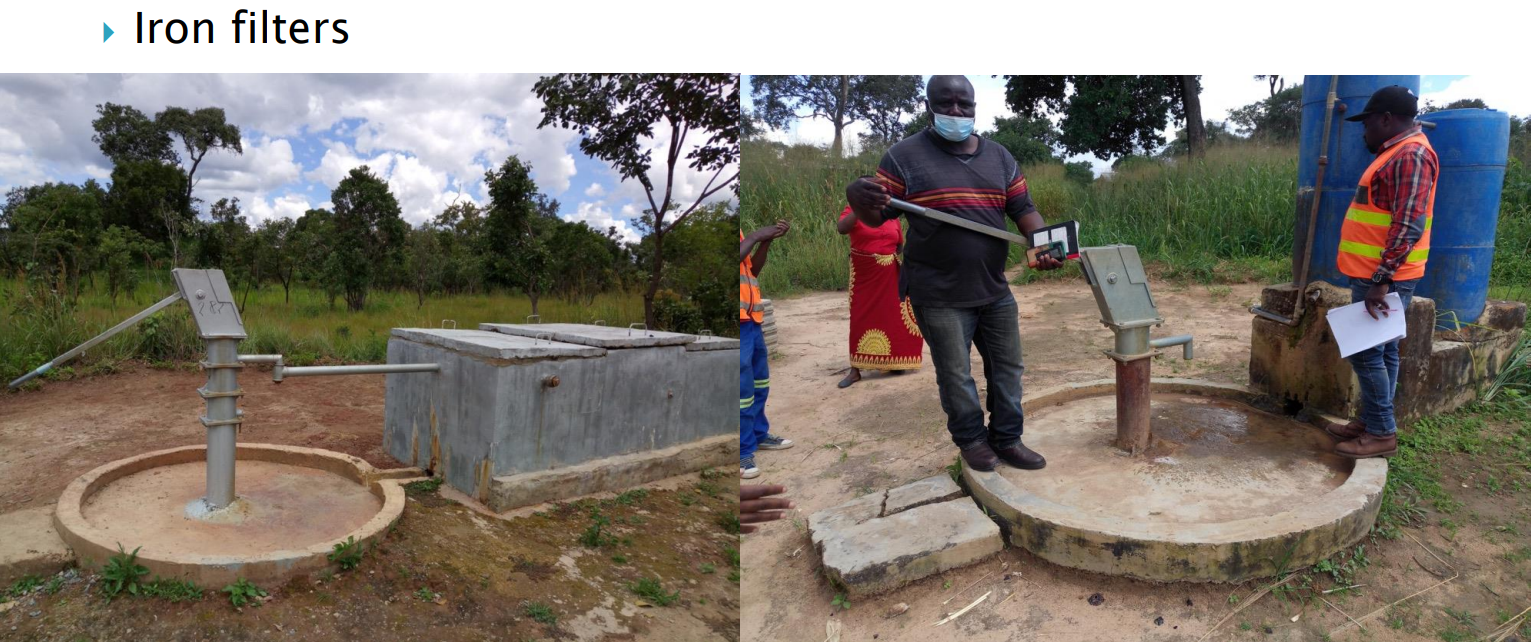
Figure 2: Handpump evaluation
One of the interventions that the district has undertaken has been iron removal filters (to remove iron from pumped water), although these have not been sustainable. In Kalumbila District it was found, that in every borehole programme, about 40% of the handpumps installed were abandoned due to high iron content, with some boreholes being abandoned as early as three months after construction and commissioning.
Projects
In 2017 UNICEF supported Kalumbila district in the drilling of 23 boreholes and rehabilitation of 15 water points.
In 2018 JICA also supported Kalumbila district with rehabilitation of 77 water points using uPVC pipes with stainless steel adapters. It is from these projects that we learnt a lot of important lessons and made recommendations to the D-WASHE committee. No water point was abandoned after one year of handover Kalumbila district decided to suspend the use of galvanised iron (GI) pipes and recommended the use of stainless steel and uPVC pipes for Indian Mark II and Afridev hand pumps.
Lessons learnt
It is from these two projects that we learnt a lot of lessons, and we told ourselves never to keep quiet. From these two projects, we observed that no water point was abandoned after one year of handover. We saw a solution – why continue to use GI pipes when there was a solution. So we made recommendations to the D-WASHE committee. After this, Kalumbila district decided to suspend the use of galvanised iron (GI) pipes and recommended the use of stainless steel and uPVC pipes for India Mark II and Afridev hand pumps. We have discovered that handpumps with stainless steel riser pipes do not require frequent repair and maintenance whereas sometimes the GI pipes would require replacement every six months. For the past four years, those handpumps remain working.
Our challenges include a lack of funding for the rehabilitation of boreholes affected by rapid corrosion. Further, some stakeholders have not supported the districts fully.
Recommendations
- Stakeholders at the national level take an interest in order to address this issue of rapid corrosion.
- The use of materials that are environmentally friendly without change of properties when they come into contact with aggressive water (i.e. materials such as stainless steel and uPVC).
- There is capacity building of all Area Pump Menders (APMs) in Afridev hand pumps.
- All hand pumps that have galvanised iron (GI) riser pipes are to be rehabilitated.
You are invited to access the presentations HERE, along with the session’s concept and report. If you would like to dive deeper into the enriching exploration of water challenges and solutions through the Stop the Rot initiative, visit this page.
About the author:

Daniel Shimanza presenting at ZAWAFE 2023
Daniel Shimanza is a Zambian Citizen who has worked in the water sector for more than 6 years. He worked on many water supply projects in Kalumbila district, Zambia in collaboration with GRZ, NGOs such as UNICEF, and World Vision. He has a passion for the improvement of access to clean water supply for people living in rural areas. He’s championing a campaign to reduce the effects of rapid corrosion in Kalumbila district by using alternative materials such as stainless steel pipes, PVC pipes, Iron Filters, and more. He holds a Diploma in Water Engineering from NRDC and currently pursuing a Bachelor of Civil Engineering from the Copperbelt University.

 Rural Water Supply Network - blog