
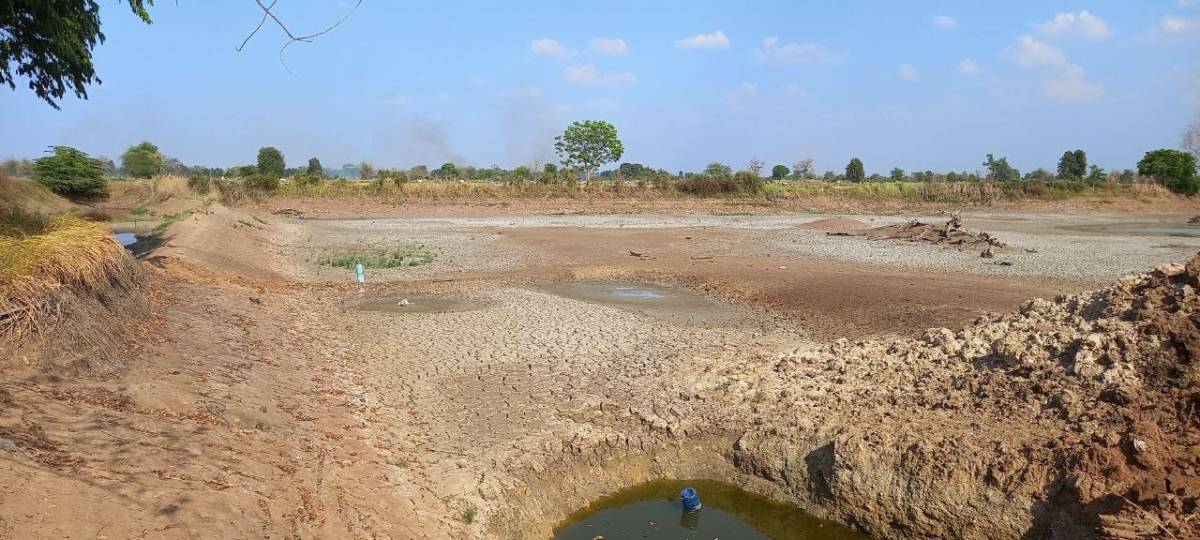
Image: Pond dried up in Banteay Meanchey province.
by Amandine Muret, Chief Partnerships Officer, 1001fontaines, RWSN Member Organisation
Am.muret@1001fontaines.com
As Asia grapples with an intense heatwave, exacerbating the already acute lack of access to safe drinking water for vulnerable communities, the call for innovative and resilient water supply solutions becomes increasingly urgent. The World Water Forum, held in Bali from May 18 to 24, brought together governments and experts from around the world, including 1001fontaines, a global NGO distinguished by its two decades of on-the-ground experience in providing safe water to communities in challenging contexts.
A Water Crisis Exacerbated by Climate Change
South and Southeast Asia are currently experiencing record temperatures. In Cambodia, where the mercury has soared to over 40°C several times, levels unprecedented in 170 years, the situation is alarming. This extreme heat wave increases the vital need for drinking water while compromising access to uncontaminated water sources, crucial to meeting this need. In rural areas, the majority of inhabitants still rely on self-supply water solutions, such as wells or ponds – with increasingly intense droughts and floods due to climate change, vulnerable populations see their water sources affected, with impacts on their
resilience and health.
The World Bank recently estimated that $36.1 billion would be needed to develop missing water access infrastructure in Asia (source: “Funding a Water-Secure Future: An Assessment of Global Public Spending” report, published in May 2024). Climate change, impacting the accessibility and quality of water resources, requires even larger investments to establish sustainable and efficient supply systems in the face of new constraints, particularly in maintenance and treatment.
In development contexts, where financial and technical resources are limited, and existing service providers already struggle to cover maintenance costs due to low household purchasing power, the idea of having a tap of safe drinking water in every home seems increasingly out of reach. Innovative approaches like those proposed by 1001fontaines appear essential to avoid regression in achieving Sustainable Development Goal 6: ensuring universal access to safe water.
Social Innovation to Address the Vital Need for Safe Drinking Water
For over 20 years, 1001fontaines has been designing and deploying sustainable solutions for access to safe drinking water for vulnerable populations in Asia and Africa. By focusing on the needs of vulnerable communities, the organization emphasizes the quality of the water produced and the strengthening of local capacities through social entrepreneurship.
In concrete terms, 1001fontaines installs decentralized water treatment stations (“Water Kiosks”) and trains local entrepreneurs to deliver the produced drinking water directly to households and schools, all in reusable
20-liter bottles.
This service, offered at an affordable price, now reaches a million consumers daily across rural Cambodian communes, where the model was initiated, while covering its operating costs. After 20 years, 90% of the deployed Water Kiosks are still operational, and consumer satisfaction reflects sustainable behavior
change benefiting public health improvement.
Sharing Experiences at the World Water Forum
At the World Water Forum in Bali, 1001fontaines will share the lessons learned from its innovative approach. With operations now expanded to four countries (Cambodia, Madagascar, Vietnam, Bangladesh), the organization has demonstrated the resilience of its model in the face of development and climate change challenges.
Unlike traditional water supply systems, which aim to provide between 50 and 100 liters of water per person, often costly to implement in sparsely populated areas, 1001fontaines focuses on a more targeted consumption, between 1 and 3 liters of safe water per person per day. This cost-effective approach ($15 subsidized per beneficiary) reduces pressure on water resources while offering better quality control. By using reusable bottles delivered directly to homes, the distribution model is less susceptible to infrastructure aging or climate-related damage, with maintenance focused on water treatment facilities.
Another key advantage is adaptability. In Cambodia, 4 regional laboratories monthly monitor water quality at the 330 active sites, allowing the identification of quality changes, often localized and related to the effects of climate change, and enabling the local technical team to implement targeted and low-cost mitigation measures.
Amandine Chaussinand, General Manager of 1001fontaines’ local entity in Cambodia, Teuk Saat 1001, testifies: “We have achieved remarkable results over two decades of operations. We are proud to share them with academic institutions, development financing institutions, and governments at the Forum in Bali because we believe that better consideration of alternative water supply systems, such as bottled water, could accelerate access to safe water for the benefit of populations facing the impacts of climate change.”
Amandine Muret, Chief Partnerships Officer, emphasizes that “Collaboration with local authorities is a key factor in the success of 1001fontaines’ programs, as is the mobilization of development aid to finance infrastructure construction and capacity building, at the heart of the sustainability of the services implemented.”
As the G7 recently announced the creation of a global coalition to address the global water crisis, high-level political dynamics could promote exchanges of successful experiences and stimulate, in the coming years, social innovations in the field of access to safe drinking water. 1001fontaines intends to contribute at its level by continuing to grow its impact.
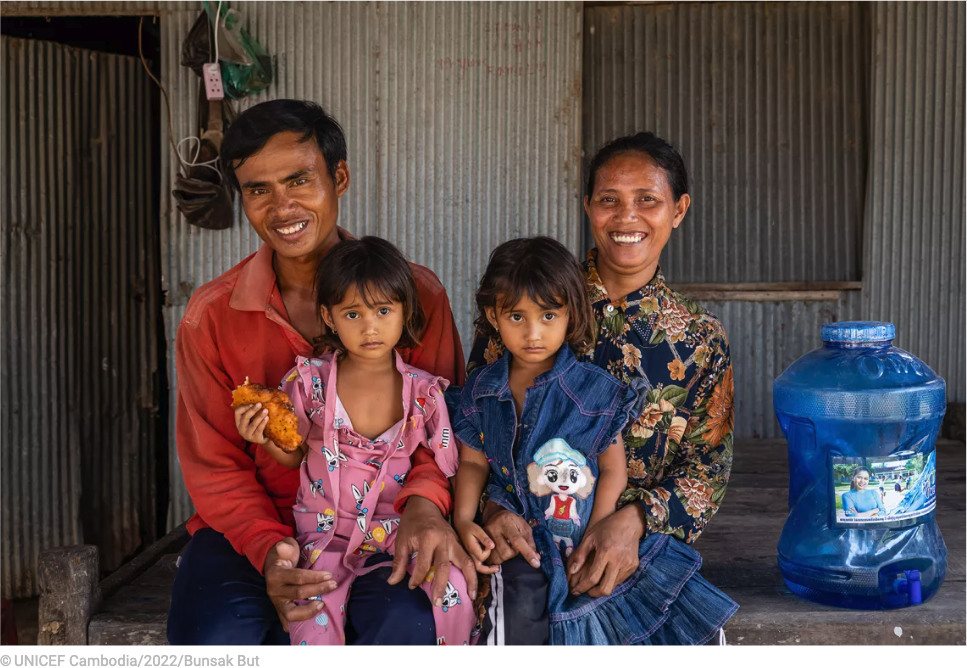
Choum Sophorn poses with her husband and twin four-year-old daughters in her home next to the 20 litre drinking water bottle that is delivered to her home every three days.

Teuk Saat 1001’s entrepreneur stands next to the UV filtration system and holds up some freshly filled bottles, ready to be sealed before delivering directly to customers in Kouk Pou commune.
About: For two decades 1001fontaines have worked to meet the needs of underserved communities through resilient water purification infrastructure and affordable and convenient services. We aim to encourage long-term behavior change and are proud that a million consumers across four countries in Asia and Africa have adopted our safe drinking water solutions.
Our 2030 ambition is to extend our impact by proving the relevance of our safe drinking water solutions in five countries and ensuring all our local partners are on track to reach financial viability at scale.
For more information: www.1001fontaines.com/en/

 Rural Water Supply Network - blog