
by Sean Furey, Director, RWSN Secretariat
Nearly 30 years ago I began my first steps into a career in Water, Sanitation and Hygiene (WASH) in Guatemala. In the morning mist, there was the dull clank of the school bell. It was an old bombshell that had been dropped on the village at some point during the thirty-year civil war. On that day it was guiding children to lessons. The clothes of the people, particularly the women, were amazing. Incredibly colourful and ornately woven, and each is distinctive to that community.
Today, my job is a different type of weaving, but no less colourful. In my previous post, I described how we, as RWSN and SuSanA, have been working with the Multilateral Development Banks, bilateral aid agencies, NGOs and researchers to weave a new narrative for rural WASH – one of learning from each other to achieve universal and lasting access.
But success doesn’t come from top-down actions only, there also needs to be a meeting with bottom-up energy, experience and initiative. Thanks to the support from SDC and IDB, through the SIRWASH project, we have had the opportunity to connect and listen to what regional practitioners are interested in and find ways to collaborate.
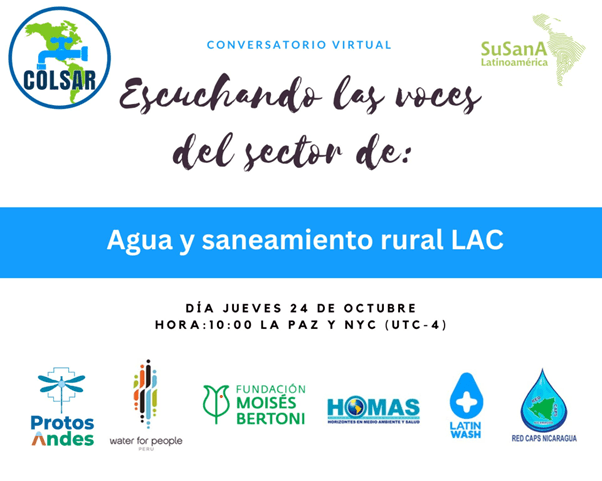
On 24 October, our partner, Lourdes Valenzuela from Aguatuya/SuSanA Latinoamérica co-hosted an online meeting with fellow WASH networks: “Conversatorio virtual: Escuchando las voces del sector de agua y saneamiento rural en Latinoamérica” (Online Conversation: Listening to the Voices of Rural Water and Sanitation Leaders in Latin America)
This 80-minute session, co-hosted with COLSAR, connected experts from diverse backgrounds to identify current sector demands and innovative approaches for improving rural water and sanitation management.
Themes and Objectives

The session, moderated by Marcelo Encalada from LatinWASH, sought to:
- Identify essential knowledge areas and skills for strengthening rural water and sanitation services.
- Explore digital tools and resources that could improve access to critical knowledge.
- Examine the role of digital platforms such as SuSanA and LatinWASH in promoting sustainable solutions.
Panelist Contributions and Key Takeaways
Each panelist contributed a unique perspective based on their expertise and the needs they observe within their respective countries.
Andrés Orozco Ruiz, RED CAPS (Nicaragua)
Andrés Orozco highlighted the need for community-driven action plans to ensure sustainable water services. In his view, promoting water conservation practices and fostering a sense of environmental stewardship are crucial for long-term impact. Orozco also emphasized the power of simple, visual communication. He pointed out that non-technical, visually rich materials (like drawings, photos, and short videos) resonate best with rural communities, where literacy and technological skills vary widely. Social media, particularly WhatsApp, was recommended as a vital channel to distribute these resources and engage community members effectively.
Julio Guzmán Tocto, Water for People (Peru)

Julio Guzmán focused on the pressing issue of climate change and its impact on water resources. He stressed the need to cultivate awareness about climate risks and the actions necessary to protect water sources that guarantee reliable service. Guzmán highlighted WhatsApp as a critical communication tool used by municipalities to reach rural communities, suggesting that WhatsApp chatbots could offer quick, accessible responses and collect information from community members. However, he cautioned that these digital solutions would only be effective if paired with investments in connectivity and accessible devices, ideally supported by government funding to bridge the digital divide in rural areas.
Carla Torreani, Fundación Moisés Bertoni (Paraguay)

Carla Torreani underscored the importance of building administrative and operational capacities among local service providers, as these small organizations often struggle with sustainability due to limited resources. Torreani advocated for introducing climate risk management and adaptive practices within rural water management, such as aquifer recharge and sustainable agricultural practices. In Paraguay, WhatsApp is widely used, but access to advanced technology remains limited in rural areas, she noted. Carla shared insights about delagua.com.py, a platform supported by BID Lab, Avina, and SENASA, which provides on-and-offline tools, including a marketplace that connects service providers with essential resources like plumbers, aiming to bring more rural users into the technological fold.
Helder Solis Carrion, Protos Andes (Ecuador)

Helder Solis highlighted the need for training in technical skills (e.g., plumbing and electrical work) that could empower rural communities to maintain their water and sanitation infrastructure and offer job opportunities. He also advocated for a cultural shift toward sustainable water practices. Solis noted that platforms like WhatsApp can create digital communities that strengthen ties among service providers, allowing them to share knowledge and collaborate more effectively. However, he cautioned that many digital platforms remain underutilized due to their complexity and the limited internet access in rural areas. Solis recommended designing simpler, localized modules for online and offline use and developing “micro-networks” for closer collaboration.
Ana Maria Acevedo Tovar, HOMAS & Red Agua Segura (Peru)
While Ana Maria Acevedo was unable to respond to some questions due to connectivity issues, her contributions underscored the challenges that many rural communities face in accessing digital platforms. WhatsApp, however, has proven invaluable in reaching rural areas in Peru. Acevedo shared that her organization uses WhatsApp groups extensively for organizing workshops, assigning roles, and disseminating critical information. For instance, they have managed to integrate data from 28,000 community water management boards (JAS) into a national database (DATASS), which reflects the potential of WhatsApp as a tool for data collection and community mobilization. She stressed the importance of improving connectivity to make digital platforms even more effective across diverse rural settings in Peru.
Audience Engagement and Strategic Challenges
The session wrapped up with a Q&A that emphasized the need for strategic alliances between communities and state actors. One key challenge raised by participants was the difficulty of forming partnerships with government institutions, especially when international philanthropy prefers working within formal state structures, which can exclude community-managed water systems. To overcome these barriers, panelists suggested empowering local organizations to build political dialogue skills and strengthen collective advocacy.
A closing poll explored the potential of artificial intelligence in supporting water and sanitation solutions. A majority (65%) believed that AI, integrated into tools like WhatsApp, could be beneficial, while 35% felt that current limitations may hinder its effectiveness in rural contexts.
Conclusion and Future Directions
The dialogue highlighted the need for inclusive digital solutions, capacity-building programs, and strong local-state alliances to improve rural water and sanitation services across Latin America. Participants underscored that digital tools must be accessible, simple, and responsive to rural realities. By fostering collaborations and creating adaptable, locally relevant digital resources, the water and sanitation sector can take significant steps toward resilience and sustainable service delivery for rural communities.
Many thanks to Lourdes for organising this great dialogue and for the network representatives and everyone who attended. We hope this will be the first among many to bring the WASH networks across LAC together on a regular basis and to connect and find common ground with global networks, including RWSN and SuSanA.
To find out more and to join the conversation:
- For latest news in Spanish subscribe to the WASH LAC WhatsApp Channel
- For the latest news on rural water, visit RWSN, the blog and join RWSN (in Spanish, French, or Portuguese).
- For sanitation and hygiene discussions and news go to SuSanA and join the SuSanA Forum and Blog
| Role | Name | Job Title | Organisation |
| Secretariat | Lourdes Valenzuela | Coordinadora | SuSanA Latinoamérica |
| Moderator | Marcelo Encalada | Director | LatinWASH / COLSAR |
| Panellist 1 | Ana Maria Acevedo | Directora de la ONG HOMAS, | Secretaría de la Red Agua Segura (RAS) – Perú |
| Panellist 2 | Andres Orozco Ruiz | Representantes | RED CAPS, Nicaragua |
| Panellist 3 | Julio Antonio Guzman | Oficial de programa – Gestión Social | Water For People, Perú |
| Panellist 4 | Carla Torreani | Gerente del área Gestión Sostenible del Agua | Fundación Moisés Bertoni, Paraguay |
| Panellist 5 | Helder Solis Carrion | Miembro representante | Protos Andes, Ecuador |

 Rural Water Supply Network - blog