Dr Kerstin Danert, Ask for Water Ltd, Edinburgh, Scotland
High-quality infrastructure design and construction is not the only important concern in relation to rural water supply services, but provides a solid basis. Poor quality infrastructure jeopardises everything that follows – including it the maintenance, and management of the service, and even being able to collect user fees.
There are many reasons why infrastructure ends up not meeting the standards needed. And for the last two decades, the Rural Supply Network (RWSN) has emphasised ensuring that boreholes are properly drilled and completed – with a range of guidance and training materials now widely available – and (I am pleased to know) used!
However, we were mainly writing (or making short films) for people that are implementing projects. With the most recent publication we are addressing a different audience – FUNDERS OF WATER SUPPLY INFRASTRUCTURE. You may ask yourself why?
Unfortunately, not all funding agencies have the policies in place, nor the checks and balances that consistently foster high-quality infrastructure – whether initial construction and installation, or rehabilitation. And to make matters worse, well-intentioned policies can actually have negative unintended consequences. Low-per capita investment costs are a case in point – they can be set too low.
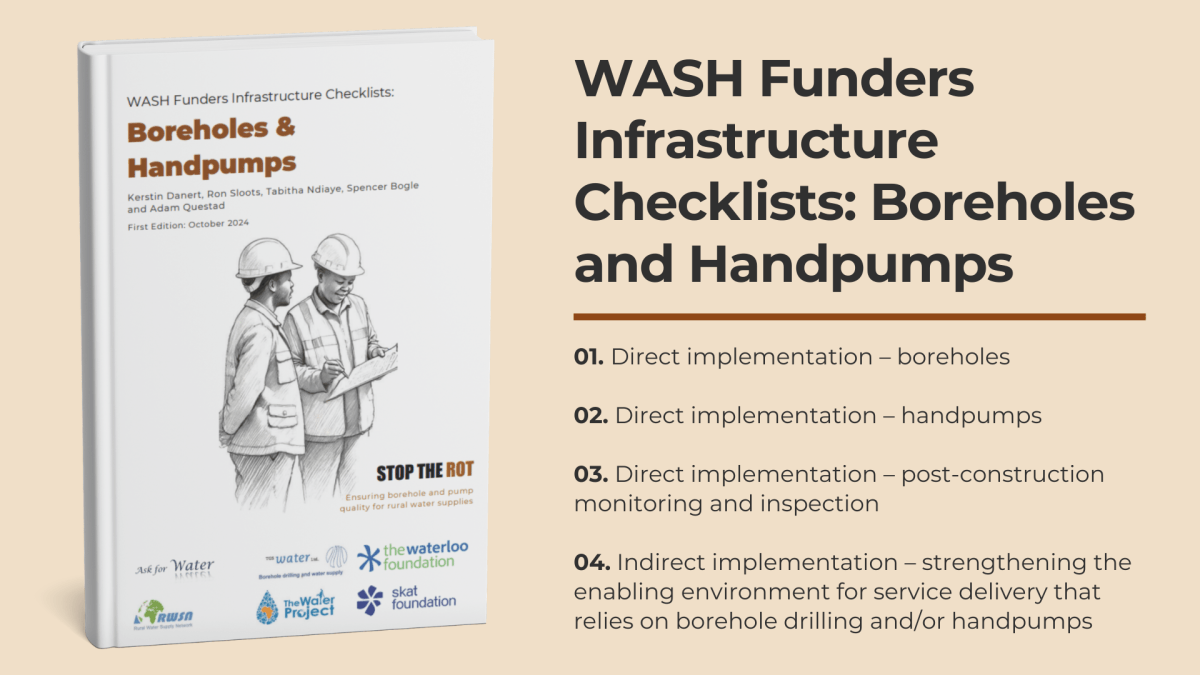
At the end of 2024, RWSN published the WASH Funders Infrastructure Checklists: Boreholes and Handpumps. They start off by recognising that when it comes to infrastructure quality, a number of things can go wrong. Grantees may simply not have the procedures in place, or the capacity to consistently ensure quality or they may not follow suitable contracting procedures. National standards may be lacking, or grantees may cut corners in order to meet Funder requests for an (unrealistic) low budget or fast schedules.
We have developed a series of four checklists – each providing guidance for WASH funders, whether financing direct implementation or systems strengthening activities. We have tried to make the checklists accessible even for those without a detailed knowledge of groundwater, drilling or handpumps. Each checklist is intended to help funders to reflect on their policies and procedures and/or those followed by the respective grantees.
Please take a look – and do get back to us through ask@ask-for-water.ch with comments feedback. We would like to keep improving this guidance in the future!
The WASH Funders Checklists were developed under the RWSN Initiative Stop the Rot.
Dr Kerstin Danert, Ask for Water Ltd, Edinburgh, Scotland
It was in 1998 when I started to work and then live in Uganda that I first really started to hear the term “Pastoralist”. That was in relation to the Karamojong (also spelt or Karimojong) – a group of people living in the semi-arid environments of north-eastern Uganda. At the time, although my knowledge of pastoralism was extremely poor, I was not fully comfortable with some of the derogatory language used about these people. However, it was hard to counteract the stereotyping and stigma that I was hearing. My efforts in relation to rural water supply had started, and continued to be with communities that were fairly, or very well settled; and if they moved in large numbers, this was primarily to flee widespread conflict and danger or settle back home again.
In my decade as a resident of the ‘Pearl of Africa’, it was largely considered too dangerous to travel through the districts of (now) Kaabong, Kotido, Moroto, Nakapiripiri, Napak and Amudet where the Karamojong and neighbouring agro-pastoral groups including the Pokot, Jie and Labwor lived. Cattle raiding (with use of firearms) and conflicts were frequent and could be deadly. On the other hand, I heard stories of Italian priests who lived among the Karamojong, plus stories of a few others. And occasionally my friends and colleagues would relate tales of some adventurous travel, or of tourists that flew up to Kidepo National Park. I never met a single Karamojong back then.
When I started to work in Kaproron, on the lush northern slopes of the extinct volcano of Mount Elgon, and staying in the residence of the local priest, I was able to look over the cliff edge onto the plains where the Karamojong lived. It was here in Kaproron that I heard stories from my colleagues and their families of their land that had been abandoned when the conflict was particularly bad. I learned a bit more about cattle raiding, but all in all, the Karamojong remained a mystery for me.
Photo (above): A view northwards from Kaproron (Source: Kerstin Danert, 2005)
In the subsequent years, other pastoral groups have fleeted in and out of my circle of attention, including the Maasai with their beautiful blankets, the Fulani with their marvellous hats and the Tuareg wearing exquisite blue. While curiosity was certainly there, my knowledge remained superficial.
It was in 2014, when working in Chad, that my path physically intersected with pastoralists. I was simply in awe as I watched what I later learned was a transhumant family travelling southwards. Asking questions, I was struck by similar, and familiar derogatory language as it was explained that for their entire lives these people travel south and then north again with the movement of the rains. I do not wish to repeat in detail some of the things that I heard. Once again though, I had no interaction with these transhumant people themselves, and was simply left with an uncomfortable feeling – one that I now recognise as my own inner reaction when I am faced with hearing stigma towards others and am at a loss for a response.
Photo (above): Transhumance in Chad (Soure: Kerstin Danert, 2014)
The discomfort I felt in Uganda, Chad and other places when listening to people talk about pastoralists never really left me. Thus, in 2020, while supporting UNICEF in preparing their Guidance Note on Leaving No One Behind in WASH, I decided to find out more about this group of people and include them in the publication. This turned out to be the start of a journey – a journey that continues. By this time, I had finally knowingly interacted with one single person from Karamoja: a woman police officer working in Kampala. She described the beauty of her home, how she travels back frequently, and how she loves to look at the stars when there. She told me that the conflicts have also eased over the years. I understand that following disarmament in 2001-2008 there was a period of stability, which was disrupted following rearmament in 2019 that degenerated into commercial raiding and involved the army, politicians and business people. You can read more here. Conflict continues with another round of disarmament underway.
In 2022 the United Nations General Assembly proclaimed that 2026 will be the International Year of Rangelands and Pastoralists (IYRP). You can learn more here in this lovely short animated film. I have to say that the openness of the international communities that concern themselves with the IYRP, and their eagerness to share has been a warm welcome for me into this new world. When I first contacted one of those communities – FAO’s online community on pastoralism – and asked the very naïve question on how to define pastoralism, I was blown away by the many helpful responses from the community. Thank goodness, for I was lost as I tried to understand more in preparing the aforementioned guidance note!
And so, in support of IYRP 2026 and particularly with a view to the linkages with water, this is my first in a series of blogs on pastoralists and water. You are most welcome to join me as I share my own journey of discovery.




 Rural Water Supply Network - blog