Pastoralists and Water 11 – Pastoralism and customary water tenure

By Barbara van Koppen,
Scientist Emerita at the International Water Management Institute

The earlier RWSN webinars and blogs about pastoralists’ water governance highlight how these communities have found solutions for survival and wellbeing in fragile environments, based on in-depth ecological knowledge . The blogs also expose the risks and threats when external agencies, such as government, NGOs, and private sector intervene, even with the best intentions of providing support. It underlines, again, the vital importance for external agencies to listen to everybody, leaving no one behind, from the very first phases of planning action.  

This blog, by Barbara van Koppen explores whether and how these insights can apply more widely. Do the various ways in which pastoralists generate solutions and receive external support or face threats also apply to smallholders and mixed farmers as well as fisherfolks in low-income rural areas in general? When we read ‘pastoralist’, can we interpret this more generally as ‘marginalized rural water user’, or in many cases even ‘humankind’? If such overlap exist, would more cross-fertilisation strengthen general calls for community-led planning and for a recognition of customary water tenure in policy and law? Let us explore, starting with pastoralists’ integrated water management.

Multiple uses

For pastoralists, water is life in many ways. Humans and animals need water daily and year-round for drinking. Every human also daily depends on water for domestic uses. Further, seasonal or year-round water enables vegetation growth for immediate use or storage for human livelihoods: nature’s grass, shrubs, and trees, or cultivated animal feed, or crops or fruits for own consumption or sale. Water is also needed for other livelihood activities, for example, the trade of milk. For humans, silos don’t exist; one use cannot without the other. When access to water is limited and prioritization inevitable, during seasonal droughts, pastoralists set a lower priority on their own drinking and other domestic uses above absolute minimum quantities than drinking by their animals. Together, the multiple water uses bring health and wealth and vice-versa.

Afar de facto multi-purpose infrastructure, Ethiopia (Source: Barbara van Koppen)
Moving to nature’s multiple, variable, unpredictable water sources

This life dependency on variable, only partly predictable and land-bound water resources, underpins age-old knowledge of the local integrated hydrological cycle of multiple sources: precipitation, surface water bodies, run-off, soil moisture (green water), wetlands, and groundwater. Without Integrated Water Resources Management (IWRM) to combine multiple sources, survival is impossible. This shapes pastoralists’ mobility to the sites of their seasonal and year-round uses: in dry seasons the (usually male) herders move their cattle to grazing areas and permanent water sources, for example up in the mountains. Even homes can remain mobile. Depending on seasons, part of mixed farming communities, may move their herds out and live in temporary houses.  

Making water move to sites of use: soil and water conservation and multi-purpose infrastructure

Pastoralists also make water move to, or stay in the favourite sites of use for themselves and their animals. Soil and water conservation in the rainy season feeds grasses, shrubs and trees for grazing or improves the cultivation of feed and crops. Construction, operation and maintenance of storage and conveyance infrastructure bring water seasonally or year-round to homesteads, distant grazing or cropping areas or other preferred sites. Dug ponds, tanks and drums store water. Groundwater is storage that is recharged. Buckets to lift or carry water, wheel burrows, canals, pipes, and trucks transport water.

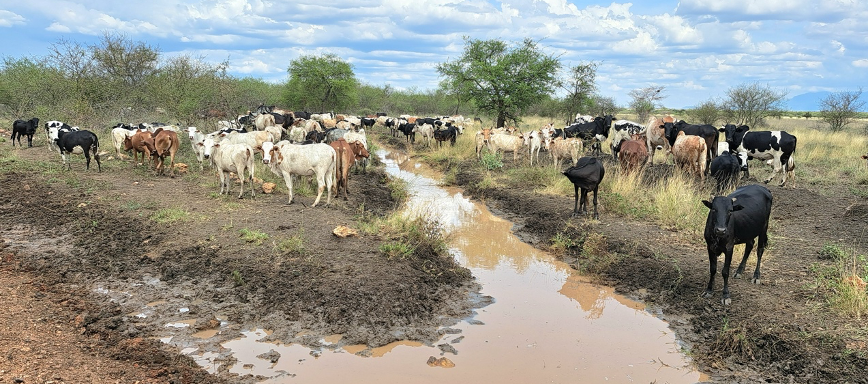
Afar livestock trough Ethiopia (Source: Barbara van Koppen)

The (usually male) individuals or self-organized groups who invest in the infrastructure typically have the strongest claims to the water stored and conveyed for their multiple needs, but other people and animals may be attracted. Access rights are even more open for infrastructure installed by government or NGOs.

In sum, at community-level, pastoralists combine multiple local surface and groundwater sources, with various infrastructures to access water for multiple uses at multiple sites Sharing of water that flows over or under these lands shapes internal and external relationships. As the Boran say: “Water is either a source that you ‘share in’ as a member of a descent-based collectivity, or one that you ‘share out’ to signify respect” (Dahl and Megerssa 1990*). These insights and arrangements are mainly orally shared, also through culture and rituals.

All the above – multiple uses, sources, infrastructures and sharing – may sound complex, but communities can draw a map (on the ground or on paper) of this core of their livelihoods and culture in a few hours.

However, the most severe threats to pastoralists’ access to water are in the ‘sharing out’ of water with foreign and national powerful third parties, grabbing land and water and polluting for profit- and export-oriented large-scale cereal farms, plantations, mining, or tourists and game parks.

Implications for support agencies

What do you think? Don’t these features fit more settled rural communities as well? And fishers? They fit FAO’s general definition of water tenure: “Relations, customarily or formally/legally defined, between people, as individuals or groups, with regard to water” (FAO 2020**). In FAO’s Global Water Tenure Dialogue, pastoralism is a clear example of a broader growing recognition of customary, or community-based, or indigenous, water tenure.

Joining forces, the following two implications for governments and other external agencies seem equally important for pastoralists and more settled rural communities or fisherfolks.

First, any external support for improved water management should start with the above-mentioned diagnostic of a resource map. Different parts of the community (men, women, young, old, different livelihood strategies) will indicate their current situation. On this basis they will identify their problems and envision and prioritise actions, while cost-effectively indicating required support.

This diagnostic resource mapping is the moment to ensure everyone’s voices are heard, so that those who need most can prioritise action. External agencies’ mandates of support on offer should be transparent and as open as possible. Too restrictive mandates can fail to align with local priorities or ignore pastoralists and fisherfolks altogether. This may even be the case in broad approaches such as the food-energy-water nexus (which tend to ignore domestic water uses) and humanitarian aid (which may ignore animals’ and other productive needs). When broader needs than the support on offer emerge, other expertise and funding sources need to be mobilised.

Second, when water is scarce during dry seasons and droughts, prioritization is inevitable. The following prioritisation proposed by the UN Special Rapporteur on the human right to water*** provides excellent guidance for decolonized prioritisation that may well align with communities’ own prioritisation.

  • 1. Water for life (domestic uses, productive uses, aquatic life);
  • 2. Water for general interest;
  • 3. Water for economic uses and profit making. 
References

*Dahl, G.; Megerssa, G. 1990. The sources of life: Boran conceptions of wells and water. In: Palsson, G. (ed.) From water to world-making. African models and arid lands. Uppsala, Sweden: The Scandinavia Institute of African Studies. pp.21–38.

**FAO. 2020. Unpacking water tenure for improved food security and sustainable development. Rome, Italy: Food and Agriculture Organization of the United Nations (FAO). 40p. (Land and Water Discussion Paper 15). https://doi.org/10.4060/cb1230en

***UN (United Nations) 2024. Water and economy nexus: managing water for productive uses from a human rights perspective. Report of the Special Rapporteur on the human rights to safe drinking water and sanitation Pedro Arrojo Agudo. Fifty-seventh session 9 September–9 October 2024. Agenda item 3. Promotion and protection of all human rights, civil, political, economic, social and cultural rights, including the right to development. A/HRC/57/48. https://www.ohchr.org/en/documents/thematic-reports/ahrc5748-water-andeconomy-nexus-managing-water-productive-uses-human

Pastoralists and Water 10 – Finding common ground between pastoralism and conservation

By Karl Wagner[1], Jennifer Gooden[2], Magnus Sylvén[3], Adrian Cullis[4]


This month, its over to Karl, Jennifer, Magnus and Adrain on our ongoing blog series which, this month, reflects on pastoralism and conservation!

Searching for common ground

Progress toward big challenges, like protecting rangelands and the pastoralists who use them, can be strengthened by finding partners who share common ground. We think this is the case with the pastoralism and conservation communities. In essence these communities have much in common, but in practice they have remained separate and therefore unable to achieve the protection of large, unfragmented landscapes. This is exacerbated by short-sighted perceptions:

  • Conservation practitioners tend to see domestic livestock, especially in managed herds, as an intrusion into the natural ecosystem. Sadly, many conservation practitioners would rather see a grassland absent of all large herbivores than a grassland grazed by pastoralists’ herds.
  • Pastoralists – for cultural and subsistence reasons – prize a “bigger is better” approach to herds, seeking to maximize the animal numbers to enhance livelihood stability in fragile environments. This can result in oversized populations of domesticated animals and add another driver of land degradation.  
Finding balance

In reality, it’s not either-or but rather a matter of finding an optimal balance of multiple land uses. This includes recognizing that livestock can cover some, perhaps many (but not all!), of the ecological functions of wild animals. For example, cattle and bison are both bovines and both increase the bioavailability of soil nitrogen for microorganisms and plants through excretion of dung and urine.

However, wild bison must face predators, extreme weather, and food shortages, which keeps their population numbers within the ecosystem’s carrying capacity. Managed herds of cattle don’t face these risks to the same degree, and are also more selective in their grazing, resulting in a loss of rangeland biodiversity over time. Furthermore, when pastoralists and ranchers manage cattle herds more commercially, there’s often an increased risk of poorer grazing practices and accelerated rangeland degradation.

Where we agree

If we can zoom out and look at grasslands as socioecological systems, there are many things we might agree on:

  • Human civilization has seriously degraded earth’s ecosystems, leaving less than 3% that could be considered fully functional.
  • The more functional an ecosystem, the greater its ability to provide the goods and services that rural and urban communities need for their survival, wellbeing and prosperity – provided they are given access.
  • The human population stands at 8 billion and counting, growing in numbers as well as in demand for natural resources.Yet we live on a finite planet, and natural resources are limited.
  • We are in a systemic crisis, and we must identify and implement systemic solutions. This requires systemic, holistic thinking. Problems can no longer be seen or solved in isolated silos.
  • As a pragmatic consequence, natural resource management must pursue multifaceted objectives. It needs to address not only harvests but also the functionality and long-term resilience of ecosystems.
What wild animals can do

There’s one more unifying but lesser-known fact: wild animals can repair and enhance an ecosystem’s functionality. Wild animal impacts on ecosystem processes benefit pastoralists, too. Left wild, they can help with nutrient cycling, carbon capture, invasive species control, flood control, and water purification. One can think of non-management of wildlife as a management tool for grazing.

Wild animals are not mere bystanders in the face of environmental change. Like climatic factors, such as temperature, precipitation, and ocean currents, wild animals affect the web of life, actively shaping the spaces in which they live.

The role all animals play

Animals large and small, wild or domestic, have been found to both directly and indirectly play an intricate role in the water regulation on rangelands, the ecohydrology, ranging from micro-perturbations to the macro-perturbation commonly described as ecosystem engineering. Examples of large mammals having a positive impact on wetlands in rangelands include:

  • Wild species: elephants, hippos, African buffalo, tapirs, beavers, muskrats, and geese
  • Domestic species: water buffalo, cattle, and horses

All these species spend time both on land and in water, connecting terrestrial with aquatic ecosystems, affecting particularly the supporting services, such as nutrient cycling, ecosystem productivity, sediment/soil formation, seed dispersal, biodiversity, food webs and trophic cascading, water distribution and flow, as well as ecosystem heterogeneity. More detailed information is provided in the following two publications “Taking animals into Account: The Critical Role of Wild Animals in Shaping Wetland Ecosystems and the Services they Provide, A Report to the Ramsar Convention on Wetlands – global outlook (February 2025) and Africa Special Report (July 2025).

What wild animals need
  1. Space: In the face of rapid population declines, wildlife needs recovery areas sufficiently large for populations to flourish.
  2. Complete food webs: Functional ecosystems require a complete food web, including predators.
  3. Ecosystem engineers: Some species significantly modify their environments, creating space for many other species to flourish. Animals like beavers, elephants, and prairie dogs all play outsized roles in positively shaping the land and water around them.
Adapting pastoralist practices

The good news is with a few adaptations, pastoralist practices can be tools for land restoration. Holistic and regenerative grazing practices can build soil organic matter, increase water retention, sequester carbon, conserve biodiversity, and reduce the spread of invasive species. Similarly, community wildlife conservancies in Africa are another example of management practices that have resulted in a significant comeback of wildlife across large areas of Africa at the same time as providing new economic opportunities for people.

Let’s join the forces of the pastoralism and conservation communities to protect the large landscapes through which abundant wildlife and nomadic pastoralists have migrated since time immemorial.

About the authors

[1] Director, Campaigns, Global Rewilding Alliance

[2] President/CEO, Biophilia Foundation

[3] Director, Science-Policy-Practice, Global Rewilding Alliance

[4] Co-Chair, IYRP 2026, Pastoralists and Water Working Group

Pastoralists and Water 9 – Reflecting on very rapid land degradation

With our 9th blog on Pastoralists on Water in this series, let me give the floor to Patrick Worms, Senior Science Policy Adviser for the Nairobi-based World Agroforestry Centre, with his reflections on very rapid land degradation. And if you are wondering how this relates to water, do check out our 5th blog – A brief introduction to green water.

By Patrick Worms

“Last month, I gave keynotes on grazing management and agroforestry at a conference on climate and health I was kindly invited to by Nightingale Wakigera, Maison Ole Kipila and Nathan Uchtmann at Maasai Mara University in Narok, Kenya. I focussed on the very rapid land degradation that typically follows the spread of fencing across the savanna, be it for livestock grazing or to keep wildlife penned into too-small conservation areas.

Maasai Mara may be one of the better places in East Africa to contrast the results of good and bad grazing management: on one side of the fence, you have the vast Serengeti-Maasai Mara ecosystem, where a million-strong wildebeest herd follows the rains and new grass in their massive migration, one of the last ones on the planet; on the other, the creeping fences are privatising the savanna into small enclosures. The resulting contrast couldn’t be greater: swaying, thick grasses on one side; degraded, bare ground and thorny bushes on the other. 

Desertifying, bush-encroached paddock near Narok, Kenya (Source: Patrick Worms)

From the perspective of soil and rangeland health, it doesn’t much matter if your grazers are cows or wildebeest. What matters is the way the grazing is done. An intense, short period of grazing followed by a long rest period is best​. That’s the management style pioneered by lions chivvying migrating herds along in tight bunches in the Serengeti.

Anything else sets the stage for land to degrade, either drying into desert or choking under invasive bush. That is the trouble of most pastures across the world’s semi-arid zones, of many of the smaller African national parks, and of the fenced grazing lands that fringe Kenya’s Mara reserve. Why? When livestock are not moved, they repeatedly graze the ​tastiest plants, manuring the thorny, toxic ones while doing so. The grass doesn’t get rested, and eventually dies from overgrazing.

Heavy bush encroachment on overgrazed paddock near Maasai Mara, Kenya
(Source: Patrick Worms)

But don’t think that removing animals altogether does the trick: grasses evolved to be grazed (they are by far the biggest group of plants that grow from their base, not from their tips). When they’re undergrazed, they eventually die and form a thick thatch that prevents new grass growth from emerging.

Overgrazing and ​u​ndergrazing is killing grasslands around the world, whether​ they’re rangelands geared to livestock production, too-small conservation areas geared to preserving iconic wildlife, or indeed mountain and hillside pastures in temperate areas. Everywhere, bare ground and woody bushland is spreading.

But this is not fate. It’s a choice.

The good news is that managing grasslands well does not require capital, but skill – and a nerdish attention to the health of the soil and rangeland. With livestock, the tools can be as simple as competent herders or cheap, mobile electric fences (if there are lions around, things get more complicated, but still manageable – lions can be scared off by guard dogs, and livestock made invisible in a night enclosure). With wildlife, the tools are salt/mineral licks and boreholes that can be turned on and off.

Pasture enclosed less than 10 years ago, encroachment progressing
(Source: Patrick Worms)

The goals are the same: to ensure high animal impact for very short periods, by imitating the Maasai Mara’s migrating wildebeest herds allowing the savannahs to rest and regrow before being grazing again, typically after the next rains. 

This is how we can regenerate grasslands around the world, by learning the lessons of the Maasai Mara”.

Kettle market in Ewaso Ngiro, Kenya (Source: Patrick Worms=

This is an adaptation of a LinkedIn post by Patrick Worms in August 2025.

Pastoralists and Water 8 – Ensuring Agency for Pastoralists to Develop their own Water Supplies

By Adrian Cullis

In addition to our planned 24-part series of blogs – one a month for 2025 and 2026 – to support the International Year of Pastoralists and Rangelands (IYRP) 2026, Kerstin and I co-facilitate the IYRP’s Pastoralists and Water working group. 

Figure: Borana women collecting water from a livestock pond (Photo credit: Adrian Cullis)

Learning about Pastoralists and Water in East Africa

The working group has around 40 members scattered around the world – Australia, India, East and Southern Africa, Europe and the Americas – and we meet online, almost every month.  The June 2024 meeting had an East Africa focus and included three excellent presentations on Borana (Ethiopia), Karamoja (Uganda) and Turkana (Kenya)[1].  The Borana presenter was Did B. a former colleague in Save the Children/US, Ethiopia. I well remember our first meeting in Nagelle, as Did wasted no time telling me that Save the Children could achieve better outcomes by working with – as opposed to ignoring – customary Borana institutions, as did Farm Africa and SoS Sahel. This resonated with my experience in Karamoja, Uganda where the value of working with customary pastoral institutions had become apparent when restructuring the Lutheran World Federation’s programming around customary sections and sub-sections. 

Social networks among the Borana

Keen to learn more, I asked how Did felt this might be done. He carefully explained the various roles and responsibilities of olla (grazing communities), maadda and dheedha (area-based rangeland grazing and landscape units), families and clans. As he explained, Borana customary institutions provide the governing framework within which Borana households operate and develop their social networks, a necessary part of navigating life in a semi-arid area subject to highly variable rainfall. It’s these social networks, for example, that have historically supported Borana families overcome the loss of livestock during times of drought, outbreak of disease or theft by neighbouring pastoralist ethnic groups. Did concluded that it was also these customary institutions that were integral to the Borana’s 560-year success living in the region, and that the lack of recognition by any international development partner was a source of considerable frustration to the Borana community and its leaders.  

A Water Project

Having agreed the principle, we moved to the detail with a wider group of Save the Children staff, and it was in this first meeting that someone proposed that we start with the water programme. I remember inwardly groaning as I had increasing reservations about water programming in pastoral areas, from my experiences in Karamoja. I’ve documented some of these reservations in the July 2025 blog.  I therefore anticipated more of the same. However, what was being suggested was far from what I’d expected. As the staff explained ‘ it’s around dry-season livestock watering – when the ponds dry –  that Borana customary institutions really come to life’. I therefore started visiting Borana adadi and tulla(shallow and deep wells), and the learning journey started. 

At that time, the Save the Children/US water programme was using USAID-funding to rehabilitate ella shallow wells: food-for-work for the excavations, the supply of cement and rebars for the construction of water-basin-stairways and cattle troughs, and the hire of experienced masons. If you’re not familiar with Borana shallow and deep well systems, then it’s worthwhile watching this short two-minute video.

Figure: Borana ella or shallow well with improved water-basin-stairway (Photo credit: Adrian Cullis) 

Water projects that work

Having visited half a dozen well complexes and met with and listened to pastoralists describing with considerable and justifiable pride how Borana clans had maintained their wells and managed the associated rangelands without over-use over four-hundred years, I was eager to visit some of Save the Children/US project sites. At each of the sites, I was introduced to the Abba Konfi – owner of the well, and the Abba Herega – manager of the well.[2]  As I became more familiar with the sites, I eventually asked the question, ‘if you could manage these sites for 560-years, what’s stopping you from doing this today?’  The response was something of a development watershed, as an elder immediately responded, ‘we didn’t ask for all this support, what we asked for was the rebars[3] and cement, with which we could build better, safer and more lasting water-basin-stairways.’  Long-story short, Save the Children/US slowly withdrew funding support for well rehabilitation other than for the purchase and supply of rebars and cement, which were delivered to a store near the site and left for the clan leaders to access and use when required. Subsequent monitoring visits confirmed that the work progressed as it had before, but with an elevated sense of pride, and that local Save the Children/US programme staff adjusted well to a more supportive role. This is what I increasingly think is the role that people in development should play.


Water resource development in pastoral areas by pastoralists 

A decade or more later, I returned to Borana on a pastoralist water assignment for CARE Ethiopia and, as good fortune would have it, I again had the pleasure of working with Did B (following Save the Children/ 

US’s withdrawal from Borana, he had accepted a position with CARE). During the visit, the team he had assigned me to work with learned of and visited an adadi excavation site in Dillo Woreda.  From the elders we learned that the excavation was being carried out without external assistance of any form, and that the Abba Konfi and clan elders were providing food and payment – including in the form of livestock – for the excavation team. The excavation was already well advanced, and the team were confident that in another 6 months it would be completed, including a water-basin-stairway and livestock troughs. 

Figure: Excavation of an ella or shallow well, Dillo Woreda, Ethiopia (Photo credit: Adrian Cullis)

This second visit closed a learning loop for me, namely that water resource development in pastoral areas is much better left to pastoralists themselves as they are typically more than able to generate their own resources and that external investment often by-passes and undermines customary institutions, to the detriment of the wider management of the rangelands. Once again, less is more! 

This is part of our blog series on pastoralists and water.


[1] Anyone not registered with the Working Group but interested to receive a copy of the presentations can request them from Kerstin. 

[2] The Abba Herega rotates herd watering based on a household’s labour contribution during the excavation and herd size, with sheep and goats watering first, followed by cattle and then camels.

[3] Rebars are steel bars used for reinforcing concrete

Pastoralists and Water 7 – Introducing the first Call to Action: Sustainable Water Development in the Pastoral Rangelands

Dr Kerstin Danert, Ask for Water Ltd, Scotland, UK

We have made it to the 7th monthly blog in this series on Pastoralists and Water. It has become a great team effort (notably without any artificial intelligence used). Here is a synopsis of where we are so far:

  • I started in blog 1 by reflecting on my early encounters with the term “Pastoralist” and my uncomfortable feelings in relation to the stigma towards pastoralists in Uganda, and later in Chad.
  • Blog 2 unpacked what pastoralism actually is – both an economic activity and cultural identity and introduced rangelands as places where livestock graze and pastoralists live. I shared my realisation of the importance of pastoralism in the global food system and that herd mobility has value! I concluded that while pastoralism is largely misunderstood, more pastoralists are gaining voice.
  • Maryam Niamir-Fuller and I explained how pastoralists specialise in making use of highly variable environments to produce food moving with their livestock, shared the link to this beautiful short film, alongside emphasising that rangelands cover 54% of the earth’s land surface, with much diversity in blog 3.
  • In blog 4 supported by their recent policy brief, Jackson Wachira, Masresha Taye, Hussein Wario and Nancy Balfour challenged us as to whether new water supplies in the Horn of Africa drylands are the solution for pastoralists resilience or part of the problem. I will return to this question later.
  • We introduced green water in the 5th blog, a team effort involving Klas Sandström, Aida Bargués Tobella, Malin Lundberg Ingemarsson, Chris Magero, and Adrian Cullis, emphasising the importance of healthy soils and highlighting that green water really matters for blue water.  If you are confused – I recommend that you read the blog!
  • In June 2025, for the 6th blog Adrian Cullis took us to Karamoja,  reflecting upon experiences in the mid 1990s up to today and with respect to pastoralists, water and management – particularly noting pastoralist being pushed out, not by an explicit excision policy or violence, but by land use practices and the quiet erosion of land access.

And so that takes us to this, our seventh blog in the series. Here I am introducing you, as readers to The First Call to Action by the IYRP Working Group on Pastoralists and Water. It is called “Sustainable Water Development in the Pastoral Rangelands”. 

The call is to stakeholders – including the financiers, planners, community workers, engineers, hydrogeologists and hydrologists who deal with rural water supply services. 

Personally, while I support it, I feel that it does not make for entirely comfortable reading. I feel challenged by it. I argue that parts of the call challenges norms, ingrained ways of working, or assumptions widely held within the Water, Sanitation and Hygiene (WASH) sector. The main one, is that, if well sited, constructed and properly managed and as long as people benefit, that a new, or rehabilitated permanent water source, is almost always a good thing to support. 

And so, with this introduction, I hope to spark some reflection, much-needed dialogue, and ultimately even changes in practice.  

I am not going to try to summarise the whole call – at five pages it is short enough in its own right! Rather I would like to draw your attention to the second point in the call, and seek your opinions, whether as responses in the comments below, through email or LinkedIn exchange, or through discussions with members of the IYRP Pastoralists and Water working group either online or face to face, or even through joining the group. 

So, … after all of this build up, what is the second point in this Call to Action?  As a clue, it echo’s the questions raised in the 5th blog which focussed on the Horn of Africa, asking whether new water supplies in the drylands are the solution for pastoralists resilience or part of the problem?

The Call to Action – Point two is

“reduce and reverse rangeland conversion:

Discontinue the development of new water infrastructure that enables the appropriation of rangelands by external investors or elite pastoralists for private benefit – such as commercial agriculture, mining, or renewable energy projects – or that would result in new settlements and year-round grazing, as both degrade pastoral rangelands and undermine pastoral livelihoods. Instead, support pastoralist communities working to reclaim and restore control over their traditional rangelands. “

What do you think of this? Do you agree? Can this statement be applied universally or is it unique to some places, such as parts of East Africa? Do you, or does your organisations work in rangelands? How would taking this into account affect the way in which you work or what you fund? Is this something that needs more space within the WASH sector. 

And what are the counter arguments? Is there need to diversifying livelihoods in pastoralist systems; what to the pastoral youth want? It is possible for a win-win with investment in rangelands, including water development, which provides new opportunities while allowing pastoralists to continue to use the rangeland sustainably? 

This is part of our blog series on pastoralists and water within the 2026 International Year of Rangelands and Pastoralists.

Dr Kerstin Danert is a Water Specialist, Researcher and Facilitator and together with Adrian Cullis, co-facilitates the IYRP Pastoralists and Water Working Group. Both Adrian Cullis and Nancy Balfour reviewed and provided inputs to this blog.

Pastoralists and Water 6 – Karamoja Then and Now – Pastoralists, Water and Management

By Adrian Cullis

In her January 2025 blog – the first in a 24-part series, of which this is the sixth – Kerstin recalled looking out from Kaproron’s cliffs on the slopes of Mt. Elgon, across the dry plains of Karamoja, and reflecting on the derogatory language so often used to describe these pastoralists in Uganda’s extreme north-east.

What I hadn’t recognised until reading her blog was that, while she was looking north, we were often passing Mt. Elgon on our way to Kampala from our home in Moroto. At that time I was working with the Karamoja Agro-Pastoral Development Project (KADP) under the Lutheran World Federation (LWF). LWF had established its base in Moroto in the early 1980s, responding to the humanitarian crisis that followed 1979-80 when cattle raiding, livestock disease, and general instability had pushed the region to the brink of famine.

By the time I joined LWF in Moroto in the mid-1990s, their emergency response had evolved into a more integrated development program, with components on water development, agriculture, women’s empowerment, and peacebuilding.

At the heart of the water programme was Tom O., a quiet, gifted engineer from West Nile. Tom and his team brought more than groundwater to the surface – they established trust through the hundreds of boreholes that they drilled from Kaabong in the north to Namalu in the south.  During a 2024 return to Karamoja, I met a pump mechanic trained by Tom nearly 30 years ago, who proudly showed me still-functioning boreholes drilled by Tom and his team that he’d maintained over the years.

There are however inevitable catches.

On that same 2024 visit, in the very next village from the pump mechanic’s home, we encountered a very different scenario: a cluster of seven failed boreholes. The Tufts University team I was working with was initially sceptical – seven? really? – until the story emerged: a well-connected sub-county official had repeatedly redirected drilling rigs toward his land, each time hoping the new rig would succeed where others had failed. He, of course, hadn’t shared the stories of those previous failures.

This kind of manipulation would, one hopes, be harder to pull off today. Uganda’s district-level computing and data capacity has grown exponentially, so in theory at least planners and engineers have ready access to every dataset they might need: hydrogeology, settlement patterns, borehole histories, yields, maintenance logs. In theory. In practice of course, data often exist in silos, are scattered, outdated, or sitting unread on a hard drive few can access and even fewer think of updating.

But I think more troubling than the data challenges is a conceptual one – especially in how water development is approached in pastoralist regions like Karamoja, where people move with their livestock. The prevailing logic goes something like this: pastoralists are but one of several vulnerable groups, and so with other vulnerable groups they should share water points. In principle, this sounds inclusive. In practice, it’s exclusion by dilution. Why? Because these pastoralists move. Their seasonal mobility means they’re often absent when decisions about ‘shared’ water points are made and, over time, these absences become a disadvantage. Eventually, ‘shared’ water becomes ‘our’ water, typically, more sedentary households who then transform the surrounding rangelands into fields, settlements, and year-round grazing areas that do far more damage than drought ever could.

And just like that, pastoralists are pushed out – not by an explicit exclusion policy, but by land use practices. Not by violence, but by the quiet erosion of access.

The apparent absence of people or livestock from a landscape is not a void to be filled. It’s a pastoral system at rest – regenerating, recovering, and waiting for the seasonal return of the pastoralists it supports.

If we want water development to work for pastoralists, it must not only support access during seasons of use but also prevent access during seasons of rest. That may sound counterintuitive – even paradoxical – but that’s exactly the point. If then you’re a water engineer, planner or policymaker, please don’t misread seasonal rangeland emptiness as under-utilisation – or worse, as opportunity. It’s not. It’s someone else’s functional rangeland – resting for now.

As the 2026 International Year of Rangelands and Pastoralists approaches, those of us working in water resource development would do well to shift not just our technologies, but also our thinking. Sometimes, the most responsible form of water development is not to drill at all.

This is part of our blog series on pastoralists and water.

Pastoralists and Water 5 – A brief introduction to green water

by Dr Kerstin Danert (1), Dr Klas Sandström(2), Dr Aida Bargués Tobella (3) , Dr Malin Lundberg Ingemarsson (4), Chris Magero (5) and Adrian Cullis (6)

In support of the International Year of Rangelands and Pastoralists (IYRP 2026) this is the fifth blog on Pastoralists and Water published through RWSN. We are going to provide you with a brief introduction to green water – a subject that is important when considering rangelands, pastoralism and pastoralists in many parts of the world (some may even argue everywhere). Before we move on, in case you have missed any of the other blogs on this topic, you can reach them here

Some of us were given an opportunity to reflect and write on green water as members of the team preparing the 2023 Somalia Economic Update, entitled ‘Integrating Climate Change with Somalia’s Development: The Case for Water’ while others are researching this topic. In this blog, we don’t intend to summarise the report, which is in the public domain, but rather we want to help you understand, and perhaps think more about green water. 

So, let’s get started – what on earth is green water? And why is it important? Ok, we shall get there via the term blue water.

Blue water

For many of us working on water supplies, water services, or irrigation, we make a living through the provision, or advice in relation to blue water. Blue water refers to the water that you see in rivers, lakes and dams, or that is abstracted from aquifers (groundwater). Blue water is what you see being used in irrigated agriculture or what livestock and humans drink. Generally, small amounts of blue water are required for Water, Sanitation and Hygiene (WASH) needs and to water livestock. In contrast, irrigated agriculture (as well as some industry) uses larger quantities of blue water. Further, downstream users often benefit from upstream (blue water) runoff – which is not always aligned with the interests of the upstream communities!

Green water

In contrast, green water is water in soil. It accumulates there from rainfall (or other forms of precipitation) and subsequent infiltration. You can feel (and see) green water in how it makes soil damp or wet. Green water will either evaporate, be consumed by plants through the process of transpiration, or may percolate to recharge groundwater. Green water is what rainfed agriculture and rainfed ecosystems rely on. Pastoralists raise domesticated grazing animals – cattle, camelids, equines, sheep, goats, yaks, reindeer, pigs and even a variety of poultry (chickens, ducks and others). Rangeland vegetation, including grass, forbes, trees and shrubs, which are essential for this pastoral livestock all depend on green water

Whether we are already familiar with the terms blue and green water or not, these definitions may not sound particularly exciting, but let’s continue. They link to a key aspect of many water scarce areas of the globe and how food and water security can improve.  

Healthy soils: The key to green water replenishment

Water at the soil surface enters through a process called infiltration. Healthy soils have good physical, chemical and biological properties and therefore can absorb more water: they have what is known as a higher infiltration capacity. 

In contrast, soil degradation results in surface compaction, crusting and sealing, which means less water can enter the soil, leading instead to surface runoff and an increased potential for erosion. This can also lead to agricultural, pastoral  or ecological droughts: a deficiency of soil water that is not necessarily linked to a deficiency of rainfall (meteorological drought) but mostly to a poor soil health and infiltration capacity also known as hydrological functioning. It rains, but much of this rain never becomes essential green water.

Erosion in West Pokot, Kenya (Source: Aida Bargués-Tobella)

However, agricultural, pastoral and ecological drought can actually be arrested and reversed through sustainable rangeland management and restoration. In other words, the replenishment of green water can be enhanced through practices that improve soil structure and through vegetative and structural measures that collect surface runoff and enable it to infiltrate. Half moons and a wide range of other rainwater harvesting structures are examples. More soil water supports plant growth, which in turn improves soil structure, enhances infiltration rates and results in improved hydrological functioning. 

Half moons in Turkana, Kenya (Source: Aida Bargués-Tobella)
What about evaporation?

As we learned in the water cycle, water moves from the atmosphere to the ground, from mountains to the sea, across land, along rivers, underground and through pipes. These are flows that we can observe or measure.

Transpiration and evaporation return some precipitation to the atmosphere. Transpiration is linked to plant growth, but evaporation, which is vast and invisible arguably remains largely overlooked and is poorly managed. Locally, transpiration contributes to the production of food, fuel, and fodder. In contrast, evaporation does not contribute locally, bit will rather condense and become rainfall (or snow, hail, sleet or fog) elsewhere. Evaporation is very important, because on a farmer’s field or in a small catchment, much of the rainfall that reaches the ground can evaporate. 

Reducing evaporation and harnessing more rainfall for productive transpiration may not be easy, but well-established knowledge about it does exist. Effective land management will capture rainwater, promote infiltration, reduce evaporation, thus providing more green water, which still returns to the atmosphere as plant transpiration. That lead us to our next point.

Rangeland management – the key to more water for food, fuel, fodder and services

Rangeland management controls two critical hydrological processes – infiltration and evaporation. It also controls the extent that rainfall is converted into green water and hence is available for transpiration (i.e. for food, fuel and fodder).  

When landscapes and watersheds are better managed, they more effectively catch rainfall, reduce and control runoff, and enable water to infiltrate the soil. This enables soil to absorb more rainfall and increase levels of green water, contributing to the productivity of grasses, shrubs, trees and crops and reducing evaporation. More green water can support more livestock, crops and forests with reduced ecological damage, ultimately contributing to healthier communities and stronger local economies.

Why does green water matter for blue water?

Better rangeland management, including using rainfall in upstream areas and promoting rainfed agriculture (including pastoral livestock), generates and harnesses more green water.  This can enable savings to be made on blue water, which can therefore be used more productively for domestic use, watering livestock and even for high-value (export) crops.

A planetary boundary for freshwater that includes green water
Let’s put green water in a larger context. In 2009, Johan Rockström and Stockholm Resilience Centre published the Planetary Boundaries (PBs) concept, presenting a set of nine planetary boundaries which are essential for present and future humanity to develop and thrive. One of the original boundaries is “freshwater use”. In 2022, they published a study on a planetary boundary for green water in which they explain how green water links the freshwater boundary to other planetary boundaries such as land use, biodiversity and climate. Based on global changes to soil moisture, the study concludes that the green water planetary boundary has already been transgressed – highlighting the urgency in giving more attention to this aspect within the hydrological cycle.

The earlier mentioned 2023 Somalia Economic Update report is not only relevant for Somalia, but for other dryland countries whose economic and human well-being depends on how their water resources are managed. We argue that a critical entry point in such contexts is recognising the role of evaporation—the often overlooked, invisible flow of water, which could be better harnessed to support food and water security, and which is closely linked to both green and blue water resources.  What do you think

Let us stop here for now. We hope that some of you may share your thoughts, and we look forward to hearing your reflections as this blog series on pastoralists and water continues.

  1.  Ask for Water Ltd, Edinburgh, United Kingdom
  2. Independent Consultant, Sweden
  3. AGROTECNIO-CERCA Center, Lleida, Spain
  4. Stockholm International Water Institute (SIWI), Stockholm, Sweden
  5. Independent Consultant, Germany
  6. Independent Consultant, United Kingdom

Pastoralists and Water 4 – Are new water supplies in the Horn of Africa drylands the solution for pastoralists’ resilience or part of the problem?

By Jackson Wachira, Masresha Taye, Hussein Wario and Nancy Balfour

“In this fourth blog in the series, I hand over to Jackson Wachira, Masreesha Taya, Hussein Wario and Nancy Balfour who have a thought-provoking blog for us concerning water supplies in the Horn of Africa. It begs us to ask whether the findings from this research in Ethiopia and Kenya could change perceptions about how water development is affecting pastoralist communities?” Dr Kerstin Danert

This blog was originally published by Supporting Pastoralism and Agriculture in Recurrent and Protracted Crises (SPARC) on this webpage in August 2024. 

In recent years, parts of the Horn of Africa have seen large investments in the water, sanitation and hygiene sector, or ‘WASH’ as a way to build resilience to droughts. In Kenya alone, investments by civil society organisations increased by over 200% between 2017 and 2019, with a significant proportion focusing on drylands. 

WASH investments come in many forms and shapes. They include the drilling of new boreholes and rehabilitation of old ones, installation of diesel and solar power systems, water resource management, water trucking, improved sanitation and ‘capacity building’. 

For many development actors, the premise is that WASH investments such as these enhance the resilience of dryland communities against shocks, including climate-induced shocks such as drought. 

But are investments in new water supplies in the drylands a solution, or part of the problem? 

Ongoing SPARC* research in Marsabit, Northern Kenya and the Somali region of Ethiopia unpacks some nuances around water development. Interviewing community members, resource managers, elders, and both governmental and non-governmental individuals who are actively engaged in water development led us to striking findings. While the establishment of new water supplies has generally enhanced people’s access to water, overall these new investments have eroded – rather than enhanced – the resilience of pastoral communities. 

Camels drinking from a trough. Credit: Masresha Taye.

Settlement and depleting resources 

First, water supply systems, including deep boreholes, have led to increased settlement in areas which pastoralists traditionally reserve for dry-season grazing. Discussions with communities revealed that, while new water supplies have enhanced access to water, particularly for women and children who are designated water collectors for the family, they have also attracted other communities who frequently access these resources. Overuse of these crucial ‘fallback’ grazing areas – which pastoralists reserve for livestock in non-rainy seasons – has led to overgrazing, increasing pastoralists’ exposure to drought. Settlement has also affected the pasture reserves and seed banks around villages where water supplies are installed.

Moreover, the frequent movement of large numbers of livestock has created tension and multiple incidents of conflict between host and incoming communities. Local communities view water points as vulnerable targets for livestock raids, which heightens their sense of insecurity.

In many cases, communities shared with us that they had not been adequately consulted about the new water sources, and their unpopularity has led to backlash. In one area, due to the absence of community consultation, a civil society organisation was prevented from installing power to a borehole by the community who thought doing so would open up the area to new settlements. We also observed cases of water sources being destroyed by local communities, who feared such developments would attract outsiders to come and settle. 

Overlapping water management regimes

Secondly, water developers’ failure to adequately integrate traditional water management structures undermines the success of projects.

Among Kenyan Borana communities, for instance, there is a person responsible for managing community water resources in ways that ensure cleanliness and fair access to all community members, including those migrating from other regions. This person, known as the aba erega, still helps manage water supplies today, but they have been overshadowed by newer Water Management Committees, which have become a key condition for partners investing in new water supplies.

The role of the Water Management Committee includes collecting fees that ostensibly go into repairing and maintaining new water supplies. However, most of the water supplies we visited were described by communities as highly unreliable, often breaking down a few months after they have been installed. The result has been widespread contestation among water users, who blame committee members for embezzling community funds while overseeing water systems that do not serve them when they need them most. Due to the high unreliability of many water systems in these areas, communities revert to walking long distances to access water, heavily impacting human and animal health, particularly during drought. By contrast, traditional water supplies run by indigenous water management appear to be much more reliable.

Poor quality

The third key issue which SPARC research uncovered is the poor quality of most of the new water supplies. In many areas, communities stated that they experience severe diarrhoea and stomach pains when they consume water from some boreholes because of high salinity, which affects both the people and the livestock that rely on them. The result is that water sources are often not used. In Ethiopia’s Somali region, for example, the government has developed deep boreholes in areas previously devoid of water supplies – but after initial enthusiasm, pastoralists have switched to traditional water sources due to health concerns. 

The issue with salinity is recognised by government water offices, and some actors have attempted to address this challenge by installing desalination plants. However, possibly due to their complex nature, the desalination plans are not operating effectively, with one community contending that their plant worked well for a short time, before starting to discharge water that was even more saline. 

Reimagining water resilience in the drylands

The provision of clean water for people and livestock is critical for the resilience of dryland communities. Yet the current approach of free-for-all investment focused only on the number of new water supplies and number of people reached often serves to undermine, rather than enhance, pastoralists’ resilience to shocks. 

What does effective pastoralist water development look like? Our research suggests some ways forward.  Efforts should be made to adequately integrate traditional governance mechanisms in the management of water supplies; failure to do so enhances social fragmentation and conflict. And urgent action needs to be taken to desalinate the toxic water that communities in these regions continue to consume every day, and improve desalination technologies so they are easier for communities to repair themselves. 

Perhaps most importantly, development actors must acknowledge that mobile pastoralism remains the key adaptation strategy for pastoralist communities in the Horn of Africa. Water development projects must take the threats of settlement around water sources, and its attendant problems, seriously if they want to contribute to building resilience in the drylands.

The research for was carried out under SPARC-funded programme carried out by the Centre for Research and Development in Drylands (CRDD) and Masresha Taye (independent researcher) in collaboration with the Centre for Humanitarian Change. Findings from the research will be published in a Technical Report and Policy Brief on SPARC website in May 2025. A photo essay on the same is available here. A video presentation of the findings was recorded at World Water Week 2024 and available here

* SPARC refers to the six-year programme entitled Supporting Pastoralism and Agriculture in Recurrent and Protracted Crises

Pastoralists and Water 3 – Learning about rangelands and pastoral mobility 

Dr Kerstin Danert [1] with Dr Maryam Niamir-Fuller [2]

In support of the International Year of Rangelands and Pastoralists (IYRP2026) and linkages with water in particular, this is my third in a series of blogs. Here, I start to draw out my highlights from the 2022 webinar on Pastoralists and Water, hosted by RWSN. If you want an introduction to pastoralists, check out my second blog. 

In contrast to some of the derogatory comments about pastoralists that I heard in my early working life (see Blog 1), pastoralism is not actually an outmoded way of living from the past at all! In fact, there are strong arguments that it is the solution for a sustainable future. Can this really be true, I ask myself?

In fact, it starts to make sense when you realise that pastoralists specialise in making use of highly variable environments to produce food. By moving with their livestock, they manage continuously changing opportunities for grazing in their landscape. You can learn more in this film, which I find fascinating. It turned some of my perceptions on their head.

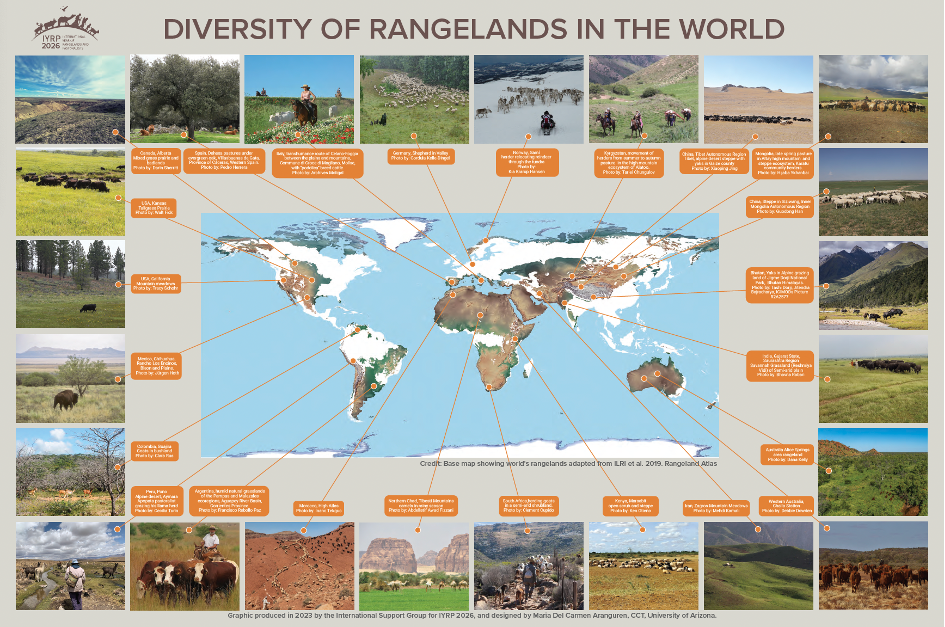
In the 2022 RWSN Webinar, Maryam Niamir-Fuller, then vice chair of the International Support Group for the IYRP2026, explained that “rangelands” is a term used for grasslands, shrublands, woodlands, tundra as well as cold or hot deserts that are grazed by domesticated or wild animals. I was surprised to learn that it is estimated that rangelands actually cover 54% of the earth’s land surface. It makes me wonder why I have heard so little about them? And further, rangelands exist beyond drylands. As Maryam gives you a taste for in her picture gallery (Figure 1), there is much diversity in rangelands. 

Figure 1 Picture gallery of rangelands (prepared by IYRP2026 Global Alliance)

It perturbed me to learn from Maryam that, although rangelands cover more than half of the earth’s land mass, they are the least known and valued ecosystem in the world. What also seems not to be widely known is that an estimated one billion people directly benefit from or have their livelihoods linked to rangelands. Further, another two million people benefit along the value chain, including processing products, gathering pharmaceuticals and making medicines. 

There are other nuggets of information that I would like to share with you. For example:

  • that pastoral milk and meat are very important sources of vital proteins that are not found in plants
  • that pastoral livestock has high genetic diversity – in stark contrast to livestock on monocultural farming and industrial systems
  • rangelands are extremely important for Planet Earth’s biodiversity

Maryam also explained that, while evidence is still emerging, research is showing that a well-managed pastoral system can be net carbon neutral or can ever sequester (store) carbon. That is something else that I would like to know more about on this journey. In summary, it seems that a lot is going on in rangelands, but this is not well known.

Let me move on to pastoral mobility (pun intended). As I mentioned above, this is not outmoded at all, despite prevailing attitudes. In the 2022 RWSN webinar, Maryam lucidly explained that mobility is a key factor in the stewardship of these ecosystems. Pastoralists have adapted to and managed natural variability through mobility of their animals. 

According to many studies, and as presented by Maryam Niamir-Fuller, one of the main reasons for rangeland degradation is because not all pastoralists are able to exercise their required mobility. Traditional movement routes have been blocked, and some rangelands have been converted to be used for cropping. The result is that animals are being confined into smaller and smaller spaces. Scientists are learning that the more the livestock keep moving, the less the degradation and the better are the chances for maintaining healthy rangelands.

Figure 2 The provisional 12 themes of the International Year of Rangelands and Pastoralism

These issues and others are recognised through the 12 themes of the International Year of Rangelands and Pastoralists (IYRP2026). The issue of water (and my own specialism) is directly included in two themes of the IYRP: 

  • Theme 3 looks at access to services and resources for pastoralists – advocating for safe and accessible water for pastoralists and their animals.
  • Theme 6 looks at water in the context of soils and land management – including waste management, the impact of droughts, aquifer recharge and watershed management.

However, water can be linked to all of the 12 themes of the IYRP – something that will be explored in the build-up to and during IYRP2026. The IYRP sets out to value the contribution of rangelands and pastoralists, break myths and influence informed, science-based policies throughout the world.

If you would like to find out more about IYRP2026, or even join the global or regional support groups or thematic working groups, check out this website or contact iyrp2026@gmail.com

Sources of information

RWSN (2022) Pastoralists and Water, Webinar, Rural Water Supply Network (RWSN).

IYRP LDN Working Group (2024) “Global Actions for Sustainable Rangelands and Pastoralism to achieve Land Degradation Neutrality: A Science-to-Policy Review with recommendations for the UNCCD Conference of Parties”.  https://iyrp.info/

[1] Director, Ask for Water Ltd, Edinburgh, Scotland

[2] Senior Advisor to IYRP2026 Global Alliance, based in USA

Pastoralists and Water 2 – Learning what is pastoralism

Dr Kerstin Danert, Ask for Water Ltd, Edinburgh, Scotland

In my first blog, I explained my discomfort around the stigma and attitudes towards pastoralists that I came across in my early working life, alongside my complete lack of understanding of how pastoralists function. With this (second) blog, let me try and share something of what I learned about pastoralism through reading and learning from the people I met through online communities since 2020 including that of IYRP2026 Global Alliance and the Food and Agriculture Organisation (FAO).

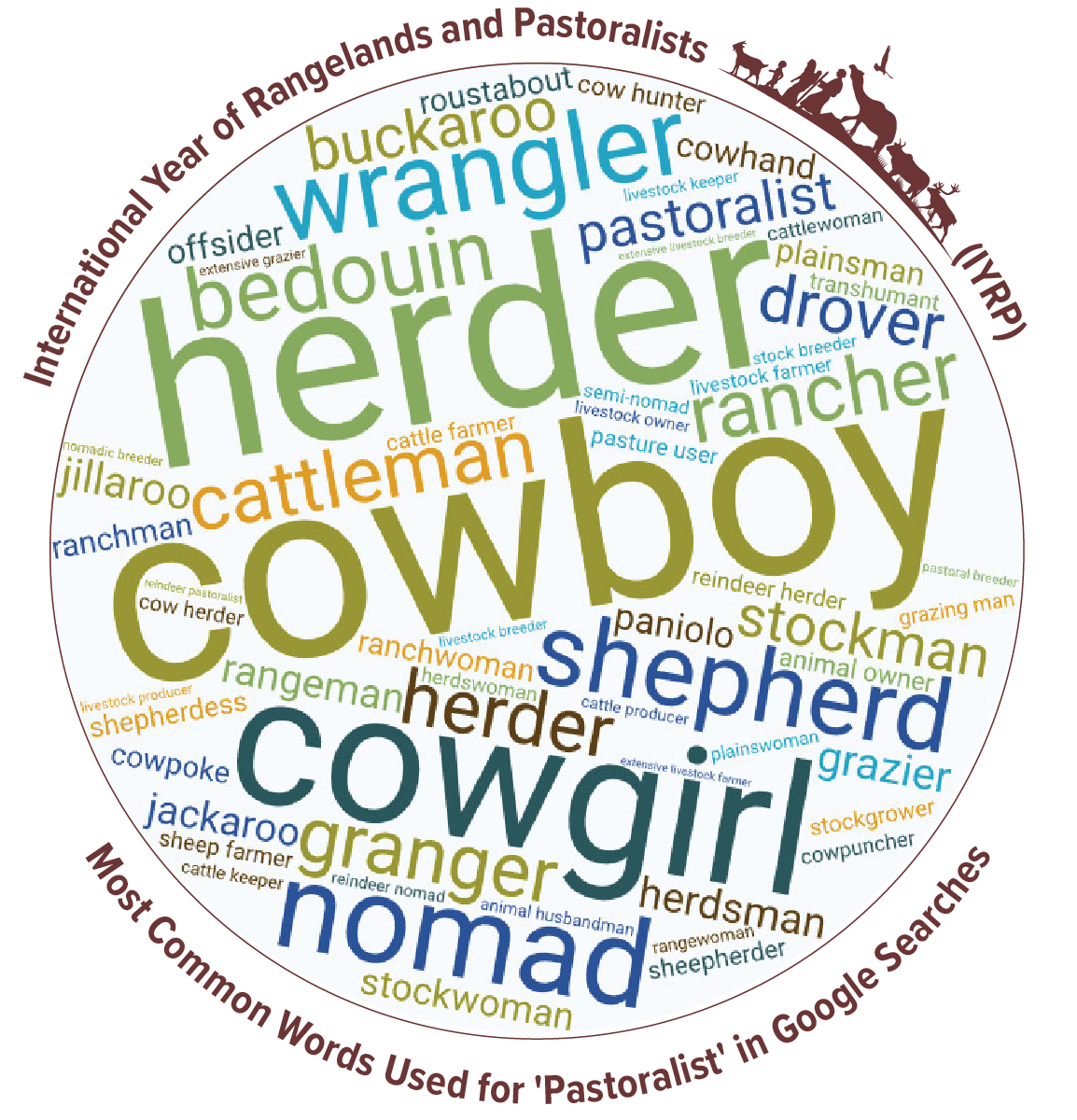
Pastoralism is an economic activity and a cultural identity. Pastoralists make a living by raising livestock or semi-domesticated animals on rangelands (a term which I shall come back to). In fact, “pastoralist” is really an umbrella terms covering many groups, as illustrated by the word cloud below (and this one is only in English!)

Figure (above): Terms for pastoralists (in English) (Link

In keeping with the diversity of names and contexts in which they live, pastoralists keep different kinds of livestock species on native and semi-native rangelands, including cows, buffalos, yaks, llamas, sheep, camels, goats, reindeer, horses and donkeys and even grazing ducks. I understand that pastoralism means that animals are herded, moved or rotated from grazing point to another grazing point at least some of the time, rather than being constantly penned or left by themselves. In short, the livestock move around, but the people may or may not move.

And now to rangelands. These are essentially the places where livestock graze and pastoralists live. Rangelands are areas where the indigenous vegetation is predominantly grasses, grass-like plants, forbs (was a new word for me) or shrubs that are grazed and browsed (which means livestock, such as camels eating shrubs and trees). Rangelands provide a natural ecosystem for raising grazing livestock and wildlife. In my next blog I will talk more about the extent of rangelands, and how they are being destroyed by conversion to cropland, which I suspect, will come as a surprise to you. But as a spoiler, rangelands cover at least 54% of the world’s land mass, and pastoralism exists in two thirds of the countries in the world! 

I mentioned cultural identity, and have learned that the term ethnic pastoralist can refer to people who come from ethnic groups that traditionally practised pastoralism but whose livelihoods are no longer derived from grazing livestock. The woman I got to know in Kampala (see Blog 1) may be among them, and I now realised that I should have asked her much more…

Pastoralists have different degrees of mobility, and can be sedentary. As an economic activity, pastoralism is an animal production system that is able to create livelihoods in highly variable environments. This point is key, and will remain a theme throughout my series of blogs. Mobile pastoral systems take advantage of environmental variability by managing grazing itineraries to improve livestock productivity as well as deal with pests and diseases and to avoid conflicts.

Further, pastoralism is a fundamental part of the global food system. One of the things that has struck me most, is that pastoralists actually produce food in the world’s harshest environments – in land that may have poor water supply or soil quality, face extreme temperatures, have steep slopes and or be remote. And it gets even more interesting when one realises that, by moving from one place to another, animals fertilise the soil with their dung and scatter seeds with their regular grazing and trampling. This has the effect of enhancing biodiversity and maintaining landscapes. I want to understand more here! 

And I am coming to realise that, despite the global significance of pastoralism and rangelands, pastoralists are under-recognised and undervalued. As I mentioned in my first blog, they can also be stigmatised. 

It seems that pastoralism is largely misunderstood, with pastoralists traditionally suffering from marginalisation and exclusion from dialogue. Pastoralists have been deeply affected by sedentary societies with poor understanding of the pastoral livelihood system have imposed alien social and governance schemes including attempts to settle pastoralists and create barriers to herd mobility or pastoralists’ access to public services. This is yet another area to learn more about. As with other marginalised groups, it is the voices of pastoralist communities themselves that need to be heard at local, national and international levels.

With more pastoralists gaining voice, and with a better understanding of pastoralism by those living with, studying and working with pastoralist communities, recognition of the value of pastoralism as well as the value of herd mobility is growing. But there is much to learn!

2026 will be the International Year of Rangelands and Pastoralists (IYRP2026). Over the coming months, I will continue to share my reflections and insights on Pastoralists and Water with you through a series of blogs. 

Sources of information

African Union (2010) Policy Framework for Pastoralism in Africa: Securing, Protecting and Improving the Lives, Livelihoods and Rights of Pastoralist Communities. Department of Rural Economy and Agriculture, African Union, Addis Ababa. 

Axweso F (2011) Understanding pastoralists and their water, sanitation and hygiene needs, Discussion Paper, WaterAid, Available at https://www.ircwash.org/sites/default/files/pastoralismintzdiscussion.pdf (accessed 28 Sept 2020)

CELEP and VSF (2020) For an International Year of Rangelands and Pastoralism [Online], Coalition of European Lobbies for Eastern African Pastoralism and Vétérinaires Sans Frontières (accessed 5 October 2020)

FAO (2020) Pastoralist Knowledge Hub [Online], Food and Agriculture Organization of the United Nations, http://www.fao.org/pastoralist-knowledge-hub/en/ (accessed 28 Sept 2020)

IFAD (2018) How to do, Engaging with pastoralists – a holistic development approach, International Fund for Agricultural Development, Rome, Available at https://www.ifad.org/en/web/knowledge/publication/asset/40318809 (accessed 5 October 2020)

IRC (2025) Pastoralism and Rangelands: People and Institutions a Glossary of Terms, International Rangeland Congress, https://www.iyrp.info/sites/default/files/2025-01/Glossary_pastoralism-rangelands_people-institutions-2024.pdf (accessed 27 Jan 2025)

IYRP (2019) A global call for a United National International Year of Rangelands and Pastoralists, Proposal for an International Year of Rangelands and Pastoralists Mongolia, International Year of Rangelands and Pastoralists, Available at https://globalrangelands.org/sites/globalrangelands.org/files/Mongolian%20Proposal_IYRP_updated_0.pdf (accessed 5 Oct 2020)

Mundy P (2020) Defining pastoralism and nomadic pastoralism, Email on https://dgroups.org/fao/pastoralist-hub/discussions, 2 October 2020,

Niamir-Fuller, M. ed. (1999). Managing Mobility in African Rangelands: The Legitimization of Transhumance. London: Intermediate Technology Publications, 1999. African Studies Review | Cambridge Core
https://www.cambridge.org/core/journals/african-studies-review/article/abs/maryam-niamirfuller-ed-managing-mobility-in-african-rangelands-the-legitimization-of-transhumance-london-intermediate-technology-publications-1999-xiv-314-bibliography-index-2995-paper/3570749A673ABF1AFE556A26002AFAE4

Jenet A. Buono N, Di Lello S, Gomarasca M, Heine C, Mason S, Nori M, Saavedra R, Van Troos K (2016) The path to greener pastures: Pastoralism, the backbone of the world’s drylands. Technical Report. Vétérinaires Sans Frontières International (VSF-International). Brussels, Belgium, Available at https://doi.org/10.13140/RG.2.2.11042.22725

Jonckheere S, Liversage H, Rota A (2017) Pastoralism and Land Tenure Security: Lessons from IFAD-supported projects, Paper prepared for presentation at the “2017 World Bank Conference on Land and Poverty”, The World Bank – Washington DC, March 20-24, 2017, Available at https://www.oicrf.org/documents/40950/43224/Pastoralism+and+land+tenure+security+Lessons+from+IFAD+supported+projects.pdf/e3b560d6-0bbc-3109-1c33-a5851e551b49?t=1510194133215 (accessed 28 Sept 2020)

Krätli S (2019) Pastoral Development Orientation Framework: Focus on Ethiopia, MISEREOR, Aachen; Available at https://www.researchgate.net/publication/336983785_Pastoral_Development_Orientation_Framework

Republic of Kenya (2012) Releasing Our Full Potential. Sessional Paper No. 8, National Policy for the Sustainable Development of Northern Kenya and other Arid Lands, Ministry of State for Development of Northern Kenya and Other Arid Lands, Nairobi. 

USAID (2017) Water Currents, September 19, 2017 – WASH and Pastoralists, United States Agency for International Development Water Team, Washington DC, Available at https://mailchi.mp/waterckm/water-currents-wash-and-pastoralists-september-19-2017?e=b631faae3e(accessed 28 Sept 2020).