New RWSN publication on EMAS Technologies in Bolivia

EMAS has been promoting low cost technologies for rural water supplies in Bolivia for over 30 years – with considerable success. EMAS technologies comprise manually drilled wells, a locally fabricated pump and rainwater harvesting technologies. EMAS are combining low-cost water supply solutions with a relatively high level of service at the household. Today RWSN publishes an independent assessment of the EMAS technologies. The authors, from the University of South Florida, undertook surveys, semi-structured interviews, sanitary inspections and functionality tests in 86 households.

Please visit http://www.rural-water-supply.net/fr/ressources/details/518 to download the publication.

EMAS is the Spanish acronym of the Mobile Water & Sanitation School in Bolivia.  An organisation established, and run by Wolfgang Buchner for over 30 years.  EMAS technologies are counted as contributing to the MDGs and SENSABA; the Bolivian national government agency responsible for rural water supply is a proponent of household water supply technologies in rural areas. Bolivia has a history of developing low-cost water supply technologies, particularly manual driller and handpumps. In fact, an estimated 20,000 manual drillers well systems are being used throughout the country.

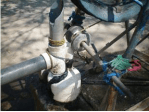
The flexi-pump is a simple design comprising PVC, glass play marbles and rubber, thus allowing it to me fabricated by local technicians. The fact that the pump can collect water from significant depths to a tank above the ground is a key selling point.  It is meant one to 6 families. The pump is reported to cost US$ 30 to 45 (excluding the drilling). As you start to ask questions about its longevity, the research found that only one of the pumps of the 79 surveyed was non-operational. It was noted that after 11 years of operation, some pumps were working less than optimally. Repairs can and are undertaken locally.  Some people prefer the Baptist pump due to its higher flow rates.

Manual drilling comprises a combination of techniques, and can be undertaken by trained technicians. Relatively small diameters are drilled, and a polyester sleeve/sock is used to prevent fine materials from entering the pump. The researchers observed that the techniques were widely used by small business, with Reyes as an example of a small rural town where most of the population has a manually drilled borehole in their yard. Here, the drillers charge US$ 140 for drilling and completing a 15m well, including the EMAS or a similar pump. Although EMAS promotes the installation of an apron, many wells observed did not have this installed. Of the 75 wells surveyed, 73 were reliable, providing water for 12 months of the year

EMAS rainwater harvesting systems comprise below-ground or above ground storage tanks. Various sizes up to 7,000 litres are promoted. The below ground tanks use a cement sand mortar mix, whereas the above ground tanks are ferro-cement. Uptake to date has been rather limited, although the technology is now catching on in Cachilaya after several years of promotion.

In terms of finance, 63% of the systems surveyed were paid for fully by the households; 5% sing loans and 28% with partial subsidies from an implementing agency or local government. There are places, such as Somopai where poor families apparently cannot afford the wells. However, this is a topic which could be explored and researched further; to understand the reasons and options for such families.  There are examples of labour exchange rather than cash payment for well construction.

EMAS has trained technicians from all over Bolivia in these technologies, and runs regular training courses, which can also be attended by people from overseas. EMAS has moved beyond Bolivia’s borders to other Central and Latin American countries, Africa and Asia. EMAS support typically consists of supporting in-country groups and organisations with training. However, technician training needs to be accompanied by promotion of the news technologies in order to bring about their adoption.

“Added value” is at the core of the EMAS concept.  This means that water users can have a much higher level of service than they would with a community supply.  Water is piped into taps in the house, and people can even have a shower and solar-heated water. How is this possible, you may ask? Well, the EMAS manual pump is able to lift water from below ground and up into an overhead tank, from which it can be distributed throughout the homestead. As people become accustomed to a high level of service, they are more likely to fix it when something breaks. The analogy with electricity supply is a good one – when you only use it for light you may just revert to a lantern when it stops working. However if the electricity is used also for a fridge, television and computer, which you are used to, you are more likely to value it and do something if the power fails. Not all households surveyed had chosen the added value option, but they have access to volumes of water within their homestead.

If you want to learn more about EMAS, please contact Wolfgang Buchner on: emasinternational@yahoo.es or visit http://www.emas-international.de/index.php?id=32&L=3

To learn more about the research, you can contact: Mike MacCarthy on mmaccarthy@mail.usf.edu

Should you wish to share your comments about the EMAS approach with other RWSN members, you can do so through the appropriate RWSN online discussion forum, e.g.:

Wishing you a productive and enjoyable weekend!

TAF to be tested on other technologies Rwenzori region

WASHTech update from Uganda

sekumapter's avatarWASHTech, THE project (2011-2013)

A comment from the recently concluded Hand Pump Mechanics Association Learning Visit to Rwenzori region indicated the need for the Technology Applicability Framework (TAF) to be tested on existing technologies in the region like the Manual drilling rig. This was  raised after a presentation made by NETWAS Uganda at the learning journey about the progress of the TAF. The suggestion was later lauded by HEWASA, a local NGO promoting manual drilling in Rwenzori who indicated that in order to scale up their technology, there was need for recommendations from the TAF.

The HPMA learning visit was organized to provide learning for the social, economic and technical transformation of the HPMAs functionality in Northern Uganda. And to be able to use the knowledge acquired to improve sustainability of water supply systems in the region. This gathering attracted 40 participants from regions of North, West and Central.

View original post

Still or sparkling? Lessons from a WASH holiday

Rural water challenges are not just an African issue…

Stef Smits's avatarwater services that last

I suspect that some of you, readers of this blog, are equal water nerds as I am, and that you also take your professional interest along on holiday. At least, I cannot resist visiting the odd water works or taking photographs of the local water and sanitation facilities during my holidays. This summer holiday I not only had the opportunity to take photos, but to live for a week the type of rural water situation, that I write about so much, but rarely experience in reality. As I spent my vacation on a family visit to my brother, who is managing a farm in the Moldovan rural village of Cuhureştii de Jos, I got some first-hand experience of the common problems around rural water supply and realized that some of the myths around it, are myths indeed.

View original post 775 more words

NETWAS Uganda to sensitize stakeholders on need to have sector specific Guidelines for Technology Introduction

Uganda WASHTech update

sekumapter's avatarWASHTech, THE project (2011-2013)

In Uganda the water and sanitation sector is not short of new and emerging technologies, however, there is no clear process of technology Introduction, adoption and upscale. Noticeable is Minimal contribution to the Millennium Development Goals. A key constraint to reaching the sector targets therefore appears to be the lack of systems to assess the potential of a technology and take it to scale effectively.

The Water Sanitation and Hygiene Technologies (WASHtech) project seeks to address the problem through research to assess the potential and sustainability of a wide range of technologies and design strategies for scaling up.

WASHtech has in the past 2 years conducted a stakeholder Knowledge Attitude and Practice (KAP) study aimed at assessing WASH technology introduction and approval process in Uganda, conducted a review of WASH technologies on their appropriateness and suitability.

Last year the project finalized the process of developing a robust Technology Assessment Framework…

View original post 120 more words

Providing drinking water is not enough to end poverty

by Francis Mujuni, World Vision Uganda

Francis Mujuni, World Vision, Uganda

In his blog post, Henk Holtslag highlighted that muitple use of water is very critical in ending poverty. I have already shown in my earlier discussions that provision of safe drinking water is not enough. In the developing countries where agriculture employs the bulk of the poor people, availability of water for families, their animals and crops is very essential. When we talk of “provision” the quick question is by who? Self supply then becomes the ideal solution. But how many of our governments, Communities and development agencies are promoting this concept? Do they know much about it? Do they know it exist and it is very feasible?

Continue reading “Providing drinking water is not enough to end poverty”

WASHTech at the IRC symposium in Addis Ababa

WASHTech presentation at Monitoring Symposium

dietvorst's avatarWASHTech, THE project (2011-2013)

With two presentations and a pre-launch side event, WASHTech was well represented at the IRC Monitoring Sustainable WASH Service Delivery symposium. The symposium and side events took place from 9-12 April 2013 in Addis Ababa, Ethiopia.

Introducing the TAF

André Olschewski (Skat) and Benedict Tuffuor (TREND Ghana) gave a general introduction to the Technology Applicability Framework (TAF) in a special session on the enabling environment. The session included a presentation on another tool, the Sustainability Monitoring Framework developed by the Dutch WASH Alliance.

Both presentations prompted a discussion about the number and variability of sustainability and how all these tools fit together. The presenters stressed that both tools fit in wider thinking around sustainability in the sector. Even though the tools are being developed in parallel, they both attempt to simplify the analysis of complex, variable data.

View original post 541 more words

Understanding the Technology Assessment Framework (TAF)

Update on WASHtech

awumbei's avatarWASHTech, THE project (2011-2013)

“Let’s invite WASHTECH to apply the TAF tool on this Household Water Treatment and Storage (HWTS) technology, the communities choices system, to determine whether it needs to be scaled up”. This came up at the 26th edition of the National Learning Alliance Platform meeting, which recently took place in Accra on theme, Household Water Treatment and Storage Strategy in Ghana.

Members of the WASHTech learning alliance at the meeting had to respond by further explaining and updating stakeholders on the project and the TAF. Abu Wumbei of the WASHTech Ghana team explained that the TAF was indeed a tool that could be used to assess the said HWTS technology, but that the tool was currently being tested on some selected technologies; and that these will enable the fine-tuning of the tool to suit the local situation and context. Thereafter, according to him, the tool will be in full operation; owned…

View original post 308 more words

Assessing the potential of solar powered pumping for domestic water supply in Uganda

Update from Uganda on testing the Technology Applicability Framework (TAF) as part of the WASHtech project

sekumapter's avatarWASHTech, THE project (2011-2013)

In Kanungu district of south western Uganda, the Technology Applicability Framework  (TAF) work was used to assess the potential of solar powered water pumping in the country.The exercise involved representatives from the Ministry of Water and Environment, Technical Support Units (TSUs),Kanungu district local governments, local NGOs, research institutions, private sector enterprises and beneficially communities. The assessment was based on the following dimension: social acceptance of the technology in the community, environmental dimension, and affordability of the technology by community members, skills and knowhow.

Solar powered pumping for domestic supply has great potential in Uganda if the following issues are adequately addressed:

  • Scheme operators and beneficially communities should provide adequate security measures to protect solar panels from theft. In addition, communities using solar water powered pumps and bore holes should be able to access loans from banks or financial institutions for replacement of highly expensive scheme components in the event of…

View original post 126 more words

Rural water supply for all, forever: Can Nicaragua become an example?

by H. Holtslag  J. de Jongh

Of the 780 million people worldwide without an improved water source some 80% live in rural areas. In sub-Saharan countries some 35% of the rural water points are not functioning. A country with a remarkable and sustainable increase in rural water supply is Nicaragua. This country has 6 million people of which some 43% live in rural areas. With development aid an innovative low cost hand pump was introduced in 1987.  By 1995 this pump became an integral part of rural water programmes of NGOs and government agencies. Rural water supply coverage between 1987 and 1995 doubled from approximately 27.5% to 54.8%. Of this  27.3%, rope pumps account for 23.6% (85% of the total increase). *

Now, 25 years later the situation is:

  1. Over 70.000 rope pumps on boreholes and hand dug wells. Cost /pump 70-150 US$
  2. Besides handpowered also pedal, horse, engine and wind powered models developed
  3. Some 10 workshops produce the pumps and another 8 outlets sell the pump
  4. 10 to 20% of the pumps are used for communal supply, the rest for self supply
  5. Even pumps that are given away in general remain working
  6. The scaling up is also thanks to the government who made it a national standard pump
  7. Most pumps are funded by Government or NGOs, some 30% is paid by private families
  8. Over 90% of the all pumps are working (Evaluation of IRC) ** This high % is explained by its repairability. (Simplicity, Low cost, decentralised production, spares available )
  9. The maintenance consist of replacement of the rope and pistons and oiling bushings
  10. The shift from imported piston pumps like Indian Mark 2 to locally produced rope pumps increased the rural water supply 3 x faster than countries without the ropepump
  11. The number of imported piston pumps has reduced to less than 2% of all hand pumps
  12. The rope pump is now by far the most used technology for rural water supply
  13. In some areas families now get piped systems or get electricity and buy an electric pump but most families will still use the rope pump for cattle watering or irrigation
  14. A market for 200.000 more handpumps (study Water & Sanitation Program, Worldbank)
  15. Even 8.000 $ boreholes of 70 meters deep are equipped with 140 $ rope pumps!
  16. All this goes on since 1998 without any NGO or external advisors involved
  17. A study of effects of water for rural families (5015 families studied) concluded

– a well increases incomes of small farmers with 30%

– a rope pump on that well increases again average incomes with $220/year **

The total investment in these pumps was USD1 million in training etc and some USD8million in pumps. The result is an increase of the GNP of USD100 million since 1990 due to family rope pumps.  There is much to improve on both pump quality and installation and some workshops make bad pumps but the pumps work and generate income for producers and users. The development in the rural area is notable and rope pumps are a step on the water ladder.

Nicaragua is an example that, where water levels are less than 50 meters and low cost wells can be made,  the rural water supply can increase drastically at investment costs of 5 to 15US$/capita.   What is possible in Nicaragua seems possible in many other countries.

References

* Alberts, H. 2004 The rope pump: An example of technology transfer. Waterlines 22(3), 22–25.

* Alberts. H.,Zee. J van der (No date). A multi sectoral approach to sustainable rural water supply in Nicaragua: The role of the rope handpump. Available on www.ropepump.com. www.ropepumps.org

** IRC 1995 Nicaraguan experiences with rope pump. http://www.washdoc.info/docsearch/title/113703

*** Zee. J.v.d Field study involving 5025 families in Nicaragua, CESADE/ICCO

Publication “Smart Water Solutions” of Netherlands Water Partnership. Other booklets in the Smart serie on

Sanitation, Water harvesting Hygiene, Finance and Disinfection www.akvo.org , www.irc.org or www.nwp.nl

Update from the WASHtech project

dietvorst's avatarWASHTech, THE project (2011-2013)

Sustainable WASH services can only be achieved if the technology used to provide services is sound enough for the specific context. Too often, however, water and sanitation services stop because the WASH technology no longer functions or is too complicated for the context which it’s in. New WASH technologies are promising successful solutions but are often not considered.

WASHTech, an action-research project, is developing and testing processes and tools to perform context-specific validations of potential WASH technologies. WASHTech also aims to successfully introduce the validated technologies into certain contexts such as countries, districts, or sub-districts.

Come and be part of this pre-launch on Friday 12 April 2013 from 09:30 – 11:00 hrs and learn how the “Technology Applicability Framework” and the “Technology Introduction Process” can help you achieve sustainable WASH services.

Register for this session here

View original post