Tracing a path to sustainable rural water services in the Democratic Republic of the Congo

by Gian Melloni, Maria Livia De Rubeis, and  Kristina Nilsson of the DRC WASH Consortium 

In 2013, the idea of rural communities paying for water services was relatively new in DRC: there was a belief in the WASH sector that this context was too fragile for community management of WASH services to be possible.Yet with extremely low access rates, a fast-growing population, and especially poor functionality of water infrastructure, something needed to change.

When the DRC WASH Consortium started that same year, there was no past experience in the country which could confirm rural communities’ willingness or ability to pay for water. The DRC WASH Consortium’s ambitions were high: five INGOs launching a six year programme to support local communities in managing and financially sustaining WASH services in rural DRC. Funded by UK-aid, the DRC WASH Consortium gathered the know-how of lead agency Concern Worldwide with ACF, ACTED, CRS, and Solidarités International to work with more than 600 rural communities and 640,000 people across seven provinces.

Five years later, with a wealth of project data at our disposal, we wanted to answer some key questions: To what extent do Consortium-assisted rural communities succeed in managing their water services in a financially self-sufficient way? And what makes a community successful?

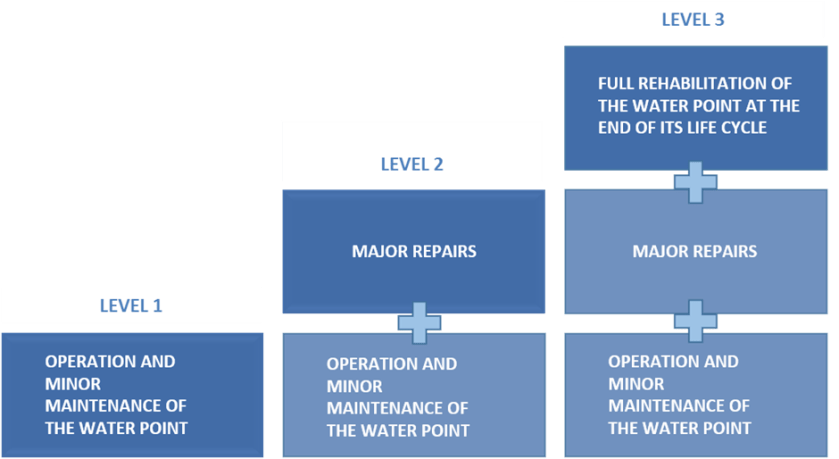
The DRC WASH Consortium developed a methodology inspired by IRC’s Life-Cycle Costs, which we call the “Economic Approach”. We support communities in developing managerial, financial and technical skills to keep their WASH infrastructure functioning long after construction, identifying three progressive levels of success in covering the costs associated with water points over time:

Figure 1 DRC
Figure 1. The three Levels used by the DRC WASH Consortium

The objective is that communities raise sufficient funds to cover Level 1 costs as a minimum, with the most committed communities reaching Levels 2 and 3. These funds are collected and managed by elected committees, trained by the DRC WASH Consortium. To lay the foundations for this success and to avoid expectations of handouts, we’ve said from the start: we will support communities by installing water points only if they prove their commitment and ability to take care of water point management costs afterwards.

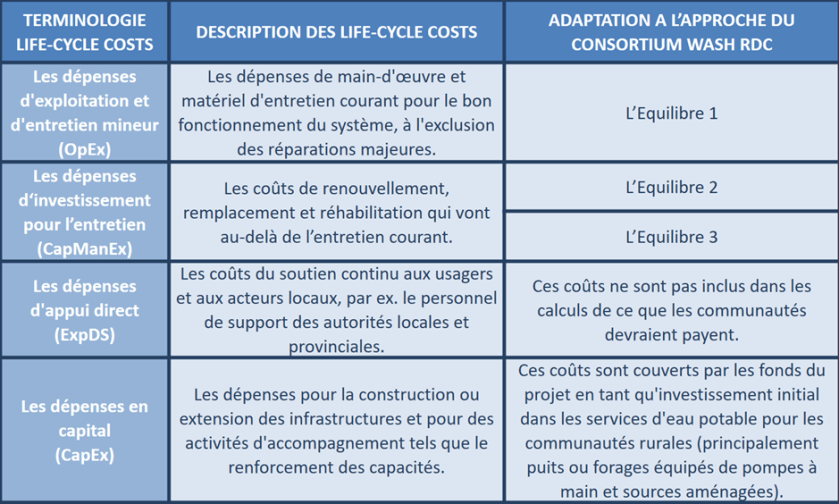
Our three Economic Approach Levels do not exactly match with the Life-Cycle Costs categories, and some modifications have been made according to the context in rural DRC. Here you can see an approximate conversion table showing how the DRC WASH Consortium adapted these principles:

Figure 2 DRC
Figure 2. Adaptation of the Life-cycle costs by the DRC WASH Consortium.

And does this Economic Approach work? After five years, our program data shows it can, even in this difficult context: so far, about two thirds of the small rural communities assisted by the DRC WASH Consortium have succeeded in achieving a degree of financial self-sufficiency and sustainability –that is to say, have reached at least Level 1. Given the challenges these communities (typically of only around 1,000 people) in this fragile environment face, this is an encouraging provisional result.

We’ve identified some operational models which support WASH committees in reaching these Levels. Committees that have chosen diversified revenue streams, combining household collections with revenue-generating activities, are markedly more successful than committees relying only on collections. This approach is often welcomed by communities who see investments in revenue-generating activities as a means to protect finances against misappropriations. Overall, revenue-generating activities seem to fit well with community management of WASH services in rural DRC.

In such a fragile context, most communities choose to identify people or groups who may be particularly vulnerable and offer them exemptions from paying community water fees. Communities who do so are no less successful in reaching the Levels of financial self-sufficiency than communities who do not offer exemptions. This is an important finding particularly in light of pro-poor and needs-based principles of development, underlining that aiming for equitable access isn’t at odds with the practice of paying for water or the goal of sustainable services.

Communities opting to remunerate some water management committee members also seem to improve their success in reaching higher Levels of financial self-sufficiency. For example, some communities pay a minimal amount to someone who keeps records of water users or who collects payments. While so far a minority of communities have opted for these remuneration systems, their success in reaching especially Levels 2 and 3 suggests some form of semi-professionalised management can be more effective than pure volunteerism.

Overall, this shows that development actors even in difficult contexts can and should design WASH interventions to focus on longer-term services, looking beyond just immediate achievements. It shows policy-makers can embrace water service payments by users even while balancing financial viability of services with pro-poor and inclusive policies. We have learned through the DRC WASH Consortium that rural communities in DRC are willing to invest to overcome challenges and can develop the capacities to manage water services in a sustainable manner. This doesn’t come easily or by chance, but through carefully designed and implemented programming which empowers local communities.


Feature photo: A WASH management committee in Manono, Tanganyika province, DRC, looks at the financial records they keep to monitor costs and revenues for managing their community water point. Source: DRC WASH Consortium, 2016


The DRC WASH Consortium is a programme of Concern Worldwide in consortium with ACF, ACTED, CRS, and Solidarités International, and funded by UK-aid. More information – in both French and English – can be found at consortiumwashrdc.net. Gian Melloni is the Director of the DRC WASH Consortium and can be reached at gian.melloni (at) concern.net. Maria Livia De Rubeis is the Communication, Advocacy and Learning Manager. Kristina Nilsson is the Monitoring and Evaluation Manager. The views expressed by the authors may not reflect the views of Concern Worldwide or of any of the organisations mentioned.

Achieving Professional and Sustainable Drilling in Madagascar? Yes, we can!

Guest blog by Charles Serele, UNICEF Madagascar

As part of its Water, Sanitation and Hygiene (WASH) program in Madagascar, UNICEF is committed to supporting the Ministry of Water, Sanitation and Hygiene (MWSH) to build the capacity of the drilling sector. With this in mind, UNICEF organized a training on “Drilling Techniques and Supervision” in collaboration with the MWSH. The training targeted various stakeholders in the water sector, including government departments, drilling companies and consultancy firms who manage water supply projects, supervise or drill boreholes.

The training was held in Antananarivo (Madagascar) and organized in three different sessions of three days each, from February 7th to 23th, 2018. Fifty-four participants, including fifteen women attended the training course. The training was facilitated by Charles Serele, an experienced WASH Specialist from UNICEF Madagascar.

madagascar

To enhance individual knowledge and ensure sharing of experiences among participants, the overall approach used to deliver the course involved a mixture of lectures, interactive discussions, group exercises and presentation of drilling videos. Extensive reading materials from RWSN and UNICEF were shared along with exercises to be carried out by the participants.

The course participants actively engaged in the discussions and group activities. The training provided an opportunity to learn from each other and to reflect on what can be improved.

Course Modules

1.      Professionalization of the drilling sector

2.      Methods of borehole siting

3.      Construction of boreholes

4.      Supervision of boreholes

5.      Management of drilling data

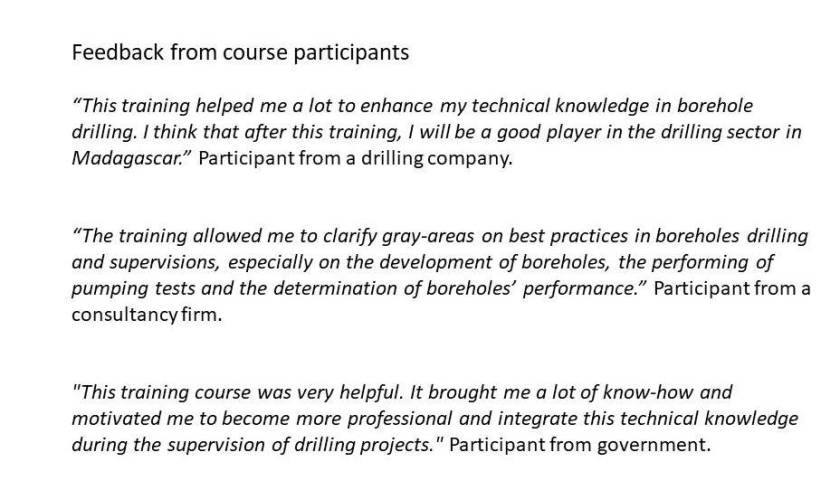
The course review showed that participants’ technical knowledge in borehole drilling and supervision greatly improved. Participants also expressed their satisfaction with the course content and the relevance of the topics that were covered.

Forty-five participants (83%), including fourteen women passed the evaluation test conducted on the last day of the training. During the official closing ceremony each successful participant received a poster on cost-effective boreholes, in addition to a certificate.

As a next step, a field-based training should be organized to better illustrate best practices in drilling professional and sustainable boreholes.

Feedback2

madagascar2

Additional resources


The training course was facilitated by Charles Serele, UNICEF Madagascar and organized under the supervision of the Chief of WASH, Silvia Gaya and with the support of the UNICEF WASH team. For additional information, contact UNICEF Madagascar on antananarivo@unicef.org.


UN-Water report: SDG6 on Water and Sanitation will not be achieved by 2030 at current rates of progress

UN-Water has released a new report on Water and Sanitation ahead of the High-level Political Forum for Sustanainable Development (HLPF) which presents, for each target, the latest data available for the Sustainable Development Goal (SDG) 6 global indicators. The report seeks to inform discussions among Member States during the HLPF (9 July -18 July 2018) in New York. The HLPF Forum will review progress especially on G6, G7, G11, G12, G15 and G17; you can see the Official Programme here.

The key message of this report is that the world will miss the SDG6 targets by 2030 at current rates of progress. It also highlights that only 50 percent of countries have comparable baseline estimates for most SDG 6 global indicators, making it difficult to track progress. It is essential to “harmonize methods and standards”, and establish a common understanding of how to assess Means of Implementation (MoI) across SDG 6. In addition to this report, UN-Water has also set up a webpage with examples of countries sharing their experiences.

RWSN had provided some comments on the draft report which was made available by UN-Water earlier this year. By and large these comments still hold – you can find out about what we said here and our take on how the report addresses sustainability of services, accountability, self-supply, capacity development, water and energy, groundwater and public participation.

So, what does the final report say? It compiles data and information available on the SDG6 Targets, including:

  • Target 6.1: Achieve access  to  safe  and  affordable  drinking  water: There are still 844 million people who lack access to basic water services, and 2.1 billion people who lack water that is accessible, available when needed and free from contamination. The report highlights that extending access to safe drinking water for all is a “huge challenge” that will not be achieved if there is no increase in “investment from governments and other sources” and a “strengthening in institutional arrangements” for managing and regulating drinking water.
  • Target 6.2: Achieve access to sanitation and hygiene and end open defecation: There are still 2.3 billion people who lack access to basic sanitation services, and 4.5 billion people who lack safely managed sanitation services. Only 27 per cent of the population in least developed countries has access to soap and water for handwashing. Extending universal access to sanitation and hygiene won’t be achieved if there is not an increase in “investment and a strengthening of the capacity of local and national authorities” for managing and regulating sanitation systems.
  • Target 6.3: Improve water quality, wastewater treatment and safe reuse: Freshwater pollution is prevalent and increasing in many parts of Latin America, Africa and Asia. The lack of water quality monitoring in many parts of the world does not allow for an exact global estimate of water pollution.
  • Target 6.4: Increase water-use efficiency and ensure freshwater supplies: Nowadays more than 2 billion people live in countries experiencing high water stress. The agriculture sector is the largest user of freshwater; it uses 70 per cent of global water withdrawals. In the report, some techniques to save water have been presented like “increasing productivity of food crops”, “improving water management practices and technologies”, “growing fewer water intensive crops in water scarce regions”, “reducing food loss and waste”, and “importing food grown from water rich countries”.
  • Target 6.5: Implement integrated   water   resources   management   (IWRM)   including    transboundary    cooperation: While all countries have at least started implementing various aspects of IWRM, only modest progress has been made in terms of implementing a fully integrated approach. The average national proportion of transboundary basins covered by an operational arrangement is only 59 per cent.
  • Target 6.6: Protect and restore water-related ecosystems: current baseline data of the indicator “do not allow for a proper picture of the state of freshwater ecosystems”, which is why further detailed data including “quantitative, geospatial and qualitative” data are necessary.

The report also looks at the targets related to the means of implementation of SDG6:

  • Target 6.a: Expand international cooperation and capacity-building: 80 per cent of Member States have insufficient finance to meet national WASH targets. The current indicator based on ODA (Official Development Assistance) does not reflect all elements of the target. That is why it is necessary to complement with additional information relating to “capacity development, human resources and other elements”.
  • Target 6.b: Support stakeholder participation: In order to empower marginalized groups and sustainable service delivery, “local communities have to participate in water and sanitation management”. But even if the current indicator monitors the existence of policies and procedures for local community participation, it does not show if “the participation is genuine or meaningful”. This links to the recent report published by our partners End Water Poverty,  Coalition Eau, Watershed Empowering Citizens Consortium, the Water Supply and Sanitation Collaborative Council (WSSCC) and with the support of Sanitation and Water for All (SWA), on accountability mechanisms for SDG6, and which was the focus of a recent RWSN webinar in English and Spanish.

In conclusion, the UN-Water report focuses on the enablers of the SDG6, highlighting that:

  • “Inequalities must be eliminated”. It is important to have data in order to identify disadvantage and provide services to groups like women, children, poor, indigenous people and rural communities.  You can find some recent RWSN webinars on Making Water Work for Women, and Making Rights Real for rural communities here.
  • “Private financing, promoting blended finance and microfinance” should be developed in order to optimize domestic and public finance. You can see a recent RWSN webinar on “grown up” finance for rural water here.

Photo credit: World Bank

Favouring Progress: Yemen’s Water Scarcity Dilemma of the 21st Century

Our RWSN Guest blogger Muna Omar takes a critical look at the issue of dwindling water supply in Yemen’s capital city

The population of Sana’a, the capital city of Yemen, depend on deep wells that are usually dug to a maximum depth of 200 meters for their drinking water. The wells draw on a cretaceous sandstone aquifer northeast and northwest of the city, with a third of the wells operated by the state-owned Sana’a Local Corporation for Water Supply and Sanitation drilled to 800 to 1,100 meters. The combined output the corporation’s wells barely meet 35% of needs of Sana’a growing population which includes displaced people, asylum seekers, refugees and other newcomers.

Public piped water delivery is once every 40 days to some houses, while others don’t receive piped water at all. Sana’a’s population is thus supplied either by small, privately owned networks, hundreds of mobile tankers and water from people’s own private wells. As water quality has degenerated, privately owned kiosks that use a water filtration method to purify poor-quality groundwater have spread in Sana’a and other towns. Many people rely on costly water that is provided by private wells supplying tankers. These tankers don’t really consider appropriate cleaning, so the quality of the water is questionable.

Despite the challenges with pumping due to a shortage of fuel and with rising prices, private well owners are trying to capture the remains of the valuable groundwater resources before their neighbours do. Coupled with the on-going war, drought sees Yemen facing a major water crisis. Water table data is based on old research which can be challenging to verify now. Given the data and the current severe situation as water use exceeds aquifer recharge, it is estimated that the water table drops by approximately 2-6 feet annually.

Although Sana’s groundwater is probably the best water in Yemen, it is considered below acceptable standards for human consumption as water infrastructure has been damaged by warplanes and the sanitation workers went on strike because they didn’t get their salary. The latter left plenty of garbage on the streets that led to contamination of drinking water supplies. Meanwhile wastewater began to leak out into irrigation canals and contaminate drinking water supplies. Inadequate attention to groundwater pollution has directly affected the quality of Sana’a’s drinking water supplies.

It Yemen, as a whole, it is estimated that about 14.5 million people don’t have sustainable access to clean drinking water. Inadequate water supply has affected the country with the worst outbreak of cholera in the human history. Over 1 million suspected cases of cholera have been reported in Yemen from 27 April 2017 to present day. Other water-borne diseases include a recent peak in diphtheria that reached 1,795 probable cases with 93 Associated Deaths and a case fatality rate (CFR) of 5.2% by 19 May 2018.

Yemen’s water problem is not only immediate with groundwater resources under pressure as never before to meet not only drinking water needs, but also demands for irrigation. In Yemen, the pressures of climate change, demographic change and the on-going conflict place an immense burden on professionals working in the country. The enormity of the urgent needs mean that water resources management is neglected, despite being absolutely essential for the future of Yemen’s population.

Sana’a groundwater resources are significantly depleted in many areas and acknowledged globally as one of the world’s scarcest water supplies. Sana’a may be the first capital city in the world to run out of water. Looking forwards, how can the country produce more food, raise farmer incomes and meet increase water demands if there is less water available?

Clearly, there are several interrelated aspects contributing to the current water crisis in Sana’a specifically and Yemen in general, and the population has to innovate to find solutions. Future supply options include pumping desalinated water from the Red Sea over a distance of 250 km, over 2,700 meter-high mountains into the capital, itself located at an altitude of 2,200 meters. However, the feasibly of this is questionable with the enormous pumping cost would push the price of water up to $10 per cubic meter. Other options to supply Sana’a from adjacent regions are fraught due to water rights.

Groundwater data is the critical foundation for water managers to both prevent problems and formulate solutions. Data is lacking in many of Yemen’s groundwater basins. Even heavily used basins have no record of how much groundwater was withdrawn and remains in the aquifers, where it was pumped from? Nor are adequate data available on groundwater quality or aquifer characteristics. Furthermore, while the drought and other cutbacks on surface water supplies are motivating groundwater users to drill new or deeper wells in increasing numbers despite the fact that well owners don’t know how their aquifer is doing and so can’t anticipate changes. There is lack of data on private wells.

Lack of groundwater data in Yemen is not the result of ignorance about its importance, but is rather the victim of chronic underfunding and politics, which have been exacerbated by the on-going conflict. The war has made it almost impossible to measure and manage groundwater development and secure its long-term sustainability.

Having just completed the online course on “Professional drilling management” led by Skat Foundation, UNICEF, and the United Nations Development Programme Cap-Net, I have learned about the need to develop our knowledge in this regard. The course highlighted important immediate and long-term actions for Yemen:

  • Raise awareness within Yemen of the groundwater issues faced by the country.
  • Find practical ways to better understand groundwater, regulate its extraction, introduce control mechanisms and engage with the local population to develop effective actions.
  • Build capacity of government, NGOs, consultants, policy makers and beneficiaries through training in groundwater management.
  • Invest in building rain-water harvesting facilities in rural areas so the people don’t have to walk miles to collect water.
  • Invest in re-building infrastructure alongside improving water resources management.

Muna Omar is an Ethiopian refugee and a young water professional, living and working in Sana’a, undertaking monitoring and evaluation of humanitarian programmes in the water, sanitation and hygiene (WASH), health and nutrition sectors such as a cholera-response project, and an executive assistant with a local NGO.

This article was first published in GeoDrilling International and is reproduced with permission and thanks.

Why does accountability matter for sustainable water services?

By Louisa Gosling, WaterAid and Meleesa Naughton, RWSN Secretariat

RWSN has been exploring the question of accountability for sustainable rural water services over the past few months through an e-discussion, a workshop, and webinars in French, English, and Spanish.

What is accountability?

Accountability is a new topic for the Leave no one behind Theme of RWSN, and one that is difficult to translate in other languages: there is no direct translation of accountability in French and Spanish, for instance – we translated it as ‘responsibility’.  In the e-discussion, we initially defined social accountability as ‘an approach that refers to the extent and capacity of citizens to hold the state and service providers accountable, and make them responsive to needs of citizens and beneficiaries’. But through the e-discussion and in particular the webinar, we also heard of initiatives that seek to empower citizens to hold not only service providers (direct accountability) and governments (indirect accountability) for water services, but also donors.

So who should be held accountable for what?

The definition proposed by Catarina Fonseca of IRC, who presented some preliminary findings from a recent study during one of the RWSN webinars, is perhaps more appropriate: she defined accountability as ‘those who are responsible, accept responsibility for their actions and omissions and accept that they are called upon to give an account of why and how they have acted or failed to act.’

While accountability is often a bottom-up process in practice, with citizens and citizens’ organisations seeking to hold  service providers, governments and donors to account, duty-bearers also have an obligation to put in place effective accountability mechanisms that lead to actionable change. The study Catarina presented showed that accountability mechanisms for SDG6 for service providers and governments are often not available in many countries, and that when they exist, they are not effective and not systematic due to the lack of financing, lack of monitoring data and reporting, and limited participation of civil society organisations.

What about donors’ accountability? According to Susan Davis from Improve International, most foundations do not prioritize evaluation of WASH projects post-implementations, which impedes learning and improving accountability for the end-users. Moreover, when they do conduct evaluations, they may not share the results – or have no incentive to share results showing poor performance of WASH services. Susan proposed a WASH donor accountability scorecard which would foster a culture of accountability and transparency through virtuous competition amongst donors to disclose the results of evaluations.

The e-discussion and the webinars highlight a range of different aspects of accountability. It is encouraging to see that this topic is gaining a higher profile in the water sector. Other recent discussions include a thinkshop on social accountability in the water sector recently held in Tanzania, and the recent expert consultation for the upcoming report by the UN Special Rapporteur for the Human Rights to Water and Sanitation. Greater understanding and application of this principle are essential for achieving SDG 6.

Resources

Photo credit: Simone D. McCourtie / World Bank  


Why getting ‘water affordability’ right matters – and how water diaries can be of help

re-posted from REACH

Dr Sonia Hoque, University of Oxford

Having access to 24/7 potable piped water in the comfort of our dwelling is a luxury that many of us take for granted. In the UK, an annual water and sewerage bill of £400 accounts for about 1% of the annual average household income of £40,000. This ‘safely managed’ water service, defined as having access to an improved source within one’s premises, is well within the widely established global affordability threshold of 3-5% of one’s household income. Estimating payments for water as a percentage of households monthly expenditures may adequately reflect ‘affordability’ in contexts where households have connections to piped water systems or rely on paid sources only.

Continue reading “Why getting ‘water affordability’ right matters – and how water diaries can be of help”

Voyage of groundwater discovery

The first ‘Professional Management of Water Well Drilling Projects and Programmes’ online course, provided by Unicef, Skat Foundation and Cap-Net kicked off in early March 2018.

Running over six weeks, the new online course provides participants with an overview of what is required to improve borehole drilling professionalism in the countries in which they work.

Requiring about six hours of investment per week, plus an additional four for the final assignment, it provides a 40-hour training opportunity for people from all over the world – and they can take part without leaving their home or workplace.

The application process was open for a month, and we received 648 applications spanning 381 organisations and 96 countries. We were astounded by the level of interest. Unfortunately, we could only accept 85 participants, a mere 13% of those who applied, our limitation being funding for sufficient, good facilitation. And so over the past weeks we have been interacting with the participants who work in 35 organisations in 43 countries, of whom 33% are women.

We provide extensive reading material and videos for each module, and the participants engage with the topics through their weekly assignments, participation in online discussion forums and a weekly quiz. For example, they have been tasked with looking at the drilling supervision practices in their own organisations, to prepare a hydrogeological desk study and to reflect on regulatory policies and practices in the countries in which they work.

I was sceptical about online courses until I undertook my first one three years ago. This time, as a facilitator, I’ve witnessed that this course provides an opportunity for people who are already managing drilling projects and programmes to improve their skills and knowledge from far and wide.

So what are we learning every day from the participants? For example, that drilling data is not shared because of fear that the information may be used for gaining the upper hand in mining minerals in one country. Or about the rapidly falling groundwater levels in Sanaa, Yemen, threatening the agriculture and domestic water supplies of the future. And we’ve found out about nuances in the way in which corruption affects the regulation of drilling professionalism in different contexts. Through the course, innovative approaches are also being revealed, such as new regulations in a number of countries, efforts to improve procurement procedures in Nigeria, or post-construction monitoring of water supply systems through private management combining mixed farming and water supply systems in northern Madagascar.

 ourse modules Course modules


Integral to the course is that it provides an opportunity for participants to learn from each other, reflect on what can be improved and to debate contentious topics – a key one being who should pay for the cost of drilling a dry borehole? The final assignment in the course involves sharing what has been learned more widely and trying to inspire others to improve borehole drilling management practices. Once the course is complete, all of the materials are accessible through the Cap-Net virtual campus (www.cap-net.org).

So what next, you may ask? Firstly, we shall learn from this first course and make improvements. We would then like to run the course again later in the year, repeat it in the future and also make it available in other languages, starting with French. We know that there is demand. With the structure and materials now developed and online, future courses will be less costly than developing and running the first one. But we need to assure the cost of good facilitation. So if anyone would like to sponsor a course, say as part of corporate social responsibility (CSR), either fully or partially, please contact us at foundation@skat.ch.


Kerstin Danert works for Skat Foundation and Skat Consulting in St. Gallen, Switzerland, and leads the Rural Water Supply Network’s (RWSN) theme on Sustainable Groundwater Development. In 2017 she was awarded the Distinguished Associate Award by the International Association of Hydrogeologists.

This article was first published in GeoDrilling International and is reproduced with permission and thanks.

Responding to UN-Water SDG6 synthesis on water and sanitation

by Sean Furey, Skat Foundation/RWSN Secretariat Director

UN Water, the body that coordinates water issues across the United Nations, is currently running a consultation in its draft report: “SDG 6 Synthesis Report 2018 on Water and Sanitation”. You can read the report and add give your feedback. Below are some comments that I have posted in the dialogue section:

Continue reading “Responding to UN-Water SDG6 synthesis on water and sanitation”

Three common myths about solar-powered water pumping

By Andrew Armstrong (Water Mission), RWSN co-lead for Sustainable Groundwater Development

Solar pumping is the trendiest technology in rural water supply today. Policy-makers and practitioners are eager to better understand its benefits and limitations and the private sector is responding with a variety of product offerings. Much of this interest is motivated by the Sustainable Development Goal to increase water service levels in the most remote areas. A more compelling driver is that rural water users are willing to pay for service that is accessible near or within their homes. There is currently no more promising technology for meeting these expectations in off-grid settings than solar pumping. Despite this high interest and the fact that solar pumping technology has been around for decades, a great deal of misinformation is being propagated.

This post aims to address a few of the most common misconceptions.

Myth #1: Solar pumping is too complicated and not appropriate for remote, rural settings

The most common barrier to adoption of solar pumping is misunderstanding of its complexity and applicability. The technology is often avoided because of perceived technical and management challenges, which are in fact common to any rural water supply system. In reality, the design and installation processes associated with solar pumping are no more complicated than other motorized pumping schemes. Operation and maintenance is more straightforward than with handpumps and generator powered schemes which, as indicated in recent evaluations published by UNICEF and the Global Solar and Water Initiative, likely leads to higher functionality and reliability rates.

Solar pumps are applicable across the same head and flow profiles as grid- and generator-powered pumps, and most solar pumping equipment available today is essentially “plug and play”. External power backup for periods of low sunlight are rarely necessary if water demand is estimated and storage is sized appropriately. In addition, current off-the-shelf computer software tools simplify equipment selection and automatically consider daily and seasonal weather and solar irradiation fluctuations when estimating water outputs.

The high capital cost of solar pumping equipment often brings its large-scale applicability into question. However, the life-cycle cost benefits of solar pumping are well documented and are within and on the lower end  of IRC’s WASHCost benchmark ranges for piped schemes and boreholes fitted with handpumps. There is no fuel cost associated with solar pumps, and the cost of maintaining power generation equipment is greatly reduced because solar modules have no moving parts and long functional lifespans. Furthermore, the cost of solar modules, which represent the most expensive element of a solar pumping scheme, continues to decrease at a rapid rate.

graph1
Click here to read about the advantages of solar pumps compared to alternative technologies commonly utilized in remote, rural settings.

Myth #2: All solar powered water pumping equipment is created equal

Equipment manufacturers have taken advantage of demand and have flooded the market with solar pumping products of all varieties and price tags. Unfortunately, many are of poor quality and likely to fail in a fraction of the lifespan of higher priced, higher quality equipment. Low-quality products seldom come with warranties covering the first few years of operation during which failures are most likely to occur. Uninformed customers often fall into the trap of choosing cheaper equipment without considering that low-quality equipment fails quicker and costs more to maintain in the long-term. This results in solar pumping schemes which were expected to function for years failing and being abandoned after a few months in operation. The best way to guard against this is to stick with brands that have a proven track record for durability and reliability, even if it costs more up-front. It is also important to verify that products adhere to internationally-recognized certification and testing standards.

Another related challenge is that imitation spare parts for major brands are easier to find than authentic ones. Logos and barcodes can be forged such that it becomes difficult to detect if a part is counterfeit. This issue can be resolved by sourcing products from trusted dealers with good technical support capacity. The private sector can also have a positive influence on product quality. By providing local dealers with exclusive access to advanced training and support networks, major manufacturers can incentivize sales of quality equipment. In fact, some solar pumping suppliers such as Bluezone Malawi  are choosing to base their business model solely on high-quality products.

Myth #3: Scaling-up solar powered water pumping will lead to widescale depletion of groundwater aquifers

There is concern that solar pumps, because they can operate automatically whenever the sun shines, could pose a long-term threat to groundwater resources. It is true that exploitation of groundwater paired with low or misunderstood aquifer recharge can lead to potentially irreversible depletion, and there is a deficiency of good hydrogeological data in countries where the most interest is being placed on solar pumping. However, abstraction technology is just one of many factors that influence aquifer sustainability and solar pumping should not be devalued because of potential risks which can be mitigated. It is also important to note that the risk of groundwater depletion due to over abstraction with solar pumps depends on the application. Domestic supply withdrawals, in comparison to agriculture and protracted emergency applications, are likely to have negligible impacts.

Below are some actions that can be taken to mitigate the risk of groundwater depletion:

  • Proper borehole development and pump sizing to safe yield – Ensures solar pumps are physically incapable of depleting aquifers. A good resource for this is the RWSN/UNICEF Guidance Note on Professional Water Well Drilling. Simple control measures such as float valves and switches can also be employed to prevent wasting.
  • Better groundwater monitoring alerts authorities to potential risk areas. Many countries successfully employ remote monitoring systems (see, for example, the USGS’s National Groundwater Monitoring Network. Read more here.
  • Water pricing in the form of tariff collections and abstraction charges enables sustainable and equitable allocation of groundwater resources, but requires sound management built on transparency and accountability. Prepaid water metering technologies may also play a role.

Further resources

Resources are available to equip rural water professionals with knowledge and skills and stop the spread of misinformation about solar pumping. Of note:

In order to generate rich discussion and continue raising awareness of existing resources around solar pumping, the RWSN Sustainable Groundwater Development theme will host a three-week e-discussion from 28 May to 15 June 2018. For more information or to participate in the e-discussion, join the RWSN Sustainable Groundwater Development DGroup.

(Photo credits: Water Mission)


RWSN members’ inputs on social accountability are helping Human Rights Special Rapporteur report to UN General Assembly

RWSN Secretariat Director, Sean Furey, took part in a consultation meeting on accountability in relation to Human Rights to Water and Sanitation.

by Sean Furey, Skat/RWSN Secretariat

What does ‘accountability’ mean to you? When it comes to the Human Rights to Water and Sanitation what progress has been made to ensure that Duty Bearers (Governments) are accountable to their Rights Holders (Citizens)?

Such legalistic sounding terms can seem distant from the needs of family in rural Mongolia or fast-growing city in India, but the Human Rights to Water and Sanitation form the legal back-bone to which signatory governments (which is nearly all of them) have to comply.

Léo Heller, the UN Special Rapporteur of the Human Rights to Water & Sanitation, has been running an open consultation on his forthcoming report to the UN General Assembly, which is focusing on the principle of accountability. I was honoured to be invited to attend a meeting in Geneva on 14 & 15 May on behalf of RWSN.

Like his predecessor, Catarina de Albuquerque , Prof. Heller has been collaborating with the network to engage with rural water supply practitioners so that he can communicate the global issues to those working on national and local implementation and policy, and likewise learn from the those who working to making Human Rights a reality at a practical level. This included the recent e-discussion on Social Accountability.

In his draft report, Prof. Heller drew points from this discussion, particularly regarding the accountability of non-governmental organisations:

“Participants [of the RWSN e-discussion] discussed that accountability is enhanced when reducing dependence on external funds, and through ensuring meaningful participation of citizens in all process relating to water, sanitation and hygiene processes.”

The principle of accountability as a core human rights principle does not have a set and agreed definition. The three dimensions that were used to frame the discussion were:

  1. “Responsibility” which means “what” Duty Bearers are accountable for; “who” carries out the duties; and “how” those WASH service responsibilities are done.
  2. “Answerability” is need for public officials to communicate what they are doing and why and how decisions have been taken. This is important because governments, as the Duty Bearers, are required to demonstrate the “progressive realisation”, which means maximising available resources to ensure universal access to safe water, sanitation and hygiene.
  3. “Enforceability” is about making sure that there are the mechanisms in place to ensure that rules and laws are enforced, and that there is a fair and accessible means for complaints and conflict resolution.

A lot of the discussion focused on factors and barriers to effective accountability, such as corruption and the lack of protection for whistle-blowers. It was also highlighted that civil society, and civil society organisations (CSOs), have a vital role to play in holding governments to account – not least where responsibility has been delegated to private sector service providers, community management or self-supply.

In the wide-ranging discussion it was clearer that there are lots of threats to accountability, not least because it involves changing power dynamics, which will be resisted by those in power. Defining clear roles and responsibilities is critical for accountability, which is why those are who are to be held accountable have an interest to keep such things vague.

“The fight for Human Rights is against human wrongs”

For rural water supply – as for rural issues generally in low and middle-income countries – a key problem is that formal legal processes and agencies, such as courts and lawyers, are often physically distant, expensive and not trusted. So where does that leave traditional social or religious mechanisms for conflict resolution? Do those working to extend a rights based approach work with these structures (at the risk of entrenching existing discrimination) or try to extend legal and judicial mechanisms?

What is clear is that these issues around accountability, rights and justice are not unique or special for rural water supply, or even for WASH, so it was great that in this meeting we had representatives from outside the sector, who highlighted, for example, the strong links between the Human Rights for Water and Sanitation with other Rights, including housing, food and dignity.

To keep up to date with this discussion and for opportunities to submit your ideas and experiences, follow Léo on Twitter.

20180515_122720 (2)
UN Special Rapporteur, Léo Heller (centre) with representatives from WASH and human rights organisations and networks (including RWSN, SIWI, Water Integrity Network, KEWASNET, End Water Poverty, Coalition Eau and WSSCC)

To find out more have a look at these RWSN resources:

E-discussion synthesis & publications:

Webinar Recordings: