
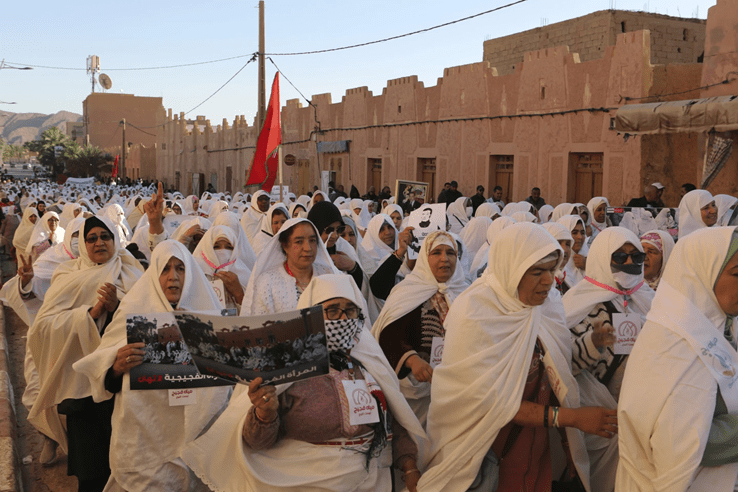
Featured photo: March 2024, Women in Figuig, Eastern Morocco marching during the biweekly protests against water privatisation. Source AP News.
Blog by Euphresia Luseka, co-lead of the RWSN Leave No-one Behind theme.
As the waves of time crash upon the shore of progress, a mighty force is rising. These waves carry the strength of female leaders, revolutionising the Water Sanitation and Hygiene (WASH) sector. To mark another milestone in the pursuit of a sustainable future, the upcoming United Nations World Water Development Report (UN WWDR 2026), will shine a spotlight on a critical yet oft-overlooked aspect of the global water crisis: the inextricable link between gender and water, illuminating a path towards a more sustainable and equitable future. UNWWDR 2026 is not merely an echo of problems, but an inspiring melody of change, empowerment, and sustainable future.
It is not just about women being disproportionately affected by lack of safe WASH access and representation in its management, but it is also about recognising the power of women as managers and catalysts for change in the WASH sector. From the pioneers in Indonesia like Retno Marsudi, UN 1st Special Envoy on Water, the indigenous Mexican women water stewards using ancient techniques passing them down to generations to preserve water in the drought-prone Oaxaca region to the relentless Figuig women of Morocco who marched in protest for several months to amplify water rights voices against water privatization and the ‘humming bird’ Nobel laureate Wangari Maathai from my country Kenya, on water catchment protection efforts, all serve as a powerful reminder that one person can create waves of change.
Water and Economic Poverty: How the Global Water Crisis Disproportionately Affects Women
The global water crisis is a crisis of inequalities disproportionately affecting women.
As we celebrate these and more trailblazing women in water leaders, the world inches closer to the 2030 deadline for achieving the Sustainable Development Goals (SDGs) with women still left behind. The United Nations’ Global Analysis and Assessment of Sanitation and Drinking Water (GLAAS) 2019 report reveals that a staggering 78% of countries have incorporated specific policies or strategies to promote gender equality in water and sanitation. On the other hand, the International Decade for Action (2018-2028) calls to address gender disparities in WASH access.
Alongside the progress, we also confront persistent gaps. Gaps that threaten to undermine our hard-won achievements, forming a path that recognizes the interconnected nature of WASH-related challenges and the need for inclusive solutions.
Terms like sex and gender may seem straightforward but their nuances hold profound implications for how we perceive and address WASH and gender issues. UNICEF defines Sex as the biological and physical differences between women and men while Gender as socially constructed differences in attributes and opportunities associated with being a woman, man, girl, or boy and to the social interactions and relations between women and men. Woman refers to biological females according to UNOHCR. In my view this affirms the gap in the context of WASH statistics where WASH data is often disaggregated by sex, but rarely disaggregated by gender.
Imagine a world where the simple act of accessing safe WASH does not dictate one’s ability to attend school, earn an income, or live a life free from danger. A world where our mothers, sisters, and daughters are not disproportionately burdened with the responsibility of fetching water, but are empowered managers and change agents in WASH initiatives. For more than two billion people around the globe, particularly women and girls, this is a distant reality. The latest stark metrics reveal a concerning reality: despite progress, millions of women and girls worldwide still lack access to safe WASH services, hindering their empowerment, health, and economic opportunities. This world, although still a distant reality, is one we must strive for, beginning with a deep understanding of the water-gender nexus.
Women are 2.5 times more likely to be responsible for water collection, yet they hold only 17% of the paid jobs in the water sector as confirmed by a Women for Water Partnerships Report. UN Women adds another layer of concern revealing that in 2022 a quarter of women globally lacked access to safely managed drinking water, and two-fifths lacked access to secure sanitation.
The gendered impact of inadequate WASH access is not just a reflection of biological differences, but a manifestation of socially constructed disparities. It serves as a stark reminder that water is not just a women’s issue – it’s a human issue and Graph 1 below illustrates these realities.

UN Water’s dictum concurs and aptly captures that “Water is a human right, not a privilege,” this blog series embodies a bold commitment to upholding the rights of all.
The upcoming UN WWDR for 2026, aims to bridge this chasm by placing gender equity at the heart of WASH management and sustainability discussions. It stands as a pivotal blueprint for understanding the critical nexus between water and gender, presenting an urgent call to action for policymakers, practitioners, and stakeholders dedicated to fostering an inclusive, equitable, and water-secure world. By weaving together, a rich narrative of data, case studies, and expert insights, the report shall transcend mere enumeration of challenges to celebrate the resilience and ingenuity of women who are at the forefront of change within the WASH sector. It shall compellingly argue that embedding gender equality and social inclusion into water policy and practice is not just a moral imperative but a pragmatic necessity for achieving all SDGs especially SDG 5 and 6. Statistical evidence revealing the extensive failures of undervaluing women’s expertise in WASH management will be juxtaposed with success stories of women-led interventions that have illuminated pathways towards peace, prosperity, and sustainability. As the report critically examines the barriers that women and girls face in accessing safe WASH, it shall highlight the detrimental impacts of gender disparities in decision-making roles, pushing the narrative beyond mere awareness to active transformation. With a focus on fostering gender-responsive approaches in the WASH sector, the UN WWDR 2026 shall serve not only as a repository of insightful analysis but as a clarion call for disruptive change, intended to inspire dialogue and galvanize global commitment towards a future where equitable access to safe WASH is a universal reality.
 Rural Water Supply Network - blog