New paper: O&M and the Finance Gap for Drinking Water Services

There is a multibillion-dollar finance gap slowing progress towards universal drinking water services. Focusing on how governments are investing to address this gap, a new open access research article examines the different elements that contribute to this gap, and argues that the funds needed for operations & maintenance (O&M) of services should be considered differently from the funds needed for infrastructure. With the functionality and sustainability issues the sector faces, these differences are worth paying attention to.

This research suggests a framework of five strategies for bridging, shrinking, and filling the finance gap for drinking water services, based on how the funds available from tariffs, taxes, and transfers compare to the life-cycle costs of services.
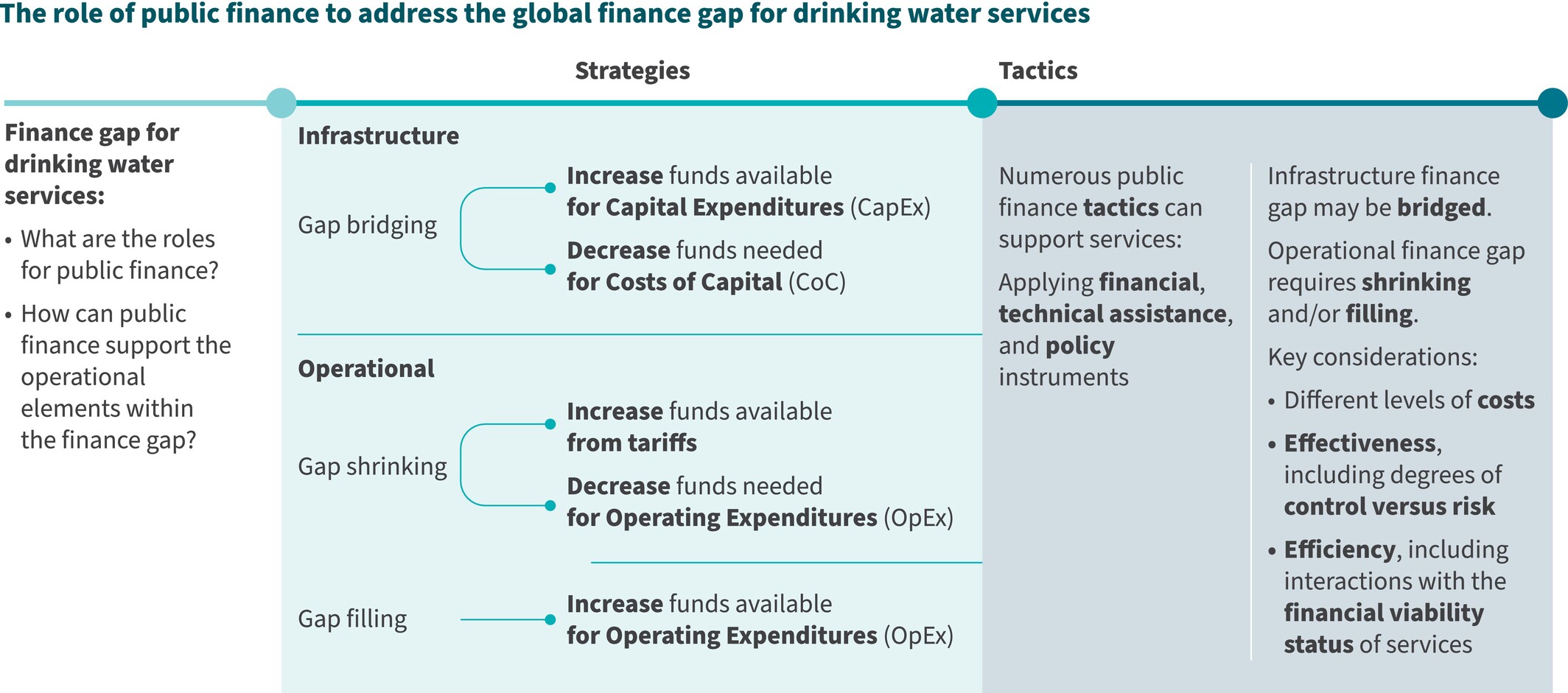
A framework for bridging, shrinking, and filling the finance gap for drinking water services (Nilsson, 2025)

Do we need a new framework?

Maybe, yes! Approaches for targeting gaps in infrastructure finance have been well studied, with many frameworks already available to guide actions and suggest new funding sources and mechanisms. However, the parts of the finance gap related to operational needs has been less analysed, even though there is an increasing need for operational finance.

The water sector continues to struggle with the financial sustainability of drinking water services. Most repayable finance sources are not suitable for operational costs, and so it falls to governments and service providers to see how to balance ongoing costs and revenues. This framework shows that, after construction, there are fairly limited options: increase tariffs, cut costs, and/or set up subsidies.

How can the operational finance gap be addressed, to keep water services flowing?

This research studied 213 examples of government investments for drinking water services, from 68 countries, to see how public finance is being used to address the operational finance gap. It found 13 tactics being used by governments from around the world, using financial, technical assistance, and/or policies, to:

  • increase funds available from tariffs, and/or
  • decrease funds needed for operations & maintenance, and/or
  • increase funds available for operations & maintenance through subsidies.

These tactics, and their investment requirements, are presented here: 
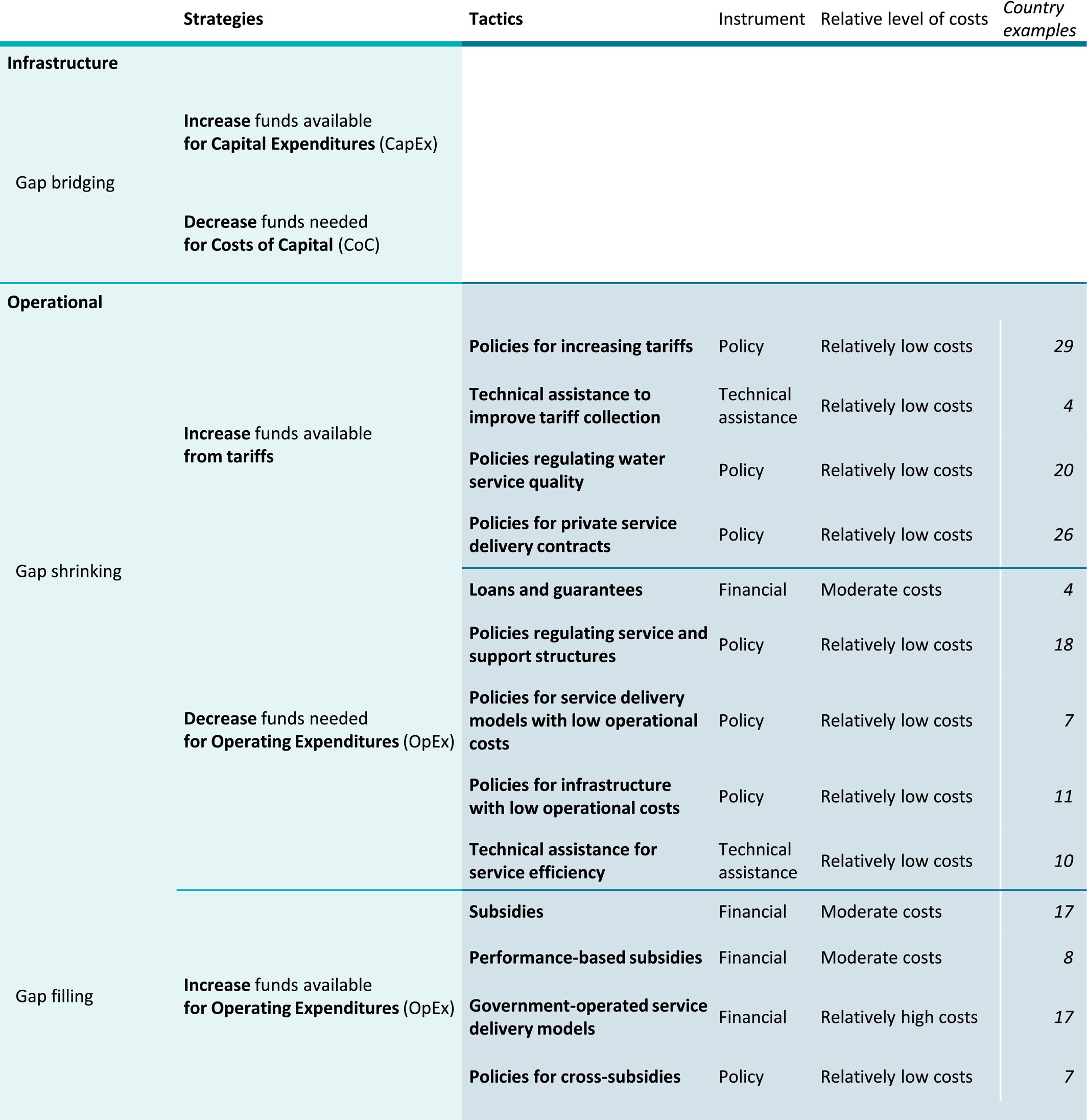
Public finance tactics to support operations of drinking water services (Nilsson, 2025)

This framework could help to better understand and compare tactics for addressing the finance gap for drinking water services. To read more about this study, you can access the full article here: The Role of Public Finance to Address the Global Finance Gap for Drinking Water Services.

What do you think?

  • Which tactics are being applied in your areas, by governments, or by other sector actors? Which are not?
  • Are the tactics being used achieving what is needed, supporting services for more people, and services which are more financially sustainable?
  • Are there other tactics being used that are not captured here?

About the author: Kristina Nilsson is a governance and development professional with over a decade of experience working on water and sanitation service delivery in Africa and Asia. She is currently a PhD student at the University of Oxford, researching public finance support for rural drinking water services.
Functionality of water supply handpumps in Cameroon (Central Africa): a review of data from 310 councils

Handpumps have revolutionized access to safe and reliable water supplies in Sub-Saharan African countries, particularly in rural areas. They constitute a healthy and viable alternative solution when surface water is contaminated. Danert (2022) estimates that 200 million people in sub-Saharan depend on 700,000 handpumps to supply themselves with drinking water.

Unfortunately, many handpumps service face performance issues or premature failure due to technical or installation defects in the borehole or pump, operational and maintenance weaknesses, or financial constraints (World Bank, 2024). Statistics on the functionality of handpumps in Cameroon are very sparse and dispersed with very little data available. However, some studies show that 25% to 32% of handpumps in Cameroon are inoperative (RWSN, 2009; Foster et al., 2019).

Previous reviews of handpumps functionality data in Cameroon have been conducted, including RWSN (2009) and Foster et al. (2019). However, these estimations were based on partial data and thus may not reflect the situation in the country as a whole. In addition, the number of handpumps installed each year is constantly increasing, and there is a need to update functionality data. Thus the interest of the study.

The methodological approach used in this study was based on online searches. To do so, we searched, collected, and analyzed relevant data from the 310 Councils Development Plan (CDP) that had been collected from 2010 to 2022. Information sources included data sets and documents available online through the data portals of the National Community-Driven Development Program (PNDP).

Overall, based on the data analysed, the number of handpumps used as the main source of drinking water supply in Cameroon is 20,572, of which 9,113 are installed in modern wells and 11,459 in boreholes. Approximately 8.2 million people in Cameroon rely on a handpump for their main drinking water supply, which is equivalent to 36.8% of the population of Cameroon. Findings indicates that one in three handpumps in Cameroon is non-functional, which in 2022 was roughly equivalent to 6,724 inoperative water points. To put this in perspective, this number is about 33% of the total number of handpumps, enough to supply 2.7 million people, assuming 400 inhabitants per handpumps. According to this estimate, it is about 44.8 billion CFA francs, or 66.8 million USD, was invested in the construction of water points that are immobilized and do not generate any benefit (improved health, nutrition, or education).

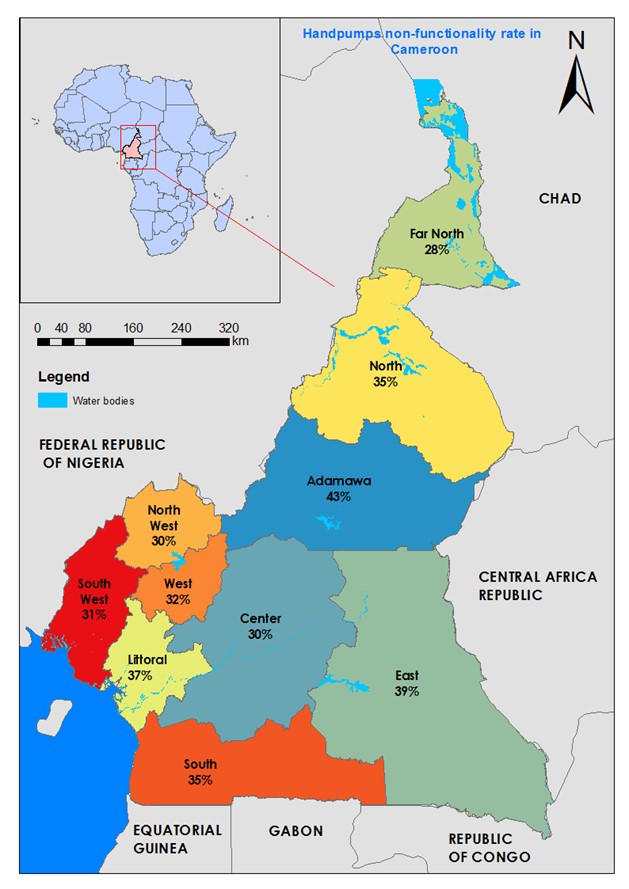
Figure 1 presents estimations of non-functionality in the ten regions of Cameroon. This figure shows that the region that had the highest level of non-functional handpumps is the Adamawa region (43%), followed by the East region (39%), the Littoral (37%), the North (35%), the South (35%), the West (32%), the South West (31%), the Center (30%), the North West (30%), and the Far North (28%).

Figure 1 | Handpump functionality rate for Cameroon

The handpumps, like the Community Based Management, seem not to have given the expected results. The fact that some handpumps fail prematurely seems to indicate that technical defects (poor quality components and rapid corrosion) contribute to handpump failure and underperformance. Further, this review notes that questions related to the quality of handpump material and the corrosion of handpumps have not been sufficiently taken into account in the various research studies in Cameroon and Sub-Saharan Africa. Thus, Future research should focus on physical audits of handpumps, and handpump rehabilitation campaigns in order to shed light on these issues. Finally, preventing rapid corrosion of handpumps through regulations should be implemented in order to improve the performance of handpumps. Regulations may be implemented at the national, regional, or local levels, and it is advised to employ a pH threshold of less than 6.5 as a corrosion risk indication. Once they are more precisely defined, additional risk factors such as salinity, chloride, and sulphate levels can be added.

About the author:

Victor Dang Mvongo, MSc is a PhD Student at the University of Dschang (Cameroon) and an independent consultant in WASH. He conducted the work featured in this blog at the Faculty of Agronomy and Agricultural Sciences.

Further reading:

Mvongo D.V, Defo C (2024) Functionality of water supply handpumps in Cameroon (Central Africa). Journal of water, sanitation and Hygiene for development. https://doi.org/10.2166/washdev.2024.085

References:

Danert, K. (2022) Halte aux dégradations Rapport I : Fiabilité, fonctionnalité et défaillance technique des pompes à motricité humaine. Recherche-action sur la corrosion et la qualité des composants des pompes à motricité humaine en Afrique subsaharienne. Ask for Water GmbH, Skat Foundation et RWSN, St Gallen, Suisse.

Foster, T., Furey, S., Banks, B. & Willets, J. 2019 Functionality of handpump water supplies: a review of data from sub-Saharan Africa and the Asia-Pacific region. International Journal of Water Resources Development 36 (5): 855–69. https://doi.org/10.1080/07900627.2018.1543117

RWSN 2009 Handpump data, selected countries in sub-Saharan Africa. RWSN, St Gallen, Suisse. https://www.ruralwater-supply.net/_ressources/documents/default/203.pdf