Pastoralists and Water 5 – A brief introduction to green water

by Dr Kerstin Danert (1), Dr Klas Sandström(2), Dr Aida Bargués Tobella (3) , Dr Malin Lundberg Ingemarsson (4), Chris Magero (5) and Adrian Cullis (6)

In support of the International Year of Rangelands and Pastoralists (IYRP 2026) this is the fifth blog on Pastoralists and Water published through RWSN. We are going to provide you with a brief introduction to green water – a subject that is important when considering rangelands, pastoralism and pastoralists in many parts of the world (some may even argue everywhere). Before we move on, in case you have missed any of the other blogs on this topic, you can reach them here

Some of us were given an opportunity to reflect and write on green water as members of the team preparing the 2023 Somalia Economic Update, entitled ‘Integrating Climate Change with Somalia’s Development: The Case for Water’ while others are researching this topic. In this blog, we don’t intend to summarise the report, which is in the public domain, but rather we want to help you understand, and perhaps think more about green water. 

So, let’s get started – what on earth is green water? And why is it important? Ok, we shall get there via the term blue water.

Blue water

For many of us working on water supplies, water services, or irrigation, we make a living through the provision, or advice in relation to blue water. Blue water refers to the water that you see in rivers, lakes and dams, or that is abstracted from aquifers (groundwater). Blue water is what you see being used in irrigated agriculture or what livestock and humans drink. Generally, small amounts of blue water are required for Water, Sanitation and Hygiene (WASH) needs and to water livestock. In contrast, irrigated agriculture (as well as some industry) uses larger quantities of blue water. Further, downstream users often benefit from upstream (blue water) runoff – which is not always aligned with the interests of the upstream communities!

Green water

In contrast, green water is water in soil. It accumulates there from rainfall (or other forms of precipitation) and subsequent infiltration. You can feel (and see) green water in how it makes soil damp or wet. Green water will either evaporate, be consumed by plants through the process of transpiration, or may percolate to recharge groundwater. Green water is what rainfed agriculture and rainfed ecosystems rely on. Pastoralists raise domesticated grazing animals – cattle, camelids, equines, sheep, goats, yaks, reindeer, pigs and even a variety of poultry (chickens, ducks and others). Rangeland vegetation, including grass, forbes, trees and shrubs, which are essential for this pastoral livestock all depend on green water

Whether we are already familiar with the terms blue and green water or not, these definitions may not sound particularly exciting, but let’s continue. They link to a key aspect of many water scarce areas of the globe and how food and water security can improve.  

Healthy soils: The key to green water replenishment

Water at the soil surface enters through a process called infiltration. Healthy soils have good physical, chemical and biological properties and therefore can absorb more water: they have what is known as a higher infiltration capacity. 

In contrast, soil degradation results in surface compaction, crusting and sealing, which means less water can enter the soil, leading instead to surface runoff and an increased potential for erosion. This can also lead to agricultural, pastoral  or ecological droughts: a deficiency of soil water that is not necessarily linked to a deficiency of rainfall (meteorological drought) but mostly to a poor soil health and infiltration capacity also known as hydrological functioning. It rains, but much of this rain never becomes essential green water.

Erosion in West Pokot, Kenya (Source: Aida Bargués-Tobella)

However, agricultural, pastoral and ecological drought can actually be arrested and reversed through sustainable rangeland management and restoration. In other words, the replenishment of green water can be enhanced through practices that improve soil structure and through vegetative and structural measures that collect surface runoff and enable it to infiltrate. Half moons and a wide range of other rainwater harvesting structures are examples. More soil water supports plant growth, which in turn improves soil structure, enhances infiltration rates and results in improved hydrological functioning. 

Half moons in Turkana, Kenya (Source: Aida Bargués-Tobella)
What about evaporation?

As we learned in the water cycle, water moves from the atmosphere to the ground, from mountains to the sea, across land, along rivers, underground and through pipes. These are flows that we can observe or measure.

Transpiration and evaporation return some precipitation to the atmosphere. Transpiration is linked to plant growth, but evaporation, which is vast and invisible arguably remains largely overlooked and is poorly managed. Locally, transpiration contributes to the production of food, fuel, and fodder. In contrast, evaporation does not contribute locally, bit will rather condense and become rainfall (or snow, hail, sleet or fog) elsewhere. Evaporation is very important, because on a farmer’s field or in a small catchment, much of the rainfall that reaches the ground can evaporate. 

Reducing evaporation and harnessing more rainfall for productive transpiration may not be easy, but well-established knowledge about it does exist. Effective land management will capture rainwater, promote infiltration, reduce evaporation, thus providing more green water, which still returns to the atmosphere as plant transpiration. That lead us to our next point.

Rangeland management – the key to more water for food, fuel, fodder and services

Rangeland management controls two critical hydrological processes – infiltration and evaporation. It also controls the extent that rainfall is converted into green water and hence is available for transpiration (i.e. for food, fuel and fodder).  

When landscapes and watersheds are better managed, they more effectively catch rainfall, reduce and control runoff, and enable water to infiltrate the soil. This enables soil to absorb more rainfall and increase levels of green water, contributing to the productivity of grasses, shrubs, trees and crops and reducing evaporation. More green water can support more livestock, crops and forests with reduced ecological damage, ultimately contributing to healthier communities and stronger local economies.

Why does green water matter for blue water?

Better rangeland management, including using rainfall in upstream areas and promoting rainfed agriculture (including pastoral livestock), generates and harnesses more green water.  This can enable savings to be made on blue water, which can therefore be used more productively for domestic use, watering livestock and even for high-value (export) crops.

A planetary boundary for freshwater that includes green water
Let’s put green water in a larger context. In 2009, Johan Rockström and Stockholm Resilience Centre published the Planetary Boundaries (PBs) concept, presenting a set of nine planetary boundaries which are essential for present and future humanity to develop and thrive. One of the original boundaries is “freshwater use”. In 2022, they published a study on a planetary boundary for green water in which they explain how green water links the freshwater boundary to other planetary boundaries such as land use, biodiversity and climate. Based on global changes to soil moisture, the study concludes that the green water planetary boundary has already been transgressed – highlighting the urgency in giving more attention to this aspect within the hydrological cycle.

The earlier mentioned 2023 Somalia Economic Update report is not only relevant for Somalia, but for other dryland countries whose economic and human well-being depends on how their water resources are managed. We argue that a critical entry point in such contexts is recognising the role of evaporation—the often overlooked, invisible flow of water, which could be better harnessed to support food and water security, and which is closely linked to both green and blue water resources.  What do you think

Let us stop here for now. We hope that some of you may share your thoughts, and we look forward to hearing your reflections as this blog series on pastoralists and water continues.

  1.  Ask for Water Ltd, Edinburgh, United Kingdom
  2. Independent Consultant, Sweden
  3. AGROTECNIO-CERCA Center, Lleida, Spain
  4. Stockholm International Water Institute (SIWI), Stockholm, Sweden
  5. Independent Consultant, Germany
  6. Independent Consultant, United Kingdom
Pastoralists and Water 4 – Are new water supplies in the Horn of Africa drylands the solution for pastoralists’ resilience or part of the problem?

By Jackson Wachira, Masresha Taye, Hussein Wario and Nancy Balfour

“In this fourth blog in the series, I hand over to Jackson Wachira, Masreesha Taya, Hussein Wario and Nancy Balfour who have a thought-provoking blog for us concerning water supplies in the Horn of Africa. It begs us to ask whether the findings from this research in Ethiopia and Kenya could change perceptions about how water development is affecting pastoralist communities?” Dr Kerstin Danert

This blog was originally published by Supporting Pastoralism and Agriculture in Recurrent and Protracted Crises (SPARC) on this webpage in August 2024. 

In recent years, parts of the Horn of Africa have seen large investments in the water, sanitation and hygiene sector, or ‘WASH’ as a way to build resilience to droughts. In Kenya alone, investments by civil society organisations increased by over 200% between 2017 and 2019, with a significant proportion focusing on drylands. 

WASH investments come in many forms and shapes. They include the drilling of new boreholes and rehabilitation of old ones, installation of diesel and solar power systems, water resource management, water trucking, improved sanitation and ‘capacity building’. 

For many development actors, the premise is that WASH investments such as these enhance the resilience of dryland communities against shocks, including climate-induced shocks such as drought. 

But are investments in new water supplies in the drylands a solution, or part of the problem? 

Ongoing SPARC* research in Marsabit, Northern Kenya and the Somali region of Ethiopia unpacks some nuances around water development. Interviewing community members, resource managers, elders, and both governmental and non-governmental individuals who are actively engaged in water development led us to striking findings. While the establishment of new water supplies has generally enhanced people’s access to water, overall these new investments have eroded – rather than enhanced – the resilience of pastoral communities. 

Camels drinking from a trough. Credit: Masresha Taye.

Settlement and depleting resources 

First, water supply systems, including deep boreholes, have led to increased settlement in areas which pastoralists traditionally reserve for dry-season grazing. Discussions with communities revealed that, while new water supplies have enhanced access to water, particularly for women and children who are designated water collectors for the family, they have also attracted other communities who frequently access these resources. Overuse of these crucial ‘fallback’ grazing areas – which pastoralists reserve for livestock in non-rainy seasons – has led to overgrazing, increasing pastoralists’ exposure to drought. Settlement has also affected the pasture reserves and seed banks around villages where water supplies are installed.

Moreover, the frequent movement of large numbers of livestock has created tension and multiple incidents of conflict between host and incoming communities. Local communities view water points as vulnerable targets for livestock raids, which heightens their sense of insecurity.

In many cases, communities shared with us that they had not been adequately consulted about the new water sources, and their unpopularity has led to backlash. In one area, due to the absence of community consultation, a civil society organisation was prevented from installing power to a borehole by the community who thought doing so would open up the area to new settlements. We also observed cases of water sources being destroyed by local communities, who feared such developments would attract outsiders to come and settle. 

Overlapping water management regimes

Secondly, water developers’ failure to adequately integrate traditional water management structures undermines the success of projects.

Among Kenyan Borana communities, for instance, there is a person responsible for managing community water resources in ways that ensure cleanliness and fair access to all community members, including those migrating from other regions. This person, known as the aba erega, still helps manage water supplies today, but they have been overshadowed by newer Water Management Committees, which have become a key condition for partners investing in new water supplies.

The role of the Water Management Committee includes collecting fees that ostensibly go into repairing and maintaining new water supplies. However, most of the water supplies we visited were described by communities as highly unreliable, often breaking down a few months after they have been installed. The result has been widespread contestation among water users, who blame committee members for embezzling community funds while overseeing water systems that do not serve them when they need them most. Due to the high unreliability of many water systems in these areas, communities revert to walking long distances to access water, heavily impacting human and animal health, particularly during drought. By contrast, traditional water supplies run by indigenous water management appear to be much more reliable.

Poor quality

The third key issue which SPARC research uncovered is the poor quality of most of the new water supplies. In many areas, communities stated that they experience severe diarrhoea and stomach pains when they consume water from some boreholes because of high salinity, which affects both the people and the livestock that rely on them. The result is that water sources are often not used. In Ethiopia’s Somali region, for example, the government has developed deep boreholes in areas previously devoid of water supplies – but after initial enthusiasm, pastoralists have switched to traditional water sources due to health concerns. 

The issue with salinity is recognised by government water offices, and some actors have attempted to address this challenge by installing desalination plants. However, possibly due to their complex nature, the desalination plans are not operating effectively, with one community contending that their plant worked well for a short time, before starting to discharge water that was even more saline. 

Reimagining water resilience in the drylands

The provision of clean water for people and livestock is critical for the resilience of dryland communities. Yet the current approach of free-for-all investment focused only on the number of new water supplies and number of people reached often serves to undermine, rather than enhance, pastoralists’ resilience to shocks. 

What does effective pastoralist water development look like? Our research suggests some ways forward.  Efforts should be made to adequately integrate traditional governance mechanisms in the management of water supplies; failure to do so enhances social fragmentation and conflict. And urgent action needs to be taken to desalinate the toxic water that communities in these regions continue to consume every day, and improve desalination technologies so they are easier for communities to repair themselves. 

Perhaps most importantly, development actors must acknowledge that mobile pastoralism remains the key adaptation strategy for pastoralist communities in the Horn of Africa. Water development projects must take the threats of settlement around water sources, and its attendant problems, seriously if they want to contribute to building resilience in the drylands.

The research for was carried out under SPARC-funded programme carried out by the Centre for Research and Development in Drylands (CRDD) and Masresha Taye (independent researcher) in collaboration with the Centre for Humanitarian Change. Findings from the research will be published in a Technical Report and Policy Brief on SPARC website in May 2025. A photo essay on the same is available here. A video presentation of the findings was recorded at World Water Week 2024 and available here

* SPARC refers to the six-year programme entitled Supporting Pastoralism and Agriculture in Recurrent and Protracted Crises

Pastoralists and Water 3 – Learning about rangelands and pastoral mobility 

Dr Kerstin Danert [1] with Dr Maryam Niamir-Fuller [2]

In support of the International Year of Rangelands and Pastoralists (IYRP2026) and linkages with water in particular, this is my third in a series of blogs. Here, I start to draw out my highlights from the 2022 webinar on Pastoralists and Water, hosted by RWSN. If you want an introduction to pastoralists, check out my second blog. 

In contrast to some of the derogatory comments about pastoralists that I heard in my early working life (see Blog 1), pastoralism is not actually an outmoded way of living from the past at all! In fact, there are strong arguments that it is the solution for a sustainable future. Can this really be true, I ask myself?

In fact, it starts to make sense when you realise that pastoralists specialise in making use of highly variable environments to produce food. By moving with their livestock, they manage continuously changing opportunities for grazing in their landscape. You can learn more in this film, which I find fascinating. It turned some of my perceptions on their head.

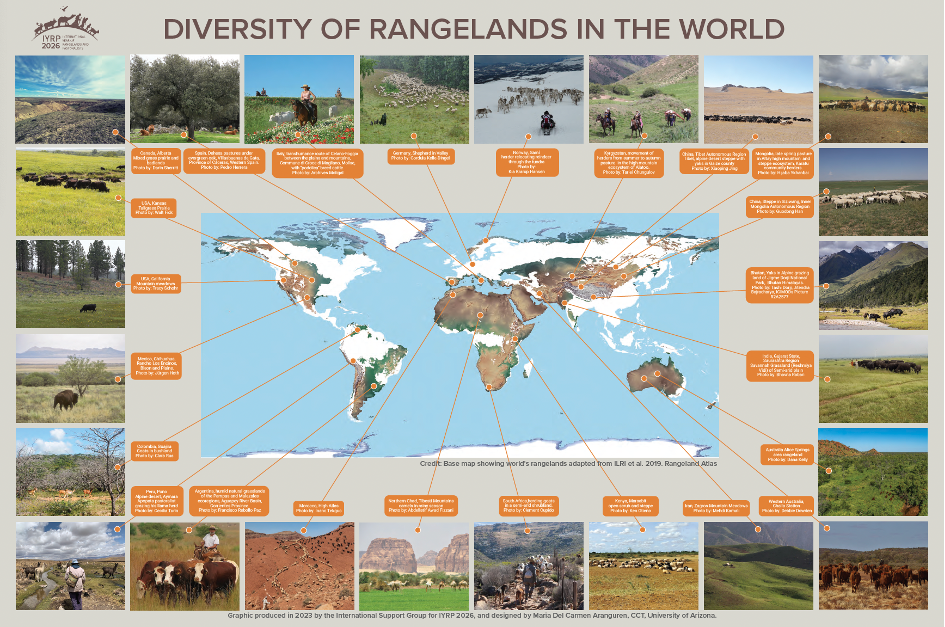
In the 2022 RWSN Webinar, Maryam Niamir-Fuller, then vice chair of the International Support Group for the IYRP2026, explained that “rangelands” is a term used for grasslands, shrublands, woodlands, tundra as well as cold or hot deserts that are grazed by domesticated or wild animals. I was surprised to learn that it is estimated that rangelands actually cover 54% of the earth’s land surface. It makes me wonder why I have heard so little about them? And further, rangelands exist beyond drylands. As Maryam gives you a taste for in her picture gallery (Figure 1), there is much diversity in rangelands. 

Figure 1 Picture gallery of rangelands (prepared by IYRP2026 Global Alliance)

It perturbed me to learn from Maryam that, although rangelands cover more than half of the earth’s land mass, they are the least known and valued ecosystem in the world. What also seems not to be widely known is that an estimated one billion people directly benefit from or have their livelihoods linked to rangelands. Further, another two million people benefit along the value chain, including processing products, gathering pharmaceuticals and making medicines. 

There are other nuggets of information that I would like to share with you. For example:

  • that pastoral milk and meat are very important sources of vital proteins that are not found in plants
  • that pastoral livestock has high genetic diversity – in stark contrast to livestock on monocultural farming and industrial systems
  • rangelands are extremely important for Planet Earth’s biodiversity

Maryam also explained that, while evidence is still emerging, research is showing that a well-managed pastoral system can be net carbon neutral or can ever sequester (store) carbon. That is something else that I would like to know more about on this journey. In summary, it seems that a lot is going on in rangelands, but this is not well known.

Let me move on to pastoral mobility (pun intended). As I mentioned above, this is not outmoded at all, despite prevailing attitudes. In the 2022 RWSN webinar, Maryam lucidly explained that mobility is a key factor in the stewardship of these ecosystems. Pastoralists have adapted to and managed natural variability through mobility of their animals. 

According to many studies, and as presented by Maryam Niamir-Fuller, one of the main reasons for rangeland degradation is because not all pastoralists are able to exercise their required mobility. Traditional movement routes have been blocked, and some rangelands have been converted to be used for cropping. The result is that animals are being confined into smaller and smaller spaces. Scientists are learning that the more the livestock keep moving, the less the degradation and the better are the chances for maintaining healthy rangelands.

Figure 2 The provisional 12 themes of the International Year of Rangelands and Pastoralism

These issues and others are recognised through the 12 themes of the International Year of Rangelands and Pastoralists (IYRP2026). The issue of water (and my own specialism) is directly included in two themes of the IYRP: 

  • Theme 3 looks at access to services and resources for pastoralists – advocating for safe and accessible water for pastoralists and their animals.
  • Theme 6 looks at water in the context of soils and land management – including waste management, the impact of droughts, aquifer recharge and watershed management.

However, water can be linked to all of the 12 themes of the IYRP – something that will be explored in the build-up to and during IYRP2026. The IYRP sets out to value the contribution of rangelands and pastoralists, break myths and influence informed, science-based policies throughout the world.

If you would like to find out more about IYRP2026, or even join the global or regional support groups or thematic working groups, check out this website or contact iyrp2026@gmail.com

Sources of information

RWSN (2022) Pastoralists and Water, Webinar, Rural Water Supply Network (RWSN).

IYRP LDN Working Group (2024) “Global Actions for Sustainable Rangelands and Pastoralism to achieve Land Degradation Neutrality: A Science-to-Policy Review with recommendations for the UNCCD Conference of Parties”.  https://iyrp.info/

[1] Director, Ask for Water Ltd, Edinburgh, Scotland

[2] Senior Advisor to IYRP2026 Global Alliance, based in USA

Pastoralists and Water 2 – Learning what is pastoralism

Dr Kerstin Danert, Ask for Water Ltd, Edinburgh, Scotland

In my first blog, I explained my discomfort around the stigma and attitudes towards pastoralists that I came across in my early working life, alongside my complete lack of understanding of how pastoralists function. With this (second) blog, let me try and share something of what I learned about pastoralism through reading and learning from the people I met through online communities since 2020 including that of IYRP2026 Global Alliance and the Food and Agriculture Organisation (FAO).

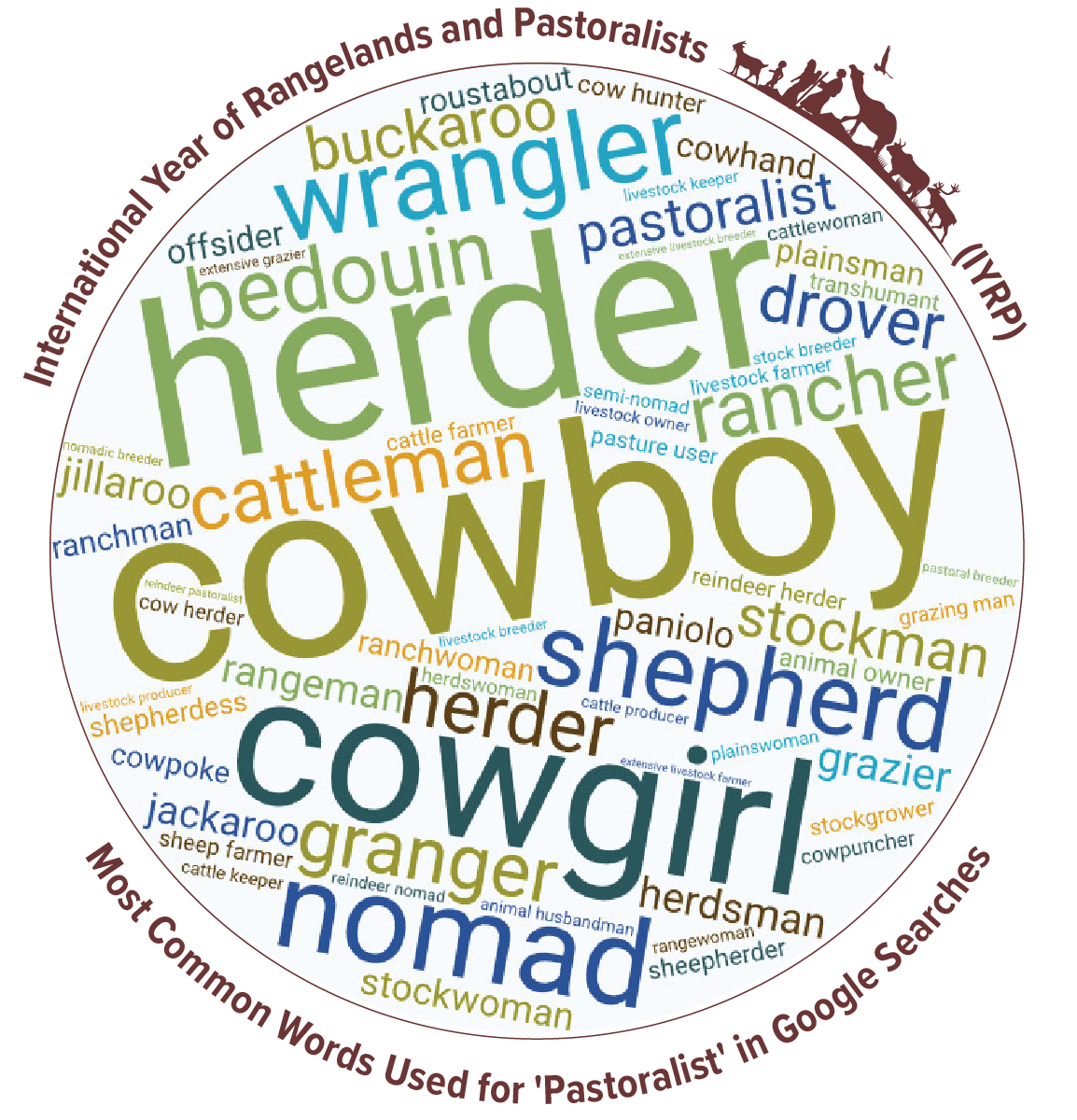
Pastoralism is an economic activity and a cultural identity. Pastoralists make a living by raising livestock or semi-domesticated animals on rangelands (a term which I shall come back to). In fact, “pastoralist” is really an umbrella terms covering many groups, as illustrated by the word cloud below (and this one is only in English!)

Figure (above): Terms for pastoralists (in English) (Link

In keeping with the diversity of names and contexts in which they live, pastoralists keep different kinds of livestock species on native and semi-native rangelands, including cows, buffalos, yaks, llamas, sheep, camels, goats, reindeer, horses and donkeys and even grazing ducks. I understand that pastoralism means that animals are herded, moved or rotated from grazing point to another grazing point at least some of the time, rather than being constantly penned or left by themselves. In short, the livestock move around, but the people may or may not move.

And now to rangelands. These are essentially the places where livestock graze and pastoralists live. Rangelands are areas where the indigenous vegetation is predominantly grasses, grass-like plants, forbs (was a new word for me) or shrubs that are grazed and browsed (which means livestock, such as camels eating shrubs and trees). Rangelands provide a natural ecosystem for raising grazing livestock and wildlife. In my next blog I will talk more about the extent of rangelands, and how they are being destroyed by conversion to cropland, which I suspect, will come as a surprise to you. But as a spoiler, rangelands cover at least 54% of the world’s land mass, and pastoralism exists in two thirds of the countries in the world! 

I mentioned cultural identity, and have learned that the term ethnic pastoralist can refer to people who come from ethnic groups that traditionally practised pastoralism but whose livelihoods are no longer derived from grazing livestock. The woman I got to know in Kampala (see Blog 1) may be among them, and I now realised that I should have asked her much more…

Pastoralists have different degrees of mobility, and can be sedentary. As an economic activity, pastoralism is an animal production system that is able to create livelihoods in highly variable environments. This point is key, and will remain a theme throughout my series of blogs. Mobile pastoral systems take advantage of environmental variability by managing grazing itineraries to improve livestock productivity as well as deal with pests and diseases and to avoid conflicts.

Further, pastoralism is a fundamental part of the global food system. One of the things that has struck me most, is that pastoralists actually produce food in the world’s harshest environments – in land that may have poor water supply or soil quality, face extreme temperatures, have steep slopes and or be remote. And it gets even more interesting when one realises that, by moving from one place to another, animals fertilise the soil with their dung and scatter seeds with their regular grazing and trampling. This has the effect of enhancing biodiversity and maintaining landscapes. I want to understand more here! 

And I am coming to realise that, despite the global significance of pastoralism and rangelands, pastoralists are under-recognised and undervalued. As I mentioned in my first blog, they can also be stigmatised. 

It seems that pastoralism is largely misunderstood, with pastoralists traditionally suffering from marginalisation and exclusion from dialogue. Pastoralists have been deeply affected by sedentary societies with poor understanding of the pastoral livelihood system have imposed alien social and governance schemes including attempts to settle pastoralists and create barriers to herd mobility or pastoralists’ access to public services. This is yet another area to learn more about. As with other marginalised groups, it is the voices of pastoralist communities themselves that need to be heard at local, national and international levels.

With more pastoralists gaining voice, and with a better understanding of pastoralism by those living with, studying and working with pastoralist communities, recognition of the value of pastoralism as well as the value of herd mobility is growing. But there is much to learn!

2026 will be the International Year of Rangelands and Pastoralists (IYRP2026). Over the coming months, I will continue to share my reflections and insights on Pastoralists and Water with you through a series of blogs. 

Sources of information

African Union (2010) Policy Framework for Pastoralism in Africa: Securing, Protecting and Improving the Lives, Livelihoods and Rights of Pastoralist Communities. Department of Rural Economy and Agriculture, African Union, Addis Ababa. 

Axweso F (2011) Understanding pastoralists and their water, sanitation and hygiene needs, Discussion Paper, WaterAid, Available at https://www.ircwash.org/sites/default/files/pastoralismintzdiscussion.pdf (accessed 28 Sept 2020)

CELEP and VSF (2020) For an International Year of Rangelands and Pastoralism [Online], Coalition of European Lobbies for Eastern African Pastoralism and Vétérinaires Sans Frontières (accessed 5 October 2020)

FAO (2020) Pastoralist Knowledge Hub [Online], Food and Agriculture Organization of the United Nations, http://www.fao.org/pastoralist-knowledge-hub/en/ (accessed 28 Sept 2020)

IFAD (2018) How to do, Engaging with pastoralists – a holistic development approach, International Fund for Agricultural Development, Rome, Available at https://www.ifad.org/en/web/knowledge/publication/asset/40318809 (accessed 5 October 2020)

IRC (2025) Pastoralism and Rangelands: People and Institutions a Glossary of Terms, International Rangeland Congress, https://www.iyrp.info/sites/default/files/2025-01/Glossary_pastoralism-rangelands_people-institutions-2024.pdf (accessed 27 Jan 2025)

IYRP (2019) A global call for a United National International Year of Rangelands and Pastoralists, Proposal for an International Year of Rangelands and Pastoralists Mongolia, International Year of Rangelands and Pastoralists, Available at https://globalrangelands.org/sites/globalrangelands.org/files/Mongolian%20Proposal_IYRP_updated_0.pdf (accessed 5 Oct 2020)

Mundy P (2020) Defining pastoralism and nomadic pastoralism, Email on https://dgroups.org/fao/pastoralist-hub/discussions, 2 October 2020,

Niamir-Fuller, M. ed. (1999). Managing Mobility in African Rangelands: The Legitimization of Transhumance. London: Intermediate Technology Publications, 1999. African Studies Review | Cambridge Core
https://www.cambridge.org/core/journals/african-studies-review/article/abs/maryam-niamirfuller-ed-managing-mobility-in-african-rangelands-the-legitimization-of-transhumance-london-intermediate-technology-publications-1999-xiv-314-bibliography-index-2995-paper/3570749A673ABF1AFE556A26002AFAE4

Jenet A. Buono N, Di Lello S, Gomarasca M, Heine C, Mason S, Nori M, Saavedra R, Van Troos K (2016) The path to greener pastures: Pastoralism, the backbone of the world’s drylands. Technical Report. Vétérinaires Sans Frontières International (VSF-International). Brussels, Belgium, Available at https://doi.org/10.13140/RG.2.2.11042.22725

Jonckheere S, Liversage H, Rota A (2017) Pastoralism and Land Tenure Security: Lessons from IFAD-supported projects, Paper prepared for presentation at the “2017 World Bank Conference on Land and Poverty”, The World Bank – Washington DC, March 20-24, 2017, Available at https://www.oicrf.org/documents/40950/43224/Pastoralism+and+land+tenure+security+Lessons+from+IFAD+supported+projects.pdf/e3b560d6-0bbc-3109-1c33-a5851e551b49?t=1510194133215 (accessed 28 Sept 2020)

Krätli S (2019) Pastoral Development Orientation Framework: Focus on Ethiopia, MISEREOR, Aachen; Available at https://www.researchgate.net/publication/336983785_Pastoral_Development_Orientation_Framework

Republic of Kenya (2012) Releasing Our Full Potential. Sessional Paper No. 8, National Policy for the Sustainable Development of Northern Kenya and other Arid Lands, Ministry of State for Development of Northern Kenya and Other Arid Lands, Nairobi. 

USAID (2017) Water Currents, September 19, 2017 – WASH and Pastoralists, United States Agency for International Development Water Team, Washington DC, Available at https://mailchi.mp/waterckm/water-currents-wash-and-pastoralists-september-19-2017?e=b631faae3e(accessed 28 Sept 2020). 

Pastoralists and Water 1 – my first blog on the topic

Dr Kerstin Danert, Ask for Water Ltd, Edinburgh, Scotland

It was in 1998 when I started to work and then live in Uganda that I first really started to hear the term “Pastoralist”. That was in relation to the Karamojong (also spelt or Karimojong) – a group of people living in the semi-arid environments of north-eastern Uganda. At the time, although my knowledge of pastoralism was extremely poor, I was not fully comfortable with some of the derogatory language used about these people. However, it was hard to counteract the stereotyping and stigma that I was hearing. My efforts in relation to rural water supply had started, and continued to be with communities that were fairly, or very well settled; and if they moved in large numbers, this was primarily to flee widespread conflict and danger or settle back home again.

In my decade as a resident of the ‘Pearl of Africa’, it was largely considered too dangerous to travel through the districts of (now) Kaabong, Kotido, Moroto, Nakapiripiri, Napak and Amudet where the Karamojong and neighbouring agro-pastoral groups including the Pokot, Jie and Labwor lived. Cattle raiding (with use of firearms) and conflicts were frequent and could be deadly. On the other hand, I heard stories of Italian priests who lived among the Karamojong, plus stories of a few others. And occasionally my friends and colleagues would relate tales of some adventurous travel, or of tourists that flew up to Kidepo National Park. I never met a single Karamojong back then. 

When I started to work in Kaproron, on the lush northern slopes of the extinct volcano of Mount Elgon, and staying in the residence of the local priest, I was able to look over the cliff edge onto the plains where the Karamojong lived. It was here in Kaproron that I heard stories from my colleagues and their families of their land that had been abandoned when the conflict was particularly bad. I learned a bit more about cattle raiding, but all in all, the Karamojong remained a mystery for me. 

Photo (above): A view northwards from Kaproron
(Source: Kerstin Danert, 2005)

In the subsequent years, other pastoral groups have fleeted in and out of my circle of attention, including the Maasai with their beautiful blankets, the Fulani with their marvellous hats and the Tuareg wearing exquisite blue. While curiosity was certainly there, my knowledge remained superficial.

It was in 2014, when working in Chad, that my path physically intersected with pastoralists. I was simply in awe as I watched what I later learned was a transhumant family travelling southwards. Asking questions, I was struck by similar, and familiar derogatory language as it was explained that for their entire lives these people travel south and then north again with the movement of the rains. I do not wish to repeat in detail some of the things that I heard. Once again though, I had no interaction with these transhumant people themselves, and was simply left with an uncomfortable feeling – one that I now recognise as my own inner reaction when I am faced with hearing stigma towards others and am at a loss for a response.

Photo (above): Transhumance in Chad
(Soure: Kerstin Danert, 2014)

The discomfort I felt in Uganda, Chad and other places when listening to people talk about pastoralists never really left me. Thus, in 2020, while supporting UNICEF in preparing their Guidance Note on Leaving No One Behind in WASH, I decided to find out more about this group of people and include them in the publication. This turned out to be the start of a journey – a journey that continues. By this time, I had finally knowingly interacted with one single person from Karamoja: a woman police officer working in Kampala. She described the beauty of her home, how she travels back frequently, and how she loves to look at the stars when there. She told me that the conflicts have also eased over the years. I understand that following disarmament in 2001-2008 there was a period of stability, which was disrupted following rearmament in 2019 that degenerated into commercial raiding and involved the army, politicians and business people. You can read more here. Conflict continues with another round of disarmament underway.

In 2022 the United Nations General Assembly proclaimed that 2026 will be the International Year of Rangelands and Pastoralists (IYRP). You can learn more here in this lovely short animated film. I have to say that the openness of the international communities that concern themselves with the IYRP, and their eagerness to share has been a warm welcome for me into this new world.  When I first contacted one of those communities – FAO’s online community on pastoralism – and asked the very naïve question on how to define pastoralism, I was blown away by the many helpful responses from the community. Thank goodness, for I was lost as I tried to understand more in preparing the aforementioned guidance note

And so, in support of IYRP 2026 and particularly with a view to the linkages with water, this is my first in a series of blogs on pastoralists and water. You are most welcome to join me as I share my own journey of discovery.

Dr Kerstin Danert is a Water Specialist, Researcher and Facilitator and together with Adrian Cullis, co-facilitates the IYRP Pastoralists and Water Working Group.