
Image Credit: Report World Bank, 2014. ©Albert Gonzalez Farran/UNAMID
This blog post is part of a series that summarizes the REAL-Water report, “Financial Innovations for Rural Water Supply in Low-Resource Settings,” which was developed by The Aquaya Institute and REAL-Water consortium members with support from the United States Agency for International Development (USAID). The report specifically focuses on identifying innovative financing mechanisms to tackle the significant challenge of providing safe and sustainable water supply in low-resource rural communities. These communities are characterized by smaller populations, dispersed settlements, and economic disadvantages, which create obstacles for cost recovery and hinder the realization of economies of scale.
Financial innovations have emerged as viable solutions to improve access to water supply services in low-resource settings. The REAL-Water report identifies seven financing or funding concepts that have the potential to address water supply challenges in rural communities:
- Village Savings for Water
- Digital Financial Services
- Water Quality Assurance Funds
- Performance-Based Funding
- Development Impact Bonds
- Standardized Life-Cycle Costing
- Blending Public/Private Finance
Understanding Blended Public/Private Finance.
Water supply development in low- and middle-income countries has traditionally relied on public or aid funding, rather than commercial financing. “Blended” finance refers to leveraging public funds (e.g., concessional loans or grants from national governments or development banks) to mobilize additional capital from private banks or investment groups (OECD 2019b).
Combining development finance with private investment can assume different structures to reduce risk, employing a range of instruments (e.g., equity, debt, partnerships, technical assistance, grant-funded transaction design, guarantees, or insurance; Figure 1; OECD 2019a; Convergence 2023). The most common blended finance instruments across the development sector from 2018–2019 were direct investments in companies or subsidiaries, loan guarantees, “syndicated” loans, and lines of credit (OECD 2019a). Syndicated loans come from a group of collaborating financial institutions (a loan syndicate) to a single borrower, reducing the risk and buy-in amount needed for each individual group and/or ensuring sufficient specialized expertise. Alternatively, a smaller amount of pure grant funding may be used to support technical assistance or subsidies, with the goal of attracting other investors.
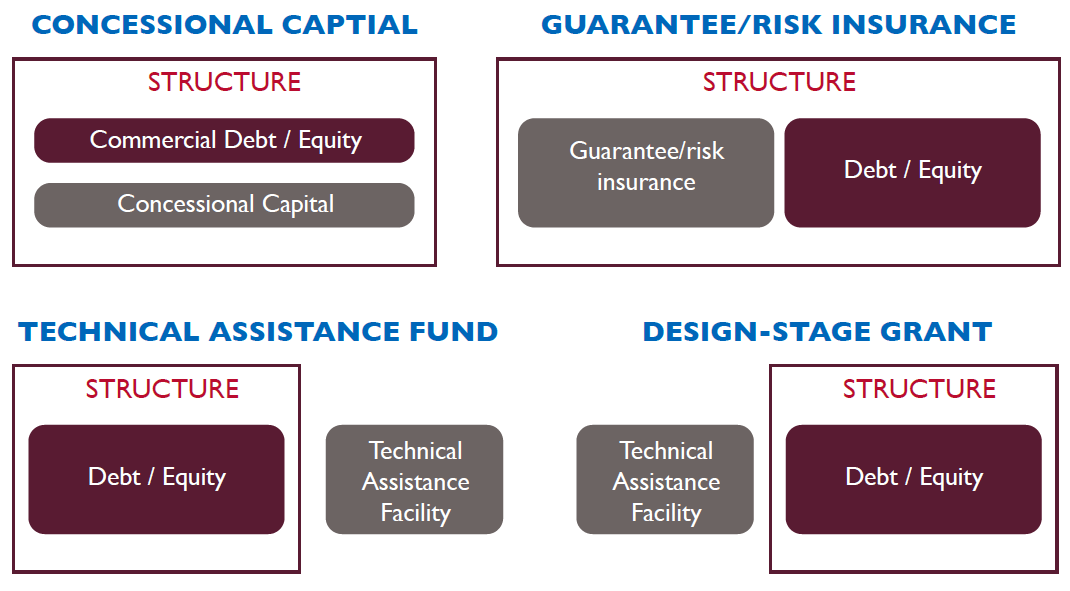
Figure 1. The four most common blended finance structures (adapted from Convergence 2023)
Examples
Although not all water-related “public-private partnerships” leverage public funding to attract commercial finance, these long-term collaborative arrangements among one or more government and private sector entities have been in place for decades in low- and middle-income countries, including throughout Africa, with encouraging results. Overall,
private operators have tended to be more efficient than governments at managing construction, service delivery, and asset maintenance (World Bank Group 2014). One frequently documented benefit among several Sub-Saharan African examples, where private management covers an estimated one-third of small piped water schemes, has been reduction of “non-revenue” water, or water losses for which production costs are never recovered. Among small-scale water providers in Uganda, a private sector participation model led to expanded coverage and financial performance with only modest tariff increases (World Bank Group 2014; Hirn 2013). Active connections tripled over 10 years with tariffs rising less than inflation.
In Madagascar, a host of rural community water user committees and private water operators have signed long-term concession agreements in which a private company invests in the water system to increase household access, generate more revenue, and share profits. This model has been replicated over roughly 15 years with donor support, such as USAID’s Rural Access to New Opportunities in Water, Sanitation, and Hygiene (RANO WASH) activity (Tetra Tech 2021).
Another long-running example of blended finance comes from Benin. Between 2007 and 2017, more than half of Benin’s rural piped water systems transitioned to private operation and maintenance contracts known as “affermages” (Comair, Delfieux, and Dakoure Sou 2021; Migan and Trémolet Consulting 2015). In these agreements, a private operator collects tariffs and then retains a percentage of an agreed-upon price per unit of water sold, turning over the remainder to the contracting authority (Janssens 2011). The initial pilot with 10 private operators successfully rehabilitated all water systems with no additional costs to the customers (World Bank Group 2018); however, subsequent scale-up experience brought a pivot to regional contracts to attract more professional operators. In 2022, a 10-year public-private partnership was formed with a consortium of French companies (Eranove, UDUMA, and Vergnet Hydro) to rehabilitate, extend, and operate rural water systems for 100% customer coverage (Marteau 2022). Public funds will ensure private connections and tariffs remain affordable.
Although some examples (e.g., Madagascar, Benin, Cambodia) have applied blended finance to rural water supply in low- and middle-income countries, it remains at a proof-of-concept stage. Blended finance is possible where rural water provision is more organized and mature and where people pay consistently, justifying lending. This is more likely to be the case in middle-income economies.
Further proof-of-concept is required to evaluate blended financing to drive rural water supply performance. It faces a dual challenge: persuading commercial lenders that water supply represents a lucrative investment opportunity and persuading water service providers to seek loans at rates higher than those routinely offered by development finance institutions.
Blended finance projects create an evidence base for effective public investment and in turn, incentivize the capture of better financial and impact data (Convergence 2019). Objective selection criteria may help “prime” service providers to continue the behaviors and actions that support blended finance (USAID 2022). Building the foundations for blended finance will require a transition period with accompanying public sector support, to allow for a paradigm shift on the part of both borrowers (who face increased pressure to manage operations efficiently) and lenders (who often do not know the market well enough to participate in investment opportunities).
While they take time, these adjustments have taken place in other sectors, most notably energy (IRC n.d.). Pories, Fonseca, and Delmon (2019) detail foundational issues ranging from governmental sector planning and tariff setting to service provider project preparation and financial market distortions. Experiences with the approach will elucidate the degree to which blended finance can work at large scales, but transformation is unlikely to occur rapidly.
Do you want to know more? Access to the complete report on financial innovations for rural water supply in low-resource settings HERE.
The information provided on this website is not official U.S. government information and does not represent the views or positions of the U.S. Agency for International Development or the U.S. Government.
References:
- Comair, Georges, Charles Delfieux, and Yeli Mariam Dakoure Sou. 2021. “Ambitious Reforms and Private-Sector Engagement Improve Access to Water in Benin.” World Bank Blogs (blog). 2021. https://blogs.worldbank.org/water/ambitious-reforms-and-private-sector-engagement-improve-access-water-benin.
- Convergence. 2019. “Blended Finance for Water & Sanitation.” Data Brief. Convergence.
- Convergence. 2023. “Blended Finance.” 2023.
- Hirn, Maximilian. 2013. “Private Sector Participation in the Ugandan Water Sector:A Review of 10 Years of Private Management of Small Town Water Systems.” Working Paper. Nairobi, Kenya: Water and Sanitation Program (WSP).
- Janssens, Jan. 2011. “The Affermage-Lease Contract in Water Supply and Sanitation.” An explanatory note on issues relevant to public-private partnerships. PPP Insights. Washington, DC: The World Bank (PPPIRC).
- Marteau, M. 2022. “Benin: Eranove, UDUMA and Vergnet Hydro Are Set to Deliver a Continuous Drinking Water Service to 9.3 Million Beninese by 2030.” UDUMA (blog). 2022.
- Migan, Sylvain Adokpo and Trémolet Consulting. 2015. “Benin – Innovative Public Private-Partnerships for Rural Water Services Sustainability – A Case Study.” World Bank WSP and the International Finance Corporation.
- OECD 2019a. “Amounts Mobilised from the Private Sector for Development.” 2019.
- OECD. 2019b. “Making Blended Finance Work for Water and Sanitation: Unlocking Commercial Finance for SDG 6.” Policy Highlights. Paris: Organisation for Economic Co-operation and Development. https://doi.org/10.1787/5efc8950-en.
- Pories, Lesley, Catarina Fonseca, and Victoria Delmon. 2019. “Mobilising Finance for WASH: Getting the Foundations Right.” Water 11
- Tetra Tech. 2021. “Mid-Term Performance Evaluation of Madagascar Rural Access to New Opportunities in Water, Sanitation, and Hygiene (RANO WASH) Activity.” Final Report. Mid-Term Performance Evaluation of RANO WASH. USAID.
- USAID. 2022. “Accessing Commercial Finance for Water and Sanitation Service Providers in Kenya, Cambodia, and Senegal.” USAID’s Water, Sanitation and Hygiene Finance (WASH-FIN) Project.
- World Bank Group. 2014. “Water PPPs in Africa.” World Bank Group and World Bank Water and Sanitation Program.


 Rural Water Supply Network - blog