
Featured photo: Ghana, Lucy Parker
Article by Cincotta K. & Nhlema M.
Abstract
Rural water supply systems in low-income settings, particularly in last-mile communities, face chronic sustainability challenges. Financing predictable operation and maintenance (OPEX) remains a persistent gap, with one in four water points in sub-Saharan Africa being non-functional at any given time. While community-based management has been the dominant model for post-construction maintenance, it is increasingly recognized as insufficient, relying on underfunded household tariffs, volunteer committees, and limited technical support. Emerging solutions like results-based financing and professionalized maintenance contracts have shown promise with some securing government financing. This paper proposes district-level maintenance endowment funds, a mechanism where invested capital generates predictable income, as another option for financing rural water maintenance. These funds would support targeted subsidies, results-based contracting, and accountable, locally governed service delivery aligned with decentralization frameworks. This proposed model is agnostic to the specific management model, whether community-based, professionalized, or hybrid. The focus is on creating a predictable, long-term financing mechanism, particularly for so‑called ‘last-mile’ rural communities: small, dispersed villages, often with fewer than 1,000 people, that are typically excluded from piped water systems due to high per-capita service costs.
Two key arguments frame this proposal: (1) while endowment funds may be initially capitalized by international donors or organizations, over time they reduce dependency on short-term donor cycles by creating a predictable, locally managed revenue stream, and (2) Piloting endowments at the district government level strikes the right balance between being close enough to last-mile communities, accountable to them, and large enough to achieve economies of scale that will ensure financial viability for service provider payments.
THE PROBLEM: Persistent Non-Functionality and Unrealistic Expectations
Across sub-Saharan Africa, one in four rural water systems are non-functional at any given time. These failures are not anomalies, but they reflect a systemic global challenge: the absence of a reliable model for rural water service delivery beyond construction. For decades, community-based management (CBM) has been the dominant approach. It assumes that because communities value water, they will voluntarily manage infrastructure. But the viability of CBM is increasingly being questioned. Tariffs based on affordability rarely cover full maintenance costs, especially in small, dispersed communities, with variable incomes, that are often not prioritized for piped systems. Trained committee members often leave, and access to spare parts or technical support is limited. Volunteer fatigue, lack of retraining, and systemic underinvestment compound the problem.
The expectation that people living in the poorest rural villages must fully fund and manage the long-term maintenance of their own water systems does not align with how water systems are managed anywhere else in the world. In high-income countries, water infrastructure is maintained by trained professionals and supported by stable funding streams, often not limited to water user fees, but supplemented by public financing mechanisms such as property taxes and municipal budgets. The same should hold true, if not more so, in low-resource rural settings. A more realistic, equitable approach is therefore urgently needed.
TRIED AND TESTED SOLUTIONS: Results-Based Financing (RBF) – When Performance Meets Poverty
New RBF models are emerging. Uptime, as an example, is a partnership supporting professionalized rural water service providers that pays providers based on verified uptime. This shifts incentives from reactive repairs to preventive maintenance. Between 2020 and 2022, Uptime supported services for 1.5 million people in seven countries. Governments in countries such as Kenya, Bangladesh, and Zambia are now beginning to adopt performance-based financing approaches like this into their own public financing systems. This has been inspired in part by the evidence generated through philanthropic pilots. Yet, a central limitation remains: these models have demonstrated viability primarily in communities large enough or more “well-off” to generate economies of scale. This makes them financially attractive to service providers, but systematically excludes smaller, remote last-mile communities that are seen as less “bankable”. This is not a critique of performance-based models like Uptime, they are delivering results and proving their value. But it does highlight the need to pilot complementary result-based financing mechanisms that can address the unique realities of last-mile communities. Expecting the world’s poorest to fully finance their own essential services is neither equitable nor realistic. What’s needed is smart, targeted financing, including well-placed subsidies, that reflects the diversity of community capacity and directs public investment where it’s needed most. This is especially critical for last‑mile communities, i.e. remote, low‑density villages where user fees alone can never sustainably cover operating expenses.
This frame of thought, of differential and context-specific financing solutions, borrows from Dorward et al.: “Hanging In, Stepping Up, and Stepping Out.” Most rural households are “Hanging In,” unable to pay without full subsidy. Others can co-finance with support (“Stepping Up”), or engage with market models (“Stepping Out”). This model enables differentiated financing that aligns with real-world capacity. Targeted subsidies are not about dependence; they free up cash for productive use while ensuring reliable services. Importantly, we differentiate between water as a service that must be reliably provided for health and dignity, and water as a productive resource used to generate income. The proposed endowment-backed financing model speaks to the former, guaranteeing essential domestic supply. Other financing tools may be more appropriate for supporting productive uses of water in agriculture or enterprise.
RBF models have proven we know how to make maintenance work. The challenge now is to pilot solutions, such as endowment funds, that can sustainably support these communities where market-based approaches do not reach, thereby ensuring universal access to all.
THE PROPOSAL: District-Level Maintenance Endowment Funds
To close the financing gap, we propose district-managed endowment funds dedicated to rural water maintenance. These funds would invest capital to generate steady income for maintenance costs, insulating service delivery from budget shocks and donor cycles. They would:
- Provide predictable financing by requiring implementing agencies to allocate a fixed amount, e.g. 10-20% of infrastructure costs, into the fund.
- Enable targeted subsidies using the Hanging In/Stepping Out framework.
- Support results-based contracting for professional maintenance providers.
- Align with decentralization by placing fund management at the district level, while national governments serve as regulators.
This model borrows from urban utility principles where professional service delivery is underpinned by predictable financing and adapts them to rural realities. It does not assume full cost-recovery from users, nor does it treat water as a commodity for profit. Instead, it creates a stable platform for targeted subsidies and professional maintenance services in communities where user fees alone are structurally insufficient.
Once established, these endowment funds can serve as a vehicle for gradual government co-financing, thereby enabling a transition from philanthropic to domestic funding while ensuring uninterrupted service delivery.
Endowment funds are common in sectors like education, healthcare, the arts, and community development because they provide steady, long-term income. The idea is simple: the capital is invested, and only part of the earnings is spent each year, while the rest is preserved for the future. This approach gives organizations financial stability even when fundraising or government budgets are unpredictable. Universities in the United States use endowments to support student scholarships and teaching, hospitals use them to secure healthcare services, and galleries such as the Tate in the UK rely on them to protect exhibitions and research. In all these cases, the purpose is the same: to provide reliable funding over time and reduce vulnerability to financial shocks.
But endowments are not without risks. Poor governance can lead to misuse of funds, such as drawing down too much of the capital and weakening the fund. Another major challenge is inflation, especially hyperinflation, which reduces the value of the money invested and makes it harder for the endowment to cover ongoing costs. Market swings, sudden downturns, or pressure to spend funds quickly can also threaten their effectiveness.
To deal with these challenges, other sectors have developed practical safeguards. Many endowments set strict spending rules, often linking annual withdrawals to inflation so that the fund keeps its value over time. Others invest in a mix of assets, such as stocks, land, or infrastructure, to balance risk and protect against rising prices. History shows that careful management can even turn crises into opportunities. For example, some universities in the United States grew their endowments during the high-inflation years of the 1970s and 1980s by combining strong investment strategies with successful fundraising. The lesson is clear: discipline and diversity in management help endowments survive and adapt, even in tough economic times.
Endowment-backed RBF model for rural water supply maintenance could build on these lessons but adapt them to local realities. Working hand in hand with local governments, pilot endowment funds can test which approaches are most practical for protecting an endowment against inflation in specific country contexts. The focus should be on co-creating solutions that make sense locally, are financially sustainable, and can support water services in small and remote communities that are often left out of performance-based financing models.
How Endowment Funds Differs from Other Financing Models
Many rural water financing ideas focus on improving how money flows to communities whether through mobile payments, savings groups, performance incentives, or blended finance. These are valuable tools, and the RealWater report published in 2023 offers a strong catalogue of them[1]. But they share one limitation: they rely on revenue streams that are often unpredictable in last-mile contexts, apart from self-supply and multiple-use systems (MUS), where households themselves generate and manage financing.
In small, remote villages, user fees alone will never cover the true cost of keeping systems running. Seasonal incomes, high per-capita service costs, and vulnerability to shocks mean that even the most efficient fee collection systems can collapse when a bad harvest or disaster strikes.
Our proposal starts from a different premise: the money for maintenance must already exist invested, earning returns, and insulated from the ups and downs of annual budgets and donor projects. That’s why we propose establishing and growing district-level maintenance endowment funds.
Like the trust funds that sustain universities, hospitals, and major NGOs, these endowments invest a lump sum and use only the interest to finance maintenance, targeted subsidies through performance-based service contracts. By embedding the funds at district level under transparent, multi-stakeholder governance, these funds align with principles of localization and create a vehicle for gradual government co-financing. This approach builds a permanent financial engine one that will keep turning long after individual projects or donor priorities have shifted.
Key Enabling Factors for an Endowment Fund to Work
If the district-level maintenance endowment fund approach is to succeed, several enabling factors must be in place. These are not policy mandates, but rather essential design elements that would need to be built into the model from the outset.
Enabling Factor 1: Regulating Endowment Contributions in Project Budgets
For the fund to be viable, a portion of last-mile rural water infrastructure project costs would need to be set aside as capital for the endowment. Without initial contributions linked to infrastructure investments, the fund cannot generate the returns needed to sustain long-term maintenance. National/Local government would, therefore, have a regulatory function to ensure philanthropic financing for new water installations or rehabilitations earmark endowment contributions.
Enabling Factor 2: District-Level Endowment Trusts with Transparent, Multi-Stakeholder Governance
Management at the district level under a governance structure that includes government, community, and sector stakeholders would ensure alignment with decentralization frameworks and strengthen accountability. Over time, these trusts could also provide a pathway for gradual government co-financing.
Enabling Factor 3: Results-Based Maintenance Contracts
Professional service providers would need to be contracted and paid based on verified delivery metrics, such as system uptime and repair response times. This ensures that predictable financing translates directly into reliable service delivery.
Enabling Factor 4: Differentiated Subsidy Mechanisms
Economic resilience assessments would help determine appropriate subsidy levels for different communities ensuring full coverage for the most vulnerable (“Hanging In”) and co-financing arrangements where communities are able to contribute (“Stepping Up” and “Stepping Out”).
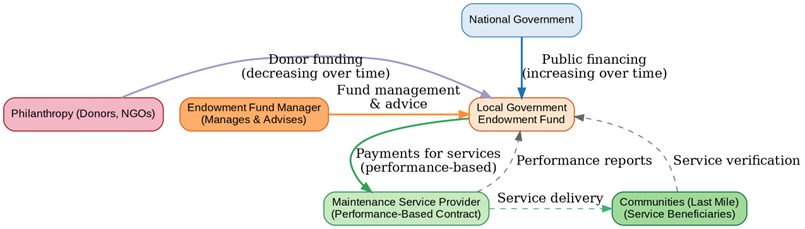
The diagram below provides a generic layout for the endowment fund and the interrelationship between key players with sole oversight resting with the local government:
Proxy Example: Malawi’s Investment-Backed Insurance Model for Flood-Resilient Infrastructure
While not a case study of an endowment fund dedicated to operation and maintenance, this example from Malawi illustrates the core principles that could underpin such a model. In this case, the focus is on the rehabilitation of rural water infrastructure specifically, protecting hand pumps vulnerable to flood damage rather than ongoing maintenance.
In the aftermath of Cyclone Freddy in early 2023 one of the most severe natural disasters to hit southern Malawi BASEflow, with support from the Conrad N. Hilton Foundation, undertook flood-proofing works in Mulanje District. This included raising the concrete aprons of hand pumps above anticipated flood waterlines to reduce damage and contamination risk. While these engineering interventions improved resilience, the risk of extreme flooding and potential damage to even the upgraded structures remained.
To address this risk sustainably, BASEflow partnered with NICO Holdings Plc, a Malawian financial services conglomerate, engaging its subsidiary, NICO Asset Managers, to manage an endowment fund seeded by philanthropic support from Shockwave Foundation and Crap Foundation. The capital was placed in an interest-bearing investment vehicle yielding around 26% annually. Importantly, the principal remains invested in perpetuity, with only the returns used, in this case, to pay premiums to NICO Insurance for flood coverage on the upgraded hand pumps.
Management of the fund is decentralized at district level, with oversight provided by a multi-stakeholder governance body that includes the District Water Office, the Department of Disaster Management Affairs, and local community representatives. The involvement of a professional fund manager not only brings investment expertise, but also helps mitigate inflation risks and advise on opportunities to grow the fund over time.
While this initiative is still in its early stages, it serves as a proxy demonstration of how an endowment-based approach professionally managed, locally governed, and partnered with the private sector can create a predictable and protected funding stream. The model is being monitored year-on-year, not only to assess performance, but also to understand how it adapts to emerging risks over time.
Some of the key risks being tracked include:
- Financial risks such as the effects of hyperinflation, market volatility, and shifts in investment performance, which could erode the fund’s value or returns.
- Governance risks such as potential imbalances of power between government and community stakeholders, or conflicts of interest within the multi-stakeholder governance structure.
- Operational sustainability risks such as such as ensuring that other organizations consistently allocate budget contributions to the endowment fund, and that district governments progressively commit to co-financing it.
A critical part of this monitoring process is the role of NICO Asset Managers, whose professional oversight supports both the preservation of value and the capacity to adapt. This includes advising on alternative investment strategies to grow the fund, manage inflationary pressures, and maintain purchasing power for its intended purpose. Tracking these adaptive measures over time will provide valuable insights into the model’s resilience and its ability to sustain objectives in a complex and volatile environment.
The same principles of professional fund management, local governance, and proactive risk adaptation could be applied to an O&M-focused endowment fund, ensuring rural water infrastructure is not only built or rehabilitated, but also remains functional and resilient for the long term.
Conclusion: Sustainability Must Be Designed, Not Assumed
We cannot continue to rely on community goodwill, short-term grants, or pilot programs that fail to scale or do not take into account last mile dynamics. Realistic financial sustainability for water systems that serve the poorest villages must be intentionally designed into the system. District-level endowment funds may offer a practical, accountable way to embed long-term financing for last-mile water system maintenance into public service delivery structures, and should be tested. These funds are not a workaround; they are potentially a bridge laying the foundation for professionalized, performance-based services while enabling future government investment.
Endowments are not new. Many philanthropic WASH funders rightly rely on them for their own financial continuity. Applying the same logic to service delivery means resourcing rural water systems with the same seriousness and stability we apply to other essential services. An endowment-backed approach is not about monetizing water as a resource, but about ensuring continuity of rural water services as a public good designed with the same financial seriousness as other essential services like health and education.
[1] REAL-Water (2023) Financial Innovations for Rural Water Supply in Low-Resource Settings. REAL-Water Innovation Overview , United States Agency for International Development (USAID) Rural Evidence and Learning for Water.

 Rural Water Supply Network - blog