Self-Supply at Scale: Lessons from rural Bangladesh

Image
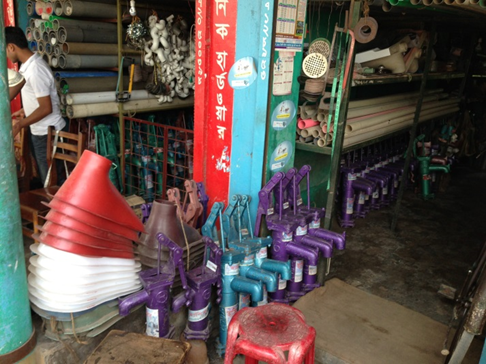
Shops like this one satisfy local demand for new pumps and replacement parts. Pumps, like ipods, come in a range of colors! (photo: J. Annis, 2013)

by Jonathan Annis is a sanitation and innovation specialist with the USAID-funded WASHplus project (www.washplus.org). His views do not represent those of USAID or the U.S. Government.

I recently traveled to southeastern Bangladesh to support WASHplus’s local implementing partner WaterAid as it begins a multi-year project in the coastal belt. The coastal belt is a marshy delta formed by Himalayan sediments transported thousands of miles by an extensive river network that settle as they reach the Bay of Bengal. Surface water is ubiquitous, and flooding—from tidal flows, excessive rainfall, or cyclones—is an annual event. I had never been in an environment so waterlogged.   Continue reading “Self-Supply at Scale: Lessons from rural Bangladesh”

USAID and Rotary International adopt innovative sustainability monitoring tool

A new sustainability tool for WASH

editor's avatarwater services that last

By Harold Lockwood 

This is great news and fantastic to see USAID adopting and promoting this approach which aims to really track and better understand the underlying causes of poor sustainability in the WASH sector. Sustaining WASH services is complex and dependent not only the hardware (the pumps, latrines and pipes), but also a range of the so-called software elements, for example reliable management entities, long-term external support and monitoring, adequate financing and so on. Measuring coverage is one thing, looking at functionality is also a useful proxy, but if we really want to know where the pinch-points are and how something so seemingly simple as water flowing out of a tap can fall down, it requires a comprehensive and powerful tool.

View original post 371 more words

TAF to be tested on other technologies Rwenzori region

WASHTech update from Uganda

sekumapter's avatarWASHTech, THE project (2011-2013)

A comment from the recently concluded Hand Pump Mechanics Association Learning Visit to Rwenzori region indicated the need for the Technology Applicability Framework (TAF) to be tested on existing technologies in the region like the Manual drilling rig. This was  raised after a presentation made by NETWAS Uganda at the learning journey about the progress of the TAF. The suggestion was later lauded by HEWASA, a local NGO promoting manual drilling in Rwenzori who indicated that in order to scale up their technology, there was need for recommendations from the TAF.

The HPMA learning visit was organized to provide learning for the social, economic and technical transformation of the HPMAs functionality in Northern Uganda. And to be able to use the knowledge acquired to improve sustainability of water supply systems in the region. This gathering attracted 40 participants from regions of North, West and Central.

View original post

Still or sparkling? Lessons from a WASH holiday

Rural water challenges are not just an African issue…

Stef Smits's avatarwater services that last

I suspect that some of you, readers of this blog, are equal water nerds as I am, and that you also take your professional interest along on holiday. At least, I cannot resist visiting the odd water works or taking photographs of the local water and sanitation facilities during my holidays. This summer holiday I not only had the opportunity to take photos, but to live for a week the type of rural water situation, that I write about so much, but rarely experience in reality. As I spent my vacation on a family visit to my brother, who is managing a farm in the Moldovan rural village of Cuhureştii de Jos, I got some first-hand experience of the common problems around rural water supply and realized that some of the myths around it, are myths indeed.

View original post 775 more words

USAID’s new water strategy – when the numbers don’t add up

Thoughts on the USAID Water Strategy

editor's avatarwater services that last

By Harold Lockwood  (Aguaconsult)

Well, probably it’s a cliché, but the USAID water strategy has had the gestation period of an elephant, but the good news is that now it’s out and its congratulations to the team in the water office of USAID for pulling this together and for bringing a clear focus on water for human consumption and agricultural production – two basic building blocks of life. No doubt it was a challenging and sensitive task to take into account all of the competing interests across USAID’s many areas of strategic intervention. For the first time in years this strategy provides a focus, a hook, on which to understand and engage with USAID around the core issue of water and sanitation.

View original post 1,249 more words

“We ate all the meat; there are only bones to chew on now”

analysis of life cycle costs in Honduras

Stef Smits's avatarwater services that last

Comimos toda la carne; sólo nos quedan los huesos” (we ate all the meat; there are only bones to chew on now”, said Luis Romero of CONASA (the water and sanitation policy making body in Honduras), in response to the graphs below, when we presented these as part of the sharing of the results of the life-cycle costs analysis in Honduras.

View original post 1,012 more words

Rethinking Data: Part 2- Graphing “Open” Data

Interesting mapping of funding data

Ben's avatarThe Water Wonk

a continuation from Rethinking Data: Part 1

Two weeks ago I posted a blog about open data in WaSH- the challenges in gaining sector buy-in and our responsibility to promote open data (read it here:  The Wild-Card: Open Data). After the Akvo Track-Day event, I had a great conversation with Henry Jewell about what do we do with open data once we have it. Once it’s on the internet, is anyone really using it? What are the using it for? Is it making an impact?

I realized that while I promote open data, but I do very little with it. I’ve used some open data to generate statistics for reports and info graphics. I’ve even used some as a primary research data source. But the real point of open data is to improve public understanding of a given topic and influence future policy/decision making, from a national level…

View original post 602 more words

Country-led Monitoring of Rural Water Supplies — Is It Just a Dream?

re-blogged from WASHfunders.org

Editor’s Note:This guest blog was authored by Dr. Kerstin Danert, water and sanitation specialist at the Swiss-based Skat Foundation. Kerstin discusses country-led monitoring and why it’s important for developing country governments to lead the WASH monitoring process. An online community is being formed around country-led monitoring efforts. If you’d like to learn more about it, you may contact country_led_monitor@dgroups.org

In April 2013, I had the privilege of facilitating six sessions on country-led monitoring at the Monitoring Sustainable WASH Service Delivery Symposium in Addis Ababa. This blog is a reflection on the papers, presentations, and discussions from that event.

International statements such as the Paris Declaration, the Busan Partnership, and the New Deal for Fragile States call for country-led development. The statements also promote results-based development and highlight the importance of monitoring — specifically monitoring that is country-led.

Read more ==>