From overseeing drilling operations to supervising them for the client: field realities from Uganda

By Ayebale Ared (Welthungerhilfe)

With this blog, I would like to share a few short reflections from my experiences overseeing and supervising drilling activities over the past ten years, both from the contractor’s and the INGO/client’s perspectives.

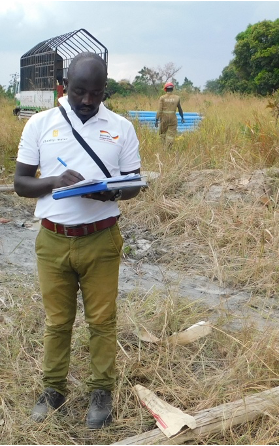
Figure 1: Ayebale Ared on the field (Welthungerhilfe)

From the drilling contractor’s side – overseeing drilling operations

I was fortunate to work with a drilling firm that prioritized quality, accountability, and training. The work culture encouraged flexibility, allowing us to try out different drilling methodologies. One of the most valuable aspects was the emphasis on real-time logging and decision-making based on live site observations. As the overseer of the drilling operations, I had to be physically present in the field, equipped with a laptop, drilling logs, a handheld GPS, a tape measure, a V-notch Weir, a dip meter, an E.C & a pH meter, and a camera, to support real time supervision and technical decisions as drilling progressed.

There was no remote oversight; everything was site-based and collaborative. Communication within the team was strong both for daily updates and for collectively addressing any issues that had financial or technical implications.

Figure 2 (above) Sample box containing drill cuttings (Source: Ayebale Ared)

However, there were limitations.

At the time, our machinery could not compete for larger contracts, particularly those requiring the drilling of production boreholes with casing diameters larger than 5″ internal diameter (ID). While we successfully drilled several open-hole design boreholes, which are suitable for handpumps these cannot be upgraded to accommodate technologies such as solar-powered water systems (SPWS) due to initial design constraints.

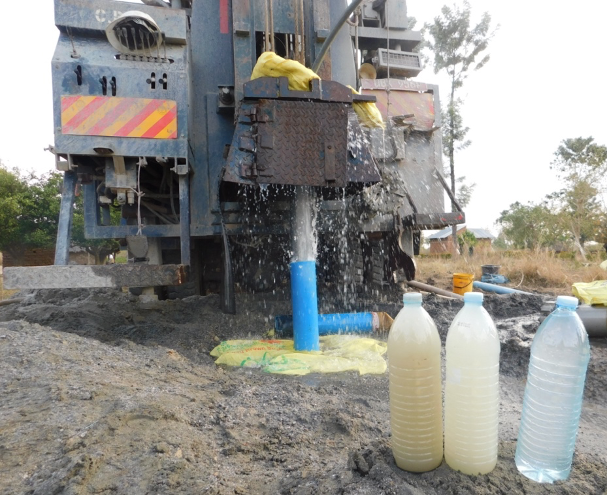
Figure 3 (above) Water Sampling during borehole development showing decreasing turbidity (Source: Ayebale Ared)

From the Client’s Side (INGO) – supervising drilling

Switching to the client’s side offered me the opportunity to work with a range of drilling firms year after year. By then, I had completed the Rural Water Supply Network (RWSN) Professional Drilling and Borehole Management course (2019), and I was actively applying the knowledge in the field. I have worked with drillers with different equipment, resulting in more efficient drilling, constructing cased, rather than open holes. I also have had the chance to mentor and train new supervisors in professional supervision practices, proper borehole logging, and how to make sound real-time decisions at the site.

However, not all experiences have been positive

Remote, or part time supervision is common with a bigger percentage of the drilling firms I have worked with, often resulting in decisions made by drillers to minimize cost rather than address real-time field conditions which are not supervised in the field by the client. Some drilling firms opt for untrained, inexpensive overseers, which undermines the quality of work. As an example, many have no idea what real time logging is but just write a number of pipes and send short video clips to their bosses in office who make remote decisions. This usually becomes a challenge with the client’s supervisor ends up being painted bad as “a bad guy”. Without a qualified client supervisor on-site, the narrative of events can shift dramatically. I’ve observed poor siting practices, with boreholes positioned near anthills or trees leading to complex drilling challenges and post-installation issues such as silting, root intrusion, and compromised water quality. This has been subsequently verified through borehole video inspections and microbial tests. Additionally, poor gravel packing techniques have led to bridging, and inadequate borehole development has left screens poorly cleaned and functioning below standard.

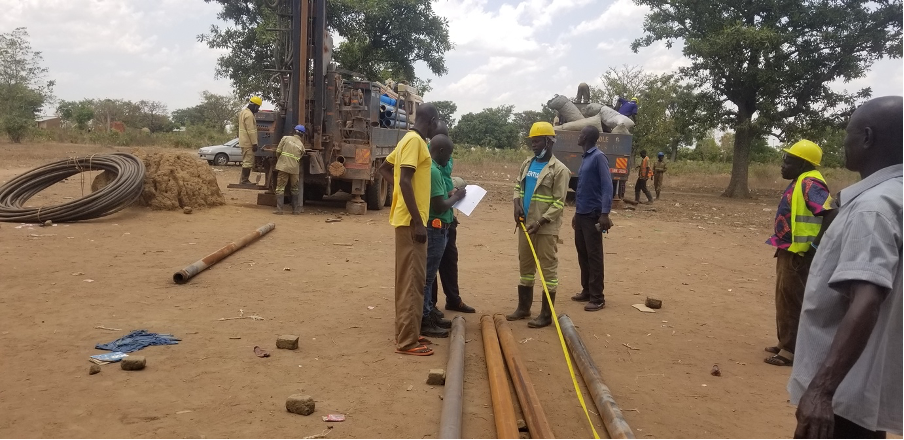
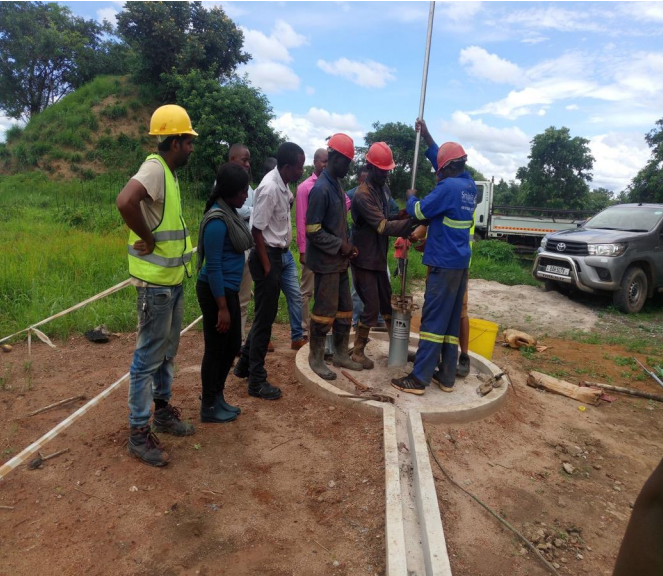
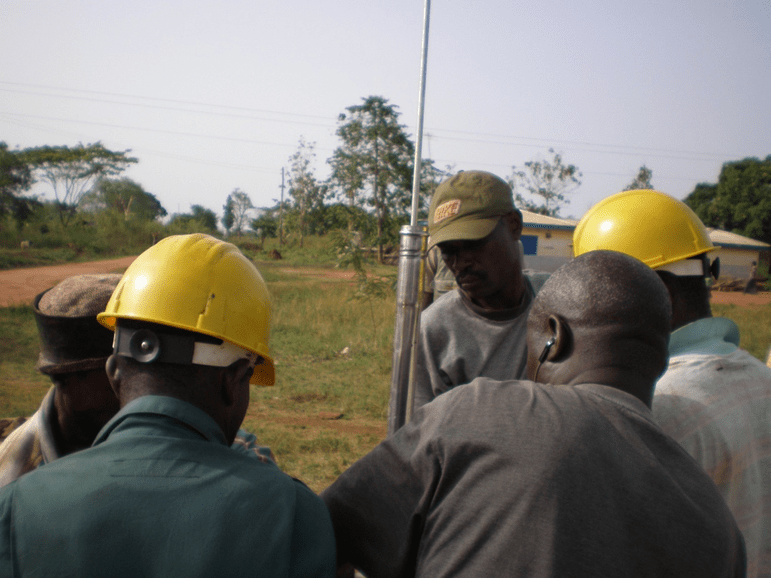
Figure 4 (above) Measuring drill pipe lengths (Source: Ayebale Ared)

These reflections underline the critical importance of professional supervision, well-trained personnel, good oversight by the drilling contractor, and appropriate on-site decision-making throughout the drilling process.

I hope these insights are helpful as we continue to improve and uphold quality in our water supply interventions.

Ayebale Ared has over 10 years of experience in the water sector, specializing in WASH programs, borehole drilling, and rehabilitation in Uganda. He has worked on both the contractor and client sides, gaining a well-rounded perspective on best and worst drilling supervision experiences and practices

Getting infrastructure quality right from the outset – a series of checklists for WASH Funders (and Grantees)

Dr Kerstin Danert, Ask for Water Ltd, Edinburgh, Scotland

High-quality infrastructure design and construction is not the only important concern in relation to rural water supply services, but provides a solid basis. Poor quality infrastructure jeopardises everything that follows – including it the maintenance, and management of the service, and even being able to collect user fees.

There are many reasons why infrastructure ends up not meeting the standards needed. And for the last two decades, the Rural Supply Network (RWSN) has emphasised ensuring that boreholes are properly drilled and completed – with a range of guidance and training materials now widely available – and (I am pleased to know) used!

However, we were mainly writing (or making short films) for people that are implementing projects. With the most recent publication we are addressing a different audience – FUNDERS OF WATER SUPPLY INFRASTRUCTURE.  You may ask yourself why?

Unfortunately, not all funding agencies have the policies in place, nor the checks and balances that consistently foster high-quality infrastructure – whether initial construction and installation, or rehabilitation.  And to make matters worse, well-intentioned policies can actually have negative unintended consequences. Low-per capita investment costs are a case in point – they can be set too low.

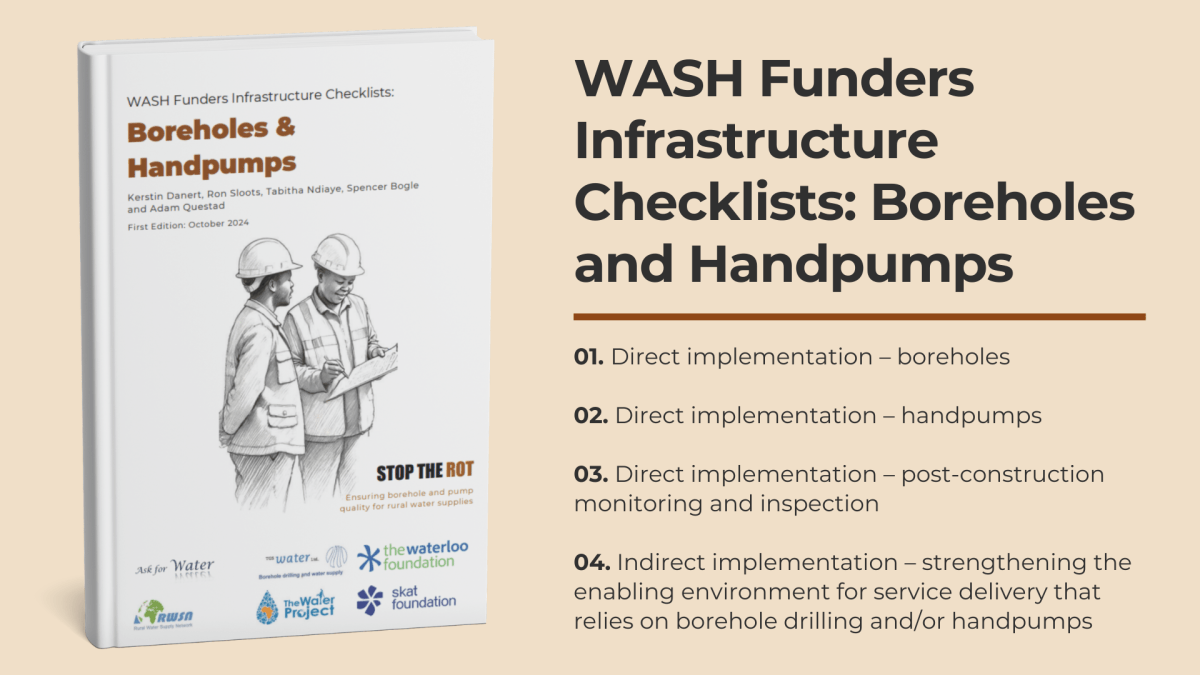
At the end of 2024, RWSN published the WASH Funders Infrastructure Checklists: Boreholes and Handpumps. They start off by recognising that when it comes to infrastructure quality, a number of things can go wrong. Grantees may simply not have the procedures in place, or the capacity to consistently ensure quality or they may not follow suitable contracting procedures. National standards may be lacking, or grantees may cut corners in order to meet Funder requests for an (unrealistic) low budget or fast schedules.

We have developed a series of four checklists – each providing guidance for WASH funders, whether financing direct implementation or systems strengthening activities. We have tried to make the checklists accessible even for those without a detailed knowledge of groundwater, drilling or handpumps. Each checklist is intended to help funders to reflect on their policies and procedures and/or those followed by the respective grantees. 

Please take a look – and do get back to us through ask@ask-for-water.ch with comments feedback.  We would like to keep improving this guidance in the future!

The WASH Funders Checklists were developed under the RWSN Initiative Stop the Rot.

Borehole Drilling Supervision Capacity in Zimbabwe

by Joseph T Njanike

Photo: Supervised Borehole Drilling Project: Collection of Water Samples for Water Quality Analysis at a completed Borehole during the Final Certification Process

As one of the few remaining qualified, experienced, and active drilling supervisors in Zimbabwe, I would like to share experiences on the status of borehole drilling supervision in my country, Zimbabwe.

Drilling Supervision: A Technical Perspective

Rural areas, where the majority of Zimbabweans reside, are mainly serviced through groundwater sources for their water supply needs. The life span for a significant number of boreholes that have invariably become the technology of choice in Zimbabwe has in most cases proved to be short. This has mainly been due to shortcomings bedeviling the drilling and construction process thereby making the professionalisation of the borehole drilling imperative. Borehole drilling supervision, among other factors, is an integral component of the borehole drilling professionalisation process. This requires the hiring of professionals with relevant qualifications and experience to provide adequate supervision of drilling and related operations for the purposes of controlling the quality of work and securing compliance with the design and technical specifications stipulated for the drilling works as well as generating information for making key decisions in terms of on-site design modifications and the final borehole depth. In this context, questions about whether there is sufficient capacity to supervise borehole drilling in Zimbabwe would need some answers.

Professionals have left the country

Most of the qualified hydrogeologists or professionals with a geological background and relevant experience in drilling supervision have migrated to other countries in the Southern Africa region and beyond. This has largely been due to the fact that job opportunities in the groundwater development field in Zimbabwe are scarce.

Continue reading “Borehole Drilling Supervision Capacity in Zimbabwe”

The journey towards reducing the effects of rapid corrosion in Kalumbila District, Zambia

Stop the Rot during ZAWAFE 2023 Zambia – 3/4

This blog is part of a four-part blog series highlighting the presentations delivered during the 11th Zambia Water Forum and Exhibition.  The event, themed “Accelerating Water Security and Sanitation Investments in Zambia: Towards Agenda 2023 through the Zambia Water Investment Programme”, lasted three days. 

Our blog series takes a focused look at the presentations and discussions that revolved around “Addressing Rapid Hand Pump Corrosion in Zambia – Stop the Rot!”, which was co-convened by UNICEF and WaterAid,  together with Ask for Water GmbH and the RWSN, hosted by Skat Foundation. 

Third session:

The journey towards reducing the effects of rapid corrosion in Kalumbila District.

Kalumbila District is a district in the North-Western Province of Zambia. It has two major mines namely Lumwana and Kalumbila Mines.

With a population of over 170,000, the district has about 300 water points (boreholes and protected wells equipped with handpumps). 

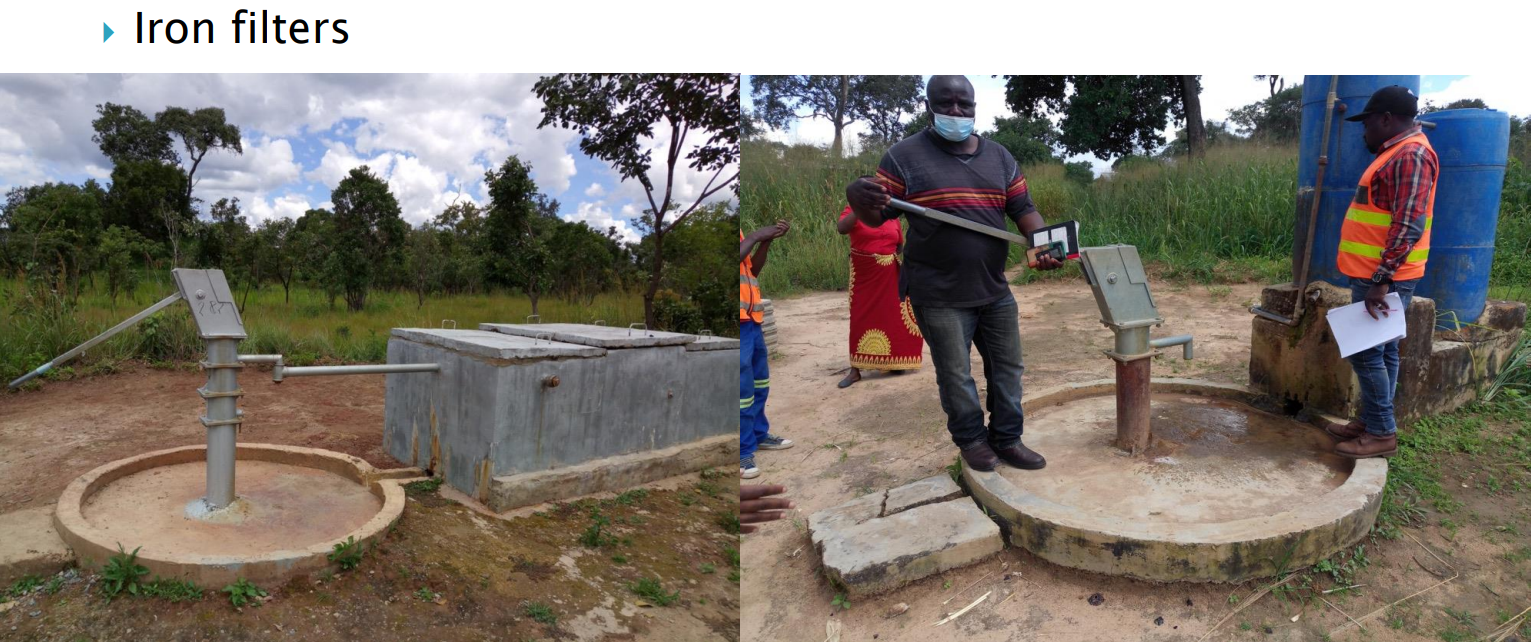
Rapid handpump corrosion has been a problem since the district was created in 2015. One of the interventions that the district has undertaken has been iron removal filters (to remove iron from pumped water), although these have not been sustainable. 

Figure 1: Location of Kalimbula District

In every program of drilling of boreholes about 40% of boreholes were abandoned within one year after handover due to rapid corrosion.

We started looking for a solution to this problem. We found that iron filters were used but were not sustainable. 

Figure 2: Handpump evaluation

One of the interventions that the district has undertaken has been iron removal filters (to remove iron from pumped water), although these have not been sustainable. In Kalumbila District it was found, that in every borehole programme, about 40% of the handpumps installed were abandoned due to high iron content, with some boreholes being abandoned as early as three months after construction and commissioning.

Projects

In 2017 UNICEF supported Kalumbila district in the drilling of 23 boreholes and rehabilitation of 15 water points.  

In 2018 JICA also supported Kalumbila district with rehabilitation of 77 water points using uPVC pipes with stainless steel adapters.  It is from these projects that we learnt a lot of important lessons and made recommendations to the D-WASHE committee.  No water point was abandoned after one year of handover  Kalumbila district decided to suspend the use of galvanised iron (GI) pipes and recommended the use of stainless steel and uPVC pipes for Indian Mark II and Afridev hand pumps. 

Lessons learnt

It is from these two projects that we learnt a lot of lessons, and we told ourselves never to keep quiet. From these two projects, we observed that no water point was abandoned after one year of handover. We saw a solution – why continue to use GI pipes when there was a solution. So we made recommendations to the D-WASHE committee. After this, Kalumbila district decided to suspend the use of galvanised iron (GI) pipes and recommended the use of stainless steel and uPVC pipes for India Mark II and Afridev hand pumps. We have discovered that handpumps with stainless steel riser pipes do not require frequent repair and maintenance whereas sometimes the GI pipes would require replacement every six months. For the past four years, those handpumps remain working. 

Our challenges include a lack of funding for the rehabilitation of boreholes affected by rapid corrosion. Further, some stakeholders have not supported the districts fully. 

Recommendations

  • Stakeholders at the national level take an interest in order to address this issue of rapid corrosion. 
  • The use of materials that are environmentally friendly without change of properties when they come into contact with aggressive water (i.e. materials such as stainless steel and uPVC). 
  • There is capacity building of all Area Pump Menders (APMs) in Afridev hand pumps.
  • All hand pumps that have galvanised iron (GI) riser pipes are to be rehabilitated.

You are invited to access the presentations HERE, along with the session’s concept and report. If you would like to dive deeper into the enriching exploration of water challenges and solutions through the Stop the Rot initiative, visit this page.

About the author:

Daniel Shimanza presenting at ZAWAFE 2023 

Daniel Shimanza is a Zambian Citizen who has worked in the water sector for more than 6 years. He worked on many water supply projects in Kalumbila district, Zambia in collaboration with GRZ, NGOs such as UNICEF, and World Vision. He has a passion for the improvement of access to clean water supply for people living in rural areas. He’s championing a campaign to reduce the effects of rapid corrosion in Kalumbila district by using alternative materials such as stainless steel pipes, PVC pipes, Iron Filters, and more. He holds a Diploma in Water Engineering from NRDC and currently pursuing a Bachelor of Civil Engineering from the Copperbelt University.

Addressing rapid handpump corrosion: the story of the Ghana Modified India Mark II

In 1983, I moved to live and work in Ghana – some 40 years ago now. Back then, I was the regional supervisor on the 3000 Well Maintenance Unit in Southern and Central Ghana which was funded by the German Development Service under the Rural Water Supply programme. The project was a pioneer of its time, and included drilling boreholes alongside the installation and testing of handpumps in six of Ghana’s regions, as well as the Nanumba district, Northern Region.

We initially installed India Mark II and Moyno pumps, before dropping the Moyno due to technical problems. However, we soon realised that the India Mark II pumps faced corrosion issues. Investigation and testing (as documented by Langennegger, 1989 and Langenegger, 1994) found that the Galvanised Iron components (rods and riser pipes), when installed in water with low pH, had a propensity to rapidly corrode – leading to discolouration of the water and affecting taste, but also causing the pumps to fail prematurely as the rods broke and riser pipes developed cracks and holes and even fell into the borehole. The envisaged idea of maintenance by communities, with assistance from mechanics who could reach villages by motorcycle, was simply not feasible with such installations. Another significant issue related to corrosion of hand pump parts was the water contamination and bad taste of the water. As a result, the water coloured the food and therefore caused the  population to stop using the borehole water and forced them to go back to unsafe water sources

We, therefore, had to seek alternatives. This involved field testing and collaborating with the Materials Testing Institute of the University of Darmstadt.

We looked into replacing the galvanised iron components with stainless steel. To ensure the pipes were light, we considered using 3 – 3.5 mm thick pipes, and used a threading that at the time was used in the drilling industry , known as the “rope thread”. Although Atlas Copco had patented this threading type at the time, it was later manufactured in India after the Atlas Copco design period (patent) ended.

Figure 1: Rope thread (Claus Riexinger)

The pump rods presented some challenges as well, since the AISI Stainless Steel grade 316 that we were using was subject to breakage, including the threaded parts. In collaboration with our partners at the University of Darmstadt, we were able to find ways to make this grade of stainless steel more elastic by adding 2-3 % Molybdenum. Other issues with the rods related to the use of rolled thread, which we learned was more durable than cut thread. Incorporating these materials and techniques, we were able to reduce the rod diameter from 12 mm down to 10.8mm, resulting in lighter rods which did not corrode. The only drawback was that the threads could not be cut in the field, but this was not such an issue, as there was no need to cut them when they were installed, or upon maintenance.

Figure 2: Pump installation (Claus Riexinger)

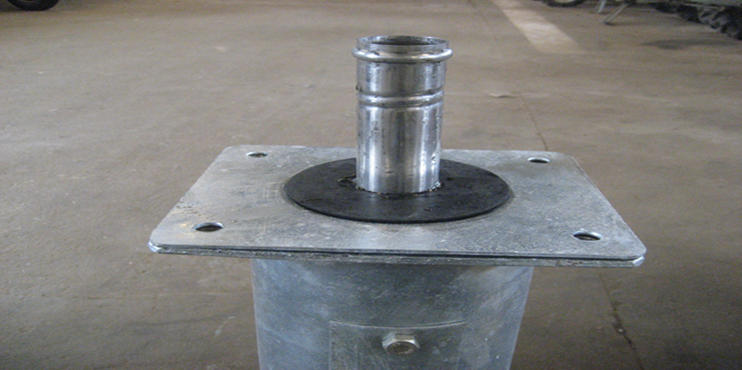
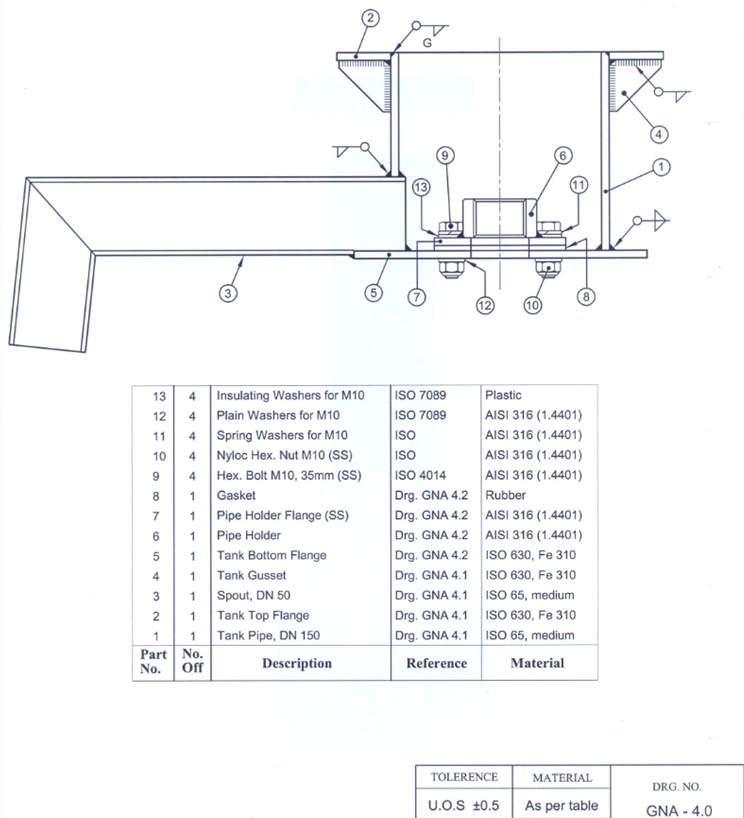
After switching to stainless steel riser pipes, we encountered another issue: -galvanic corrosion between the pipe and the water tank. This type of corrosion occurs when two dissimilar materials come into contact in solution. It was yet another challenge! Fortunately, we were able to solve this problem by replacing the existing flange with a new one made of stainless steel with an insulating gasket, into which the riser pipe could be screwed and prevent any further galvanic corrosion.

Figure 3: Ghana Modified India Mark II Handpump – water tank, spout and flange

After conducting extensive testing and collaborating with the University of Darmstadt over a period of around 4 years, we managed to solve the problem of rapid corrosion of handpumps in Ghana. The improved pump design came to be known as the Ghana Modified India Mark II, and was officially adopted by the Government of Ghana in the 1990s. Its specifications can be downloaded here.

Designing and publishing the specifications for a new pump is one thing, but the other is ensuring that these are adhered to.  A series of meetings with government, donors, and NGOs working in the water sector in the 1990s, led to the agreement to no longer use Galvanised Iron. All stakeholders were on board with the change.

Of particular importance was the tremendous support and buy-in of the major donor at the time – KfW (Germany). They agreed to pay for the increased costs of the Ghana Modified Pump on new installations, which at the time was about three times more expensive than the version using Galvanised Iron.  KfW also supported the rehabilitation and replacement of the pumps that had previously been installed using Galvanised Iron. As a result, we were able to remove and replace the corroded installations systematically, rather than addressing the issue in a piecemeal manner.

It is estimated that over 4,500 Ghana Modified India Mark II handpumps had been installed in Ghana by the time I left the 3000 Well Maintenance Unit in 1992.  Anecdotally, I would say that 90% were working, and of the 10% out of use, they were down for maintenance/repair.

KfW took this design to Cameroon, while Danida took it to Burkina Faso and Zambia. I am not fully aware of what happened next, but I do know that ensuring the quality of stainless steel was a problem in Burkina Faso.

I am very pleased to see that Ghana Modified India Mark II handpumps are now available through the Rural Water Supply Network (RWSN), and hope that these can be of use to other countries that are struggling to overcome the rapid handpump corrosion problem.

Figure 4: Example factory inspection Modified India MKII (Claus Riexinger)

However, I have a work of caution too. Although specifications, standards, and clear procurement documents are essential, they are rendered meaningless in the absence of inspection. During my time with the 3000 Well Maintenance Unit and later as an independent consultant, I traveled to India and other places for pre-shipment inspections. I also oversaw the rejection of consignments from India and Europe due to poor quality or manufacturing mistakes. And so, I urge all of you involved in handpump procurement and installation to make sure that you ensure the quality, especially through inspection and material testing.

Ghana Modified India Mark II Drawings and Specifications

More information about Ghana Modified India Mark II (external website)

About the author: Claus Riexinger is a rural WASH expert and freelance consultant with over forty years of experience in development cooperation with Government organisations, private companies, and development agencies mainly in Botswana, Lesotho, Malawi, Germany, India, Tanzania, and Ghana.

Photo credits: Claus Riexinger

Online learning on groundwater – strengthening capacity in African member states and beyond

Professional Drilling Management & Groundwater Resources Management

Thanks to funding from the Federal Institute for Geosciences and Natural Resources (BGR) in Germany, 2022 saw Ask for Water GmbH, together with the Africa Groundwater NetworkCap-Net UNDP and several other partners (see below) develop and run two online courses on groundwater. The courses strengthened the capacity of staff of governments, NGOs, the private sector and academia in African member states and beyond. 

The courses, hosted by Cap-Net UNDP, and offered free of charge to participants, were entitled Groundwater Resources Management and Professional Drilling Management. Each course was specifically developed for professionals working on these issues, or responsible for decision making.

Face to face training course on drilling supervision
in Sierra Leone (Source: Kerstin Danert)

Professional Drilling Management Course

Drilled water wells are vital to achieving universal clean drinking water, providing safe, affordable, reliable and available water sources. To ensure that the water wells or boreholes are built to last, they must be drilled, developed and completed in a professional manner. Key elements of a professional drilling sector are robust procurement, contract management, siting, borehole design, construction, and supervision. Furthermore, the management of the groundwater resources must also be considered and support provided to long-term maintenance if services are to last. Unfortunately, in many countries it is difficult to develop skills in these areas due to a lack of training and mentoring opportunities.

The 2022 online course on Professional Drilling Management provided participants with a comprehensive overview of the different aspects of drilling management, specifically (i) groundwater data and siting; (ii) procurement and contract management (including costing and pricing; (iii) borehole drilling and supervision and (iv) legal and institutional frameworks. In the last of five modules, participants were encouraged to reflect upon and share actions that they as individuals and as organisations could take to raise drilling professionalism in the context in which they work. From the 781 people who applied for the course, 314 were selected, of which 209 were active participants. A total of 162, equivalent to 78% of the active participants passed the course. 

You can access the 2022 course report, manual and key training materials here.

If you would like to learn about what alumni of previous online courses on Professional Drilling Management have done with their knowledge, check out the short film below or the short report of their testimonials.

Groundwater Resources Management Course

An estimated 50% of the global and 75% of the African population rely on groundwater for their drinking water supplies. Groundwater supports social and economic development and will become increasingly important in the face of climate change, as groundwater resources are often less affected than surface water by climate change impacts. If groundwater is to provide reliable, safe and sustainable water supplies now and for future generations, the resource must be well-managed. This requires consideration of the entire system of policies & laws, strategies & guidance, monitoring & management as well as investments & projects. Good groundwater management needs sound capacities in water authorities. But at same time, as many elements of groundwater management fall in other sectors, a general understanding of groundwater management principles in sectors like agriculture and urban planning is key for its successful implementation. 

The 2022 online course on groundwater resources management provides participants with a comprehensive overview of the multiple factors that impact upon groundwater. It was a self-paced course and was hosted on the virtual campus of Cap Net/UNDP.

The course comprised 5 modules; each with a short introduction, goal, learning objectives and orientation video, as well as mandatory videos and reading materials: 

  • Module 1: Characterization of Aquifer Systems from a Management Perspective
  • Module 2: Groundwater monitoring and data/information management & communication
  • Module 3: Groundwater quality and source water protection
  • Module 4: Groundwater regulation, licensing, allocation and institutions for aquifer management
  • Module 5: Transboundary aquifers in Africa: Approaches and mechanisms

You can access the 2022 course report, manual and key training materials here.

Artesian well near Lake Chad, Chad
(Source: Moustapha Diene

What next?

The Rural Water Supply Network (RWSN), Ask for Water GmbH, the Africa Groundwater Network (AGW-Net), Cap-Net UNDP and partners would like to offer these courses on an annual basis. We are currently looking for sponsors/funders to make this possible. In case you are interested, please contact us via  info@rural-water-supply.net.

Should we manage to get these courses off the ground, we will announce them through the Africa Groundwater NetworkCap-Net UNDP and the Rural Water Supply Network as well via LinkedIn.

Funded by

Partners

The need for professional associations for water well drillers

This is a guest blog by RWSN Young Professional Uyoyoghene U. Traoré, geologist and freelance consultant in water and environment. This article was originally published in GeoDrilling international and is reposted with thanks. You can read the original article here.

Groundwater accounts for over 97% of the world’s fresh water with over two million people depending on it for their Survival. In Africa, it is estimated that groundwater provides over 75% of the population with a drinking water supply, and has been said to be essential in securing equitable water access for the rural and urban poor around the world. It has been established that groundwater has a major role to play in achieving the Sustainable Development Goal (SDG) for drinking water. Though very important, groundwater is not properly captured in national or international monitoring. As an unseen resource, it is easily forgotten, making it undervalued and not properly managed.

As an entry point towards the progressive and effective management of groundwater, I undertook a study on the challenges of water well drillers and drillers association in six countries – Angola, Burkina Faso, Mozambique, Nigeria, Uganda and the United State of America was carried out. I tried to understand groundwater issues within these countries from the perspective of drillers themselves. Drillers are in direct contact with the resource, and some have recognised the importance of having a drillers association.

As at the time of the study (2019) only three water well drillers association exist and were active only in Nigeria, Uganda and the USA. In the case of the others (inactive), there is an informal working group in Angola, an organised body in Burkina-Faso and Mozambique.  Where they exist, drillers associations were an entry point to support national, international and local partners in groundwater management, were able to advocate and lobby for sustainable policies and realistic contracts. They also sensitised the public on the resource and helped reduce the presence of unqualified drillers from the sector.

In the study, I identified eight main challenges for water well drillers, namely – capacity, contracts and standards, procurement, finance and payment, corruption, data, logistics, and the availability of spare parts. I also learned about the advantages and disadvantages of having an association, as well as what makes them successful or not. A lack of clarity with respect to groundwater policies, and a lack of capacity by national institutions to implement policies or engage in groundwater monitoring was apparent in four (Angola, Burkina Faso, Mozambique and Nigeria) of the six countries.

So, what did the study reveal?

  • With the exception of the USA, there is a lack of capacity of drillers and national institutions in the countries studied. Drillers often lack the capacity to drill water wells in a sustainable way. In most of the cases, this is due to the absence of dedicated training institutions on groundwater issues or the inability of organised drillers association to engage in the development of its members.
  • Poor contract management, lack of transparency and corruption in procurement processes were mentioned. These have adversely affected the quality of drilled wells leading to a short lifespan of these wells. “Turn- key contracts” (Burkina Faso & Uganda), “No water no pay principle” (Mozambique & Nigeria) and “the gentleman’s agreement” (Angola) are some forms of poor contract identified. The client passes all, or most of the risk of finding water to the drillers – even in places where good groundwater resources are not easy to find.
  • Delayed payments by clients poses danger to the long-term viability of drillers’ businesses. This is a particular challenge in countries where the government is the major client (Angola, Burkina Faso, Mozambique and Uganda).
  • The absence or lack of groundwater data means underestimation of prices of drilling in certain terrains as well as drilling with uncertainty. The USA and Uganda are the only two countries with some form of groundwater data.
  • Drillers associations struggle to sustain themselves on a long term due to lack of finance resulting from low membership. In Mozambique and Burkina Faso for example, some drillers still do not see the need for an association while, there is no dedicated member to run the informal working group in Angola.
  • It was noted that there is a lack of transparency in existing associations except the USA. Leadership find it difficult and costly to be accountable to members and non-members alike.
  • Except for the USA, and more recently Uganda, the associations have not been able to engage in continuous capacity building, or training programs for its members. This has been identified as mainly being a result of lack of funds.

A major concern observed is the future of groundwater. In all six countries studied, it was found that there are very few or no young professionals in the field. This indeed put the future of groundwater development at a very high risk. In addition, very few women were observed to be in the profession.

From my work, I have two sets of recommendations:

  • In the short term, it is imperative that drillers association in other countries be investigated. Prioritise the establishment of drillers associations in countries where there are none and support rekindling inactive ones. The capacity of drillers and national institutions should be strengthened – advocate for compulsory internship programs on a continuous basis. Also, develop school curriculum on water with emphasis on ground water. Create a global platform for young professionals dedicated to training, learning, including internships with local firms.
  • In the long term, there is need to create a global platform for drillers, experts and institutions working on groundwater water issues in collaboration with existing institutions to learn and share best practices. Develop in study and exchange programmes, including creating mechanisms for international internships and volunteering.

I hope, that my study will help to inspire developmental organisation, funders, national institutions and above all drillers themselves to recognise the importance of using professional drillers and to support, and collaborate with water well drillers associations.

The study was carried out by Uyoyoghene U. Traoré as a volunteer for the Rural Water Supply Network (RWSN) under its 2018-2023 young professional engagement strategy. The full study can be downloaded here.

Ugandan drillers receive training at the Water Resources Institute

Being back in Uganda again after an absence of five years gives me immense joy. This country of warmth, friendliness and humour, where one can literally have an engaging conversation with anyone, whether askari (guard), taxi driver, fruit and vegetable seller, driller or civil servant. Thus, my few days here have been filled with shared laughter and kaboozi (Luganda for conversation or gossip, but the word conveys so much more).

My visit to Kampala has coincided with the first day of a three-day training entitled “Practical Skills in Drilling” by Uganda’s Water Resources Institute. The training is for 25 drillers and assistant drillers, and comprises a classroom day, followed by two days in the field. As we sit waiting for the training to commence, I ask the participants (all men so far) why there are no women drillers. We talk about the man’s world of drilling (stamina needed), and the women’s world of fetching water (stamina needed). The discussion is engaging and together we reflect on the role of women and men in society and the home. For my side I feel proud to be one of the few women involved in drilling and talk about the two manual companies that I have heard about in Zambia which are run by women. On the spot, I really wish that there were many more of us….

The training commences. The course is a collaboration between the Ministry of Water and Environment (MWE) Water Resources Institute (WRI) and the Uganda Drilling Contractors Association (UDCA). The Chair of the Association, Dr Flavio Pasqualato from Draco (U) Ltd., gives a his opening words of encouragement, followed by the Managing Director, Anthony Luutu of Aquatech Ltd. I am invited to say a few words, and express my delight at seeing training of drillers that I wish was happening on a regular basis in ALL countries on the African continent and beyond.

Training 1

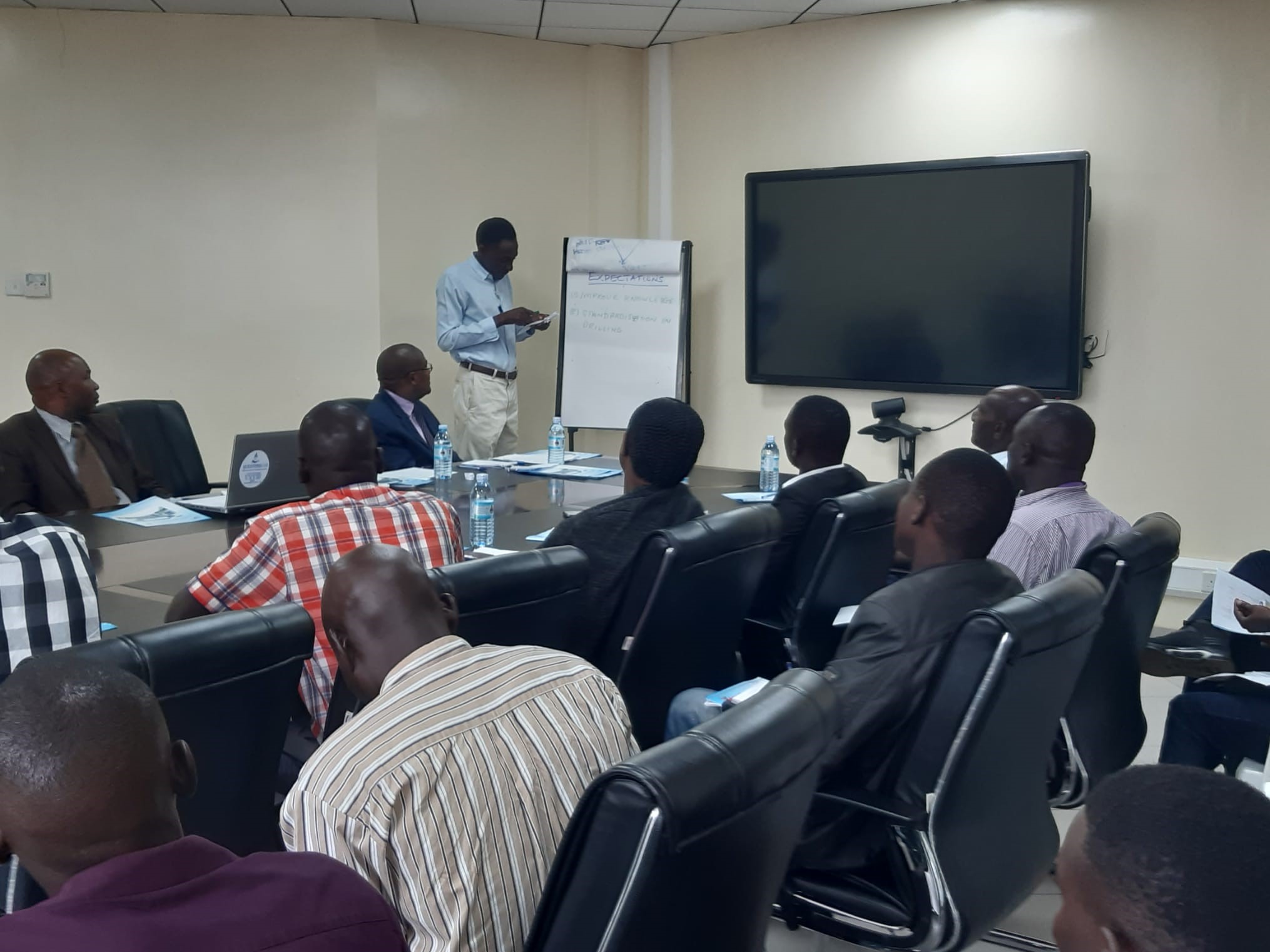
Gracious Sembali systematically collects the expectations of the participants

Dr Callist Tindimugaya (MWE) officially opens the training, pointing out that when people are learning informally from each other, that the message will change over time. I think of the game of Chinese whispers and vow to include it as an icebreaker at the start of my next drilling training course make his point. Callist also adds that “Nobody has all the knowledge; you can learn from each other”, something that is key in adult education.

Training 2

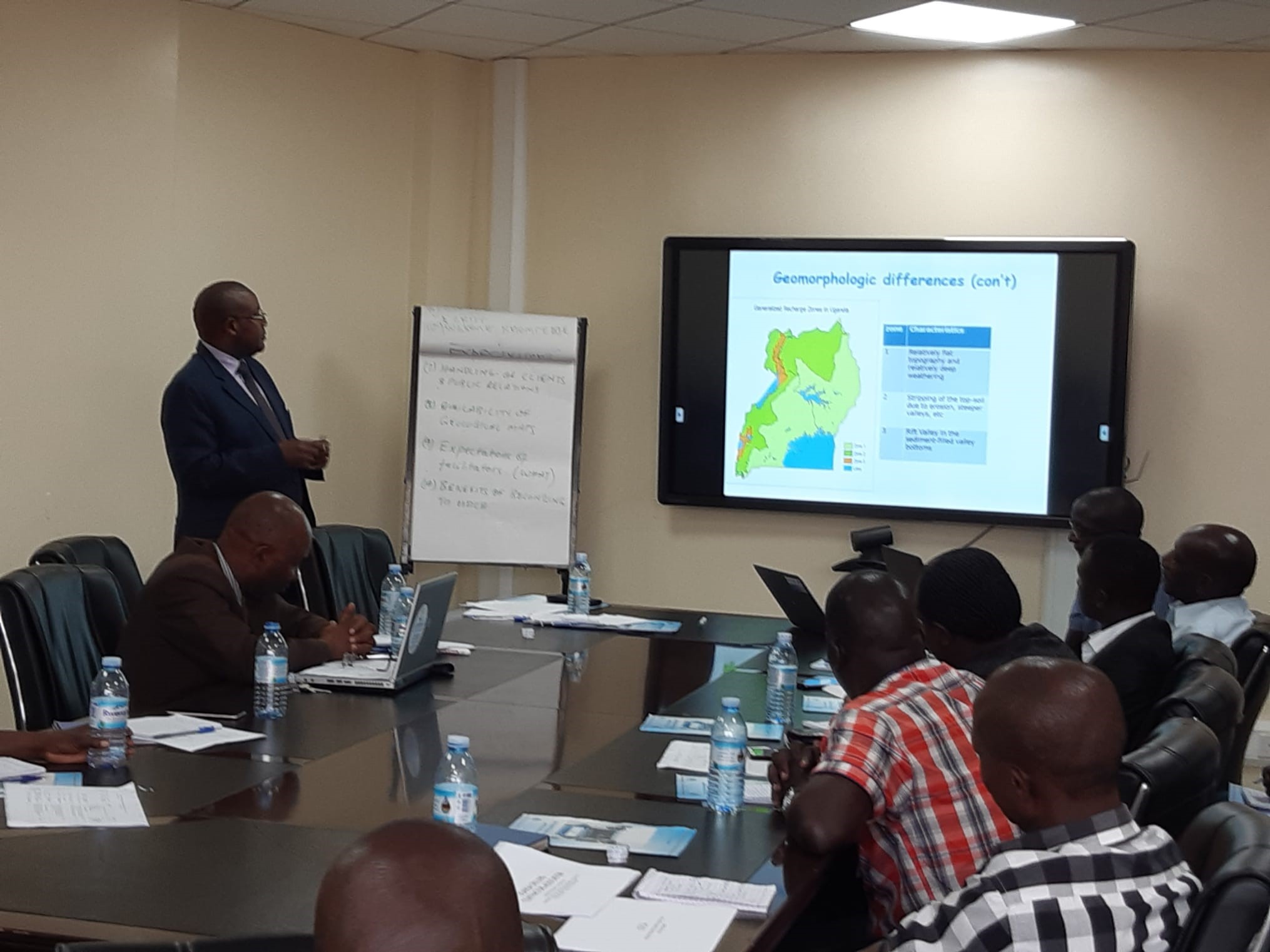
Dr Callist Tindimugaya explains the hydrogeology of Uganda to participants

Trying to raise drilling professionalism is a significant undertaking, and I am struck by the pragmatic messages that Callist conveys to all of us. “If you and your colleagues are doing a good job, you will raise the respect for drillers in Uganda…..we want drillers to be seen as serious and doing good quality work”.

It is clear that the training that the institute has been undertaking has had an effect on training methods. Gracious Sembali from Hippo Technical Services systematically collects the expectations of the participants, and writes them up on a flip chart, carefully grouping them:

  1. Improve knowledge and skills (e.g. when to stop drilling, mud drilling techniques, formation collapse, drilling in sediments)
  2. Standardisation in drilling
  3. Knowledge of different formations
  4. Certification as a driller by UCDA
  5. Knowledge-sharing including experiences
  6. Hydrological aspects and siting
  7. Handling of clients and public relations
  8. Availability of geological maps
  9. Expectations of facilitators
  10. Benefits of UCDA membership and recognition

As I listen, I am struck by the number of issues that are beyond the training course itself, something I have also observed in the course I have run, or managed. The specific skills sought and wider concerns are intertwined.

Alas, I am only able to attend the first presentation, an overview of Uganda’s geology and hydrogeology. I learn a lot, and observe the participants taking notes, and later asking questions. There is so much to be learnt, and the eagerness of these drillers and assistant drillers is apparent. I am delighted at what I see, encouraged, and then start thinking about the number of drillers on the African continent, and that this is needed for all. I try not to get disheartened. There are national training institutes undertaking short courses like these, or longer courses in Nigeria and Ethiopia. In some countries, people are more than aware of the need, and the demand, but are looking left and right for funding, without success. I am glad to have run similar courses, but am so aware that to date these have been ad hoc.

So my closing words? A huge thank you to the Ministry of Water and Environment’s Water Resources Institute and the Uganda Drilling Contractors Association (UCDA) for what you are doing. It is inspirational.

Now, how can training in drilling professionalism be institutionalised elsewhere?

Photo credits: Dr Kerstin Danert.

Corrosion de la pompe à main et qualité des matériaux : Un défi pour le Burkina Faso et le reste du monde

Au Burkina Faso, le nombre élevé de forages équipés d’une pompe à motricité humaine (PMH) qui dysfonctionnent ou qui nécessitent de grosses réparations quelques années seulement après leur construction est alarmant. Les audits techniques effectués en 2013 et 2014 au Burkina Faso sur des forages équipés de PMH ont révélé des situations préoccupantes en termes de qualité de l’eau, de matériel inadapté aux profondeurs des puits et de pompes non-conformes. Dans plus d’un tiers des cas, les forages équipés de PMH dysfonctionnent ou deviennent même totalement inutilisables en moins de quelques années. Entre 0.6 milliards de FCFA (0.9 million d’€) et 2.9 milliards de FCFA (4,5 millions d’€) d’investissements annuels seraient ainsi perdus du fait de l’installation de PMH de qualité médiocre et de diverses malfaçons lors des travaux de construction. Chaque année, plus de 130 000 personnes bénéficient d’un service d’approvisionnement en eau dont la pérennité n’est de ce fait pas assurée au-delà des premières années.

La corrosion des PMH est un phénomène connu depuis plus de 30 ans ; elle demeure pourtant un problème majeur au Burkina Faso car les gouvernements successifs et les agences d’aide au développement ont continué d’installer des pompes fabriquées à partir de matériaux inadaptés. Ces pratiques ont généré des coûts d’entretien élevés, de multiples pannes et le rejet de nombreux points d’eau par les communautés car l’eau y était de mauvaise qualité. La corrosion des PMH est un problème mondial majeur, dont le secteur EAH ne s’est jusqu’à présent toujours pas saisi à sa juste mesure, et qui risque d’empêcher la réalisation de l’Objectif du Développement Durable n°6 au Burkina Faso comme dans d’autres pays. Sur les forums de discussion en ligne du Réseau pour l’Approvisionnement Rural en Eau (RWSN), les experts internationaux font notamment remonter comme principales préoccupations à ce sujet : des matériaux et des pièces composantes de qualité inadaptée, un manque de contrôle qualité, des prix anormalement bas, et des pratiques d’achat et de commande problématiques.

Une enquête sur la qualité des composants des pompes manuelles au Burkina Faso a été lancé début 2017. Des échantillons de la conduite principale montante et de la tige de la pompe ont été achetés auprès de fournisseurs à Ouagadougou, et d’autres échantillons provenaient de pompes en service ou abandonnées. Tous les échantillons ont été testés pour leur composition chimique. En 2019 des tests de composition chimique ont été réalisés sur l’ensemble de ces échantillons. L’analyse des résultats de ces tests révèle que : cinq des six colonnes d’exhaure et deux des quatre tringles ne sont pas conformes aux normes internationales de composition de l’acier inoxydable du grade indiqué. La faible teneur en nickel de ces échantillons signifie notamment que les pièces analysées ont en réalité une résistance à la corrosion moindre que celle qu’elles devraient avoir si elles étaient effectivement du grade indiqué.

Les 13 pièces composantes qui ont été testées dans le cadre de cette étude forment un trop petit échantillon pour s’avérer statistiquement représentatives de la situation du Burkina Faso dans son ensemble.  Cet échantillon corrobore toutefois les inquiétudes du Gouvernement et des foreurs. Il y a quelque chose qui ne va pas avec certains composants disponibles sur le marché, malgré le fait qu’ils soient vendus comme étant de l’acier inoxydable. L’ampleur du problème reste inconnue à ce stade au Burkina Faso ou dans d’autres pays. Comme le montre ce rapport publié par la Fondation Skat, le constat est celui d’un échec du « marché » à fournir systématiquement des matériaux de haute qualité. Afin de rectifier cette situation, il est nécessaire de trouver des solutions à la fois au sein des pays d’importation, comme le Burkina Faso, et au niveau international.

Cette étude rapide a révélé pour le Burkina Faso et au-delà une série d’enjeux interconnectés:

  1. Il est nécessaire de poursuivre les recherches sur l’utilisation des pièces composantes en acier inoxydable afin d’éviter la corrosion des pièces de PMH immergées dans des eaux souterraines agressives.
  2. La norme indienne pour les modèles India Mark II et III comprend quelques erreurs, et aucune option n’est proposée pour les cas d’eaux souterraines agressives. Les normes internationales (notamment celles publiées par SKAT/ Le Réseau pour l’Approvisionnmenet Rural en Eau-RWSN) portant sur les matériaux des pièces de PMH adaptés aux eaux souterraines agressives pourraient être améliorées.
  3. De nombreuses entreprises en Inde vendent des PMH et des pièces de modèles India Mark II et III. Les prix de vente pratiqués par certaines de ces entreprises sont si bas qu’il semble impossible que la qualité de ces pompes et pièces soit conforme aux normes internationales.
  4. Il n’existe aucun organisme international chargé de contrôler systématiquement la qualité des matériaux de PMH, et le rôle et l’activité du Bureau de Normalisation International à ce sujet ne sont pas clairs ni évidents.
  5. Lorsque les PMH sont achetées dans le pays où elles doivent être installées, la longue chaîne d’approvisionnement (souvent anonyme de surcroît du fait de la multiplicité des intermédiaires) fait qu’il n’existe pas ou peu de lien entre les fabricants (situés majoritairement en Inde) et les installateurs des PMH en question. De plus, l’absence de compilation systématique des problèmes rencontrés préalablement signifie que les agences, les entreprises et les ménages s’engagent dans l’installation de PMH sans saisir l’ampleur de ces soucis de qualité et ne s’en rendent compte que trop tard.
  6. De nombreuses PMH utilisées en Afrique sont importées d’Inde (et visiblement du Nigéria également), donc les efforts menés pour résoudre cet enjeu de garantie de qualité doivent absolument inclure l’Inde ainsi que plusieurs pays africains.
  7. L’intérêt des financeurs pour l’équipement des PMH est probablement actuellement au plus bas depuis 30 ans, il s’avère donc très difficile de mobiliser à grande échelle pour développer un processus de certification internationale ou financer davantage de recherches à ce sujet. Une telle initiative nécessiterait d’une part des investissements supplémentaires et d’autre part des engagements de long terme de la part des principales agences et des gouvernements qui financent et mettent en œuvre des programmes d’installation et d’entretien de PMH.

Nous espérons que cette courte étude attirera l’attention des gouvernements, des organismes de recherche et des agences internationales d’aide au développement et les incitera à travailler sur la résolution des problèmes pressants que sont la corrosion et la mauvaise qualité des pièces composantes des PMH. Si rien n’est fait la communauté mondiale de l’approvisionnement en eau, par négligence ou désintérêt, prive de fait les populations rurales du Burkina Faso et d’ailleurs des bénéfices d’un approvisionnement en eau élémentaire et fiable.

L’étude complète peut être téléchargée ici : Qualité et corrosion des pièces composantes des Pompes à Motricité Humaine au Burkina Faso et au-delà (anglais et français)

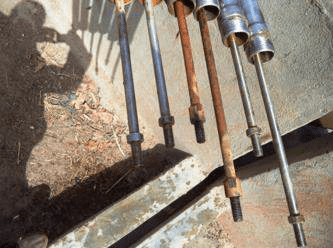
Crédit photo: Colonnes montantes corrodées photographiées au Burkina Faso dans le cadre de l’audit d’équipements d’approvisionnement en eau in situ. (Kerstin Danert)


Handpump corrosion and material quality: A challenge for Burkina Faso and globally

In Burkina Faso, concerns have been raised regarding the high number of handpump boreholes that have failed, or need to be rehabilitated within a relatively short time of their initial construction. Physical audits of handpump boreholes in 2013 and 2014 raise concerns over water quality, inappropriate handpump for deep water and non-conformant pumps. In more than one third of cases, the handpump boreholes will function poorly, or cease to function completely within a few years. It is estimated that investments of between FCFA 0.6 billion (€0.9 million) and FCFA 2.9 billion (€4.5 million) per year are lost due to the installation of poor quality handpumps and other aspects of the construction. In one year, over 130,000 people were provided a water supply service that is likely to break down within a few years.

Despite knowledge of handpump corrosion for over 30 years, it remains a problem in Burkina Faso, as governments and aid agencies have continued to install pumps manufactured with unsuitable materials, leading to high maintenance costs, pump failure and rejection of water sources due to poor water quality. Handpump corrosion is a major global problem which the WASH sector has so far, systemically failed to address, and which will impede the realisation of Sustainable Development Goal 6. Concerns cited by experts from a range of countries on the Rural Water Supply Network (RWSN) online discussion platforms include the following: inadequate quality of materials and components, lack of quality control, unrealistic (low) prices and problematic purchasing practices.

A renewed call to investigate the quality of handpump components in Burkina Faso was raised in early 2017. Samples of the rising main and pump rod were purchased from suppliers in Ouagadougou, and additional samples were from pumps in use or abandoned. All samples were tested for their chemical composition. Analysis showed that of the samples, five of six riser pipes, and two of four pump rods did not conform to international standards for the composition of stainless steel of the specified grade. In particular, the low nickel content means that the components have less corrosion resistance than they would if they were of the specified grade.

The small sample size of 13 components tested in this study is not a statistically representative of the situation in Burkina Faso as a whole but it verifies concerns raised by the Government and drillers themselves. Something is not right with some components available on the market, despite the fact that they are being sold as stainless steel. What we do not know is the extent of the problem, in Burkina Faso, or other countries. What is being witnessed, as documented in the new study published by Skat Foundation, is a failure of “the market” to guarantee high quality materials. Addressing this failure requires solutions from within importing countries, such as Burkina Faso, but also internationally.

This short study has shed light on a number of interconnected issues for Burkina Faso and beyond including:

  1. There is no international body systematically controlling handpump material quality.
  2. The need for further research on the use of stainless steel components to prevent the corrosion in aggressive groundwater is needed.
  3. Many of the handpumps used in Africa are imported from India (and apparently Nigeria too). There is often no connection between manufacture (primarily in India) and installation of the pump (in African countries). Agencies, companies or households installing handpumps are not aware of the extent, and scale of quality problems until it is too late.
  4. Donor interest in handpump hardware is arguably at its lowest in 30 years, and so galvanising interest to develop an international certification process or fund research is extremely difficult. Such an initiative would require not only investment, but also long-term commitment from the large agencies and governments that fund and implement programmes installing handpumps and their maintenance.

It is hoped that this short study will trigger interest by governments, and by research organisations, and international development agencies to explore ways to solve the problems of corrosion and poor quality handpump components. If this is not done, by inadvertent neglect, the global water supply community is arguably preventing rural populations in Burkina Faso and beyond from the benefits of a reliable, basic drinking water supply.

The full study is available for download here: Concerns about corrosion and the quality of handpump components in Burkina Faso and beyond (English and French).

Photo credit: Corroded rising mains being photographed as part of a physical audit of water facilitiesin Burkina Faso (Kerstin Danert).