Comment attirer les meilleurs, ou pourquoi certains consultants et entrepreneurs de forage expérimentés ne sont plus disposés à travailler pour le gouvernement local du district

Il s’agit du troisième d’une série de quatre blogs intitulée ‘Le forage professionnel de puits d’eau: Apprendre de l’Ouganda” de Elisabeth Liddle et d’un webinaire en 2019 sur le forage de puits professionnel. Cette série s’appuie sur les recherches menées en Ouganda par Liddle et Fenner (2018). Nous vous invitons à nous faire part de vos commentaires en réponse à ce blog ci-dessous.

Plusieurs rapports récents ont remis en question la qualité des forages en cours de construction en Afrique subsaharienne rurale (UNICEF/Skat, 2016, Bonsor et al., 2015; Anscombe, 2011; Sloots, 2010). Pour implanter et construire des forages de haute qualité être, un personnel qualifié et expérimenté doit être en mesure d’effectuer ces travaux. Des recherches récentes en Ouganda montrent qu’un certain nombre de consultants et d’entrepreneurs en forage parmi les plus expérimentés en Ouganda (ceux qui sont en activité depuis quinze à vingt ans) ne sont plus disposés à être engagés pour des contrats de collectivités locales de district (Liddle and Fenner, 2018). Ceci est préoccupant, étant donné que les projets des collectivités locales de district représentent 68% des nouveaux forages profonds forés au cours de l’année fiscale 2016/17 (MWE, 2017).

Dans ce blog, j’explique pourquoi ces consultants et entrepreneurs en forage ne sont plus disposés à travailler pour les districts.

1. Les prix sont trop bas

Un certain nombre de consultants et d’entrepreneurs de forage interrogés ne sont tout simplement pas satisfaits des prix que les collectivités locales de district sont prêtes à payer par rapport aux organisations non gouvernementales (ONG). Les consultants interrogés, par exemple, ont déclaré que les districts sont généralement disposés à payer de 1 à 2 million d’UGX (276 $US – 552 $US [1]) pour l’implantation et la supervision, tandis que les ONG sont généralement disposées à payer de 2,5 à 3,5 millions d’UGX (691 $US – 967 $US) pour le même travail. Le prix que les districts sont prêts à payer n’est apparemment pas réaliste et, en conséquent, ces consultants ne seraient pas en mesure de réaliser un travail de qualité. Les mêmes problèmes ont été signalés chez les foreurs qui ne sont plus disposés à travailler pour les autorités locales du district. Ces consultants et foreurs ne sont pas prêts à réaliser des points d’eau inférieurs aux normes pour les communautés du fait de ces bas prix, à prendre des raccourcis dans leur travail, ou à ternir la réputation de leurs entreprises.

2. Usage abusif des modalités de paiement forfaitaire “pas d’eau, pas de paiement”

Comme l’explique le blog “Contrats clés en main pour l’implantation et le forage de puits d’eau“, l’utilisation de contrats clés en main est fréquente en Ouganda: sur les 29 organisations interviewées au cours de cette recherche, 26 organisations travaillaient avec le secteur privé dans le cadre de contrat de forages, et 19 rémunéraient les foreurs pour l’implantation et le forage à travers des paiements forfaitaires “pas d’eau, pas de paiement”. Il est typique selon ces modalités de paiement que le foreur ne soit pas payé, si un forage échoue (si il est à sec ou à faible rendement). Si le forage est réussi, le foreur doit recevoir le prix forfaitaire total, quels que soient les coûts engagés sur place. Un certain nombre de districts, cependant, s’écartent des normes de paiement forfaitaire “pas d’eau, pas de paiement”. Au lieu de payer la totalité de la somme forfaitaire comme ils devraient le faire, ils ne paient que pour le travail réellement effectué et les matériaux utilisés (connu sous le nom de paiement au devis (BoQ) ou paiement ‘admeasurement’ en Ouganda). Bien que cela puisse être spécifié dans le contrat de forage, cela reste inquiétant, étant donné la prémisse sur laquelle les modalités de paiement forfaitaire “pas d’eau, pas de paiement” est basée: même si les foreurs perdent de l’argent sur les forages infructueux, ils devraient être en mesure de récupérer ces coûts à travers les sommes forfaitaires qui leur sont versées pour les forages réussis. Sans un paiement forfaitaire intégral, les foreurs sont incapables de recouvrir leurs pertes.

3. Les pots-de-vin pendant le processus d’appel d’offres

Les demandes de pots-de-vin seraient fréquentes lors des appels d’offres pour des contrats de collectivités locales de district. Lorsqu’un pot-de-vin est exigé, les consultants et les foreurs ont du mal à rendre compte de ce coût : s’ils en tiennent compte dans leur devis, leur devis sera trop élevé et ils ne gagneront donc pas le contrat. Si, toutefois, ils ne tiennent pas compte du prix du pot-de-vin dans leur devis, le consultant ou le foreur devra alors récupérer ce coût à un moment donné, généralement en effectuant un travail de mauvaise qualité sur place. Si les consultants et les foreurs ne veulent pas travailler dans ces conditions, ils ne soumissionneront pas.

4. Les retards de paiement

Recevoir un paiement intégral de la part des districts pour les travaux achevés peut être difficile: plusieurs entrepreneurs de forage signalent que dans certains cas, ils ont dû attendre plus d’un an pour recevoir leur paiement intégral. Cela rend les affaires difficiles. Il est beaucoup plus facile de ne travailler que pour des ONG qui ont la réputation de payer à temps.

Les citations suivantes aident à illustrer les problèmes ci-dessus:

«Mais je vous le dis, ces dernières années, je n’ai pas soumissionné pour un contrat avec le district, car le processus de candidature est tellement ridicule. Vous savez, ils savent déjà qui va remporter le contrat avant même de l’annoncer … Et les termes et conditions du contrat sont très défavorables au foreur … Je n’ai donc pas foré pour le district depuis cinq ans, rien ne garantit qu’ils nous paieront, ce n’est pas un modèle commercial viable pour nous… Ils paient seulement à temps dans 50% des cas. Même si le forage a réussi, ils diront: Nous n’avons pas d’argent, nous devrons payer le prochain trimestre. Parfois, cela dure depuis un an. Avec un district, il a fallu 14 mois pour que je sois payé une fois… La garantie de recevoir un paiement est frustrante» (Entrepreneur de forage).

«Je crois fermement que la passation de marché est seulement une procédure pour la plupart des projets. Dans la plupart des cas, les districts signent des contrats après que le soumissionnaire leur ait donné de l’argent pour celui-ci. Alors, disons que c’est un contrat de 100 millions, ils voudront 20 millions lors du processus d’appel d’offres. Ce problème concerne les districts, pas les ONG, ni le ministère … J’ai donc arrêté de forer pour les districts, c’était trop cher» (Entrepreneur de forage)

«Je n’aime pas travailler pour le district. Pour être honnête, ils sont tout simplement corrompus. Il est très difficile d’obtenir un contrat de leur part, vous devez souvent payer pour obtenir le contrat. Ils demanderont toujours de l’argent en plus. C’est dérangeant. Si vous n’acceptez pas de les payer, ils trouveront un moyen d’expliquer pourquoi vous n’avez pas obtenu le contrat » (Consultant)

Les districts commencent maintenant à remarquer ce problème également, comme l’explique l’un des responsables de l’eau du district ci-dessous:

«Un si grand nombre d’entre eux [les foreurs] ont une mentalité tellement axée sur le “business” que pendant la période de la passation de marché, ils montent une offre qui défie toute concurrence avec des prix trop bas afin de pouvoir remporter le contrat. La plupart des foreurs sérieux travaillent maintenant seulement avec les ONG car ils savent que le processus de passation de marché est beaucoup plus transparent et qu’ils pourront obtenir l’argent dont ils ont besoin pour faire du bon travail. Mais avec le gouvernement local, ils ne peuvent pas. Nous avons donc perdu de très bons foreurs à cause de cela, parce qu’ils ne peuvent pas défier cette concurrence, et que la plupart des gouvernements locaux veulent choisir le soumissionnaire aux prix les plus bas… Nous avons donc un gros défi à relever car nous ne voulons pas que le gouvernement perde de l’argent en sélectionnant les foreurs les plus chers mais cela signifie que les foreurs qui font du travail de très haute qualité ne travaillent plus avec le district » (Responsable de l’eau pour le district)

Ces citations mettent en évidence les conséquences à long terme pour les administrations locales de district connues pour des pratiques telles que payer des prix trop bas, proposer des conditions de paiement défavorables, solliciter des pots-de-vin et effectuer des paiements en retard. Il est essentiel de trouver des solutions à ces problèmes pour que des consultants expérimentés et des entrepreneurs en forage soient prêts à soutenir les travaux des districts.

Qu’en pensez-vous?

Alors, qu’en pensez-vous? Avez-vous des expériences de prix bas irréalistes (ou l’inverse), de conditions de paiement défavorables, de corruption dans le processus de passation de marché ou de retards de paiement? Ou pouvez-vous partager des pratiques particulièrement prometteuses avec nous? Vous pouvez répondre ci-dessous en postant un commentaire, ou vous pouvez participer au webinaire en direct le 14 mai (inscriptions ici)

Références

Anscombe, J.R. (2011). Quality assurance of UNICEF drilling programmes for boreholes in Malawi. Lilongwe, Malawi: Ministry of Agriculture Irrigation and Water Development, Government of Malawi, Available from http://www.rural-water-supply.net/en/resources/details/509

Bonsor, H.C., Oates, N., Chilton, P.J., Carter, R.C., Casey, V., MacDonald, A.M., Etti, B., Nekesa, J., Musinguzi, F., Okubal, P., Alupo, G., Calow, R., Wilson, P., Tumuntungire, M., and Bennie, M. (2015). A Hidden Crisis: Strengthening the evidence base on the current failure of rural groundwater supplies, 38th WEDC International Conference, Loughborough University, UK, 2014, Available from https://wedc-knowledge.lboro.ac.uk/resources/conference/38/Bonsor-2181.pdf

Liddle, E.S. and Fenner, R.A. (2018). Review of handpump-borehole implementation in Uganda. Nottingham, UK: BGS (OR/18/002). https://nora.nerc.ac.uk/id/eprint/520591/

MWE (2017) Sector Performance Report 2017, Ministry of Water and Environment, Government of Uganda, Available from https://www.mwe.go.ug/sites/default/files/library/SPR%202017%20Final.pdf

Sloots, R. (2010). Assessment of groundwater investigations and borehole drilling capacity in Uganda. Kampala, Uganda: Ministry of Water and Environment, Government of Uganda, and UNICEF, Available from http://www.rural-water-supply.net/en/resources/details/133

UNICEF/Skat (2016). Professional water well drilling: A UNICEF guidance note. St Gallen, Switzerland: Skat and UNICEF, Available from http://www.rural-water-supply.net/en/resources/details/775

[1] taux de change de Mai 2017

Remerciements

Ce travail fait partie du projet Hidden Crisis du programme de recherche UPGro – cofinancé par le NERC, le DFID et l’ESRC.

Le travail de terrain entrepris pour ce rapport fait partie de la recherche doctorale des auteurs à l’Université de Cambridge, sous la supervision du Professeur Richard Fenner. Ce travail sur le terrain a été financé par le Ryoichi Sasakawa Young Leaders Fellowship Fund et UPGro : Hidden Crisis.

Merci à ceux d’entre vous de l’Université de Makerere et de WaterAid Ouganda qui m’ont apporté un soutien logistique, y compris sur le terrain, pendant que je menais les entretiens pour ce rapport (en particulier le Dr Michael Owor, Felece Katusiime et Joseph Okullo de l’Université Makerere et Gloria Berochan de WaterAid Uganda). Merci également à tous les répondants d’avoir été enthousiastes et disposés à participer à cette recherche.

Photos

photo: ” Affiche d’évaluation des offres et d’attribution du contrat exposée dans un bureau de passation de marché de district ” (Source: Elisabeth Liddle)


Turnkey contracts for borehole siting and drilling

This is the first in a series of four blogs entitled Professional Borehole Drilling: Learning from Uganda written by Elisabeth Liddle, and a RWSN webinar in 2019 about professional borehole drilling. It draws on research in Uganda by Liddle and Fenner (2018). We welcome your thoughts in reply to this blog below.

Drilling under a ‘turnkey contract’ has become increasingly common across sub-Saharan Africa. Recent research in Uganda by Liddle and Fenner (2018) found turnkey contracts to be the most common contract type when the private sector provides new rural handpump-boreholes, although this has not always been the case. In this blog we provide an overview of what turkey contracts are, why they are being used in Uganda, and the benefits and challenges associated with their use in Uganda.

What is a turnkey contract they and why are they being used in Uganda?

Under a turnkey contract a drilling contractor is responsible for both the siting and the drilling/installation work. Turnkey contracts are paid via ‘lump sum no-water-no-pay’ payment terms. If the borehole is successful, the driller will be paid the full lump sum price, regardless of the costs incurred on-site. If, however, the borehole is unsuccessful (dry or low-yielding), the driller will not be paid at all.

Turnkey contracts rose to prominence in Uganda in the mid-2000s as implementing agencies (District Local Governments and Non-Governmental Organisations) became increasingly frustrated with the number of unsuccessful boreholes that were being drilled when consultants were conducting the siting work. Because the consultant was telling the driller where to drill, if the borehole was unsuccessful, the implementing agency had to pay the driller for all the work done and materials used, i.e. according to a Bill of Quantities (BoQ). Unsuccessful boreholes were blamed on the quality of the consultants’ siting work, with briefcase consultants (meaning those with no formal geology or hydrogeology training) having flooded the market. Because of the low prices they offered, coupled with a lack of regulation, these consultants were gaining siting contracts.

Paying for unsuccessful boreholes was challenging and it was becoming difficult for District Local Governments to meet their targets for new safe water sources. Project managers were being made to look inept. Moreover, political leaders failed to understand that some unsuccessful boreholes were a common part of drilling, hence, if a driller was paid for an unsuccessful borehole, politicians saw this as corrupt. Some district water officers were even threatened with jail.

The solution found was to remove the consultant and hand over all of the responsibility for finding water to the driller. If the driller then drilled an unsuccessful borehole, they would not be paid as they were the ones responsible for siting the borehole. The risk of finding water of an inadequate yield fell squarely on the driller.

Benefits and challenges of turnkey contract use

Turnkey contracts have greatly simplified the procurement and contract management process for project managers in Uganda. Under turnkey contracts, implementing agencies only need to procure and manage a drilling contractor. Furthermore, as the amount the drilling contractor will be paid if the borehole is successful is determined during the tender process, there are no surprise costs for the implementing agency. Additionally, under the no water, no pay payment terms, agencies do not have to directly spend any money on unsuccessful boreholes; money is only being spent on boreholes that are declared successful.

While turnkey contracts have notable benefits, several concerns were raised among those interviewed in Uganda as to the quality of the work:

  • Siting based on ease of finding water: under turnkey contracts, drilling contractors need to find sufficient water in order to be paid. Consequently, it was widely reported that drilling contractors are siting boreholes where it is easy to find water, for example, in valleys, or near swamps or riverbanks. Not only are drilling contractors extremely likely to find water in these areas, hence be paid, but they will often drill to a much shallower depths than their lump sum cost estimate was based on. A greater margin can therefore be made in these areas. Boreholes situated in such areas, however, are vulnerable to pollution. While a borehole may pass water quality tests immediately after drilling, the water may be unsafe for human consumption in the rainy months as surface pollutant transport and leaching rates increase or in several years’ time as pollutants accumulate in these areas. Furthermore, community access may be limited, especially in rainy months when these areas may be vulnerable to flooding.
  • Short-cuts on-site: under no-water-no-pay payment terms, drilling contractors need to save money wherever possible so they can recover the losses that they make on unsuccessful boreholes. To save money, it was reported that certain drilling contractors in Uganda are known for:
  • Using low quality and/or hydrogeologically inappropriate materials, for example, galvanised iron rising mains rather than stainless steel in acidic groundwaters. Galvanised iron rising mains are 4-5 times cheaper than stainless steel. When galvanised iron rising mains are used in acidic groundwaters (which are common in Uganda), red/brown coloured water, unfit for human consumption is extremely likely (Casey et al., 2016).
  • Using inappropriate materials for the borehole design, for example, using 5″ casing when a 6/6.5″ open-hole borehole[1] has been drilled as 5″ casing is cheaper than 6/6.5″. To prevent the 5″ casing from falling into the 6/6.5″ open-hole, drilling contractors heat the base and stretch this to fit on top of the open area. 42% of drilling contractors interviewed (n = 14) admitted to this practice. While some see this as a clever trick, others were concerned that silt will accumulate in these boreholes over time, due to gaps between the casing and the consolidated rock and/or cracks that form in the thinly stretched areas of the casing. Such siltation will not only wear the handpump parts down, but it may also lead to appearance problems from the users’ perspective as this silt enters the water supply.
  • Stopping drilling at the first water strike. A great deal of money can be saved here; in Ethiopia, for example, drilling to 50 metres instead of 60 metres reduces the drilling cost by 13% (Calow et al., 2012). If the borehole does not penetrate the main aquifer, however, the quantity of water available post-construction may be problematic, even if the borehole passes the pumping test.
  • Skewing the pump test data or cutting the pump test time short to mask low-yielding, unsuccessful sites. These boreholes will inevitably be low-yielding post-construction, or in worst case, dry.

The need for drilling contractors to take the above shortcuts in Uganda is exacerbated by the fact that, in many cases, the lump sum contractors are paid for drilling a successful borehole is too low in the first instance. Furthermore, supervision by a trained hydrogeologist is rare.

Where to from here for turnkey contracts?

Opinions on whether turnkey contracts should continue to be used in Uganda differ among different actors: the majority of implementing agencies in Uganda believe the use of turnkey contracts should continue, while consultants and the Ministry of Water and the Environment (MWE) believe that they should cease, given the quality of work concerns outlined above.

MWE went so far to release a directive in January 2017 discouraging the use of turnkey contracts, instead stating that split contracts, one for siting (awarded to a hydrogeologist/consultant) and one for drilling/installation (awarded to a drilling contractor) be used going forward. Opinions among drilling contractors themselves seemed impartial; most do not mind working under turnkey contracts, they simply ask that the lump sum prices implementing agencies are willing to pay for successful boreholes increase in the future so they are not forced to take shortcuts on-site.

What do you think?

So what do you think? Do you have experiences of turnkey contracts for borehole drilling, or other practices that you would like to share. You can respond below by posting in the reply below, or you can join the live webinar on the 14th of May (register here).

References

Calow, R., MacDonald, A., and Cross, P. (2012). Corruption in rural water supply in Ethiopia. In J. Plummer (Ed.), Diagnosing Corruption in Ethiopia: Perceptions, realities and the way forward for key sectors (pp 121-179). Washington DC, USA: World Bank. Available from https://www.odi.org/sites/odi.org.uk/files/odi-assets/publications-opinion-files/8555.pdf

Casey, V., Brown, L., Carpenter, J.D., Nekesa, J., and Etti, B. (2016). The role of handpump corrosion in the contamination and failure of rural water supplies. Waterlines, 35(1), 59-77. Available from https://www.developmentbookshelf.com/doi/full/10.3362/1756-3488.2016.006

Liddle, E.S. and Fenner, R.A. (2018). Review of handpump-borehole implementation in Uganda, Nottingham, UK: BGS (OR/18/002). Available from https://nora.nerc.ac.uk/id/eprint/520591/

[1] Boreholes may be ‘fully-cased’ or ‘open-hole’. If a borehole is ‘fully-cased’ the entire vertical is cased, with screens in the water bearing layers. If the borehole is ‘open-hole’, however, only the unconsolidated areas of the vertical borehole are cased – the remaining consolidated rock is left ‘open’ (no casing or screens).

Acknowledgements

This work is part of the Hidden Crisis project within the UPGro research programme – co-funded by NERC, DFID, and ESRC.

The fieldwork undertaken for this report is part of the authors PhD research at the University of Cambridge, under the supervision of Professor Richard Fenner. This fieldwork was funded by the Ryoichi Sasakawa Young Leaders Fellowship Fund and UPGro: Hidden Crisis.

Thank you to those of you from Makerere University and WaterAid Uganda who provided logistical and field support while I was conducting the interviews for this report (especially Dr Michael Owor, Felece Katusiime, and Joseph Okullo from Makerere University and Gloria Berochan from WaterAid Uganda). Thank you also to all of the respondents for being eager and willing to participate in this research.

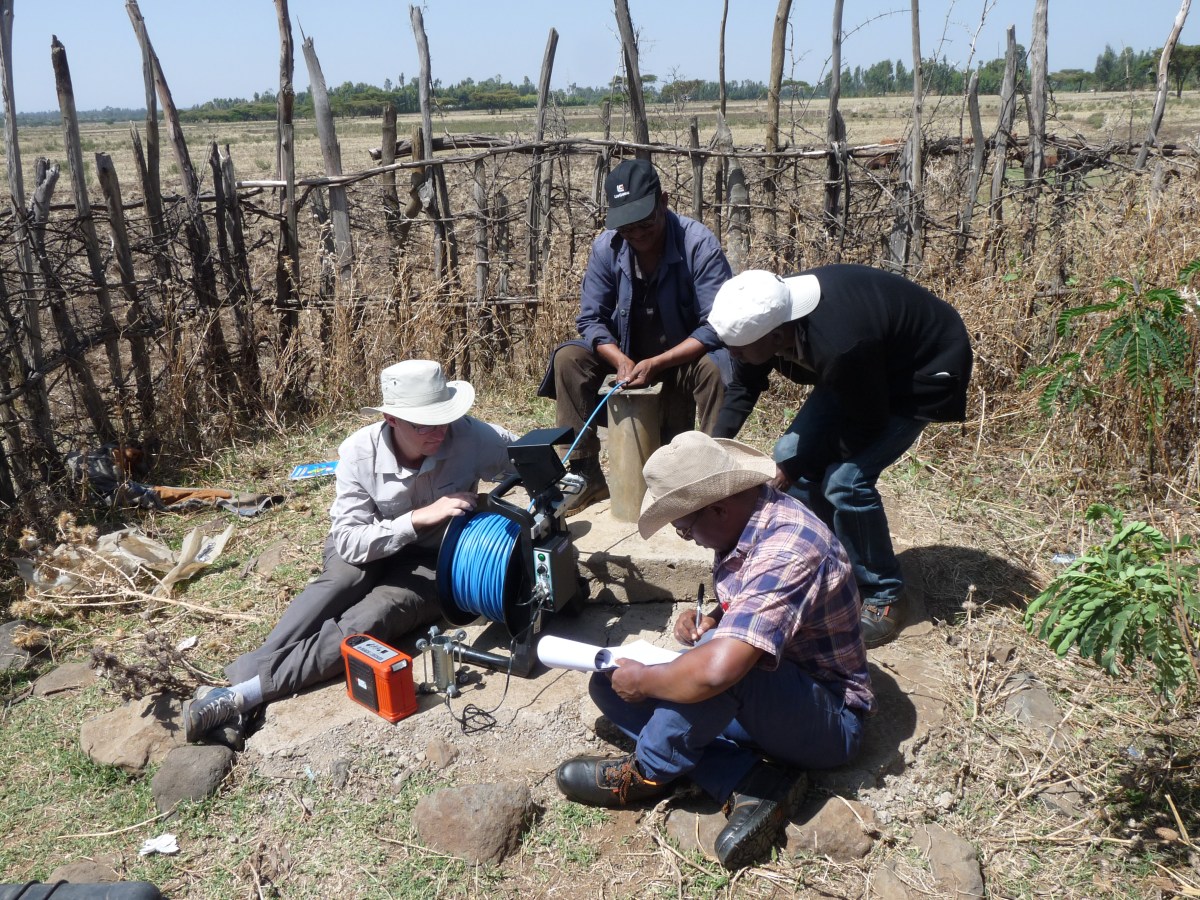
Photo: “Hidden Crisis team members using a CCTV camera to undertake downhole observations of the borehole construction of a community borehole” (Source: ‘BGS © NERC. UPGro Hidden Crisis Project.’)

Les contrats clés en main pour l’implantation et le forage de puits d’eau

Il s’agit du premier d’une série de quatre blogs intitulée ‘Le forage professionnel de puits d’eau: Apprendre de l’Ouganda” de Elisabeth Liddle et d’un webinaire en 2019 sur le forage de puits professionnel. Cette série s’appuie sur les recherches menées en Ouganda par Liddle et Fenner (2018). Nous vous invitons à nous faire part de vos commentaires en réponse à ce blog ci-dessous.

Les forages réalisés dans le cadre d’un “contrat clé en main ” sont devenus de plus en plus courants dans toute l’Afrique subsaharienne. Des recherches récentes menées en Ouganda par Liddle et Fenner (2018) ont montré que les contrats clés en main sont le type de contrat le plus courant lorsque le secteur privé fournit de nouveaux forages pour des pompes manuelles en milieu rural, bien que cela n’ait pas toujours été le cas. Dans ce blog, nous donnons un aperçu de ce que sont les contrats clé en main, pourquoi ils sont utilisés en Ouganda, et les avantages et les défis associés à leur utilisation en Ouganda.

Qu’est-ce qu’un contrat clé en main et pourquoi ces contrats sont-ils utilisés en Ouganda ?

Dans le cadre d’un contrat clé en main, un entrepreneur en forage est responsable à la fois de l’implantation et des travaux de forage et d’installation. Les contrats clés en main sont payés par le biais de modalités de paiement au forfait, c’est-à-dire “pas d’eau, pas de paiement “. Si le forage est fructueux, le foreur recevra la totalité du prix au forfait, quels que soient les coûts engagés sur place. Toutefois, si le forage est infructueux (forage à sec ou à faible rendement), le foreur ne sera pas payé du tout.

Les contrats clés en main ont pris de l’importance en Ouganda au milieu des années 2000 lorsque les agences d’exécution (autorités locales de district et Organisations Non Gouvernementales) devenaient de plus en plus frustrées par le nombre de forages infructueux réalisés lorsque les consultants effectuaient les travaux d’implantation de forages. Comme le consultant indiquait au foreur l’endroit où forer, si le forage échouait, l’agence de mise en œuvre devait payer le foreur pour tous les travaux effectués et les matériaux utilisés, c’est-à-dire selon un cahier des charges. L’échec des forages était imputé à la qualité du travail d’implantation des consultants ; de fait, les « consultants à mallette » (c’est-à-dire ceux qui n’avaient pas de formation officielle en géologie ou en hydrogéologie) avaient inondé le marché. En raison des bas prix qu’ils offraient et de l’absence de réglementation, ces consultants parvenaient à remporter des contrats d’implantation de forage.

Payer pour des forages infructueux était donc un problème, et il était devenu difficile pour les autorités locales de district d’atteindre leurs objectifs en matière de nouvelles sources d’eau potable. Les chefs de projet passaient pour incompétents. De plus, les responsables politiques ne comprenaient pas qu’un nombre de forages infructueux faisait partie intégrante du travail de forage ; par conséquent, si un foreur était payé pour un forage infructueux, les responsables politiques le considéraient comme corrompu. Certains responsables des services de l’eau au niveau du district ont même été menacés de prison.

La solution trouvée a été de retirer le consultant et de confier toute la responsabilité de la recherche de l’eau au foreur. Si le foreur forait alors un puits infructueux, il ne serait pas payé, car c’est lui qui était responsable de l’implantation du trou de forage. Le foreur prenait également tous les risques associés à un rendement d’eau inadéquat.

Avantages et défis de l’utilisation de contrats clés en main

Les contrats clés en main ont grandement simplifié le processus de passation de marché et de gestion de contrat pour les responsables de projets en Ouganda. Dans le cadre de contrats clés en main, les maitres d’ouvrage n’ont qu’à sélectionner et gérer un entrepreneur en forage. En outre, étant donné que le montant payé à l’entrepreneur si le forage est fructueux est déterminé au cours du processus d’appel d’offres, il n’y a pas de coûts imprévus pour le maitre d’ouvrage. De plus, en vertu des modalités de paiement « pas d’eau, pas de paiement », les organismes n’ont pas à dépenser directement de l’argent pour des forages infructueux ; l’argent n’est dépensé que pour des forages qui sont déclarés fructueux.

Bien que les contrats clés en main présentent des avantages notables, les chercheurs se sont entretenus avec plusieurs personnes en Ouganda qui se sont dites préoccupées par la qualité du travail :

  • Le choix du site est fonction de la facilité à trouver de l’eau: Dans le cadre de contrats clés en main, les entrepreneurs de forage doivent trouver suffisamment d’eau pour être payés. De multiples entretiens ont confirmé que les entrepreneurs en forage forent des puits là où il semble plus facile de trouver de l’eau, par exemple dans les vallées ou près des marécages ou des rivières. Non seulement les entrepreneurs de forage sont extrêmement susceptibles de trouver de l’eau dans ces zones, donc d’être payés, mais ils forent souvent à des profondeurs beaucoup moins profondes que celles sur lesquelles leur estimation forfaitaire de coûts était basée. Une marge plus importante peut donc être réalisée dans ces conditions. Les forages situés dans ces zones sont toutefois vulnérables à la pollution. Bien qu’un forage puisse passer les tests de qualité de l’eau immédiatement après avoir été foré, l’eau peut être impropre à la consommation humaine pendant les mois pluvieux en raison de l’augmentation du transport des polluants de surface et des taux de lixiviation ou, après plusieurs années, du fait de l’accumulation des polluants dans ces zones. En outre, l’accès des communautés à ces puits peut être limité, en particulier pendant les mois pluvieux où ces zones peuvent être vulnérables aux inondations.
  • Le bricolage pour faire des économies: En vertu des modalités de paiement « pas d’eau, pas de paiement »,, les entrepreneurs de forage doivent économiser dans la mesure du possible afin de pouvoir amortir les pertes qu’ils ont subies. Pour économiser de l’argent, il a été rapporté que certains entrepreneurs de forage en Ouganda sont connus pour les pratiques suivantes :
  • L’utilisation de matériaux de mauvaise qualité et/ou qui ne sont pas appropriés qux conditions hydrogéologiques, par exemple, des conduites montantes en fer galvanisé plutôt qu’en acier inoxydable dans les eaux souterraines acides. Les conduites montantes en fer galvanisé sont 4 à 5 fois moins chères que l’acier inoxydable. Lorsque des conduites montantes en fer galvanisé sont utilisées dans les eaux souterraines acides (qui sont courantes en Ouganda), une eau de couleur rouge/brune impropre à la consommation humaine est fort probable (Casey et al., 2016).
  • L’utilisation de matériaux inappropriés pour la conception du forage, par exemple, l’utilisation d’un tubage de 5 pouces lorsqu’un forage ouvert de 6/6,5 pouces[1] a été foré, car le tubage de 5 pouces est moins cher que celui de 6/6,5 pouces. Pour éviter que le tubage de 5 pouces ne tombe dans le trou ouvert de 6/6,5 pouces, les foreurs en chauffent la base et l’étirent pour l’ajuster au dessus de la zone ouverte. 42 % des entrepreneurs en forage interrogés (n = 14) ont admis avoir recours à cette pratique. Alors que certains y voient une bonne astuce, d’autres craignent que de la vase ne s’accumule dans ces forages avec le temps, en raison de l’espace entre le tubage et la roche consolidée et/ou des fissures qui se forment dans les zones les plus tendues du tubage. Un tel envasement use non seulement les pièces de la pompe à main, mais peut également entraîner des problèmes d’apparence du point de vue de l’utilisateur lorsque la vase pénètre dans l’alimentation en eau potable.
  • Arrêter de forer lorsqu’on rencontre de l’eau pour la première fois: On peut économiser beaucoup d’argent ainsi ; en Ethiopie, par exemple, forer à 50 mètres au lieu de 60 mètres réduit le coût du forage de 13% (Calow et al., 2012). Toutefois, si le forage ne pénètre pas dans l’aquifère principal, la quantité d’eau disponible après la construction peut être problématique, même si le forage passe l’essai de pompage.

3) Interférer avec les données d’essai de la pompe ou raccourcir le temps d’essai de la pompe

Cela permet de masquer les sites à faible rendement et les sites infructueux. Ces forages seront inévitablement à faible rendement après construction ou, dans le pire des cas, à sec.

La nécessité pour les foreurs d’avoir recours aux pratiques ci-dessus en Ouganda est exacerbée par le fait que, dans de nombreux cas, le forfait auquel les foreurs sont payés pour un forage réussi n’est pas assez élevé. De plus, la supervision par un hydrogéologue qualifié est rare.

Que faire en ce qui concerne les contrats clés en main ?

Les contrats clés en main devraient-ils continuer à être utilisés en Ouganda ? Les avis diffèrent d’un acteur à l’autre : la majorité des maitres d’ouvrage en Ouganda estiment que le recours aux contrats clés en main devrait se poursuivre, tandis que les consultants et le Ministère de l’eau et de l’environnement estiment qu’ils devraient cesser, au vu des problèmes de qualité des travaux décrits ci-dessus.

Le Ministère de l’eau et de l’environnement est allé jusqu’à publier une directive en janvier 2017 décourageant l’utilisation de contrats clés en main, et préconisant plutôt que les contrats subdivisés, un pour le choix du site (attribué à un hydrogéologue/consultant) et un pour le forage et l’installation (attribué à un entrepreneur en forage) soient dorénavant utilisés. Les opinions des foreurs eux-mêmes semblent impartiales ; la plupart d’entre eux ne s’opposent pas à l’idée de travailler dans le cadre de contrats clés en main ; ils demandent simplement à ce que les prix forfaitaires que les maitres d’ouvrage soient prêts à payer pour des forages réussis augmentent dans le futur, pour qu’ils ne soient pas obligés de prendre de bricoler pour faire des économies sur place.

Qu’en pensez-vous?

 Alors, qu’en pensez-vous? Avez-vous de l’expérience en matière de contrats clés en main pour forer des puits d’eau, ou d’autres pratiques que vous aimeriez partager ? Vous pouvez répondre ci-dessous en postant un commentaire, ou vous pouvez participer au webinaire en direct le 14 mai (inscriptions ici)

Références

Calow, R., MacDonald, A., and Cross, P. (2012). Corruption in rural water supply in Ethiopia. In J. Plummer (Ed.), Diagnosing Corruption in Ethiopia: Perceptions, realities and the way forward for key sectors (pp 121-179). Washington DC, USA: World Bank. Available from https://www.odi.org/sites/odi.org.uk/files/odi-assets/publications-opinion-files/8555.pdf

Casey, V., Brown, L., Carpenter, J.D., Nekesa, J., and Etti, B. (2016). The role of handpump corrosion in the contamination and failure of rural water supplies. Waterlines, 35(1), 59-77. Available from https://www.developmentbookshelf.com/doi/full/10.3362/1756-3488.2016.006

Liddle, E.S. and Fenner, R.A. (2018). Review of handpump-borehole implementation in Uganda, Nottingham, UK: BGS (OR/18/002). Available from https://nora.nerc.ac.uk/id/eprint/520591/

[1] Les trous de forage peuvent être ” entièrement tubés ” ou ” ouverts “. Si un trou de forage est ” entièrement tubé “, toute la partie verticale est tubée, avec des grilles dans les couches d’eau. Toutefois, si le trou de forage est ” ouvert “, seules les zones non consolidées du forage vertical sont tubées – le reste de la roche consolidée est laissé à l’état “ouvert ” (pas de tube ni de grilles).

Un pouce équivaut à 2,54 cm (note du traducteur).

Remerciements

Ce travail fait partie du projet Hidden Crisis du programme de recherche UPGro – cofinancé par le NERC, le DFID et l’ESRC.

Le travail de terrain entrepris pour ce rapport fait partie de la recherche doctorale des auteurs à l’Université de Cambridge, sous la supervision du Professeur Richard Fenner. Ce travail sur le terrain a été financé par le Ryoichi Sasakawa Young Leaders Fellowship Fund et UPGro : Hidden Crisis.

Merci à ceux d’entre vous de l’Université de Makerere et de WaterAid Ouganda qui m’ont apporté un soutien logistique, y compris sur le terrain, pendant que je menais les entretiens pour ce rapport (en particulier le Dr Michael Owor, Felece Katusiime et Joseph Okullo de l’Université Makerere et Gloria Berochan de WaterAid Uganda). Merci également à tous les répondants d’avoir été enthousiastes et disposés à participer à cette recherche.

Photo: ” Les membres de l’équipe Hidden Crisis utilisent une caméra de CCTV pour l’observation du fond de puits de la construction d’un forage communautaire ” (Source: ‘BGS © NERC. UPGro Hidden Crisis Project.’)


Borehole drilling supervision in Malawi: why it is essential, not optional

Guest Blog from Mr Gift Jason Wanangwa, a Groundwater Development Officer with the Malawi Government’s Ministry of Agriculture, Irrigation and Water Development.

New PictureGuest Blog by GIFT JASON WANANGWA

Introduction

Malawi is one of the least developed countries in Africa. It has a population of more than 17 million people, 84% of whom live in rural areas and rely solely on groundwater for their daily water needs for social and economic development.

Studies of the drilling practices in Malawi by UNICEF (GoM/UNICEF 2011; GoM 2012) and borehole forensics activities done by students of the University of Strathclyde under the Climate Justice Fund-Water Futures Programme  (CJF-WFP Work Records 2017-2018) as well as MSc Hydrogeology masters research students activities into drilling practices in Malawi (Polmanteer, 2014) have all revealed some shortcomings which explained problems in rural water supply through boreholes like poor siting, low yield of boreholes, weak drilling procedures and poor water quality or mechanical failures of pumps and boreholes. This was attributed much to poor drilling supervision.

Continue reading “Borehole drilling supervision in Malawi: why it is essential, not optional”

Professional Water Wells Drilling: Country Assessments of the Sector – UPDATED!

From 2003 to date, assessments of borehole drilling sector cost-effectiveness and professionalism have been undertaken for the following countries:

Do you know of other national assessments of borehole drilling sector cost-effectiveness and professionalism, perhaps in your own country? If so, please share in the comments below.

Update 21 August 2018

Key points:

  • “Turn-key” contracts should not be used, instead implementing agencies should procure an independent consultant for drilling and supervision and pay drillers for drilling/installation work done.
  • The research supports the guidance set out Danert K., Gesti Canuto J. (2016) Professional Water Well Drilling. A UNICEF Guidance Note  , Unicef , Skat Foundation http://www.rural-water-supply.net/en/resources/details/775

Achieving Professional and Sustainable Drilling in Madagascar? Yes, we can!

Guest blog by Charles Serele, UNICEF Madagascar

As part of its Water, Sanitation and Hygiene (WASH) program in Madagascar, UNICEF is committed to supporting the Ministry of Water, Sanitation and Hygiene (MWSH) to build the capacity of the drilling sector. With this in mind, UNICEF organized a training on “Drilling Techniques and Supervision” in collaboration with the MWSH. The training targeted various stakeholders in the water sector, including government departments, drilling companies and consultancy firms who manage water supply projects, supervise or drill boreholes.

The training was held in Antananarivo (Madagascar) and organized in three different sessions of three days each, from February 7th to 23th, 2018. Fifty-four participants, including fifteen women attended the training course. The training was facilitated by Charles Serele, an experienced WASH Specialist from UNICEF Madagascar.

madagascar

To enhance individual knowledge and ensure sharing of experiences among participants, the overall approach used to deliver the course involved a mixture of lectures, interactive discussions, group exercises and presentation of drilling videos. Extensive reading materials from RWSN and UNICEF were shared along with exercises to be carried out by the participants.

The course participants actively engaged in the discussions and group activities. The training provided an opportunity to learn from each other and to reflect on what can be improved.

Course Modules

1.      Professionalization of the drilling sector

2.      Methods of borehole siting

3.      Construction of boreholes

4.      Supervision of boreholes

5.      Management of drilling data

The course review showed that participants’ technical knowledge in borehole drilling and supervision greatly improved. Participants also expressed their satisfaction with the course content and the relevance of the topics that were covered.

Forty-five participants (83%), including fourteen women passed the evaluation test conducted on the last day of the training. During the official closing ceremony each successful participant received a poster on cost-effective boreholes, in addition to a certificate.

As a next step, a field-based training should be organized to better illustrate best practices in drilling professional and sustainable boreholes.

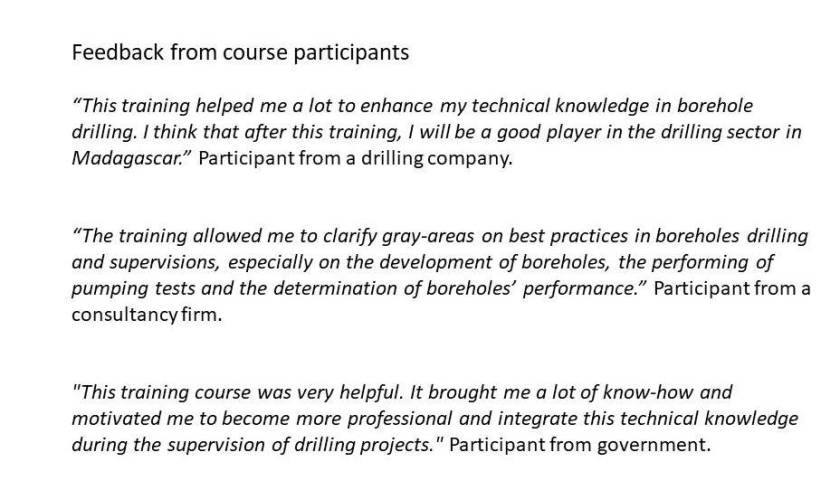
Feedback2

madagascar2

Additional resources


The training course was facilitated by Charles Serele, UNICEF Madagascar and organized under the supervision of the Chief of WASH, Silvia Gaya and with the support of the UNICEF WASH team. For additional information, contact UNICEF Madagascar on antananarivo@unicef.org.


Voyage of groundwater discovery

The first ‘Professional Management of Water Well Drilling Projects and Programmes’ online course, provided by Unicef, Skat Foundation and Cap-Net kicked off in early March 2018.

Running over six weeks, the new online course provides participants with an overview of what is required to improve borehole drilling professionalism in the countries in which they work.

Requiring about six hours of investment per week, plus an additional four for the final assignment, it provides a 40-hour training opportunity for people from all over the world – and they can take part without leaving their home or workplace.

The application process was open for a month, and we received 648 applications spanning 381 organisations and 96 countries. We were astounded by the level of interest. Unfortunately, we could only accept 85 participants, a mere 13% of those who applied, our limitation being funding for sufficient, good facilitation. And so over the past weeks we have been interacting with the participants who work in 35 organisations in 43 countries, of whom 33% are women.

We provide extensive reading material and videos for each module, and the participants engage with the topics through their weekly assignments, participation in online discussion forums and a weekly quiz. For example, they have been tasked with looking at the drilling supervision practices in their own organisations, to prepare a hydrogeological desk study and to reflect on regulatory policies and practices in the countries in which they work.

I was sceptical about online courses until I undertook my first one three years ago. This time, as a facilitator, I’ve witnessed that this course provides an opportunity for people who are already managing drilling projects and programmes to improve their skills and knowledge from far and wide.

So what are we learning every day from the participants? For example, that drilling data is not shared because of fear that the information may be used for gaining the upper hand in mining minerals in one country. Or about the rapidly falling groundwater levels in Sanaa, Yemen, threatening the agriculture and domestic water supplies of the future. And we’ve found out about nuances in the way in which corruption affects the regulation of drilling professionalism in different contexts. Through the course, innovative approaches are also being revealed, such as new regulations in a number of countries, efforts to improve procurement procedures in Nigeria, or post-construction monitoring of water supply systems through private management combining mixed farming and water supply systems in northern Madagascar.

 ourse modules Course modules


Integral to the course is that it provides an opportunity for participants to learn from each other, reflect on what can be improved and to debate contentious topics – a key one being who should pay for the cost of drilling a dry borehole? The final assignment in the course involves sharing what has been learned more widely and trying to inspire others to improve borehole drilling management practices. Once the course is complete, all of the materials are accessible through the Cap-Net virtual campus (www.cap-net.org).

So what next, you may ask? Firstly, we shall learn from this first course and make improvements. We would then like to run the course again later in the year, repeat it in the future and also make it available in other languages, starting with French. We know that there is demand. With the structure and materials now developed and online, future courses will be less costly than developing and running the first one. But we need to assure the cost of good facilitation. So if anyone would like to sponsor a course, say as part of corporate social responsibility (CSR), either fully or partially, please contact us at foundation@skat.ch.


Kerstin Danert works for Skat Foundation and Skat Consulting in St. Gallen, Switzerland, and leads the Rural Water Supply Network’s (RWSN) theme on Sustainable Groundwater Development. In 2017 she was awarded the Distinguished Associate Award by the International Association of Hydrogeologists.

This article was first published in GeoDrilling International and is reproduced with permission and thanks.

Three common myths about solar-powered water pumping

By Andrew Armstrong (Water Mission), RWSN co-lead for Sustainable Groundwater Development

Solar pumping is the trendiest technology in rural water supply today. Policy-makers and practitioners are eager to better understand its benefits and limitations and the private sector is responding with a variety of product offerings. Much of this interest is motivated by the Sustainable Development Goal to increase water service levels in the most remote areas. A more compelling driver is that rural water users are willing to pay for service that is accessible near or within their homes. There is currently no more promising technology for meeting these expectations in off-grid settings than solar pumping. Despite this high interest and the fact that solar pumping technology has been around for decades, a great deal of misinformation is being propagated.

This post aims to address a few of the most common misconceptions.

Myth #1: Solar pumping is too complicated and not appropriate for remote, rural settings

The most common barrier to adoption of solar pumping is misunderstanding of its complexity and applicability. The technology is often avoided because of perceived technical and management challenges, which are in fact common to any rural water supply system. In reality, the design and installation processes associated with solar pumping are no more complicated than other motorized pumping schemes. Operation and maintenance is more straightforward than with handpumps and generator powered schemes which, as indicated in recent evaluations published by UNICEF and the Global Solar and Water Initiative, likely leads to higher functionality and reliability rates.

Solar pumps are applicable across the same head and flow profiles as grid- and generator-powered pumps, and most solar pumping equipment available today is essentially “plug and play”. External power backup for periods of low sunlight are rarely necessary if water demand is estimated and storage is sized appropriately. In addition, current off-the-shelf computer software tools simplify equipment selection and automatically consider daily and seasonal weather and solar irradiation fluctuations when estimating water outputs.

The high capital cost of solar pumping equipment often brings its large-scale applicability into question. However, the life-cycle cost benefits of solar pumping are well documented and are within and on the lower end  of IRC’s WASHCost benchmark ranges for piped schemes and boreholes fitted with handpumps. There is no fuel cost associated with solar pumps, and the cost of maintaining power generation equipment is greatly reduced because solar modules have no moving parts and long functional lifespans. Furthermore, the cost of solar modules, which represent the most expensive element of a solar pumping scheme, continues to decrease at a rapid rate.

graph1
Click here to read about the advantages of solar pumps compared to alternative technologies commonly utilized in remote, rural settings.

Myth #2: All solar powered water pumping equipment is created equal

Equipment manufacturers have taken advantage of demand and have flooded the market with solar pumping products of all varieties and price tags. Unfortunately, many are of poor quality and likely to fail in a fraction of the lifespan of higher priced, higher quality equipment. Low-quality products seldom come with warranties covering the first few years of operation during which failures are most likely to occur. Uninformed customers often fall into the trap of choosing cheaper equipment without considering that low-quality equipment fails quicker and costs more to maintain in the long-term. This results in solar pumping schemes which were expected to function for years failing and being abandoned after a few months in operation. The best way to guard against this is to stick with brands that have a proven track record for durability and reliability, even if it costs more up-front. It is also important to verify that products adhere to internationally-recognized certification and testing standards.

Another related challenge is that imitation spare parts for major brands are easier to find than authentic ones. Logos and barcodes can be forged such that it becomes difficult to detect if a part is counterfeit. This issue can be resolved by sourcing products from trusted dealers with good technical support capacity. The private sector can also have a positive influence on product quality. By providing local dealers with exclusive access to advanced training and support networks, major manufacturers can incentivize sales of quality equipment. In fact, some solar pumping suppliers such as Bluezone Malawi  are choosing to base their business model solely on high-quality products.

Myth #3: Scaling-up solar powered water pumping will lead to widescale depletion of groundwater aquifers

There is concern that solar pumps, because they can operate automatically whenever the sun shines, could pose a long-term threat to groundwater resources. It is true that exploitation of groundwater paired with low or misunderstood aquifer recharge can lead to potentially irreversible depletion, and there is a deficiency of good hydrogeological data in countries where the most interest is being placed on solar pumping. However, abstraction technology is just one of many factors that influence aquifer sustainability and solar pumping should not be devalued because of potential risks which can be mitigated. It is also important to note that the risk of groundwater depletion due to over abstraction with solar pumps depends on the application. Domestic supply withdrawals, in comparison to agriculture and protracted emergency applications, are likely to have negligible impacts.

Below are some actions that can be taken to mitigate the risk of groundwater depletion:

  • Proper borehole development and pump sizing to safe yield – Ensures solar pumps are physically incapable of depleting aquifers. A good resource for this is the RWSN/UNICEF Guidance Note on Professional Water Well Drilling. Simple control measures such as float valves and switches can also be employed to prevent wasting.
  • Better groundwater monitoring alerts authorities to potential risk areas. Many countries successfully employ remote monitoring systems (see, for example, the USGS’s National Groundwater Monitoring Network. Read more here.
  • Water pricing in the form of tariff collections and abstraction charges enables sustainable and equitable allocation of groundwater resources, but requires sound management built on transparency and accountability. Prepaid water metering technologies may also play a role.

Further resources

Resources are available to equip rural water professionals with knowledge and skills and stop the spread of misinformation about solar pumping. Of note:

In order to generate rich discussion and continue raising awareness of existing resources around solar pumping, the RWSN Sustainable Groundwater Development theme will host a three-week e-discussion from 28 May to 15 June 2018. For more information or to participate in the e-discussion, join the RWSN Sustainable Groundwater Development DGroup.

(Photo credits: Water Mission)


A borehole that lasts for a lifetime

Groundwater is a valuable resource for communities, but accessing and maximising its potential can be difficult. Vincent Casey, WaterAid’s Technical Support Manager for Water Security, introduces a series of videos demonstrating good practice in borehole drilling.

Groundwater is a valuable resource for communities, but accessing and maximising its potential can be difficult. Vincent Casey, WaterAid’s Technical Support Manager for Water Security, introduces a series of videos demonstrating good practice in borehole drilling.

Good practice must be followed if groundwater development programmes are to reach their full potential. If certain steps are not taken, there is a high chance that boreholes will fail, investment will be wasted and people will remain un-served.

Continue reading “A borehole that lasts for a lifetime”

What is the big deal about manual drilling anyway?

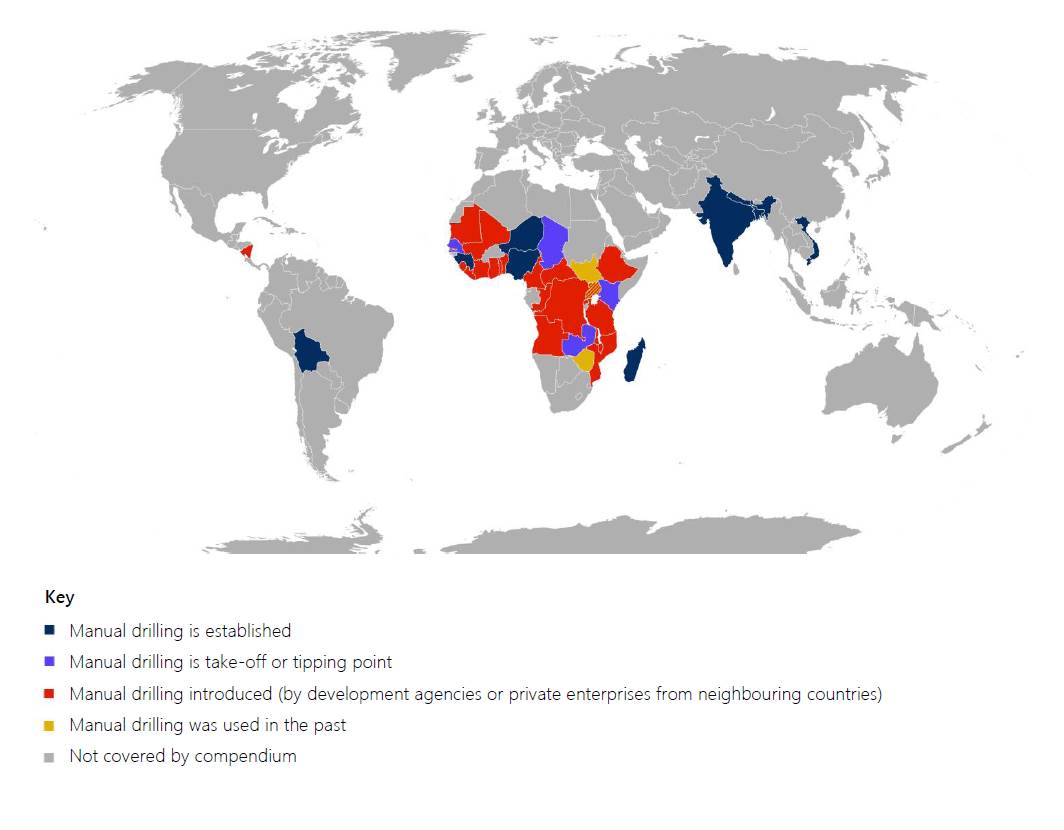
Let me tell you a not-very-well-kept secret. My PhD research some 15 years ago was on manual drilling. That was what took me to Uganda in the first place and taught me how to link social science, business development and technology. For those of you who don’t know what it is, manual drilling refers to several drilling methods that rely on human energy to construct a borehole and complete a water supply. These methods can be used in areas where formations are quite soft and groundwater is relatively shallow. And by the way, the “Pounder rig” as we called it worked, but it never took off in Uganda (the details are in my thesis).
Continue reading “What is the big deal about manual drilling anyway?”