Start time for all webinars: 14:30 Central Europe // 08:30 New York // 12:30 Dakar (13:30 in November) // 15: 30 Nairobi (16:30 in November) // 18:00 New Dehli (19:00 in November) // 19:30 Jakarta (20:30 in November)
RWSN webinars are made possible and kept free to all thanks to the following support:
In-kind contributions RWSN Theme and Topic Leaders and their organisations who put the programme together, specifically (in alphabetical order): IRC, Simavi, Skat, UNICEF, Water Mission, WaterAid and the World Bank.
If your organisation would be interested in sponsoring a future series, a single or set of webinars then please contact me for details.
Very sadly, we are not able to support French or Spanish webinars in this series, but they will be back again in 2019. Thank you for your understanding and patience.
Nous sommes vraiment désolés de ne pas pouvoir organiser de webinaires en français dans cette série. Cependant, nous reviendrons aux webinaires français en 2019. Nous vous remercions beaucoup pour votre patience et votre compréhension.
Lamentamos mucho no poder realizar seminarios web en español en esta serie. Sin embargo, volveremos a los webinars en español en 2019. Muchas gracias por su paciencia y comprensión.
by Lena Farré, recent Post-Graduate from University of Basel, Switzerland, summarises the findings of her Masters degree thesis
This exploratory case study carried out in the Kilombero Valley in southwestern Tanzania shows the mechanisms and challenges communities of a rural village face while seeking water access and maintaining their water pumps. The Tanzanian Government and non-governmental organizations follow a Demand Responsive Approach (DRA). According to the water source providers, communities should demand, own, and maintain their water sources as well as contribute to implementing costs in cash or labour. This participatory approach has been criticised to shift the states responsibility to provide water service towards the community level. To design better policies for interventions that will ensure a sustainable and equitable water provision, it is necessary to understand how communities themselves perceive and deal with this implemented community management system. Here, three key findings are presented, which must be taken stronger into consideration when formulating recommendations for practitioners, since they have been found in other case studies as well.
1. Women bear the most time and physical strength consuming tasks
While men mostly get the leading position within a water source committee, the role of the secretary or treasurer is mainly given to women. Women are responsible for the house-to-house monthly fee collection from the families using the water sources. Most social conflicts between the committees and the water source users are linked to the monetary contribution. This results in women being directly exposed to these conflicts and therefore less willing to participate actively in the committees.
2. Mutual mistrust and low transparency
The vulnerable livelihood of the community makes water source users and committee member mistrust each other concerning the payment or safe guarding of the maintenance fees. The need for a sudden financial resource, was mentioned as a reason why water source users doubted that committee members put the entire collected amount of cash onto a bank account. Furthermore, the ability of the committees to control and record the payments of the water source users are restricted due to different reasons: A lack of administrative and accounting skills and remoteness of widely dispersed settlements challenges communication flows. The organization of meetings between water source committees and water users is therefore also difficult. This low transparency fuels mutual mistrust.
3. Social mechanisms to equalize water access exists
Sanctions such as imposed fines or denied access are assumed to push users to pay their monthly fees. However, they were rarely applied. The committee members often grant exemptions after evaluating the socio-economic situations of the water users. Conflicts between the committees and the users occurred if a household is assumed to be able to pay but refuses it. Private water sources within the community caused conflicts as well. Households who purchased a private one feel under pressure to share it with their neighbours. The system of sanctioning community members for not contributing the payment fees or getting a private water source correspond to market rules. However, water is perceived as a free good by many people. Hence, denying water access to a fellow member of the community transgresses cultural norms and behaviour. Sharing water and preventing someone from getting a private water source, are social mechanisms to equalize water access on the village level.
Behaviour based on the social value of water need to be acknowledged
If a sustainable water source management shall be achieved – community mechanisms have to be understood and acknowledged. Sharing water, conflict avoidance and other behaviour which equalizes access amongst the community members can be seen as obstacles towards the community management of water sources within a Demand Responsive Approach. However, it is suggested to evaluate these social structures positively, allowing the poorest of the community to access water. The government’s responsibility to provide water access and to accomplish the Human Right to Water for its citizens should nevertheless not be denied.
The study showed that the potential of collectively managing water sources based on a barely existing consumer culture must be questioned. Additionally, it is recommended to focus more on the understanding of the social values that water has within a rural community. How they look like in more detail within a rural, Tanzanian community is presented in the study.
Reflections from 3 past leaders of HTN/RWSN on the loss of great friend.
(1) Rupert Talbot, former Chair of the Handpump Technology Network (UNICEF – retired) (2) Dr Peter Wurzel, former Chair of the Handpump Technology Network (UNICEF – retired)
(3) Erich Baumann, former Director of the HTN/RWSN Secretariat (Skat – retired)
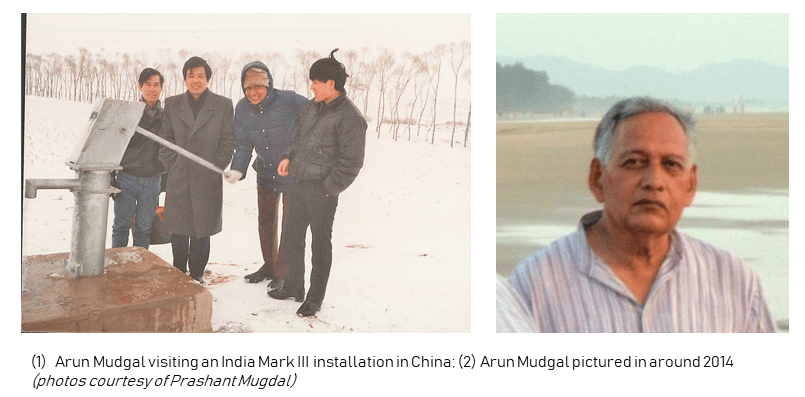
Rupert: “I am writing to let you know that Arun Mudgal died on September 13th after a long battle with Alzheimer’s.
“Although his many friends will surely regret his passing, those of us who visited him in recent times will be glad that he did not linger for longer; Alzheimer’s is a fearful illness.
“Arun was a familiar face to many within the HTN/RWSN fraternity. He made an unparalleled contribution to hand pump development in India from the 1970s and was instrumental in putting the first India MK II and MK III hand pumps into production.
“I would argue that the Mark II simply would not have happened without Arun. At least, not in the form that we would recognise today. He was absolutely key at Richardson and Cruddas, the Government of India engineering company that manufactured the prototype Mark II pumps, field tested them in the deep bore wells of Coimbatore and closely monitored their performance, translating technical problems encountered in the field into pragmatic, engineering solutions; Arun was the conduit between Unicef field staff and the factory that first made the pump.
“It was his persona – his charm and calm disposition combined with astute engineering expertise and manufacturing know-how – that led to the mass production of the India MK II. The development of the pump is best summarised in the Skat/HTN Working Paper WP 01/97 : ‘India Hand Pump Revolution: Challenge and Change‘. Written by Arun, it is probably the most authentic account of how the MKII and Mark III hand pumps came about.
“Arun’s legacy is much more than the MkII and MkIII hand pumps, of course; in a career spanning some forty years, Arun also contributed to the development of the Afridev and the VLOM concept and he worked extensively on water quality issues, especially arsenic testing and treatment. His influence on rural water supply programmes stretches far beyond India’s borders.
“I and many others will miss his thoughtful insights into troublesome problems; we shall miss too, his companionship on those long field trips….”
Peter: “Arun was a dear and much admired friend. I had the privilege and pleasure to work with him in Mozambique and Ethiopia and we met several times over the years at handpump meetings. It was an education to talk handpumps with Arun and such was his towering knowledge and authority of handpump issues that his assertions on the topic were always received with little argument.
“But he was much more than a supreme handpump guru – he had an appealing, if somewhat serious, retiring and studious, personality. In essence a supremely nice guy. I shall remember his Arun as genuine and kind, humble, self-effacing with a quick mind who achieved much during a lifetime devoted to our sector and specifically handpumps – and even more specifically the India Mark II (though knew a thing or two about the Afridev too!).
“Farewell Arun – a friend and mentor to all who were fortunate enough to know you.”
Erich: “I do not know what to write. Even though Arun had in the last few years faded out of our life because of his illness. He was and will forever be remembered as the great friend and professional.
“A true handpump guru with many other qualities. I had the privilege to work with him for years very closely. We travelled several trips together and his input into the work was very valuable. As Peter rightly said also the Afridev development profited from his knowledge and experience. Look at the piston. But Arun did not a want to be put into the lime-light.
“One incident will stay with me for ever. Arun visited us in Switzerland and stayed in our house. Our youngest son had a bit of a rough time in school. During my next visit to India Arun gave me a small statue of Ganesh. He mentioned that Ganesh has a calming effect and if we would put the statue in my son’s room it might help him. He was not only a very rational engineer but also a believer.”
Arun leaves behind his wife Krishna, a son Prashant and a daughter Ankur.
Guest Blog from Mr Gift Jason Wanangwa, a Groundwater Development Officer with the Malawi Government’s Ministry of Agriculture, Irrigation and Water Development.
Guest Blog by GIFT JASON WANANGWA
Introduction
Malawi is one of the least developed countries in Africa. It has a population of more than 17 million people, 84% of whom live in rural areas and rely solely on groundwater for their daily water needs for social and economic development.
Studies of the drilling practices in Malawi by UNICEF (GoM/UNICEF 2011; GoM 2012) and borehole forensics activities done by students of the University of Strathclyde under the Climate Justice Fund-Water Futures Programme (CJF-WFP Work Records 2017-2018) as well as MSc Hydrogeology masters research students activities into drilling practices in Malawi (Polmanteer, 2014) have all revealed some shortcomings which explained problems in rural water supply through boreholes like poor siting, low yield of boreholes, weak drilling procedures and poor water quality or mechanical failures of pumps and boreholes. This was attributed much to poor drilling supervision.
A sum of money granted by the state or a public body to help an industry or business keep the price of a commodity or service low
— Oxford English Dictionary
Rural Water Services ARE Subsidized
Even the United States has subsidies for rural water services. This doesn’t make something unsustainable. However, it does create a critical need for clarity of the total cost of the services, how it is funded, and how it will continue to be funded. There also needs to be a good definition of what the costs are (CapEx vs OpEx vs CapManEx). Thankfully our friends at IRC have laid this out here.
Rural population in Sub-Saharan Africa is projected to continue growing for decades to come. In spite of urbanization, rural populations are not going to disappear. Both as individuals and as organizations, we need to spend more efforts in reaching out to the people in rural areas, and we need to come up with more diversified strategies to facilitate the delivery of services to these people.
“Communities themselves, when a borehole is drilled, are supposed to be responsible. They are supposed to have fundraising for maintenance. This is challenging. Often breakdowns are due to simple things. They say ‘we are lacking x, y ,z’. And we ask ‘don’t you have the funds’? But they say ‘no we don’t have money, we are poor, we can’t contribute’. And we try to tell them ‘but this water point is for you, it is yours to look after.’ They don’t take it as their own. They have to take responsibility. Sometimes they go to the councillor or MPs for support.” (Extension worker, Malawi)
In November I wrote a blog describing my first impressions of life in Balaka, Malawi, where I am doing my PhD fieldwork. To recap, my research concerns the sustainability of rural water services. I am particularly interested in the role that actors at the district-level play in developing and, crucially, maintaining these services. Several months on, I am starting to make sense of my experiences shadowing extension workers in their day-to-day work. What strikes me is how these actors have to navigate competing interests and find creative ways to get their jobs done. In this blog I focus on their relationship with communities (service users).
How do extension workers secure cooperation from communities?
A community in Balaka learns how to look after their new water point (author’s own)
In my conversations with government and NGO staff, it was evident that the ‘community-based management’ (CBM) model for water governance is not only enshrined in national water policies, but has become deeply embedded in development practice. CBM means that while government or other external agencies may provide the infrastructure, responsibilities for day-to-day management lie with communities. In other words, communities are expected to look after the water point and cover the costs of repairs. Extension workers play a supporting role, providing training, monitoring and technical advice. This approach is meant to empower service users and ensure that services are more efficient and effective.
As the opening quote illustrates, extension workers have internalised key elements of the CBM model and this does inform their decisions, whether consciously or unconsciously. But policy implementation also entails negotiation. Extension workers have to mediate between the demands of formal policies and government institutions, the interests of communities and their leaders (which are not homogenous) and the influences of other actors such as NGOs or politicians.
What went wrong? An extension worker chats to water users about their faulty pump (author’s own)
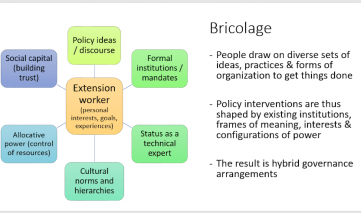
In this respect, policies on paper are often an inadequate guide to action. I find the concept of bricolage (Cleaver, 2012) useful to understand how extension workers navigate between these different interests, drawing on a variety of resources. The bricoleur is a kind of amateur handyman, making do with the tools available, whether old or new. This might include formal and informal institutional arrangements, social relations or networks, material and financial resources, ideas and technologies, and so on. The result (policy in practice) is often a hybrid.
How is an extension worker a bricoleur?
Firstly, my research participants tend to see themselves as a bridge between state and citizen, not only representing their Ministry but also communicating people’s needs to the District Council and development partners (donors/NGOs). In carrying out their roles, extension workers shift between ‘insider’ and ‘outsider’ positions, drawing on social networks, their status as government employees, and cultural norms.
The insider: Often extension workers are not originally from the areas (or ethnic groups) which they currently serve, hence they have to make an effort to gain and maintain trust from communities. They do this primarily through the development of personal relationships, in other words building social capital. For example, participants talked about stopping to drink beer or attending funerals as an important part of their job.
The outsider: Extension workers are afforded a certain status vis-à-vis community members in recognition of their technical expertise and as government employees. Government employees can also leverage support from local leaders such as village headmen who are expected to facilitate policy interventions.
Access to different resources shapes the practices of extension workers as bricoleurs
Cultural norms play a role in reinforcing these relationships. Hierarchy is accepted and less powerful people tend to depend on more powerful people, whether traditional or state elites. In rural contexts of Malawi, these hierarchies can undermine community self-help as ordinary people tend to wait for orders or assistance from ‘above’ and rarely question the activities of their ‘betters’. This might give extension workers a degree of authority but clearly has disadvantages for a CBM model aimed at citizen empowerment.
Secondly, cooperation from communities is by no means guaranteed but is essential for CBM to work. Extension workers do meet with resistance, and express frustration when community members make their task difficult. For example, a common problem is the collection of water user fees, which in theory provide the funds needed for water pump repairs. People will often assert they cannot afford to pay, labelling themselves as ‘too poor’.
Extension workers employ several strategies in dealing with resistance. The first is evident in the quote above, namely reiterating key elements of the national water policy. Communities are reminded that they have responsibility for managing the water point and raising funds for its maintenance. It is emphasised that they are the ‘owners’ of that water point. Moreover, if they do not take action there are consequences – they will not have water.
Learning the ropes – I help to reassemble a hand pump (author’s own)
Another strategy is to enlist the support of the village headman, for example calling a meeting in which a problem is discussed communally and a solution agreed. This seems to be an effective way of securing consensus, at least verbally. Extension workers can also resort to threats, for example removing the handle of the pump (effectively cutting off the water supply) until the community has complied. For new projects, the infrastructure can be built in a different village, one where the community is more willing to cooperate. However, antagonistic strategies are a last resort and consensus is generally preferred.
To sum up, extension workers play a crucial role in translating policy into practice, operating at the interface between state and society. Shadowing individuals in the field and getting involved in community training and water points repairs is helping me to better understand what this means in reality. I have seen, first-hand, the constraints the water office faces in terms of financial and material resources and their consequent reliance on other actors (particularly NGOs) to deliver services.
At the same time, I have come to appreciate the dedication and creativity with which extension workers carry out their work and engage with communities. Being a bricoleur is certainly necessary to ‘get the job done’ in rural Balaka.
Le mot de la présidente du RWSN: Kelly Ann Naylor, UNICEF
Le mot de la présidente du RWSN: Kelly Ann Naylor,
UNICEF
Nous fêtions ce mois-ci la Journée Internationale de la Jeunesse (le 12 août). Plus de la moitié de la population mondiale aujourd’hui a moins de 30 ans et 1.8 milliards de personnes ont entre 10 et 24 ans. Parmi ces dernières, neuf personnes sur dix vivent dans des pays moins dévelopés (UNFPA, 2014). Ces tendances démographiques montrent combien il est indispensable d’assurer que les jeune participent activement aux questions d’approvisonnement en eau des zones rurales.
Alors même qu’à l’échelle mondiale 1% des actifs travaillent directement dans le secteur de l’eau et de l’assainissement (ONU, 2016), attirer des personnes qualifiées dans les zones rurales reste un vrai défi : d’après le rapport du GLAAS (2014), sur les 67 pays qui ont fait état de leurs systèmes d’opération et de maintenance, seuls 11 disposaient des compétences nécessaires pour gérer et pour entretenir leurs infrastructures rurales d’accès à l’eau potable. Par ailleurs, à l’échelle mondiale, les femmes ne représentent que 17% des actifs du secteur Eau, Assainissement et Hygiène (IWA, 2016).
Les jeunes ont clairement un rôle à jouer pour atteindre les Objectifs mondiaux concernant l’eau potable en milieu rural d’ici 2030. Malgré cela, 75% des jeunes dans les pays en développement sont soit sans-emploi soit travaillent de façon irrégulière ou non-déclarée (viS4YE, 2015). Le recrutement et le développement des jeunes professionnels sont donc déterminants pour le futur du secteur de l’eau dans ls zones rurales.
La nouvelle stratégie 2018-2023 du RWSN considère l’opportunité de dialoguer avec les jeunes et de leur permettre de devenir de véritables agents du changement comme une dimension à part entière de notre travail. C’est la jeunesse actuelle qui montrera la voie -dans nos communautés et pays respectifs- pour accomplir la vision des ODDS d’un accès universel à l’eau potable.
Activités récentes:
Plusieurs jeunes professionnels exceptionnels traduisent d’ores et déjà dans les faits cette nouvelle orientation passionnante du RWSN:
Shabana Abbas, du Pakistan, chercheuse junior dans le programme UPGro travaille désormais à temps plein à Aqua for All aux Pays Bas. Shabana est également la présidente du Water Youth Network et membre du Junior Global Advisory Panel du programme REACH https://upgro.org/2018/05/18/life-after-upgro/
Muna Omar est une réfugiée éthiopienne et une jeune professionnelle du secteur de l’eau, qui vit et travaille à Sana’a au Yemen où elle suit et évalue des programmes humanitaires EAH. Muna a participé au cours en ligne RWSN-CapNet sur la professionalisation des métiers du forage. Vous pouvez lire son histoire sur le blog du RWSN.
À venir prochainement:
Il y aura d’autres opportunités de participer aux événements des jeunes professionnels dans les prochains mois :
@Stockholm Semaine Mondiale de l’Eau
Le “Lab Assurance Qualité” de la Jeunesse pour l’eau et le climat (Youth for Water and Climate, mercredi 29): de jeunes chercheurs/ entrepreneurs présenteront leurs projets et posters à une série de pairs critiques qui leur feront un retour sur leur travail et les conseilleront sur la suite à donner à leurs projets
Un événement informel sur le stand du Partenariat Suisse pour l’Eau (mercredi 29 de 16h à 18h): 14 jeunes entrepreneurs feront une présentation commerciale de leurs projets/ entreprises sociales aux participants
@UNC Conférence sur l’eau et la santé
Les deux sessions du RWSN sont une double opportunité pour les professionnels du secteur EAH en général et de l’approvisionnement rural en eau en particulier, jeunes et senior, de se rencontrer et de discuter des enjeux que nous partageons:
Chimère ou réalisable: atteindre celui qui est le plus éloigné derrière le premier dans le secteur EAH?
Le suivi et les données de l’eau en milieu rural: objectifs communs, différentes perspectives
Rejoignez notre communauté en plein essor de Jeunes professionnels de l’eau en milieu rural !
Le réseau RWSN compte plus de 10 000 membres et offre une plateforme exceptionnelle au secteur pour rassembler les jeunes professionnels et les seniors expérimentés venus du monde entier. Nous vous encourageons vivement à accompagner et à communiquer avec vos collègues plus jeunes et moins expérimentés afin de former la génération suivante du RWSN!
Word from the RWSN Chair: Kelly Ann Naylor, UNICEF
This month we celebrated International Youth Day (on August 12th). More than half of the world’s population today is under 30: 1.8 billion people are between the ages of 10-24. And nine out of 10 people between the ages 10 and 24 live in less developed countries (UNFPA, 2014). These demographic trends mean it is vital to ensure full participation of young people in rural water supplies.
Whilst 1% of the global workforce works directly in water and sanitation jobs (UN, 2016) attracting skilled workers to rural areas remains a key constraint: according to GLAAS (2014), of the 67 countries that reported on systems operation and maintenance, only 11 had the capacity to operate and maintain their rural drinking systems. And globally women make up less than 17 percent of the water, sanitation, and hygiene labour force (IWA, 2016).
Young people clearly have a role to play to ensure the Global Goals for rural water become a reality by 2030. Yet, 75% of young people in developing countries are either unemployed or in irregular or informal employment (viS4YE, 2015). The recruitment and development of young professionals will be critical to the future of the rural water sector.
RWSN’s new Strategy 2018-2024 has embraced our work as an opportunity to engage with young people and empower them to be agents of change. This current generation of young people will be the ones leading the way- in our communities and countries- towards the achievement of the SDG vision of universal access to safe drinking water.
Recent activities:
Already this exciting agenda has been launched into action and we have some exceptional young water professionals leading the way:
6 early-career UPGro researchers from Kenya, Malawi, Ethiopia, Uganda and New Zealand had the opportunity to tell the story of their groundwater research to a packed auditorium at the 41st WEDC Conference in Nakuru, Kenya
Shabana Abbas, from Pakistan, has gone from being a junior researcher in the UPGro programme to a full-time job at Aqua for All, in the Netherlands. Shabana is also the President of the Water Youth Network and a member of the REACH programme Junior Global Advisory Panel
Muna Omar is an Ethiopian refugee and a young water professional, living and working in Sana’a, Yemen, undertaking monitoring and evaluation of humanitarian programmes in WASH. Muna took part in the RWSN-CapNet online course on Drilling Professionalisation. Read her story on the RWSN blog.
More Coming Up:
There will be other opportunities to get involved in Young Professional events in the months ahead.
@Stockholm World Water Week
The Youth for Water and Climate “Quality Assurance Lab” (Wednesday 29th): young fellows/ entrepreneurs will pitch their projects and present their posters to a series of reviewers who will work with them giving feedback on their projects.
An informal event at the Swiss Water Partnership booth (Wednesday 29th from 4 pm to 6 pm): where 14 young entrepreneurs will pitch their project/ social enterprises to people present.
@UNC Water & Health Conference
Two RWSN Sessions are an opportunity for rural water and WASH professionals, young and old, to engage with the issues and meet each other:
Pipe dream or possible: Reaching the furthest behind first in the WASH sector?
Monitoring & Data for Rural Water: Different perspectives, common goals
Join our growing community of Young Rural Water Professionals!
The RWSN network has over 10,000 members and provides a unique platform to bring together young professionals and seasoned sector experts and practitioners from around the world.
We encourage you to reach out to your colleagues who are Young Professionals to help shape the future next generation of RWSN! If you are under 35, Sign-up here: https://dgroups.org/rwsn/rwsn_yrwp
Do you know of other national assessments of borehole drilling sector cost-effectiveness and professionalism, perhaps in your own country? If so, please share in the comments below.
“Turn-key” contracts should not be used, instead implementing agencies should procure an independent consultant for drilling and supervision and pay drillers for drilling/installation work done.



 Guest Blog by GIFT JASON WANANGWA