New Online Course – Professional Management of Water Well Drilling Projects and Programmes


We would like to announce to you that the registration is now open for an online course: Professional Management of Water Well Drilling Projects and Programmes – an Overview that will run from the 5 March to 14 April.

The course provides an overview of what is required to improve borehole drilling professionalism within an organisation and for the country more widely. The course provides participants with an understanding of the following key elements: groundwater information, siting, costing and pricing, procurement and contract management, borehole drilling and supervision and how professional drilling is affected by the wider institutional environment. Click here for more information.

The course builds up to a final assignment whereby participants are tasked with exploring actions that could be taken within their own organisations, local authority and/or country to improve borehole drilling professionalism. Certificates will be awarded to those that successfully complete the course.

The course is open to a maximum of 80 participants from Government, the Private Sector, NGOs, UN-Agencies, Academia and Donor Agencies.

To apply for a place, register here by the 14th February.

The course is designed for both those with a technical (i.e. engineering/science) and those with a non-technical (i.e. social science/economics/arts/politics) background. Participants should have a diploma or bachelor’s degree qualifications and at preferably at least three years of work experience in water supply service delivery (social or technical aspects), civil engineering, rural development or water/environmental management.  As this is an introductory course, participants are not expected to have a detailed understanding of hydrogeology.  The course language is English.

The six week course (5 March to 14 April) is hosted on the UNDP Cap-Net Virtual Campus. It will be facilitated by Skat Foundation, UNICEF, RWSN, AGW-Net and UPGro together with sector experts.


Why is Groundwater Data important?

by Dr Fabio Fussi, Università degli Studi di Milano-Bicocca

The role of groundwater data in rural water supply has changed markedly in over the last few year:

6th RWSN Forum in Kampala, 2011: Some pilot projects of groundwater data collection and organization is presented. Uganda is presenting its groundwater atlas, a promising example for other countries.

7th RWSN Forum in Abidjan,  2016: there were entire sessions dedicated to groundwater data collection, mapping, analysis and application, with presentation of country programs from national water institutions, some example of international projects to create continental or world groundwater database (e.g. the groundwater atlas of Africa from the British Geological Survey) and application of groundwater data analysis.

What has raised the interest up to this level? There are several factors:

  • Data collection has become easy, with IT tools available in portable devices and smartphones for water point mapping. The increased availability of information has allowed to use these data to take decision about groundwater development and monitoring.
  • Depletion of groundwater resources (both in quantity and quality) requires the definition of sustainable groundwater development strategies and monitoring the effectiveness and impact of their implementation.
  • International donors have an increased interest to support countries to create groundwater information system, and national water institutions have, in several cases, understood the importance to put effort in this.

This seems a promising path for the future to support an effective and sustainable use of groundwater. However there are critical factors that must be taken into consideration:

  1. An increasing amount of data are available, but still there is lack of control in their quality. National databases are full of information, but limited effort is spent to revise them and depurate from mistakes. If this aspect is not properly considered, the risk of incorrect interpretation is high, leading to the formulation of incorrect strategies.
  2. Despite of the huge amount of information and the availability of powerful tools to process it, the level of data analysis to deepen our understating of groundwater system and give a practical support for complex decisions seems still basic. At this time we need creativity, technical capacity and collaboration between decision makers and scientist to unlock the potential of massive groundwater databases.
  3. An unbelievable amount of information is available, held by national water authorities and organizations involved in groundwater development. Most of this information is in hard copy, almost unused, not yet transformed into numeric database. This task is huge and time consuming, but if we can support it, we avoid the risk to loose relevant data and in they can be easily used to take decisions.

In the coming years the effect of climate change and the increase in water needs (due to population growth and improved living conditions) will lead to a more intense exploitation of groundwater resources, whose feasibility and sustainability must be carefully evaluated by a detailed interpretation of reliable data.

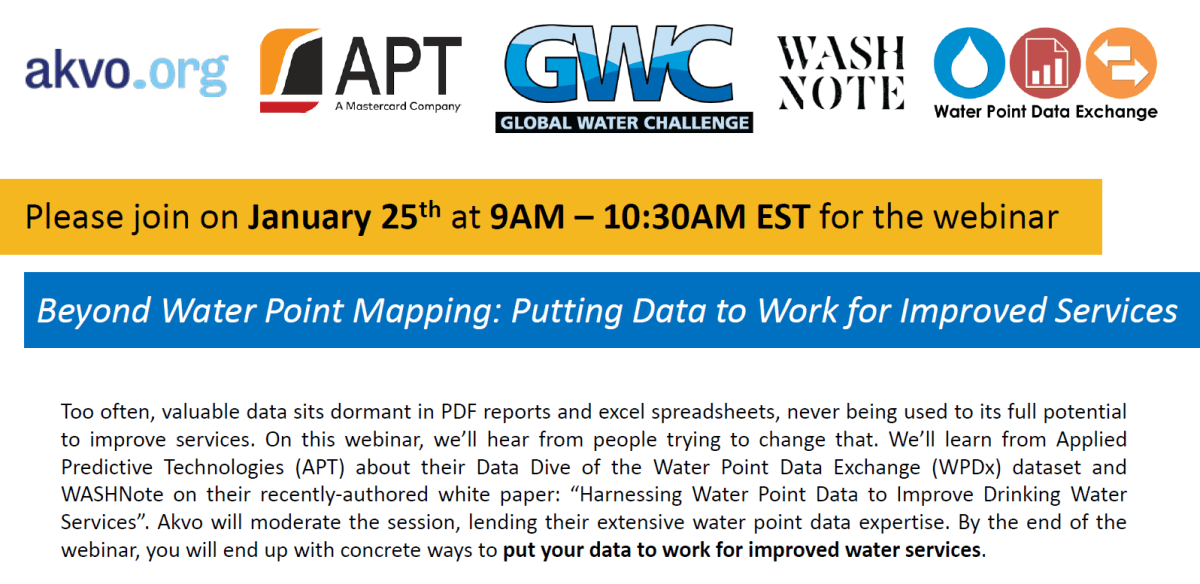
WPDx webinar: Beyond Water Point Mapping: Putting Data to Work for Improved Services

Too often, valuable data sits dormant in PDF reports and excel spreadsheets, never being used to its full potential to improve services.

Join this webinar and learn from people trying to change that. Joining Global Water Challenge will be Applied Predictive Technologies (APT) sharing findings from their Data Dive of the Water Point Data Exchange (WPDx) dataset and WASHNote addressing their recently-authored white paper: “Harnessing Water Point Data to Improve Drinking Water Services.” Akvo will moderate the session, lending their extensive water point data expertise.

By the end of the webinar, you will learn strategies to put your data to work for improved water services.

Register here

Grown-up finance for the rural water sector

The challenge of achieving the SDGs is upon us and with this concrete and short-term objective, the sector is finally taking the issue of financing more seriously, which is a very good thing but not before time. Whilst a few years ago finance was the privilege of a selected few, everyone is now talking about it; however, whether this is a case of better late than never still needs to be proven.

by , re-posted from Aguaconsult with thanks

The challenge of achieving the SDGs is upon us and with this concrete and short-term objective, the sector is finally taking the issue of financing more seriously, which is a very good thing but not before time. Whilst a few years ago finance was the privilege of a selected few, everyone is now talking about it; however, whether this is a case of better late than never still needs to be proven.

Last week, I chaired with interest the RWSN webinars on “grown up finance” for rural water supply. Kelly-Ann Naylor (UNICEF), Catarina Fonseca (IRC WASH), Sophie Trémolet and John Ikeda (World Bank) and Johanna Koehler (Oxford University) gave great presentations and here are my few take aways from the discussions:

The magnitude of the challenge is huge and greater than we probably think. We often hear about the figure of USD 114 billion to achieve SDGs 6.1 and 6.2, but this is only part of the story. This figure covers investment and maintenance of new services, but excludes the crucial maintenance of existing services and the broader sector support.

We know there is a huge funding gap and the current finance model will not fit the bill. Official Development Assistance (ODA) has not increased as much for WASH as it has for other sectors and concessional finance as well as domestic investments only accounts for a fraction of the required investments. The sector has the potential to attract other sources of finance, but we need to take a few steps.

We need to have an honest conversation about the exact magnitude of the challenge at national and district level to support planning and budgeting. This is taking place at national level as part of the SWA process in some countries, but only partially at district level. More robust data on service levels as well as cost of services, which are currently insufficiently researched, can help us in this direction, but we need to move faster.

We need to get better at understanding budgeting processes and supporting strategic multi-year budgeting both at national and district levels. Most countries are not very good at this at the moment and it has to change.

We need to advocate beyond the WASH sector and target more important political decision makers – Ministries of Finance and even the office of the president) to prioritise domestic investment in WASH and increase it through a larger tax base and increasing tariffs. Again, evidence will take us a long way in bringing politicians round the table.

We need to look at other sources of finance, particularly private finance to complement existing funding sources. Making the sector more attractive to private investment will be a necessary first step, but this will hinge on Governments playing a crucial role in strengthening the enabling environment and de-risking the sector. ODA, currently crowding the sector will need to focus on the riskiest segments and leave space for private investments to come in (e.g. stop lending to urban utilities and focus on rural water supply). Assessing sector entities’ performance and risk profile will be a necessary first step.

We need to start experimenting with innovative “blended finance” models, learn from them and adjust. Examples are already out there from Benin, where subsidised concessions are being tested; but also from Kenya and other countries.

After decades of ODA dependency, the WASH sector is slowly opening up to the real world of finance to reach its ambitious targets. This means being transparent and accountable, providing evidence of performance and better understanding what will incentivize the commercial finance world. A huge task ahead and surely a dramatic and positive change in culture!

Photo: Inspecting community-level financial records in Tajikistan (S. Furey)

Consultation period on the RWSN Strategy now open – Période de consultation sur la stratégie RWSN maintenant ouverte

The draft RWSN Strategy 2018-2023 can be downloaded here for consultation, and you can also view a short presentation about it here; please leave a comment below or email us, telling us:

  • What you like about the strategy
  • What could be improved
  • If you, or your organisation, could contribute staff time, funding or knowledge to strengthen any of the topics or themes

The consultation on the RWSN Strategy is open to all for 6 weeks  (until 22 December 2017)

Watch the webinar on the RWSN strategy

*****

La stratégie RWSN 2018-2023 peut être téléchargée ici (en anglais)  pour consultation, ou vous pouvez également télécharger une présentation à ce sujet en français ici; n’hésitez pas à laisser un commentaire ci-dessous ou nous envoyer un email, en nous disant:

  • Ce que vous aimez dans cette stratégie
  • Ce qui pourrait être amélioré
  • Si vous, ou votre organisation, pouvez contribuer du temps, des financements ou des connaissances pour renforcer les sujets ou les thèmes

La consultation sur la stratégie RWSN est ouverte à tous pour 6 semaines (jusqu’au 22 décembre 2017)

Regarder le webinaire sur la stratégie RWSN

Gender and rural water services – lessons from RWSN members

Gender relations are critical to nearly every aspect of rural water supply, but rarely addressed in practice by rural water professionals. All water supply programmes affect men and women in different ways, and while practitioners assume their work will benefit women, how do they know whether it will or not, how do they know what impact it will have?

In 2016 RWSN’s Mapping and Monitoring Theme members had an impromptu and rich e-discussion on gender equality and WASH. In early 2017, RWSN’s Equality, Non Discrimination and Inclusion (ENDI) Theme launched a call to their members for examples of inspiring experiences of ‘Making Water Work for Women’. Both discussions have been rich with experiences from across Asia, Africa and Latin America, and reinforcing of each other. We have put together a short brief highlighting the key points from these discussions:

  • The nature of female participation within water committees should be discussed in terms of quality as well as quantity.  If women’s roles do not offer any opportunity to influence committee decisions and outcomes, their participation is largely tokenistic. Qualitative indicators can help to show whether women’s participation is tokenistic, or active and meaningful.
  • High-level government commitment to minimum quotas for women’s participation was seen as a crucial prerequisite to creating the space for the inclusion of women and the ability to demand it.
  • Where women were more influential on Water User Committees, it was strongly attributed to the special efforts of implementing organisations who worked on mobilising women and increasing their confidence and awareness about  the work involved, and sensitising men equally to create space for women’s involvement in the committees, as the example in India shows.
  • By working closely with women and men together it is possible to challenge gender norms amongst women and men in rural communities, so that they begin to share unpaid work associated with WASH more equally, as the example in Ethiopia shows.
  • Identifying the agents of change (women and men) from the community who are motivated and determined to advocate for water and sanitation can nurture lifelong advocates, as illustrated by the experience from Bangladesh.
  • Disaggregating monitoring indices by gender can help to raise gender equality as a priority, and set specific expectations about the participation of women in different aspects of service provision.
  • Conflict-sensitive approaches to water and sanitation can help to facilitate peace building by creating a platform for women around a common need, as in the example from India.

Download the brief : Gender and rural water services – lessons and experience from RWSN members

The 2017 RWSN Evaluation is now out!

Back in June 2017, we announced that RWSN would be undergoing an external evaluation, which was undertaken by PEMconsult over July and August 2017.

What were the main findings from the Evaluation?  Overall, the evaluation found that “RWSN is highly relevant for the rural water sector, in comparison to other networks, and for the benefits it provides to its members and organizational partners…. The RWSN is a highly competent, advanced community-building network which connects people who would likely not have been connected before and disseminates valuable knowledge to its members, which can be applied to practice.”

While the report is overall positive, it makes 12 recommendations around (1) RWSN’s strategy (2) RWSN’s governance structure and (3) the way the network operates.  RWSN’s Executive Steering Committee has responded to these recommendations, which will be addressed in the coming years and in its new Strategy. We will discuss these at an upcoming webinar on November 9th, for which you can register here.

Download:

*****

En juin dernier, nous avons annoncé que RWSN ferait l’objet d’une évaluation externe, réalisée par PEMconsult en juillet-août 2017.

Quels sont les résultats principaux de l’évaluation?  L’équipe de l’évaluation a conclu que “RWSN est très pertinent pour le secteur de l’eau rurale, par rapport à d’autres réseaux, et offre des avantages à ses membres et à ses partenaires organisationnels …. Le RWSN est un réseau très compétent et avancé, qui permet de former des communautés qui connecte les personnes qui ne pourraient pas autrement être connectées et dissémine des connaissances ayant de la valeur pour ses membres, et qui peuvent être mises en pratique.”

Bien que le rapport soit positif, il y a 12 recommandations portant sur  (1) la stratégie de RWSN (2) la structure de gouvernance de RWSN et (3) la façon dont le réseau fonctionne.  Le comité de pilotage de RWSN a répondu à ces recommandations qui seront considérées dans les années à venir et dans sa nouvelle stratégie. Nous allons en parler lors d’un wébinaire le 9 novembre, pour lequel vous pouvez vous inscrire ici.

Télécharger le résumé exécutif du rapport d’évaluation (français).


Declining groundwater levels in Malawi impacting rural water supplies

RWSN member, Muthi Nhlema, has challenged the government of Malawi over how groundwater is used for rural water supplies: 30% of water points are not working across the country and he points to declining groundwater levels being a major factor. Mr Nhlema therefore challenged the wisdom of further drilling and groundwater development, if the use of the water resource is unsustainable.

Read the full article: The Nation, 1 October 2017

RWSN’s Kerstin Danert wins top award

Dr Kerstin DanertSkat Foundation, who is a member of the UPGro Knowledge Broker team and Chairs UPGro’s Programme Coordination Group (PCG) has been given the “Distinguished Associate Award, 2017” by the International Association of Hydrogeologists (IAH) for her outstanding contribution improving the use of groundwater worldwide.

Kerstin has been a driving force behind the Rural Water Supply Network, and in particular the promotion of drilling professionalisation and documentation of manual drilling practices. In addition to working on UPGro, she is currently leading an RWSN collaboration between UNICEF and Skat Foundation on professionalising water well drilling in Africa, which includes capacity development activities in Angola, Burkina Faso and Zambia.