May 8, 2013 Webinar – Removing Barriers to WASH by the RWSN equity and inclusion group

Join the webinar tomorrow

WASHplus's avatarSanitation Updates

The RWSN equity and inclusion group is pleased to announce its latest webinar on Removing Barriers to WASH. If you would like to attend, please inform ShamilaJansz@wateraid.org. For more details, see below:  wateraid-logo

Description: WEDC and WaterAid have developed a new set of ‘Equity and Inclusion in WASH’ learning materials.

We have been collaborating to develop practical training materials for WASH practitioners, to help them analyse and address the problems faced by the most disadvantaged people in accessing WASH services. Extensively field-tested by WaterAid and WEDC in Africa and Asia, the materials are participatory and interactive, and are ideal to facilitate practical collaboration and problem-solving between disabled people and technical service providers. They can be used as stand-alone activities, or as part of a broader training programme. Although rooted in the social model of disability, the scope of the analysis framework has been broadened to encompass exclusion…

View original post 235 more words

A bit short of a miracle …

The “Everyone Forever” is gaining traction

editor's avatarwater services that last

By Patrick Moriarty and John Sauer

What is it that IADB’s Max Valasquez Matute in Honduras finds ‘only a bit short of a miracle’?  The decision by seven INGOs to align their programming in Honduras in support of an Everyone Forever movement aimed at delivering full coverage in sustainable rural water, sanitation and hygiene services.

Whether there was divine intervention or not, the meeting we attended on the 24 May between the assembled board members of the Millennium Water Alliance and the Mesa de Cooperantes (the donor coordination platform) of the Honduran WASH sector was pretty unusual – and very exciting.

View original post 630 more words

Planning for impact

A very useful update on the Triple-S project

editor's avatarwater services that last

By Patrick Moriarty

Back in June and July of 2012, Triple-S underwent a mid-term assessment (MTA) by an excellent team led by Dr. Ben Ramalingam. The MTA was a hugely useful exercise, allowing the Triple-S team and our partners to take some time out from our day to day work to reflect on how we were doing. The MTA team held up a mirror to us as a project and process – in much the same way that Triple-S seeks to hold up a mirror to the rural water sector – allowing us to have a long hard look at ourselves.

View original post 397 more words

WASHTech at the IRC symposium in Addis Ababa

WASHTech presentation at Monitoring Symposium

dietvorst's avatarWASHTech, THE project (2011-2013)

With two presentations and a pre-launch side event, WASHTech was well represented at the IRC Monitoring Sustainable WASH Service Delivery symposium. The symposium and side events took place from 9-12 April 2013 in Addis Ababa, Ethiopia.
Introducing the TAF

André Olschewski (Skat) and Benedict Tuffuor (TREND Ghana) gave a general introduction to the Technology Applicability Framework (TAF) in a special session on the enabling environment. The session included a presentation on another tool, the Sustainability Monitoring Framework developed by the Dutch WASH Alliance.

Both presentations prompted a discussion about the number and variability of sustainability and how all these tools fit together. The presenters stressed that both tools fit in wider thinking around sustainability in the sector. Even though the tools are being developed in parallel, they both attempt to simplify the analysis of complex, variable data.

View original post 541 more words

Islands of success

Evaluation of a Water For People intervention in partnership with local government India

Stef Smits's avatarwater services that last

Sagar is an island at the mouth of the river Ganges where it meets the Bay of Bengal. Every year in January, about half a million pilgrims visit the island to worship at the holy Ganges. The hundreds of mobile toilet units standing on the empty festival terrain during the rest of the year are witness to the island’s authority’s efforts to ensure that the pilgrim’s stay on the island is as comfortable, hygienic and safe as possible. But the authorities also don’t forget about the 200.000 permanent inhabitants when it comes to sanitation. Together with the NGO Water For People (WFP) and other partners, it seeks to achieve full coverage in sanitation and water supply in the next few years.

View original post 1,146 more words

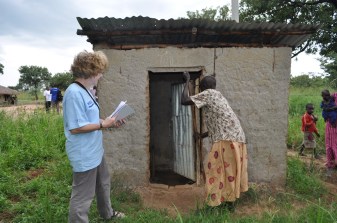
Making sanitation and water accessible to people with disabilities in Uganda

by James Kiyimba, WaterAid Uganda

Pascal Emalu is an old man and resident of Agwajua village, Aweelu parish, Morungatuny Sub County of Amuria district which is over 330 km North East of Kampala. He remembers when young, he was very swift and energetic, doing all his household chores with ease. At 63 years now, he finds problems in doing all what he used to do in his youth full stage.

Ijan Janet Norah (old lady) demonstrating to Hazel Johns (WEDC) the challenges she goes through to use a pit latrine Photo: WaterAid / James Kiyimba

“Way back, I could not think of old age as a kind of disability. Now I am vulnerable, I face lots of challenges in squatting to use a latrine,” Pascal says.
Continue reading “Making sanitation and water accessible to people with disabilities in Uganda”

Scaling Up Water Supply: A Focus on Zambia’s Eastern Water And Sewerage Company

news from Zambia

Water Journalists- Africa's avatarWaterSan Perspective

Julius Phiri
April 19, 2013

ZAMBIA has vast water resources in form of rivers, streams, lakes and groundwater, but the declining patterns over the years have had a significant adverse impact on the country’s water resources.

In terms of groundwater, the country has favorable geological conditions for accessing groundwater with regard to depth, storage capacity, available yields and exploitation potential.
It is not disputed that over the years, strides have been made towards improved water service delivery to the urban population.

This is due to cognizance of the concerted efforts of the Zambian Government, cooperating partners and many other stakeholders that have contributed to improved water supply and sanitation service provision in Zambia.

The National Water Supply and Sanitation Council (NWASCO) is charged with the responsibility of regulating water supply and sanitation service provision for efficiency and sustainability. In executing the tasks, NWASCO ensure that the commercial utility companies abide…

View original post 835 more words