I am sorry to inform you of the passing of Dr. Otto Langenegger, who peacefully left us on 19 February, 2023 surrounded by his family, aged 84.
Dr Langenegger was the pioneer of rapid handpump corrosion. His seminal publications in 1989 and 1994 set the foundation for all that followed in trying to understand and address this phenomenon.
In his eulogy, he was poignantly referred to as a “nomad around water”. He grew up, in humble surroundings, close to Lake Constance in eastern Switzerland, the youngest of six siblings.
His thirst for discovering and learning could not be quenched by his apprenticeship as a radio technician in Winterthur. He was a through-and-through scientist and researcher, moving between subjects throughout his life, and building on the learning from one area as he branched into another. Together with his wife Dorothea, he moved to work in Canada for several years, from where he was able to, amongst other experiences, be part of an expedition to the Arctic, an exposure that he relished for the rest of his life.
Dr. Langenegger and his wife, with their two sons Urs and Thomas, moved back to Switzerland, and he completed his first PhD at the University of Bern in 1973. But he was soon on the move again, this time to Ethiopia, where he worked as a Hydrogeologist with the Christoffel Mission. He was fascinated by the people and culture, and was saddened to have to leave in 1976 due to the difficult political situation at the time.
Dr. Langenegger was not long back in Switzerland, before heading off to Africa in 1981, initially to Ghana, where he worked for the World Bank on the pioneering water well drilling and handpump installation project of its time in West Africa. This position, and the subsequent assignment based out of Abidjan, took him to Burkina Faso, Cote d’Ivoire, Ghana, Mali and Niger.
As a keen observer and compassionate man, Dr Langenegger was both intrigued and appalled by the ‘red water’ problem, coupled with corroding and failing handpumps that he observed in many parts of West Africa during his field work. And so, he set out to understand the causes. Initially using his own allowances to test water quality, he diligently researched this issue. One of his colleagues from the time told me that he stayed in the cheaper hotel in Kumasi – saving money for testing, and filling the bathtub with his tests. He also had his wife, Dorothea, cook plantain with different concentrations of iron-rich water from the rapidly corroding handpumps to see what happened to them. They changed colour.
Anyone working on handpump corrosion is familiar with Otto Langenegger’s seminal publications (1989 and 1994), which have provided the foundation for all that has followed on this topic. His second PhD was in fact on Handpump Corrosion.
After returning to Switzerland in 1989, Dr. Langenegger set up his private consultancy practice, working out of his home in Gais, Appenzell. Overlooked by snow-capped Alpstein mountains, his interest in water found an outlet in learning about the blue coloured snow, high on the slopes. And so once again, this through-and-through researcher set about observing, measuring and interpreting. I would say that Dr. Langenegger’s, keen interest and thirst for knowledge in relation to water was insatiable.
It was 2019 that Dr. Langenegger, who would soon to be known to me by the informal address simply as Otto, contacted me. He had found my own report on Rapid handpump corrosion in Burkina Faso and beyond and wanted to know more. Otto was both disgusted that the corrosion problem had not been fully addressed (after more than 30 years), but was also pleased that it was at least being looked at again. Unbeknown to me previously, he lived just a few stops along the train line from St. Gallen where I am based!
Otto had been out of touch with the water supply world in Africa for a long time, but had, now and then, searched for what may have followed on from his work on handpump corrosion. And so he was aware of the presentation entitled ‘New signs of an old Problem’ at the WaTer Conference in Oklahoma in 2015 by Vincent Casey, Lawrence Brown and Jake Carpenter.
Over the last two and a half years that Otto and I were able to share, he followed all of the ongoing efforts and work to address rapid handpump corrosion – the issue which he has pioneered in the 1980s. He was delighted to be able to talk about the subject, and, researcher that he was, always asked such pertinent questions and put forward ideas.
Throughout his long illness, and even as he grew weak towards the end of his magnificent life, he always wanted to hear the latest news. His delight to hear that the corroding handpumps in Ghana had been replaced in the 1990s is something that will always remain with me. “It was not all for nothing” he remarked, fist in the air, referring to his efforts over 30 years ago.
Dr. Otto Langenegger will be much missed. May he Rest in Peace.
He leaves behind a large family:
Urs and Marika Langenegger-Bohse with their children Tabea, Dominik and Eliane.
Thomas and Anita Langenegger Vogel, with their children Samuel, Jonas, Elias, Rahel and Salome.
In 1983, I moved to live and work in Ghana – some 40 years ago now. Back then, I was the regional supervisor on the 3000 Well Maintenance Unit in Southern and Central Ghana which was funded by the German Development Service under the Rural Water Supply programme. The project was a pioneer of its time, and included drilling boreholes alongside the installation and testing of handpumps in six of Ghana’s regions, as well as the Nanumba district, Northern Region.
We initially installed India Mark II and Moyno pumps, before dropping the Moyno due to technical problems. However, we soon realised that the India Mark II pumps faced corrosion issues. Investigation and testing (as documented by Langennegger, 1989 and Langenegger, 1994) found that the Galvanised Iron components (rods and riser pipes), when installed in water with low pH, had a propensity to rapidly corrode – leading to discolouration of the water and affecting taste, but also causing the pumps to fail prematurely as the rods broke and riser pipes developed cracks and holes and even fell into the borehole. The envisaged idea of maintenance by communities, with assistance from mechanics who could reach villages by motorcycle, was simply not feasible with such installations. Another significant issue related to corrosion of hand pump parts was the water contamination and bad taste of the water. As a result, the water coloured the food and therefore caused the population to stop using the borehole water and forced them to go back to unsafe water sources
We, therefore, had to seek alternatives. This involved field testing and collaborating with the Materials Testing Institute of the University of Darmstadt.
We looked into replacing the galvanised iron components with stainless steel. To ensure the pipes were light, we considered using 3 – 3.5 mm thick pipes, and used a threading that at the time was used in the drilling industry , known as the “rope thread”. Although Atlas Copco had patented this threading type at the time, it was later manufactured in India after the Atlas Copco design period (patent) ended.
Figure 1: Rope thread (Claus Riexinger)
The pump rods presented some challenges as well, since the AISI Stainless Steel grade 316 that we were using was subject to breakage, including the threaded parts. In collaboration with our partners at the University of Darmstadt, we were able to find ways to make this grade of stainless steel more elastic by adding 2-3 % Molybdenum. Other issues with the rods related to the use of rolled thread, which we learned was more durable than cut thread. Incorporating these materials and techniques, we were able to reduce the rod diameter from 12 mm down to 10.8mm, resulting in lighter rods which did not corrode. The only drawback was that the threads could not be cut in the field, but this was not such an issue, as there was no need to cut them when they were installed, or upon maintenance.
Figure 2: Pump installation (Claus Riexinger)
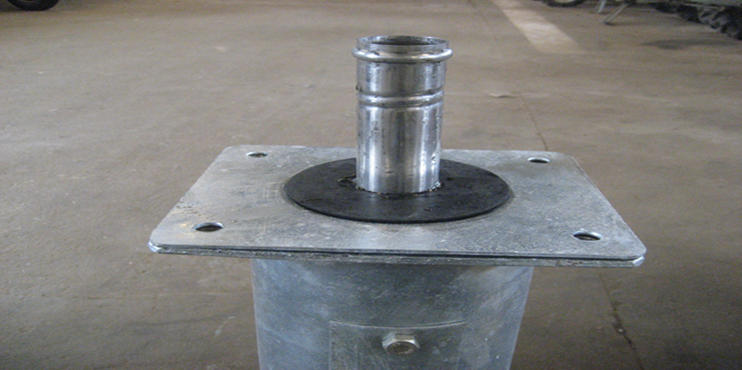
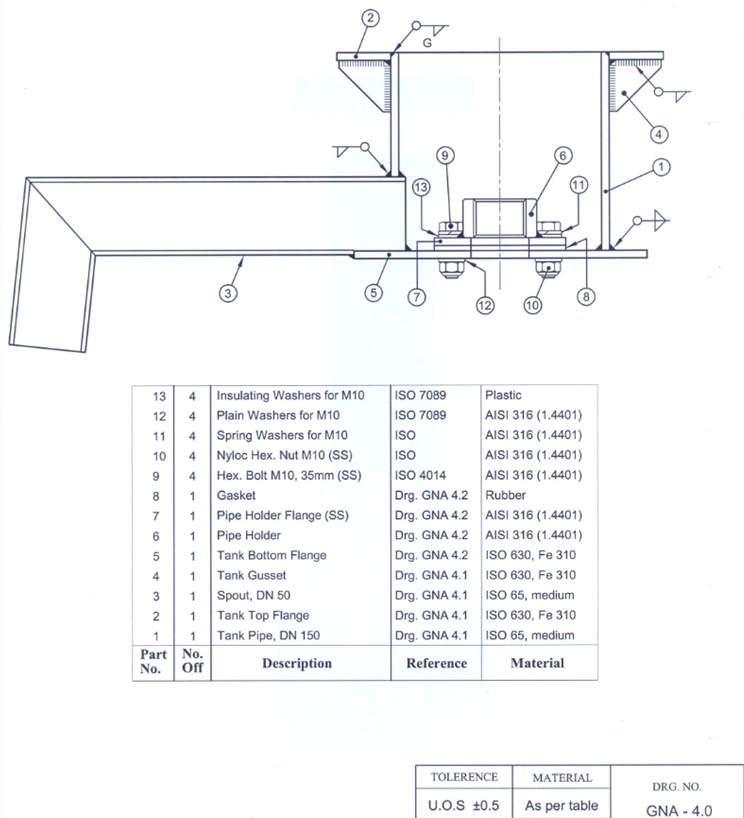
After switching to stainless steel riser pipes, we encountered another issue: -galvanic corrosion between the pipe and the water tank. This type of corrosion occurs when two dissimilar materials come into contact in solution. It was yet another challenge! Fortunately, we were able to solve this problem by replacing the existing flange with a new one made of stainless steel with an insulating gasket, into which the riser pipe could be screwed and prevent any further galvanic corrosion.
Figure 3: Ghana Modified India Mark II Handpump – water tank, spout and flange
After conducting extensive testing and collaborating with the University of Darmstadt over a period of around 4 years, we managed to solve the problem of rapid corrosion of handpumps in Ghana. The improved pump design came to be known as the Ghana Modified India Mark II, and was officially adopted by the Government of Ghana in the 1990s. Its specifications can be downloaded here.
Designing and publishing the specifications for a new pump is one thing, but the other is ensuring that these are adhered to. A series of meetings with government, donors, and NGOs working in the water sector in the 1990s, led to the agreement to no longer use Galvanised Iron. All stakeholders were on board with the change.
Of particular importance was the tremendous support and buy-in of the major donor at the time – KfW (Germany). They agreed to pay for the increased costs of the Ghana Modified Pump on new installations, which at the time was about three times more expensive than the version using Galvanised Iron. KfW also supported the rehabilitation and replacement of the pumps that had previously been installed using Galvanised Iron. As a result, we were able to remove and replace the corroded installations systematically, rather than addressing the issue in a piecemeal manner.
It is estimated that over 4,500 Ghana Modified India Mark II handpumps had been installed in Ghana by the time I left the 3000 Well Maintenance Unit in 1992. Anecdotally, I would say that 90% were working, and of the 10% out of use, they were down for maintenance/repair.
KfW took this design to Cameroon, while Danida took it to Burkina Faso and Zambia. I am not fully aware of what happened next, but I do know that ensuring the quality of stainless steel was a problem in Burkina Faso.
I am very pleased to see that Ghana Modified India Mark II handpumps are now available through the Rural Water Supply Network (RWSN), and hope that these can be of use to other countries that are struggling to overcome the rapid handpump corrosion problem.
Figure 4: Example factory inspection Modified India MKII (Claus Riexinger)
However, I have a work of caution too. Although specifications, standards, and clear procurement documents are essential, they are rendered meaningless in the absence of inspection. During my time with the 3000 Well Maintenance Unit and later as an independent consultant, I traveled to India and other places for pre-shipment inspections. I also oversaw the rejection of consignments from India and Europe due to poor quality or manufacturing mistakes. And so, I urge all of you involved in handpump procurement and installation to make sure that you ensure the quality, especially through inspection and material testing.
About the author: Claus Riexinger is a rural WASH expert and freelance consultant with over forty years of experience in development cooperation with Government organisations, private companies, and development agencies mainly in Botswana, Lesotho, Malawi, Germany, India, Tanzania, and Ghana.
REAL-Water to coordinate data and actions for the sustainable development of water resources in arid Southern Madagascar.
In Madagascar, there are significant disparities in access to essential water and sanitation services. Currently, only about half of the population (54.4%) has access to vital water services, and just over 10% have access to necessary sanitation services. The situation is particularly challenging in Southern Madagascar, where various development issues, such as population growth, changes in land use, and worsening dry-season water shortages, are present. These difficulties are exacerbated by poverty, which hinders water resource development, leads to poor infrastructure, and contributes to food insecurity.
To guide regional programming that considers the development and humanitarian requirements, USAID Madagascar has commissioned REAL-Water to assess water resources and infrastructure needs. The program will entail specific activities, including a literature review of water development activities, data collection on existing and planned water infrastructure, analyses of remaining water resources and infrastructure needs, and planning for future investments.
The six districts of interest covered in the assessment are shown on an I-digital elevation model (from the Shuttle Radar Topography Mission). Small gray and green polygons indicate areas of human settlement (“Settlement Extents”) from the GRID3 DATA HUB. Each settlement extent type (built-up area, small settlement area, and hamlet) is included, with built-up areas depicted in green).
Professional Drilling Management & Groundwater Resources Management
Thanks to funding from the Federal Institute for Geosciences and Natural Resources (BGR) in Germany, 2022 saw Ask for Water GmbH, together with the Africa Groundwater Network, Cap-Net UNDP and several other partners (see below) develop and run two online courses on groundwater. The courses strengthened the capacity of staff of governments, NGOs, the private sector and academia in African member states and beyond.
The courses, hosted by Cap-Net UNDP, and offered free of charge to participants, were entitled Groundwater Resources Management and Professional Drilling Management. Each course was specifically developed for professionals working on these issues, or responsible for decision making.
Face to face training course on drilling supervision in Sierra Leone (Source: Kerstin Danert)
Professional Drilling Management Course
Drilled water wells are vital to achieving universal clean drinking water, providing safe, affordable, reliable and available water sources. To ensure that the water wells or boreholes are built to last, they must be drilled, developed and completed in a professional manner. Key elements of a professional drilling sector are robust procurement, contract management, siting, borehole design, construction, and supervision. Furthermore, the management of the groundwater resources must also be considered and support provided to long-term maintenance if services are to last. Unfortunately, in many countries it is difficult to develop skills in these areas due to a lack of training and mentoring opportunities.
The 2022 online course on Professional Drilling Management provided participants with a comprehensive overview of the different aspects of drilling management, specifically (i) groundwater data and siting; (ii) procurement and contract management (including costing and pricing; (iii) borehole drilling and supervision and (iv) legal and institutional frameworks. In the last of five modules, participants were encouraged to reflect upon and share actions that they as individuals and as organisations could take to raise drilling professionalism in the context in which they work. From the 781 people who applied for the course, 314 were selected, of which 209 were active participants. A total of 162, equivalent to 78% of the active participants passed the course.
You can access the 2022 course report, manual and key training materials here.
If you would like to learn about what alumni of previous online courses on Professional Drilling Management have done with their knowledge, check out the short film below or the short report of their testimonials.
Groundwater Resources Management Course
An estimated 50% of the global and 75% of the African population rely on groundwater for their drinking water supplies. Groundwater supports social and economic development and will become increasingly important in the face of climate change, as groundwater resources are often less affected than surface water by climate change impacts. If groundwater is to provide reliable, safe and sustainable water supplies now and for future generations, the resource must be well-managed. This requires consideration of the entire system of policies & laws, strategies & guidance, monitoring & management as well as investments & projects. Good groundwater management needs sound capacities in water authorities. But at same time, as many elements of groundwater management fall in other sectors, a general understanding of groundwater management principles in sectors like agriculture and urban planning is key for its successful implementation.
The 2022 online course on groundwater resources management provides participants with a comprehensive overview of the multiple factors that impact upon groundwater. It was a self-paced course and was hosted on the virtual campus of Cap Net/UNDP.
The course comprised 5 modules; each with a short introduction, goal, learning objectives and orientation video, as well as mandatory videos and reading materials:
Module 1: Characterization of Aquifer Systems from a Management Perspective
Module 2: Groundwater monitoring and data/information management & communication
Module 3: Groundwater quality and source water protection
Module 4: Groundwater regulation, licensing, allocation and institutions for aquifer management
Module 5: Transboundary aquifers in Africa: Approaches and mechanisms
You can access the 2022 course report, manual and key training materials here.
Artesian well near Lake Chad, Chad (Source: Moustapha Diene
What next?
The Rural Water Supply Network (RWSN), Ask for Water GmbH, the Africa Groundwater Network (AGW-Net), Cap-Net UNDP and partners would like to offer these courses on an annual basis. We are currently looking for sponsors/funders to make this possible. In case you are interested, please contact us via info@rural-water-supply.net.
This is a guest blog by RWSN members D. Daniel, Trimo Pamudji Al Djono, and Widya Prihesti Iswarani, based in Indonesia.
Data tell us many things. We can learn the patterns of any phenomenon using data. In this blog, we bring you to the archipelago country of Indonesia where water access is still a challenge, especially in rural areas. As of 2020, only 82% of households in rural Indonesia have access to basic water services, while almost 95% of urban households enjoy those water services.
To tackle this, the Indonesian government launched the community-based drinking water supply program, called “Program Penyediaan Air Minum dan Sanitasi Berbasis Masyarakat (PAMSIMAS)” in 2007. Almost 22 million people in 32 thousand villages throughout Indonesia got PAMSIMAS access from 2008 to 2020. PAMSIMAS is one of the biggest rural water supply programs in the world. Unfortunately, not many stories from PAMSIMAS are shared with the global community, so we are here to tell you the story!
PAMSIMAS infrastructure
PAMSIMAS is conducted at the village level and managed by the community itself. If we talk about functionality, the data in 2020 indicates that 85.4% of the PAMSIMAS programs were fully functioning, 9.1% were partially functioning, and 5.5% were not functioning. Thus, we can say that the success rate for this program is quite high.
The main question now is what can we learn from the PAMSIMAS program? Here are some lessons learned from our study:
First, household connections have a higher chance of being sustainable (99%) than communal or public connection (69%), e.g., public tap. We can relate it to the payment system. Almost 40% of the communal connections had no payment system, compared to only 3.5% of the household connection. From the field experience, it is relatively challenging to implement and collect water fees in the communal systems, especially because there is no water meter measuring the actual use of households. We should take into account also that other people from outside often come and draw water without paying for it, which can cause jealousy from the actual beneficiaries and make them hesitate to continue paying for the water service. All of these can result in not enough money for the water board to maintain and repair any damage in the system.
Second, let’s talk about the contribution made by the community or beneficiaries toward the program. We all agree that it is important for the community to contribute to the program, either in form of in-kind, e.g., in the program planning, pipe and system construction, etc., or in-cash, e.g., monthly tariff or construction cost. We may think that the more people participate in those activities, the higher the chance of the water service being sustainable. And yes, it is true. However, our analysis found that community contribution in the form of regular-monthly payment is more influential than in-kind contributions at the beginning of the project to sustain the PAMSIMAS program. We again highlight that regular payment by the beneficiaries is important to sustain the program.
PAMSIMAS infrastructure
Third, the success of the rural water supply program cannot be achieved without favorable human factors, such as a well-performing water board and good support or contributions from the community. For the former, we suggest that mentoring of the village water board by the district facilitator can be done to ensure that the water board has sufficient capacity to efficiently manage the piped system, e.g., repair broken pipes or implement cost-effective operation & maintenance.
Fourth, financial support from the national and district government is critical, e.g., by providing extra subsidies or incentives outside the main fund scheme. In this case, only well-performing water boards or PAMSIMAS programs have a chance to apply for these extra funds. Thus, this will trigger the water board to perform well before they apply for it. In short, we need support from all governmental levels: national, district, and village.
Fifth, we have to understand the relationship between water board performance and support from the community. Let’s have a look, for example, at monthly payments: the well-performing water boards will increase the trust of the community and minimize any interruption in water delivery. As a result, the community would be happy to pay the water fee regularly and support the water board activities. In other words, this will create positive conditions for the water board.
Lastly, we know that water access is a human right. We (and the government) are trying to provide water to everyone in need, especially vulnerable groups, e.g., poor people or those who live in difficult areas. On behalf of human rights, the government is willing to spend a lot of money on those groups, which may result in a very high investment per capita. Some reasons for the high investment per capita are a small number of beneficiaries, wide coverage area of the water supply system, or scattered housing in remote areas. However, our analysis found that a high investment per capita is not associated with a sustainable PAMSIMAS program. We don’t want to say stop providing water for them, but rather the need for a comprehensive economic analysis and system design in the feasibility study before the project starts.
There are many things to share with you but we don’t have enough space to write everything here. If you are still curious, please check our scientific publications about PAMSIMAS below. See you!
Factors related to the functionality of community-based rural water supply and sanitation program in Indonesia. Geography and Sustainability. https://doi.org/10.1016/j.geosus.2022.12.002
The effect of community contribution on the functionality of rural water supply programs in Indonesia. Groundwater for Sustainable Development. https://doi.org/10.1016/j.gsd.2022.100822
A System Dynamics Model of the Community-Based Rural Drinking Water Supply Program (PAMSIMAS) in Indonesia. Water. https://doi.org/10.3390/w13040507
About the authors:
(D.) Daniel is a lecturer and researcher at Public Health Graduate program, Universitas Gadjah Mada, Indonesia. His main topics of interest are water, sanitation, and hygiene (WASH) system in rural areas, household water treatment practice/behaviour, the sustainability of WASH services, drinking water quality at the household level, and public health issue in general.
Trimo Pamudji Al Djono has 25 years of experience in community development and empowerment programs/projects in urban and rural. Trimo has worked for the World Bank for 14 years managing national programs and has experience as a researcher and lecturer by becoming a Lecturer in Environmental Engineering at the Jakarta Sapta Taruna College (STTST) and Singaperbangsa Karawang University. Other experiences include working as a consultant at GHD, Plan International, Unicef, UNIDO, Aguaconsult, and NORC University of Chicago.
Widya Prihesti Iswarani is a lecturer/researcher in the field of environmental science and engineering. She is currently working at Avans University of Applied Sciences and Centre of Expertise Biobased Economy in The Netherlands. Her main topics of interest are water and wastewater treatment, resource recovery, and the sustainability of WASH in developing countries.
Photo credits: D. Daniel, Trimo Pamudji Al Djono, and Widya Prihesti Iswarani
This year we are celebrating 30 years since the Rural Water Supply Network was formally founded. From very technical beginnings as a group of (mostly male) experts – the Handpump Technology Network- we have evolved to be a diverse and vibrant network of over 13,000 people and 100 organisations working on a wide range of topics. Along the way, we have earned a reputation for impartiality, and become a global convener in the rural water sector.
RWSN would not be what it is today without the contributions and tireless efforts of many our members, organisations and people. As part of RWSN’s 30th anniversary celebration, we are running a blog series on rwsn.blog, inviting our friends and experts in the sector to share their thoughts and experiences in the rural water sector.
This is a guest blog by RWSN Member Lilian Pena P. Weiss based in Washington DC, USA.
I started working in the rural water sector in 2002, in my very first assignment with the World Bank, when I was part of a team assessing the social and environmental impacts of rural water systems in the dry northeast part of Brazil. As a recent engineering graduate, I was very much focused on the infrastructure – but I quickly learned that sustainable rural water services need to take into account a lot more than that. I remember vividly exchanging with the rural users on how to organise the community associations for managing water services, discussions on tariffs, Operation & Maintenance, and support from local governments amongst others. Since there, I never stopped working on delivering rural water services
In the early 2000s in Latin America, I worked on many projects in rural water services to indigenous and Afro-Latin communities that had been financed by the Inter-American Development Bank and the World Bank. Through those, I gained a better understanding of how these communities value water, the related cultural connections, and their willingness to have and pay for better services! This underlined the importance of working on the social side, especially behavior change and communications to make rural water services sustainable. At the time, the Demand-Responsive Approach (DRA) was the mantra with rural water practitioners! Some of the lessons learned from my engagement with Indigenous communities in Latin America and the Caribbean were later captured in this publication.
Around 2010, we started to develop a joint rural water information system, SIASAR, with Honduras, Nicaragua and Panama, which has since turned into a rural water platform across 14 national or subnational governments, from Costa Rica and Uganda to Kyrgyzstan. Developing SIASAR has been one of the most interesting and rewarding initiatives of my professional career so far; we worked hand in hand with multiple countries to develop – from scratch – a new governance and structured information system that focused on service delivery and sustainability with active participation from local users up to central governments harmonized across a wide range of countries.
It was around 2012 that I became involved in the Rural Water Supply Network. At the time, I was co-chairing the internal rural water thematic group of the World Bank together with my colleague Miguel Vargas. The interactions with the RWSN I believe were a win-win for us and for them. The RWSN with its powerful outreach and strong presence in Africa could deepen our dialogue and understanding of how to reach the last mile in rural water supply and give us the opportunity to exchange lessons and initiatives with so many institutions working on the same topic. At the same time, the World Bank’s global perspective also helped the RWSN to expand beyond Africa.
Later in 2015, I was fortunate to join the World Bank’s team in Vietnam, to lead a new generation of rural water projects where financing was fully based on results. It was fascinating to evolve our dialogue from delivering tanks and connections to really focusing on ‘how can we make sure these systems will deliver 24/7, reliably, with O&M cost recovery and sustain over the years? The work started in Vietnam has scaled up globally; this blog gives a good overview of the lessons learned from this approach in Vietnam. To date that the World Bank has supported more than 20 programs for results in the water sector globally.
Although so much progress has been achieved in rural water over the last 20 years, from an old top-down, infrastructure-based approach, to the evolution of the CBO-based models with institutionalized backstopping support, and growing Private Sector Participation, the challenges ahead remain complex. Not only do we need to continue working to ‘leave no one behind’,we also need to promote better and more efficient levels of service (ie. household connections, 24/7 supply, financial sustainability, etc). Moreover, climate change and its impacts on water security are perhaps the greatest challenge for this decade. Rural systems and their water sources are naturally more vulnerable to extreme climate events. The role of Development Partners, including the RWSN, become increasingly important to work with Governments, rural water practitioners, academia, and the private sector to develop and deploy effective solutions and advocate for the necessary funding to ensure universal, sustainable and climate resilience rural water services.
About the author: Lilian Pena P. Weiss is a Lead Water Supply and Sanitation specialist at the World Bank, based in Washington DC, USA. She has been working for over 20 years with World Bank operations, in Latin America countries, in East Asia and more recently in South Asia. She has led over 20 World Bank-financed investment projects in the water and sanitation sector, mostly focused on the rural water and sanitation sector. Lilian has also worked with water sector reforms, institutional strengthening of water utilities, environmental sanitation topics, community-driven development (CDD), results-based approaches and water security. She was the co-chair of the World Bank’s Rural Water Thematic Group from 2012 to 2015. Lilian is a Brazilian national, civil engineer, has a master in water resources management and environmental technology, and has a MBA in financial management.
Did you enjoy this blog? Would you like to share your perspective on the rural water sector or your story as a rural water professional? We are inviting all RWSN Members to contribute to this 30th anniversary blog series. The best blogs will be selected for publication. Please see the blog guidelines here and contact us (ruralwater[at]skat.ch) for more information. You are also welcome to support RWSN’s work through our online donation facility. Thank you for your support.
Photo credits:
Inauguration ceremony of a new water system in Panama. Photo credit: Lilian Pena P. Weiss.
SIASAR information system. Each point represents a rural community and the colour defines the status of rural water services.
Visiting a rural water source in Vietnam. Photo credit: Lilian Pena P. Weiss.
This year we are celebrating 30 years since the Rural Water Supply Network was formally founded. From very technical beginnings as a group of (mostly male) experts – the Handpump Technology Network – we have evolved to be a diverse and vibrant network of over 13,000 people and 100 organisations working on a wide range of topics. Along the way, we have earned a reputation for impartiality, and become a global convener in the rural water sector.
RWSN would not be what it is today without the contributions and tireless efforts of many our members, organisations and people. As part of RWSN’s 30th anniversary celebration, we are running a blog series on rwsn.blog, inviting our friends and experts in the sector to share their thoughts and experiences in the rural water sector.
This is a blog post from a RWSN Thematic Lead, Euphresia Luseka, from Kenya
“In Diversity there is beauty and there is strength”
Maya Angelou
Diversity is the difference. People are the same and different by their ethnic, age, professional experience, religion, race, and gender.
Let’s agree that women’s contributions and leadership are central to providing solutions to water challenges. Consequently, the water sector needs a more diverse labour force to establish a more inclusive and equitable experience for all its practitioners. By highlighting the scale of issues facing female Water leaders, we can better understand their challenges, and galvanize action for progressive, systemic change while examining other robust potential and scalable solutions.
The current women’s underrepresentation in water sector leadership is a prominent concern. According to a World Bank publication on Women in Water Utilities, women are significantly underrepresented; less than 18% of the workforce sampled were women, one in three utilities sampled had no female engineers and 12% of utilities have no female managers. Referencing the analysis of the employment data from participating organizations in a FLUSH LLC publication that I co-authored, white males from High-Income Countries comprised over a third of all sanitation leadership positions. With regards to race, two-thirds of all sanitation leaders were white, with white leaders 8.7 times more likely to hold multiple positions across different organizations than Black, Indigenous and People of Colour (BIPOC). BIPOC Women were the least represented group.
This affirms the importance of an intersectional perspective in advancing gender and racial equity in the water sector leadership.
Women and specifically BIPOC female water leaders are missing out on opportunities in the water sector that hold the promise of advancement of SDG6 targets and the rising economic security that comes with it.
Without diverse leadership, the water sector will continue to experience failure.
Are there consequences for this?
Gender diversity in the Water sector is not only a pressing political, moral and social issue but also a critical economic challenge. There are consequences for not having women in water leadership, the financial consequences are significant.
The untapped and unmeasured contribution of women is enormous. Women make up half the world’s population but generate 37% of the global GDP, reflecting the fact that they have unequal access to labour markets, opportunities, and rights. A McKinsey & Co study found that companies in the top quartile for gender or racial and ethnic diversity are more likely to have financial returns above their national industry medians. Companies in the bottom quartile in these dimensions are statistically less likely to achieve above-average returns.
Beyond that, compared to senior-level men, senior-level women have a vast and meaningful impact on an organization’s culture; they champion racial and gender diversity more.
Unfortunately, given the high male dominance in the Water sector they are usually the “Onlys” – the only or one of the only women hence more resistance, sharper criticism especially on affirming their competence, more prejudice, and more experience to micro-aggressions.
If women leaders are not present in the workforce, women at all levels lose their most powerful champions.
Absolutely, diversity wins and here are some examples of what I mean.
Though many ambitious women in water desire to advance into leadership positions, very few have the managerial and Ally support to get and keep those positions. Though many employees perceive themselves as our Allies, they do not take enough action such as publicly advocating for racial or gender equality, publicly confronting discrimination, publicly mentoring and sponsoring them. Though women in water have the capacity to lead in the sector, there exist geographic mismatches between them and opportunities, we remain underrepresented and paid less. Though many organizations are hiring more women to entry-level positions numbers dwindle at management level, particularly for BIPOC women.
This obviously has a long-term impact on the talent pipeline; eventually, there are fewer women to hire, fewer to promote to senior managers and overall fewer women in the sector. If women continue encountering the sticky floor, a broken rung on the ladder to success, and a revolving door in entry-level jobs, we might never break the glass ceiling.
Women can never catch up with this status quo!
But why are we missing and losing women in water leadership?
We have come from so far as a sector but have moved very little on Gender parity at the workplace.
To give an illustration, the United Nations organized four outstanding world conferences for women: 1) at Mexico City in 1975; establishing the World Plan of Action and Declaration of Equality of Women and their Contribution to Development and Peace. 2) The Copenhagen conference in 1980, 3) the Nairobi Conference in my country Kenya, in 1985 4) in Beijing in 1995 which marked a significant turning point for the global agenda on gender equality with an outcome of a global policy document.
27 years later, still the water sector is investing in the same gender challenges emerging from gender norms that are stuck with us generation after generation.
Women’s dual roles and time burden affect their economic productivity however inequalities in access to education impact their growth attributing to the high rates of poor women. Therefore, the woman in water at work and society starts at a disadvantaged position.
This affirms the supposition that instead of making transformation the goal in gender and water sector leadership, how about we make it a way of doing business?
Are women better leaders than men?
As demonstrated in Eagly (2007) study, women are manifesting leadership styles associated with effective performance. On the other hand, there appears to be widespread recognition that women often come in second to men in leadership competitions. Women are still suffering disadvantage in access to leadership positions as well as prejudice and resistance when they occupy these roles. It is more difficult for women than men to become leaders and to succeed in male-dominated leadership roles. This mix of apparent advantage and disadvantage that women leaders experience reflects the considerable progress towards gender equality that has occurred in both attitudes and behaviour, coupled with lack of complete attainment of this goal. Although prejudicial attitudes do not invariably produce discriminatory behaviour, such attitudes can limit women’s access to leadership roles and foster discriminatory evaluations when they occupy such roles.
It is time for Women to take up power, are they?
The 20th-century paradigm shift championed by UN towards gender equality has not ceased as affirmed by the profound changes taking place in diversity targets in the Water sector. The trends are clear that women are ascending towards greater power and authority. The presence of more women in water leadership positions is one of the clearest indicators of this transformation.
The central question of gender equality is a question of power, we continue to live in a male-dominated world with a male-dominated culture. Power is not given, power is taken; we have to push back against the resistance to change, as advised by António Guterres, Secretary General, United Nations.
Photo 3: Water Utility Staff during a Non-Revenue Water management training, Kenya, 2022
How do we sustain the gains?
Focus and execution discipline not only makes a big difference, it is the only thing that can sustain change. It is noteworthy that placing a higher value on diversity and implementing targeted initiatives have not closed the representation gaps for women leaders in Water and especially BIPOC Women, with most outcomes remaining elusive despite scaling up of initiatives.
Useful data can resolve this; effective policies are informed best by evidence. We cannot change what we do not measure and we cannot measure what we do not know. Therefore, borrowing from President Biden’s approach upon issuing an executive order on advancing racial equity and support for underserved communities, I guide, assess institutional gender capacity to build a robust pipeline for women in water professionals at all levels of-management.
Inquire what actions can influence diverse representation in the water sector leadership towards an inclusive environment where women feel supported by peers and leaders.
Co-creation will be key in strategically prioritising interventions addressing necessary changes across the organisation, progress cannot be made in silos. Collaborative efforts galvanise collective action that will build trust across the organization. Focus should not take a gender-neutral approach; some interventions can specifically focus on men others women as a corrective measure to enhance leadership diversity. This shall move the process of change through equality to equity to justice.
Empowering and equipping management to not only develop technical and managerial skills but advance female leaders and mainly BIPOC could follow. Use influencers to drive change. Translate allyship into action across all levels. Maintain open communication and feedback channels. Reinforce and scale what works and re-envision what does not. Measure and celebrate progress towards diversity outcomes.
****
I thought I would support transforming the water sector instead it transformed me. This blog is dedicated to Leslie Gonzalez, Director of Project Delivery, Africa at DAI. I acknowledge the efforts of Portia Persley Division Chief, RFS/Center for Water Security, Sanitation and Hygiene at USAID, Heather Skilling, Principal Global Practice Specialist, WASH at DAI, and Dr. Leunita Sumba, at WIWAS. History will remember your efforts in advancing women in water, working with you is like working with the change you want to see in the water sector.
Photo credits: Euphresia Luseka
About the author:
Euphresia Luseka is a Water Governance Specialist and Co-Lead of RWSN Leave No-One Behind Theme. She is a seasoned Expert with experience in leadership, strategy development, partnerships and management in WASH sector nationally, regionally and internationally. She has specialised in WASH Public Policy, Business Development Support Strategies and Institutional Strengthening of urban and rural WASH Institutions. Euphresia has several publications and research work in her field.
Did you enjoy this blog? Would you like to share your perspective on the rural water sector or your story as a rural water professional? We are inviting all RWSN Members to contribute to this 30th anniversary blog series. The best blogs will be selected for publication. Please see the blog guidelines here and contact us (ruralwater[at]skat.ch) for more information. You are also welcome to support RWSN’s work through our online donation facility. Thank you for your support.
This year we are celebrating 30 years since the Rural Water Supply Network was formally founded. From very technical beginnings as a group of (mostly male) experts – the Handpump Technology Network – we have evolved to be a diverse and vibrant network of over 13,000 people and 100 organisations working on a wide range of topics. Along the way, we have earned a reputation for impartiality, and become a global convener in the rural water sector.
RWSN would not be what it is today without the contributions and tireless efforts of many our members, organisations and people. As part of RWSN’s 30th anniversary celebration, we are running a blog series on rwsn.blog, inviting our friends and experts in the sector to share their thoughts and experiences in the rural water sector.
This is a blog post from RWSN Member Hannah Ritchie, based in the United Kingdom
—
In 2020, I joined forces with Sand Dams Worldwide (SDW) to help them answer the question of “how long water from sand dams is lasting throughout the year”. In this short blog post, I am happy to discuss with you our findings and the implications of this study. We’ll be discussing “why we are interested in this question”, “how we researched this question”, and “what we found out”.
Firstly though, for those of you not familiar with what a sand dam is, I would like to direct you here for a video, which explains them better than I could, and here to SDW’s website where you can find everything sand dam related you might need to know.
Why are we interested (and why you should be too)?
So, why do we care about whether sand dams are providing water year-round? There is uncertainty over whether water from sand dams is lasting all the way through the dry season, or whether people can only abstract water from sand dams at the beginning of the dry season, when they have just been replenished by the rains. Because of this conflict in results, we can’t easily conclude how effective sand dams are as a dryland and specifically dry season water source. For example, can people rely on them when other water sources are unavailable (such as when surface waters have run dry)? Or are the dams dry by the second week of the dry season? Answering this question is very important for understanding their level of use, acceptance, and financial viability, helping to inform future water management interventions and to ensure that communities are serviced with a continuous improved supply. Knowing whether there are certain dry season months when sand dams have no water being abstracted can also inform on months when water supply from other sources needs expanding. Finally, knowing which sand dams have more or less water being abstracted can aid in optimising sand dam design.
You might be thinking, “but no water abstracted doesn’t necessarily mean no water being available”, and you would be right. Because, whilst abstraction volumes may be linked to storage, many other variables, such as convenience, quality, and the use of other sources can also impact abstraction. Thus, the contribution that sand dams make to water security is not synonymous with the amount of water actually stored in the dam. Therefore, whilst this study can show us abstraction patterns from sand dams and therefore behaviours of use, it cannot confirm for certain whether there is or isn’t any water available.
How did we do it?
Now you know why we’re interested and why it matters, how did we actually go about answering the question: “how long water from sand dams is lasting throughout the year”? In 2019, 26 sand dam hand pumps in Makueni and Machakos Counties, Kenya were fitted with Waterpoint Data Transmitters (WDT) by ASDF. These devices measure the number of times and with what force a handpump is used over an hour and convert this into an estimated volume of water abstracted (Thomson et al., 2012). This data point is then transmitted by SMS. I had access to this remotely sensed data from April 2019 until October 2021. With a data point every hour for 26 sites over 31 months, I ended up with a very large data set!
Alongside this abstraction data, I also had access to interview and observation data provided by MSc student Joanna Chan, ASDF, and SDW. These variables included perceived salinity, abstraction limits, livestock use, whether the dam is said to have ever run dry, presence of rainwater harvesting tanks, actual salinity (μs/cm), area of dam wall (m2), average distance travelled from home to dam (km), and user numbers (Chan, 2019).
This data was then analysed to assess how much water people were abstracting and for how long throughout the year the water continued to be abstracted for. The variables collected from interview and observation were then analysed to provide insight into differences in abstraction between sites. For example, did sites with larger dam walls have more water being abstracted, or did salinity impact abstraction in any way?
Finally, we looked specifically at the last week in September (as a proxy for the end of the long dry season) to assess whether enough water to specifically meet drinking water needs (2 L/p/day) was still being abstracted at any sites. Due to the necessity of an improved source of water for drinking (of which a handpump is one), we wanted to know whether the handpumps could independently meet drinking water needs, in case no other water sources were available.
What did we find out?
After analysing all of the data and wrapping my head around some statistical analysis, I like to think that we found some interesting results.
The most obvious finding was that of high variability in abstraction volume between the 26 hand pumps and seasons. We found abstraction to be significantly higher in the long dry season, indicating a high reliance and delivery of water when other sources are compromised. The diagram below shows median monthly abstraction (L/month) (red line) and average monthly rainfall (mm) (brown bars – dry season and blue bars rainy season) across all sites – indicating higher abstraction when rainfall is lower.
There was abstraction data available from 21 handpumps (81%) by the end of at least one of the analysed long dry seasons, with at least some water still being abstracted. At 59.1% of these sites, enough water to meet each user’s drinking water needs (2 L/p/day) was being abstracted in at least one of the analysed years. This indicates that such dams can meet the drinking water needs of users independently of other sources.
Using the variables which were collected in interviews and observations, we found that sites with a greater proportion of people using the water for livestock, higher salinity, and larger dam walls had significantly higher levels of abstraction. This is to be expected as higher salinity sites are often used more for livestock (Chan, 2019), which have a greater water demand than that for drinking, whilst larger dam walls can lead to a greater volume of sand build up and therefore water storage (Maddrell & Neal, 2012).
These results highlight sand dams as a sustainable alternative to other dry season sources such as water vendors, which can be expensive and unreliable. However, lower abstraction in certain months and sites highlights that we must approach water management holistically. No one technique is necessarily the answer to dryland water security and all available water sources must be considered. Clearly, not all sand dams behave the same, with certain sand dams always likely to have higher levels of abstraction than others. However, high abstraction and sustained water availability by the end of the long dry season at many sites profess the positive contribution that sand dams can make to a community’s water supply, offering opportunities for further success in the future.
Closing remarks
I really hope you enjoyed learning about abstraction trends from sand dams as much as I enjoyed studying them (most of the time!) If you’re interested in learning more, I hope the paper will be published soon, which will be freely available for everyone to read. If you’d like to reach out, my email is hannah.ritchie@cranfield.ac.uk. Many thanks for reading.
A bit about the author
I am a PhD student at Cranfield University. I began my PhD in September 2019 in WaSH with the CDT Water WISER. With a background in geology and environmental engineering, I wanted to design my PhD project around earth sciences and development. This was how I ended up finding sand dams and partnering with SDW and Africa Sand Dam Foundation (ASDF).
Outside of work I love to run, hike (generally be outdoors as much as possible), read, and am learning French. I am very passionate about science communication and firmly believe that research results need to be translated into accessible formats for all to read and understand, hence why I have written this blog post for you (definitely shorter, more fun, and less boring than reading a 15-page paper!)
Did you enjoy this blog? Would you like to share your perspective on the rural water sector or your story as a rural water professional? We are inviting all RWSN Members to contribute to this 30th anniversary blog series. The best blogs will be selected for publication. Please see the blog guidelines here and contact us (ruralwater[at]skat.ch) for more information. You are also welcome to support RWSN’s work through our online donation facility. Thank you for your support.
Photo credits: Hannah Ritchie
References
Chan, J. (2019). Abstraction of Water from Sand Dams in Machakos and Makueni Counties (Kenya) via Handpumps.
Maddrell, S., & Neal, I. (2012). Sand Dams: a Practical Guide.
Thomson, P., Hope, R., & Foster, T. (2012). GSM-enabled remote monitoring of rural handpumps: A proof-of-concept study. Journal of Hydroinformatics, 14(4), 829–839. https://doi.org/10.2166/hydro.2012.183
Este año celebramos los 30 años de la fundación formal de la Red de Abastecimiento de Agua en Zonas Rurales. Desde unos inicios muy técnicos como grupo de expertos (en su mayoría hombres) la Red de Tecnología de Bombas de Mano- hemos evolucionado hasta convertirnos en una red diversa y vibrante de más de 13.000 personas y 100 organizaciones que trabajan en una amplia gama de temas. En el camino, hemos ganado una reputación de imparcialidad, y nos hemos convertido en un convocante global en el sector del agua rural.
La RWSN no sería lo que es hoy sin las contribuciones y los incansables esfuerzos de muchos de nuestros miembros, organizaciones y personas. Como parte de la celebración del 30º aniversario de la RWSN, estamos llevando a cabo una serie de blogs en rwsn.blog, invitando a nuestros amigos y expertos del sector a compartir sus pensamientos y experiencias en el sector del agua rural.
Esta es una entrada de blog del miembro de la RWSN Joshua Briemberg, con sede en Nicaragua.
Mi carrera en el sector del agua y el saneamiento comenzó en 1993, poco después de que naciera la RWSN. Fue una elección deliberada para mí después de un breve período en la industria petrolera del Reino Unido que siguió a vivir y trabajar durante 4 meses entre 1991 y 1992 en la zona rural de Nicaragua para construir una casa escuela de dos habitaciones. Durante ese tiempo, la diarrea estaba a la orden del día, y de la noche, en una rudimentaria letrina de pozo. Todavía recuerdo que miraba a las hojas de plátano gigantes que se agitaban a la luz de la luna para encontrar una sensación de paz en cierta agonía. En aquella época, luchaba por concentrarme mientras estaba en la universidad en Canadá, entre los estudios de ingeniería química, con una clase de tratamiento del agua que me llamaba la atención, y los estudios de humanidades, intrigado por el debate sobre los derechos del agua y los pueblos de las Primeras Naciones de Canadá.
Una vez terminada mi carrera de ingeniería en 1992, mi verdadera vocación siguió eludiéndose y me trasladé al Reino Unido. Durante mi estancia en Londres, primero como mensajero en bicicleta y luego como ingeniero de salud y seguridad para la construcción de una plataforma petrolífera de 11.000 millones de dólares en el Mar del Norte, la librería Intermediate Technology (que más tarde se convertiría en Practical Action) se convirtió en mi destino favorito y la publicación mensual Waterlines en una temprana inspiración, mientras planeaba volver a Nicaragua para hacer algo, cualquier cosa relacionada con el agua. También recuerdo haber llevado algún que otro paquete como mensajero a una pequeña oficina de WaterAid en un edificio cercano a Green Park. Veinte años más tarde, todavía viviendo en Nicaragua, se me pediría que diseñara y luego dirigiera el primer programa de país de WaterAid en América Latina.
En algún momento, dejé de lado cualquier idea de seguir una formación formal en las aulas de institutos de renombre como el WEDC de la Universidad de Loughborough, donde una vez me reuní con John Pickford, o el IHE de Delft, donde también hice una breve visita. El campo se convertiría en mi aula.
Mi andadura en el mundo del agua y el saneamiento en 1993 empezó de verdad al realizar un estudio sobre la presencia de pesticidas en las aguas subterráneas de las ciudades del histórico cinturón algodonero de Nicaragua en los años setenta. De ahí pasé a un par de trabajos en lo que iba a ser mi campo como ingeniero químico: planes maestros de alcantarillado para Managua y tratamiento de aguas residuales mientras estaba brevemente en Canadá.
Foto: Clase de graduados de Agua para la Vida
Pero fue entonces, cuando me encontré dirigiendo el primer ciclo de un programa de formación de ingenieros de pueblos para diseñar y construir pequeños sistemas rurales de abastecimiento de agua por gravedad alimentados por manantiales en las montañas del centro-norte, cuando realmente encontré mi vocación: el abastecimiento de agua en zonas rurales. En poco más de 30 años esta operación –Agua para la Vida– ha trabajado con pequeñas comunidades rurales de montaña para establecer más de 100 sistemas de abastecimiento de agua utilizando herramientas de diseño de última generación para optimizar el rendimiento y el coste. Los sistemas de abastecimiento de agua por gravedad alimentados por manantiales de montaña bien diseñados son asombrosamente duraderos con unos costes de funcionamiento muy manejables; el principal reto es la protección de la zona de recarga de la cuenca y garantizar la cohesión de la comunidad y una gestión eficaz.
Cautivado por la alegría de abrir el grifo y tener agua limpia a borbotones después de meses de sudor y esfuerzo, me sentí impulsado a seguir en la búsqueda de un vaso de agua limpia en todas partes.
Una cosa que descubrí durante estos años fue que, mientras diseñábamos para el crecimiento, las comunidades a menudo se reducían en tamaño debido a la migración en busca de mayores oportunidades económicas en otros lugares.
Aproveché los conocimientos aprendidos con las comunidades devastadas por la guerra en la frontera agrícola para trabajar con las comunidades indígenas Miskitu y Mayangna para llevar agua limpia de montaña a la gente a lo largo de un sistema de ríos en las profundidades más lejanas de una de las dos reservas de la biosfera en Nicaragua. El suministro de agua por tubería alimentada por gravedad siguió siendo mi opción por defecto hasta que se agotaron los manantiales.
En mi primera misión de reconocimiento, en 1997, en la aldea de Raiti, en el río Coco (Wangki), que separa Honduras de Nicaragua, me acompañó un hidrogeólogo estadounidense que no hablaba ni español ni la lengua local, el Miskitu. Durante la conversación con los líderes de la comunidad sobre la existencia de fuentes potenciales de manantiales, un líder de la comunidad me dijo que la fuente potencial estaba a unos 15 minutos de distancia mientras que otro dijo que estaba más bien a un día de distancia. Ni que decir tiene que mi hidrogeólogo decidió quedarse atrás y tardamos cerca de 6 horas en llegar al lugar que los aldeanos consideraban una fuente viable.
Desafortunadamente, como casi todas las fuentes de agua superficiales en la región oriental o caribeña de Nicaragua, estaba situada a una altura inferior a la de la comunidad, que era la forma en que las comunidades se protegían contra el riesgo de inundaciones. Y así comenzaron mis primeras experiencias de excavación y perforación de pozos con lo que para entonces se había convertido en un estándar nicaragüense: la bomba de mecate.
Transportando tubos en el Río Coco (2000-2003)
No fue hasta principios de la década de 2000, y con una década de experiencia empírica sobre el terreno, cuando empecé a entrar en contacto con redes como la RWSN, que se convirtieron en referencias esporádicas pero importantes, combinadas con otros focos de inspiración que encontraba en las escasas oportunidades en que salía de comunidades remotas por senderos, caminos de tierra y ríos.
A través de estos contactos, me inspiré para añadir nuevas herramientas a mi caja de herramientas en la búsqueda continua de agua limpia. La recogida de agua de lluvia y el tratamiento en el punto de uso o los filtros se convirtieron en aspectos importantes de mi búsqueda para llegar realmente a la última milla, al tiempo que experimentaba con bombas hidráulicas de ariete en el camino. Además de las tecnologías en sí, enfoques como el Marco de Aplicabilidad de la Tecnología (TAF), la aceleración del autoabastecimiento y el fortalecimiento de los sistemas se han convertido en herramientas esenciales en los últimos diez años de mi viaje.
De estos contactos surgieron no sólo referencias técnicas clave, sino una mayor comprensión de la importancia del contexto en la aplicabilidad de una solución, la complejidad de la sostenibilidad, la importancia de los enfoques basados en la demanda acompañados de sistemas que no son necesariamente exclusivos del sector público, sino que incluyen el papel del sector privado local, el espíritu empresarial, las alianzas y la aceleración de los modelos de autoabastecimiento de la prestación de servicios.
Todavía existe una tensión considerable entre estos dos enfoques del suministro de agua -el fortalecimiento de los sistemas y la aceleración de los modelos de autoabastecimiento-, aunque considero que estos últimos son complementarios y forman parte de los primeros, y a pesar de que en el ámbito del saneamiento las soluciones familiares individuales siguen siendo la norma para la población de las zonas rurales.
Ni que decir tiene que pasé de mis inicios en los sistemas de abastecimiento por gravedad alimentados por manantiales a los pozos de sondeo superficiales y profundos, a la perforación manual y mecánica, a las bombas manuales y a las impulsadas por energías renovables, a la captación de agua de lluvia en los tejados y al tratamiento y almacenamiento de agua en los hogares. También me adentré en el concepto de resiliencia y en los conceptos de usos múltiples y fuentes múltiples o sistemas híbridos, este último todavía menos considerado.
No debe pasar desapercibido que mi búsqueda de agua limpia en Nicaragua se ha visto confrontada y marcada en el camino por un número creciente de huracanes: Mitch en 1998, que me llevó al río Coco para construir sistemas de abastecimiento de agua donde no los había, pero donde las comunidades a lo largo del río habían sido totalmente arrasadas. Félix, en 2007, dejó una franja de destrucción en la costa caribeña nororiental. Y, más recientemente, Eta e Iota, en noviembre de 2020, arrasaron con todos los más de 250 sistemas de captación de agua de lluvia en los tejados, con tanques de ferrocemento de 4.000 litros, que habían sido construidos uno a uno durante 5 años por hombres y mujeres en la comunidad de Wawa Bar.
Training RWH System installers Wawa Boom (2021)
En el camino, también me encontré con algunas contribuciones significativas al abastecimiento de agua en las zonas rurales, incubadas en Nicaragua en el espíritu de su afamado poeta de las letras españolas modernas Rubén Darío: Si la Patria es pequeña, uno grande la sueña. Entre ellas se encuentran la bomba de mecate, el filtron de barro (Filtron) y un clorador en línea de fabricación artesanal (conocido originalmente como CTI-8).
Fueron el tratamiento y el almacenamiento de agua en el hogar y Ron Rivera, de Alfareros por la Paz, los que me iniciaron en el concepto de autoabastecimiento y los enfoques basados en el mercado. Este concepto ha terminado por costarme dos veces mi trabajo con organizaciones “sin ánimo de lucro” que no están dispuestas a socavar su modelo de caridad y su dependencia de un estado permanente de “filantropía humanitaria”.
Ahora que mi camino de vida entra en su recta final, mi enfoque es reunir tanto física como virtualmente la mayor cantidad de todas estas grandes iniciativas y las nuevas que surjan, dentro de un marco basado en el contexto y la construcción colectiva de modelos de prestación de servicios adecuados. Mi vehículo desde 2017 es el Centro SMART de Nicaragua: Conectando, asistiendo, acelerando. El Centro SMART fue inspirado en 2015 por Henk Holtslag, a quien conocí en el Foro de la RWSN en Kampala en 2011.
Joshua ha trabajado como profesional en el sector de WASH rural durante más de 30 años, casi en su totalidad en Nicaragua, América Central, con la excepción de un período de 3 años en el que dirigió el desarrollo de un programa en Colombia. Su trabajo le ha llevado desde breves periodos en el sector público y en una empresa privada de consultoría de ingeniería, hasta organizaciones no gubernamentales pequeñas e internacionalmente reconocidas, y agencias de ayuda bilateral. Es el director fundador del Centro de Tecnologías SMART de Agua, Saneamiento e Higiene de Nicaragua, una empresa social que reúne a los sectores público y privado, las instituciones de microfinanciación y el mundo académico para promover los enfoques SMART, incluido el autoabastecimiento para llegar a la última milla. Recientemente ha sido coautor de una nota de campo de la RWSN en la que se hace un balance de los 40 años de historia de la bomba de mecate en Nicaragua.
¿Le ha gustado este blog? ¿Le gustaría compartir su perspectiva sobre el sector del agua rural o su historia como profesional del agua rural? Invitamos a todos los miembros de la RWSN a contribuir a esta serie de blogs del 30º aniversario. Los mejores blogs serán seleccionados para su publicación y traducción. Por favor, consulte las directrices del blog aquí y póngase en contacto con nosotros (ruralwater[at]skat.ch) para obtener más información.Si aprecia el trabajo de la RWSN y desea apoyarnos económicamente, puede hacerlo aquí.
This year we are celebrating 30 years since the Rural Water Supply Network was formally founded. From very technical beginnings as a group of (mostly male) experts – the Handpump Technology Network – we have evolved to be a diverse and vibrant network of over 13,000 people and 100 organisations working on a wide range of topics. Along the way, we have earned a reputation for impartiality, and become a global convener in the rural water sector.
RWSN would not be what it is today without the contributions and tireless efforts of many our members, organisations and people. As part of RWSN’s 30th anniversary celebration, we are running a blog series on rwsn.blog, inviting our friends and experts in the sector to share their thoughts and experiences in the rural water sector.
This is a blog post from RWSN Member Joshua Briemberg, based in Nicaragua.
My career in the water and sanitation sector started in 1993 not long after RWSN was born. It was a deliberate choice for me after a brief stint in the UK oil industry that followed upon living and working during 4-months between 1991 and 1992 in rural Nicaragua to build a two-room school house. During this time diarrhea was often the order of the day, and night, for me in a rudimentary pit latrine. I still remember looking up into giant banana leaves waving in the moonlight to find a sense of peace in certain agony. At the time, I struggled to focus while in university in Canada between studies in chemical engineering with one class in water treatment that caught my attention, and studies in humanities, intrigued by the discussion of water rights and the First Nations people of Canada.
Having finished my engineering degree in 1992, my true calling continued to elude me and I moved to the UK. While in London, first as a bicycle courier and then as a health and safety engineer for the construction of an 11 billion dollar North Sea oil platform, the Intermediate Technology book shop (which later became Practical Action) became my favorite destination and the monthly publication Waterlines an early inspiration, as I planned a return to Nicaragua to do something, anything related to water. I also remember carrying the odd parcel as a courier to a small WaterAid office in a building near Green Park. Twenty years later, still living in Nicaragua I would be asked to design and then lead WaterAid’s first country program in Latin America.
Somewhere along the way, I let fall by the wayside any idea of pursuing further formal training in the halls of renowned institutes like WEDC at the University of Loughborough, where I once met with John Pickford, or IHE in Delft where I also made a short visit. The field was to become my classroom.
My journey in the world of water and sanitation in 1993 started for real by conducting a study of the presence of pesticides in the groundwater supplies for the cities of Nicaragua’s historic cotton-belt of the 1970s. I moved on from there to a couple of jobs in what was meant to be my field as a chemical engineer – sewerage master plans for Managua and wastewater treatment while briefly back in Canada.
Photo: Agua Para la Vida Graduating Class
But it was then, as I found myself heading up the first cycle of a program to train village-engineers to design and build small rural spring-fed gravity-driven water supply systems in the north-central mountains that I truly found my calling: rural water supply. In just over 30 years this operation – Agua para la Vida – has worked with small rural mountainous communities to establish more than 100 water supply systems using state-of-the-art design tools to optimize performance and cost. Well-designed mountain spring-fed gravity-driven water supply systems are amazingly durable with highly manageable operating costs; the main challenge is the protection of the recharge area of the watershed and ensuring community cohesion and effective management.
Captivated by the joy of opening the tap and having clean water gushing out after months of sweat and toil, I was driven to carry on in pursuit of a glass of clean water everywhere.
One thing I found during these years was that while we designed for growth the communities often shrunk in size due to migration in search of greater economic opportunities elsewhere.
I took the skills learned with war-ravaged communities on the agricultural frontier to work with indigenous Miskitu and Mayangna communities to bring clean mountain water to people along a system of rivers in the farthest depths of one of two biosphere reserves in Nicaragua. Gravity-fed piped water supplies continued to be my default option until the springs ran out.
On my first reconnaissance mission in 1997 to the village of Raiti on the Coco River (Wangki) that separates Honduras from Nicaragua, I was accompanied by an American hydrogeologist who spoke neither Spanish nor the local language Miskitu. During the conversation with community leaders about the existence of potential spring sources, one community leader told me that the potential source was about 15 minutes away while another said it was more like a day away. Needless to say my hydrogeologist decided to stay behind and it took us close to 6 hours to reach the place thought by the villagers to be a viable source!
Unfortunately, like almost all surface water sources in the eastern or Caribbean region of Nicaragua, it was located at lower elevations than the community, which was the way the communities would protect themselves against the risk of flooding. And thus began my first experiences with digging and drilling wells with what had become a Nicaraguan standard by then: the rope pump.
Transporting pipes on the Rio Coco (2000-2003)
It was not until the early 2000s, and with a decade of empirical experience in the field, that I began to come in contact with networks such as RWSN which became sporadic but important references combined with other guiding lights of inspiration that I encountered in the rare opportunities when I emerged from remote communities by footpaths, dirt roads, and rivers.
Through these contacts, I was inspired to add new tools to my toolbox in the continued search for clean water. Rainwater harvesting and point-of-use treatment or filters became significant aspects of my search to truly reach the last mile, while also experimenting with hydraulic ram pumps along the way. In addition to technologies themselves, approaches such as the Technology Applicability Framework (TAF), accelerating self-supply, and systems strengthening have become essential tools in the last ten years of my journey.
In addition to RWSN, which I did not formally encounter until 2011 when I attended the RWSN’s 6th International Forum in Kampala, Uganda, I also found inspiration from the HWTS network, the International Rainwater Harvesting Alliance (IRHA), the SMART Centre Group, SuSanA, Agenda for Change, and others. At the local level the Nicaraguan and Central American WASH Networks (RASNIC and RRAS-CA respectively) represented efforts to bring collaboration to the regional, national and local levels.
Out of these contacts came not only key technical references, but a greater understanding of the importance of context in the applicability of a solution, the complexity of sustainability, the importance of demand-based approaches accompanied by systems that are not necessarily exclusive to the public sector but include the role of the local private sector, entrepreneurship, alliances and the acceleration of self-supply models of service delivery.
There is still considerable tension between these two approaches to water supply – systems strengthening and accelerating self-supply models – although I consider the latter to be complementary and part of the former, and despite the fact that in sanitation individual family solutions continue to be the standard for the population in rural areas.
Needless to say, I moved on from my beginnings in spring-fed gravity-driven systems to shallow and deep borehole wells, manual and machine drilling, handpumps and renewable energy-driven pumps, rooftop rainwater catchment, and household water treatment and storage. I also ventured in to the concept of resilience and the concepts of both multiple uses and multiple sources or hybrid systems, the latter still less commonly considered.
It should not go unnoticed that my search for clean water in Nicaragua has been both confronted and marked along the way by an increasing number of hurricanes: Mitch in 1998 that took me to the Coco River to build water supply systems where there had been none but where the communities along the river had been entirely wiped away. Felix in 2007 left a swath of destruction across the northeast Caribbean Coast. And most recently Eta and Iota back-to-back in November 2020 that wiped out all of the more than 250 rooftop rainwater catchment systems with 4,000 litre ferrocement tanks that had been built one by one over 5 years by men and women in the community of Wawa Bar.
Training RWH System installers Wawa Boom (2021)
On this journey, I also came across some significant contributions to rural water supply incubated in Nicaragua in the spirit of its famed poet of modern Spanish letter Ruben Dario: Si la Patria es pequeña, uno grande la sueña. (If the homeland is small, one dreams it to be grand.) These include the rope pump (known in Nicaragua as the bomba de mecate), the clay pot filter (Filtron), and an artisan-made in-line chlorinator (originally known as CTI-8).
It was household water treatment and storage, and Ron Rivera of Potters for Peace that started me on the road to the concept of self-supply and market-based approaches. This concept has ended up twice costing me my job with “non-profit” organizations unwilling to undermine their charity model and dependence on a permanent state of “humanitarian philanthropy”.
Now as my life journey enters its home stretch, my focus is on bringing together both physically and virtually as many of all these great initiatives and new ones as they come along, within a context-based framework and the collective construction of appropriate service delivery models. My vehicle since 2017 is the Nicaragua SMART Centre: Connecting, assisting, accelerating. The SMART Centre was inspired in 2015 by Henk Holtslag whom I first met that the RWSN Forum in Kampala in 2011.
Joshua has worked as a practitioner in the rural WASH sector for over 30 years almost entirely in Nicaragua, Central America with the exception of a 3-year period when he led the development of a program in Colombia. His work has taken him from brief stints in the public sector and with a private engineering consulting firm, to both small and internationally recognized non-governmental organizations, and bilateral aid agencies. He is the founding director of the Nicaragua Centre for SMART Technologies for WASH (Centro de Tecnologías SMART de Agua, Saneamiento e Hygiene), a social enterprise bringing together the public and private sectors, microfinance institutions, and academia to promote SMART approaches including self-supply to reach the last mile. He recently co-authored a RWSN Field Note taking stock of the 40-year history of the rope pump in Nicaragua.
Did you enjoy this blog? Would you like to share your perspective on the rural water sector or your story as a rural water professional? We are inviting all RWSN Members to contribute to this 30th anniversary blog series. The best blogs will be selected for publication. Please see the blog guidelines here and contact us (ruralwater[at]skat.ch) for more information. You are also welcome to support RWSN’s work through our online donation facility. Thank you for your support.