Pipe dream or possible: Reaching the furthest behind first in WASH sector?

By Sara Ahrari (Simavi) RWSN Theme Leader for the Leave no one behind Theme.

Simavi’s Programme Manager, Sara Ahrari, moderated a side event during the UNC Water and Health Conference on 1 November 2018. This event was convened by Simavi, Wateraid, Rural Water Supply Network (RWSN),London School of Hygiene and Tropical Medicine (LSHTM) and World Vision (WV). The purpose of this section was to reflect jointly on “who are left behind” from “Use of” and “Participation in decision making processes related to” WASH services, “what are the barriers for their inclusion” and “what can be done and what roles can different WASH stakeholder play to accelerate their inclusion”.

The session started with a short introduction to “Leave No One Behind” Concept in the WASH sector. Afterwards the participants were divided into groups to focus on a specific scenario related to multiple exclusion factors facing by different personas. Initially 8 personas were defined (for elaborated description of the personas, please click here) but based on the number of participants and their interests only 6 personas were discussed in the groups.

The groups were asked to work through the following process to come to recommendations (in form of a pitch) on how “Leave No One Behind” can be reached for the persona in their scenario:

  • Illustrate using mind map technique draw the barriers faced by the persona as a group
  • Inspire list anything that inspires them as individuals (people, products, programmes, services, innovations, insights, etc.).
  • Selection come up with as many ideas/ solutions/ practical recommendation to address the barriers faced by the persona, then cluster all the ideas and select one idea as a group to further work on it
  • Sketching draw a storyboard using pictures representing the idea or recommendation, who will be impacted by the idea, what would be their experience, the way idea would be rolled out. Prepare your pitch.
  • Pitch The idea to the plenary in one minute.

After the group work a Ms. Ellen Greggio presented Wateraid experience on using Washington Indicators on disability in their monitoring including the challenges and insights that application of such tool might entail.

Key results of the group exercise

Group 1-Mariette: who lives on daily wages and is a member of WASH committee.


The mind mapping exercise had led to identification of poverty, no support at household when husband is away, time constrain, lack of community support and lack of government support as main barriers faced by Mariette. The selected solutions were:

  • Share responsibilities: train more members of the committee to be able to do repair work, make sure roles are divided properly and backed up.
  • Increase awareness among community members/users: to pay their WASH costs (which are affordable) so that the repair work can be paid for; other support in forms of other incentives (i.e. help with the children) and manage expectations
  • Create a safe platform for everyone to share the experiences and challenges.

An interesting discussion which took place during the group exercise was selection of the “right” person for the committee and “dividing the roles”. While very valid points, one should be careful that defining “right” as people who have time to participate can lead to “leaving those who can’t afford to participate behind”. Also when dividing the roles, it is important to make sure that dominating community role (namely men being the decision maker and women doing the work) will not influence the decision making process. The group pitch can be seen here.

Group 2- Sharon: A young girl living with HIV/AIDS who produces & sells low cost sanitary napkin.

The participants indicated that Sharon is disempowered due to stigma and lack of access to education, has limited voice, suffers from trauma due to loss of her parents and lack of institutionalized support for the poor. The suggested solutions included:

  • Improved access to WASH services: City authorities, utilities and local government need to ensure that proper pro-poor WASH policies and services are available, provide subsidized tariffs, access to affordable sanitation and hygienic products. Advocacy organisations can influence policies to ensure that this will take place.
  • Increased learning opportunities: NGOs, faith-based organisations or vocational training institutes can provide skill and entrepreneurship training as well as scholarships.
  • Enhanced link to social services: Government of NGOs can create youth homes, facilitate peer support and mentorship (female, people with HIV/AIDS and business mentorships).

The group pitch can be seen here.

Group 3- Maria: :A visually impaired girl who is sent out to city to live with her aunt in slum area and earn income through begging on streets.

The main barrier identified for this persona was her visual impairment which in her situation causes dependency on family and strangers for support, poverty, lack of accessible WASH service and transport, unsafe and non-trustworthy environment at home and outside, which leads to mental health problems feeling as a burden and stress.

The group concluded that if Maria can be provided access to school and kept at school, many of these barriers would be overcome. This means that schools need to have inclusive education as well as access to safe sanitation and water. Schools also can facilitate “Eye vision test” and promote measures for preventable visual impairments not to occur. There should be also safe transport to and from school. Also the care-givers (aunt or her family) need to be supported to have increased income. Depending on the country, public awareness raising needs to be done on right to education, children’s right and disability rights. Legal protection and safety nets supports need to be provided to families with people with disabilities. The people with disability also need to be empowered and equipped with skills and knowledge which allows them to live an independent life.
The final pitch of the group can be seen here.

Group 4- Bilegt: A nomad man whose source of water is diminishing and has no access to proper sanitation.

The group had identified the following barriers:

  • Environmental: harsh environment due to increased effect of climate change and scarcity of water resources.
  • Social/cultural: due to challenges, there is increased migration to the cities which for Bilegt it means losing “his sense of being” and social support system.
  • Political: limited political voice and influence of population, conflict with companies, no investment in hydrogeological survey.
  • Economic: limited access to financial resources, loss of traditional income generating activity.
  • Physical: difficulty of access due to mobility.

An integrated understanding of solutions, combining bottom-up (socially inclusive) and top-down (sustainable solutions) approaches would be needed according to the group to remove these barriers. The group pitch can be see here.

Group 5- Ruksana: A 15 years old girl without forearms who is pregnant with her 2nd child.

The group identified the main barriers faced by Ruksana to be poverty, lack of support from family or community members, lack of education/trainings, disability, limited availability and distance from water sources, insecure feeling when using the latrine, social stigma inside and outside, married as a child and child pregnancy. The solution thought by group were:

  • Technological: Accessible toilets with locks which can be operated by people with disability, technology to support mobility, household access to safe drinking water (i.e. through filters).
  • Services: Accessible education/skill building centres with appropriate courses and technology for people with disability, identification & support by local government, regular follow up/ home visit by government/community health workers, optional services to deliver safe water.
  • Health: family planning methods (cycle beads), regular home visits by health workers.
  • Social Engagement & awareness: Awareness raising among different stakeholders (community leaders, men, local government, etc.).
  • Economic development: Increased livelihood options at the community level.

The group identified access to water and family planning option as priority to improve Ruksana’s situation.
You can see the pitch the group presented here.

Group 6- Amin: A district engineer in charge of WASH service delivery with insufficient resources, needing to prioritise different areas within the district.

Amin’s challenges were found to be rooted in legal, financial, knowledge, political barriers at the national level and cultural, knowledge, communication and financial at the community level. Lack of transparency and proper coordination between these two levels were also identified as a barrier. The solutions suggested by the group were:

  •  Encourage private sector financial investment.
  • Dedicated structural leadership support to district level staffs.
  • District management support in communication and planning.
  • Town halls communicating plans to the communities.
  • Capacity building at all levels.
  • Relationship building based on trust.
  • Cultivating demands and grassroots community planning.
  • Transfer of power & decision making rights from national to district and lower levels.

The group’s pitch can be seen here.

Reflection and way forward

The side event had brought together participants from the different background and organisations, namely NGOs, knowledge institutes and government. As we have defined “Active contribution of the participants and lots of ideas not to leave anyone behind” as one of the success indicators for this event, we can say that it a very successful event thanks to the energetic and engaged participants.

We still hope to receive more stories of success (or constructive failures) and increased collaboration on “Leave No One Behind” and to “Reach the Furthest Behind First”. The conveners will continue to promote the dialogue on the topic in different platforms, in particular RWSN “Leave No One Behind” discussion group.

Participants’ feedback

Lena Bunzenmeyer, Global WASH Advisor, CAWST: “ I truly enjoyed the participatory session and I definitely learned a lot. It was by far my favourite session of the entire conference! Would it be possible to get a copy of the PowerPoint presentation that went along with the session? I’d like to bring it up at CAWST as an example of both participatory learning (we love learning new techniques from others!) and also how to approach the topic of inclusive WASH services. Thank you again for your excellent facilitation!”

Reposted with thanks from Simavi; the original blogpost is available here:  https://simavi.org/long-read/pipe-dream-or-possible-reaching-the-furthest-behind-first-in-wash-sector/

Photo credits: Tom Flunder

Webinar 6 Nov: Data for Sustainable Rural Water Supply

Save the date!! 6th November – Rural Water Supply Network Webinar on Rural water Asset management and how it contributes to increase sustainability of services! Register https://goo.gl/wZhTsH and you will receive invite with log-in details.

We will hear experiences and lessons from Rwanda by Agenda4Change partners where Asset inventory is used to support local government planning and budgeting processes Malawi by the Climate Justice Fund Water Futures Programme of Strathclyde University – developing asset management for Malawi rural water supply We will discuss data needs and how this is used to inform planning.

Governments asked to accelerate access to water and sanitation security for Africa

by Isaiah Esipisu at the 7th Africa Water Week, Gabon

Water experts, policy makers, government representatives, UN agencies, donors and nongovernmental organisations kicked off the celebration of the seventh edition of the Africa Water Week in Libreville city of Gabon on 29th October 2018, calling on African governments to reflect on achievements made so far towards availing clean water and sanitation services to all.

Continue reading “Governments asked to accelerate access to water and sanitation security for Africa”

Introducing Justine Olweny : a Ugandan WASH entrepreneur and resource centre founder

My name is Justine Olweny, and this is my story:

Where I came from:

Being born to a water engineer and a teacher in a town in Northern Uganda strategically molded me for who I am today. At 12 years old I was practicing and solving problems using a Pentium II computer desktop. I undertook vocational study (Certificate – Degree) and gained a BSc. in Information Systems and Technology (Dev’t & Integration). At this time, I founded Youth Against Poverty (a community based organisation) and wrote an article on ‘Youth Successes in Northern Uganda’. As an ICT freelancer I was able to market my work and landed a couple of opportunities one of which was Geophysical Survey using Vertical Electrical Sounding with Water4.org.

Continue reading “Introducing Justine Olweny : a Ugandan WASH entrepreneur and resource centre founder”

:: REGISTER NOW :: RWSN Webinar Series Oct/Nov

We delighted to announce the next RWSN webinar series, which will take place each Tuesday from 9 October onwards.

Please register at – https://goo.gl/wZhTsH

Follow the link below to sign up for any or all of the weekly RWSN webinars below

  • [9 Oct] Taking stock of solar pumping for domestic water supply – O&M in five countries
  • [16 Oct] Mapping social inclusive approaches in WASH
  • [23 Oct] Reaching the poor through market-based interventions: Point-of-use water treatment

** no webinar on 30 October due to UNC Water & Health Conference and Africa Water Week **

  • [6 Nov] Data for Sustainable Rural Water Supply – Lessons from Asset monitoring & management
  • [13 Nov] Public Utility Service Delivery in Rural Areas: Opportunities and Challenges
  • [20 Nov] Water beyond WASH (in association with the REACH Programme)

Further details on speakers will announced soon.

Please register at – https://goo.gl/wZhTsH

Start time for all webinars: 14:30 Central Europe // 08:30 New York // 12:30 Dakar (13:30 in November) // 15: 30 Nairobi (16:30 in November) // 18:00 New Dehli (19:00 in November) // 19:30 Jakarta (20:30 in November)

RWSN webinars are made possible and kept free to all thanks to the following support:


If your organisation would be interested in sponsoring a future series, a single or set of webinars then please contact me for details.


Very sadly, we are not able to support French or Spanish webinars in this series, but they will be back again in 2019. Thank you for your understanding and patience.

Nous sommes vraiment désolés de ne pas pouvoir organiser de webinaires en français dans cette série. Cependant, nous reviendrons aux webinaires français en 2019. Nous vous remercions beaucoup pour votre patience et votre compréhension.

Lamentamos mucho no poder realizar seminarios web en español en esta serie. Sin embargo, volveremos a los webinars en español en 2019. Muchas gracias por su paciencia y comprensión.


For rural Tanzanians, water has a social value too

by Lena Farré, recent Post-Graduate from University of Basel, Switzerland, summarises the findings of her Masters degree thesis

This exploratory case study carried out in the Kilombero Valley in southwestern Tanzania shows the mechanisms and challenges communities of a rural village face while seeking water access and maintaining their water pumps. The Tanzanian Government and non-governmental organizations follow a Demand Responsive Approach (DRA). According to the water source providers, communities should demand, own, and maintain their water sources as well as contribute to implementing costs in cash or labour. This participatory approach has been criticised to shift the states responsibility to provide water service towards the community level. To design better policies for interventions that will ensure a sustainable and equitable water provision, it is necessary to understand how communities themselves perceive and deal with this implemented community management system. Here, three key findings are presented, which must be taken stronger into consideration when formulating recommendations for practitioners, since they have been found in other case studies as well.

1.      Women bear the most time and physical strength consuming tasks

While men mostly get the leading position within a water source committee, the role of the secretary or treasurer is mainly given to women. Women are responsible for the house-to-house monthly fee collection from the families using the water sources. Most social conflicts between the committees and the water source users are linked to the monetary contribution. This results in women being directly exposed to these conflicts and therefore less willing to participate actively in the committees.

2.      Mutual mistrust and low transparency

The vulnerable livelihood of the community makes water source users and committee member mistrust each other concerning the payment or safe guarding of the maintenance fees. The need for a sudden financial resource, was mentioned as a reason why water source users doubted that committee members put the entire collected amount of cash onto a bank account. Furthermore, the ability of the committees to control and record the payments of the water source users are restricted due to different reasons: A lack of administrative and accounting skills and remoteness of widely dispersed settlements challenges communication flows. The organization of meetings between water source committees and water users is therefore also difficult. This low transparency fuels mutual mistrust.

3.       Social mechanisms to equalize water access exists

Sanctions such as imposed fines or denied access are assumed to push users to pay their monthly fees. However, they were rarely applied. The committee members often grant exemptions after evaluating the socio-economic situations of the water users. Conflicts between the committees and the users occurred if a household is assumed to be able to pay but refuses it. Private water sources within the community caused conflicts as well. Households who purchased a private one feel under pressure to share it with their neighbours. The system of sanctioning community members for not contributing the payment fees or getting a private water source correspond to market rules. However, water is perceived as a free good by many people. Hence, denying water access to a fellow member of the community transgresses cultural norms and behaviour. Sharing water and preventing someone from getting a private water source, are social mechanisms to equalize water access on the village level.

Behaviour based on the social value of water need to be acknowledged

If a sustainable water source management shall be achieved – community mechanisms have to be understood and acknowledged. Sharing water, conflict avoidance and other behaviour which equalizes access amongst the community members can be seen as obstacles towards the community management of water sources within a Demand Responsive Approach. However, it is suggested to evaluate these social structures positively, allowing the poorest of the community to access water. The government’s responsibility to provide water access and to accomplish the Human Right to Water for its citizens should nevertheless not be denied.

The study showed that the potential of collectively managing water sources based on a barely existing consumer culture must be questioned. Additionally, it is recommended to focus more on the understanding of the social values that water has within a rural community. How they look like in more detail within a rural, Tanzanian community is presented in the study.

CM_in_Tanzania

Download the Thesis report from the RWSN website

Have you recent done research on rural water supply and would like it featured through RWSN? Contact the Secretariat for details.

In Memoriam: Arun Mudgal – a great handpump guru, mentor and friend

Reflections from 3 past leaders of HTN/RWSN on the loss of great friend.

(1) Rupert Talbot, former Chair of the Handpump Technology Network (UNICEF – retired)
(2) Dr Peter Wurzel, former Chair of the Handpump Technology Network (UNICEF – retired)
(3) Erich Baumann, former Director of the HTN/RWSN Secretariat (Skat – retired)

Rupert: “I am writing to let you know that Arun Mudgal died on September 13th after a long battle with Alzheimer’s.

“Although his many friends will surely regret his passing, those of us who visited him in recent times will be glad that he did not linger for longer; Alzheimer’s is a fearful illness.

“Arun was a familiar face to many within the HTN/RWSN fraternity. He made an unparalleled contribution to hand pump development in India from the 1970s and was instrumental in putting the first India MK II and MK III hand pumps into production.

“I would argue that the Mark II simply would not have happened without Arun. At least, not in the form that we would recognise today. He was absolutely key at Richardson and Cruddas, the Government of India engineering company that manufactured the prototype Mark II pumps, field tested them in the deep bore wells of Coimbatore and closely monitored their performance, translating technical problems encountered in the field into pragmatic, engineering solutions; Arun was the conduit between Unicef field staff and the factory that first made the pump.

“It was his persona – his charm and calm disposition combined with astute engineering expertise and manufacturing know-how – that led to the mass production of the India MK II. The development of the pump is best summarised in the Skat/HTN Working Paper WP 01/97 : ‘India Hand Pump Revolution: Challenge and Change‘. Written by Arun, it is probably the most authentic account of how the MKII and Mark III hand pumps came about.

“Arun’s legacy is much more than the MkII and MkIII hand pumps, of course; in a career spanning some forty years, Arun also contributed to the development of the Afridev and the VLOM concept and he worked extensively on water quality issues, especially arsenic testing and treatment. His influence on rural water supply programmes stretches far beyond India’s borders.

“I and many others will miss his thoughtful insights into troublesome problems; we shall miss too, his companionship on those long field trips….”

Peter: “Arun was a dear and much admired friend. I had the privilege and pleasure to work with him in Mozambique and Ethiopia and we met several times over the years at handpump meetings. It was an education to talk handpumps with Arun and such was his towering knowledge and authority of handpump issues that his assertions on the topic were always received with little argument.

“But he was much more than a supreme handpump guru – he had an appealing, if somewhat serious, retiring and studious, personality. In essence a supremely nice guy. I shall remember his Arun as genuine and kind, humble, self-effacing with a quick mind who achieved much during a lifetime devoted to our sector and specifically handpumps – and even more specifically the India Mark II (though knew a thing or two about the Afridev too!).

“Farewell Arun – a friend and mentor to all who were fortunate enough to know you.”

Erich: “I do not know what to write. Even though Arun had in the last few years faded out of our life because of his illness. He was and will forever be remembered as the great friend and professional.

“A true handpump guru with many other qualities. I had the privilege to work with him for years very closely. We travelled several trips together and his input into the work was very valuable. As Peter rightly said also the Afridev development profited from his knowledge and experience. Look at the piston. But Arun did not a want to be put into the lime-light.

“One incident will stay with me for ever. Arun visited us in Switzerland and stayed in our house. Our youngest son had a bit of a rough time in school. During my next visit to India Arun gave me a small statue of Ganesh. He mentioned that Ganesh has a calming effect and if we would put the statue in my son’s room it might help him. He was not only a very rational engineer but also a believer.”

Arun leaves behind his wife Krishna, a son Prashant and a daughter Ankur.

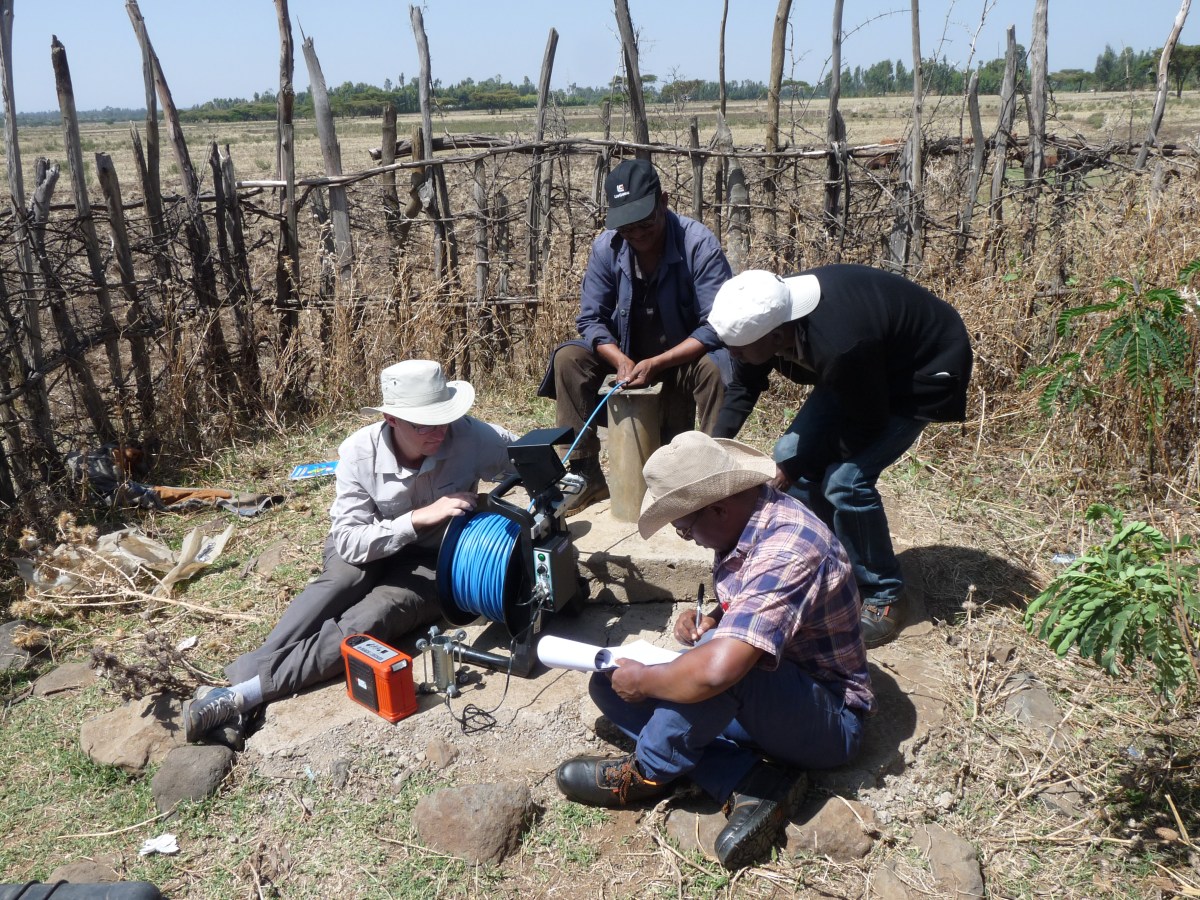
Borehole drilling supervision in Malawi: why it is essential, not optional

Guest Blog from Mr Gift Jason Wanangwa, a Groundwater Development Officer with the Malawi Government’s Ministry of Agriculture, Irrigation and Water Development.

New PictureGuest Blog by GIFT JASON WANANGWA

Introduction

Malawi is one of the least developed countries in Africa. It has a population of more than 17 million people, 84% of whom live in rural areas and rely solely on groundwater for their daily water needs for social and economic development.

Studies of the drilling practices in Malawi by UNICEF (GoM/UNICEF 2011; GoM 2012) and borehole forensics activities done by students of the University of Strathclyde under the Climate Justice Fund-Water Futures Programme  (CJF-WFP Work Records 2017-2018) as well as MSc Hydrogeology masters research students activities into drilling practices in Malawi (Polmanteer, 2014) have all revealed some shortcomings which explained problems in rural water supply through boreholes like poor siting, low yield of boreholes, weak drilling procedures and poor water quality or mechanical failures of pumps and boreholes. This was attributed much to poor drilling supervision.

Continue reading “Borehole drilling supervision in Malawi: why it is essential, not optional”

Ops Talks: Total Cost of Services

re-blogged with thanks from Water for Good

sub·si·dy

A sum of money granted by the state or a public body to help an industry or business keep the price of a commodity or service low

— Oxford English Dictionary

Rural Water Services ARE Subsidized

Even the United States has subsidies for rural water services. This doesn’t make something unsustainable. However, it does create a critical need for clarity of the total cost of the services, how it is funded, and how it will continue to be funded. There also needs to be a good definition of what the costs are (CapEx vs OpEx vs CapManEx). Thankfully our friends at IRC have laid this out here.

The politics of water: part two

by Naomi Oates, Grantham Centre for Sustainable Future, UK – re-posted from Grantham

“Communities themselves, when a borehole is drilled, are supposed to be responsible. They are supposed to have fundraising for maintenance. This is challenging. Often breakdowns are due to simple things. They say ‘we are lacking x, y ,z’. And we ask ‘don’t you have the funds’? But they say ‘no we don’t have money, we are poor, we can’t contribute’. And we try to tell them ‘but this water point is for you, it is yours to look after.’ They don’t take it as their own. They have to take responsibility. Sometimes they go to the councillor or MPs for support.” (Extension worker, Malawi)

In November I wrote a blog describing my first impressions of life in Balaka, Malawi, where I am doing my PhD fieldwork. To recap, my research concerns the sustainability of rural water services. I am particularly interested in the role that actors at the district-level play in developing and, crucially, maintaining these services. Several months on, I am starting to make sense of my experiences shadowing extension workers in their day-to-day work. What strikes me is how these actors have to navigate competing interests and find creative ways to get their jobs done. In this blog I focus on their relationship with communities (service users).

How do extension workers secure cooperation from communities?

image1-Naomi-300x225
A community in Balaka learns how to look after their new water point (author’s own)

In my conversations with government and NGO staff, it was evident that the ‘community-based management’ (CBM) model for water governance is not only enshrined in national water policies, but has become deeply embedded in development practice. CBM means that while government or other external agencies may provide the infrastructure, responsibilities for day-to-day management lie with communities. In other words, communities are expected to look after the water point and cover the costs of repairs. Extension workers play a supporting role, providing training, monitoring and technical advice. This approach is meant to empower service users and ensure that services are more efficient and effective.

As the opening quote illustrates, extension workers have internalised key elements of the CBM model and this does inform their decisions, whether consciously or unconsciously. But policy implementation also entails negotiation. Extension workers have to mediate between the demands of formal policies and government institutions, the interests of communities and their leaders (which are not homogenous) and the influences of other actors such as NGOs or politicians.

image2-Naomi-300x225
What went wrong? An extension worker chats to water users about their faulty pump (author’s own)

In this respect, policies on paper are often an inadequate guide to action. I find the concept of bricolage (Cleaver, 2012) useful to understand how extension workers navigate between these different interests, drawing on a variety of resources. The bricoleur is a kind of amateur handyman, making do with the tools available, whether old or new. This might include formal and informal institutional arrangements, social relations or networks, material and financial resources, ideas and technologies, and so on. The result (policy in practice) is often a hybrid.

How is an extension worker a bricoleur?

Firstly, my research participants tend to see themselves as a bridge between state and citizen, not only representing their Ministry but also communicating people’s needs to the District Council and development partners (donors/NGOs). In carrying out their roles, extension workers shift between ‘insider’ and ‘outsider’ positions, drawing on social networks, their status as government employees, and cultural norms.

The insider: Often extension workers are not originally from the areas (or ethnic groups) which they currently serve, hence they have to make an effort to gain and maintain trust from communities. They do this primarily through the development of personal relationships, in other words building social capital. For example, participants talked about stopping to drink beer or attending funerals as an important part of their job.

The outsider: Extension workers are afforded a certain status vis-à-vis community members in recognition of their technical expertise and as government employees. Government employees can also leverage support from local leaders such as village headmen who are expected to facilitate policy interventions.

image4-Naomi-e1534946790516-361x213
Access to different resources shapes the practices of extension workers as bricoleurs

Cultural norms play a role in reinforcing these relationships. Hierarchy is accepted and less powerful people tend to depend on more powerful people, whether traditional or state elites. In rural contexts of Malawi, these hierarchies can undermine community self-help as ordinary people tend to wait for orders or assistance from ‘above’ and rarely question the activities of their ‘betters’. This might give extension workers a degree of authority but clearly has disadvantages for a CBM model aimed at citizen empowerment.

Secondly, cooperation from communities is by no means guaranteed but is essential for CBM to work. Extension workers do meet with resistance, and express frustration when community members make their task difficult. For example, a common problem is the collection of water user fees, which in theory provide the funds needed for water pump repairs. People will often assert they cannot afford to pay, labelling themselves as ‘too poor’.

Extension workers employ several strategies in dealing with resistance. The first is evident in the quote above, namely reiterating key elements of the national water policy. Communities are reminded that they have responsibility for managing the water point and raising funds for its maintenance. It is emphasised that they are the ‘owners’ of that water point. Moreover, if they do not take action there are consequences – they will not have water.

image3-Naomi-300x225
Learning the ropes – I help to reassemble a hand pump (author’s own)

Another strategy is to enlist the support of the village headman, for example calling a meeting in which a problem is discussed communally and a solution agreed. This seems to be an effective way of securing consensus, at least verbally. Extension workers can also resort to threats, for example removing the handle of the pump (effectively cutting off the water supply) until the community has complied. For new projects, the infrastructure can be built in a different village, one where the community is more willing to cooperate. However, antagonistic strategies are a last resort and consensus is generally preferred.

To sum up, extension workers play a crucial role in translating policy into practice, operating at the interface between state and society. Shadowing individuals in the field and getting involved in community training and water points repairs is helping me to better understand what this means in reality. I have seen, first-hand, the constraints the water office faces in terms of financial and material resources and their consequent reliance on other actors (particularly NGOs) to deliver services.

At the same time, I have come to appreciate the dedication and creativity with which extension workers carry out their work and engage with communities. Being a bricoleur is certainly necessary to ‘get the job done’ in rural Balaka.