Are you responsible for universal, safe, sufficient, affordable & equitable water services?

by Johanna Koehler, University of Oxford, re-posted from REACH

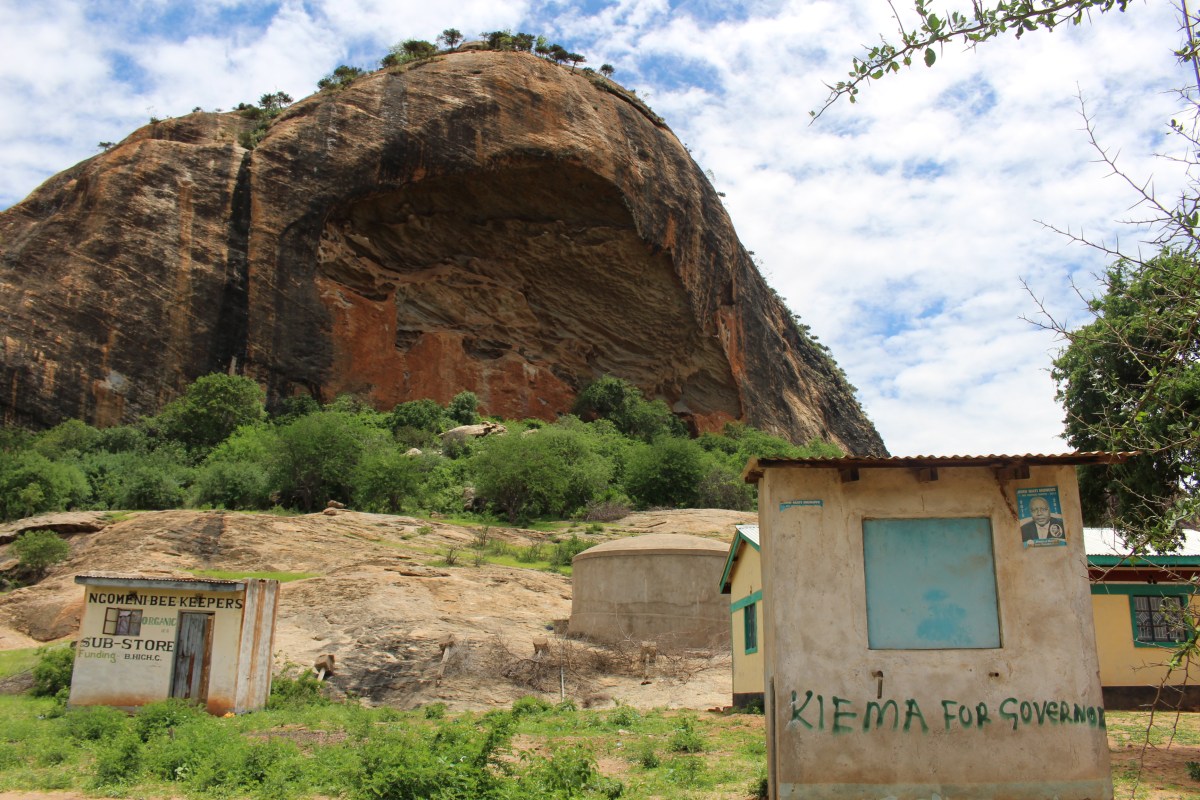
The answer to this question was mixed by the policymakers across all 47 water ministries of the first devolved county governments in Kenya. Political, socioclimatic and spatial factors influence to what degree county policymakers assume responsibility for the water service mandate. A new article published in Geoforum presents novel insights into Kenya’s devolution and water service reform drawing on perceptions by all devolved county water ministries.

Continue reading “Are you responsible for universal, safe, sufficient, affordable & equitable water services?”

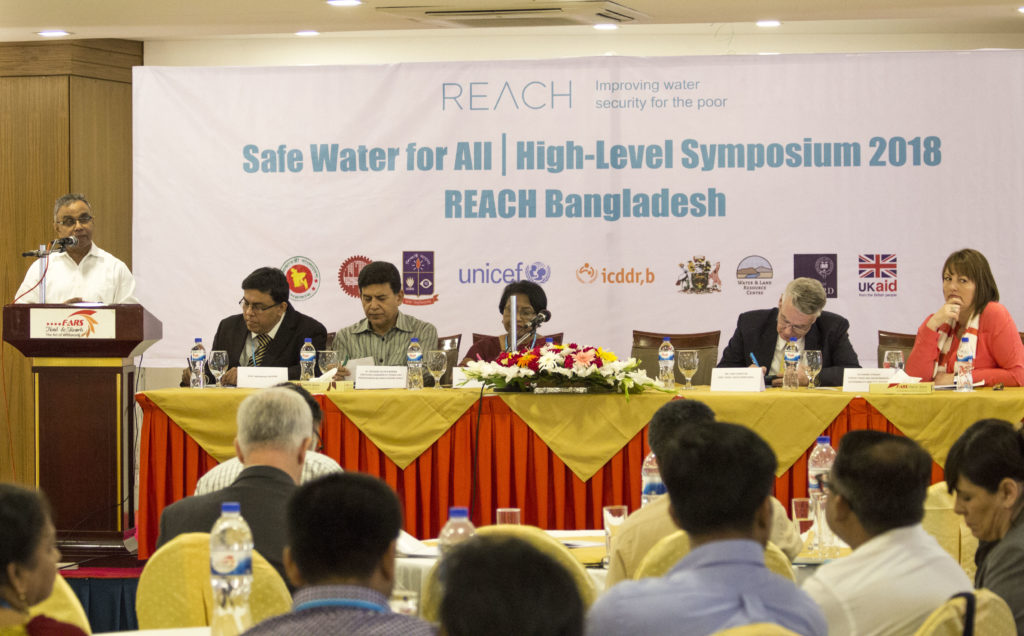
Safe Water for All: REACHing everyone in Bangladesh

by Dr. Rob Hope, University of Oxford, Prof. Mashfiqus Salehin, Bangladesh University of Engineering and Technology and Dara Johnston, UNICEF Bangladesh , re-posted from REACH

A large concrete pipe belches untreated sewage into the Buriganga River in Dhaka, whilst men wade through the water to shift aggregate to construct more buildings for more people. The riverbanks team with life and colour as hospital bed sheets dry after being recently washed in the river, bamboo poles float-in-waiting for the next tower block and mountains of fresh fruit lie ready for sale in nearby markets while countless children play without a care in the water.

Continue reading “Safe Water for All: REACHing everyone in Bangladesh”

You cannot manage what you do not measure; but should you measure what you cannot manage?

Countries have committed to reach SDG 6, providing universal access to their population with safely managed water supply services, with country specific targets. This is a process that governments, as duty bearers, need to manage. Therefore they also need to measure progress in that.
Continue reading “You cannot manage what you do not measure; but should you measure what you cannot manage?”

La stratégie RWSN 2018-2023 #eau

La stratégie RWSN 2015-2017 a pris fin l’an dernier. Les responsables thématiques et le secrétariat de RWSN ont pris l’initiative de consulter les membres et les partenaires du réseau afin de développer une nouvelle stratégie pour la période 2018-2023. Nous avons reçu des bonnes idées pour le réseau à travers des consultations avec les groupes de travail, l’enquête des membres RWSN 2017 et l’évaluation du réseau, et la consultation ouverte de 6 semaines à laquelle nous avons invité tous les membres de RWSN. Nous avons également organisé un wébinaire en novembre 2017 qui a permis au Secrétariat et à la Présidente de RWSN d’expliquer les changements proposés par rapport à la stratégie existante. Les idées et commentaires reçus des membres et des partenaires du réseau à travers cette consultation ont été incorporés dans la nouvelle stratégie RWSN début 2018. La version finale de la stratégie a été approuvée par le Comité de Pilotage Exécutif de RWSN en mars 2018.

La nouvelle stratégie RWSN strategy est maintenant disponible ici

Continue reading “La stratégie RWSN 2018-2023 #eau”

#WorldWaterDay #WWF8 : Publication of the new RWSN Strategy 2018-2023

The 2015-2017 RWSN strategy came to an end last year, and the RWSN Theme Leads and Secretariat have been busy consulting members and partners to develop a new strategy for the period 2018-2023. We have received valuable ideas for the network through consultations with working groups, the 2017 RWSN member survey and evaluation of the network, and the 6-week open consultation to which we invited all RWSN members. We also hosted a webinar in November 2017 during which the RWSN Secretariat and Chair outlined the proposed changes to the existing strategy. Ideas and comments received from the network members and partners through the open consultation were incorporated into the RWSN Strategy in early 2018. The final version of the Strategy was approved by the RWSN Executive Steering Committee in March 2018.

The new RWSN strategy is now available for download here

Continue reading “#WorldWaterDay #WWF8 : Publication of the new RWSN Strategy 2018-2023”

“The borehole is not a madman” 3 reasons why Community Based Management demands a rethink

by Dr Luke Whaley, Professor Frances Cleaver and Felece Katusiime (UPGro Hidden Crisis)

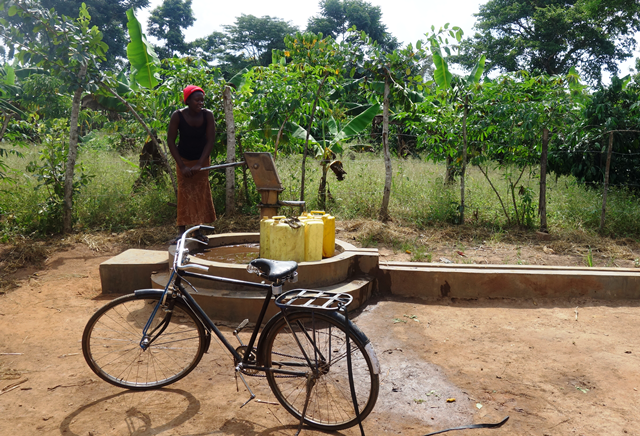
In Uganda, waterpoint committees exist more in name than in reality. Many waterpoints have been ‘personalised’. That is to say, they are under the control of one or a small number of individuals. Moreover, where local management arrangements (of any sort) are effective they tend to rely heavily on the authority of the head of the village council, known as the LC1 Chairperson. Indeed, it is often the LC1 Chairperson and not a waterpoint committee who is instrumental in collecting funds, securing maintenance and resolving disputes. Where an apparently functioning committee is in place, this is usually the result of concerted efforts on the part of particular local NGOs, who cannot guarantee this level of commitment in the longer term.

At least, these are the impressions of Felece Katusiime, a social science field researcher working on the UPGro ‘Hidden Crisis’ project, concerned with the sustainability of rural groundwater supply in Ethiopia, Uganda, and Malawi. They are field insights (preceding full data analysis) from someone who has spent many months in the field undertaking research in roughly 200 rural Ugandan villages. The discussion that follows is intended as a provocation and not a promulgation of project findings. We are interested in the extent to which the points made here accord or contrast with the experiences of you, the readers, and we welcome dialogue on these matters.

So, why might it be that in Uganda waterpoint committees,as envisaged on paper, seldom exist as such on the ground?

Continue reading ““The borehole is not a madman” 3 reasons why Community Based Management demands a rethink”

Getting to the heart of climate resilient WASH

by Dr John Butterworth, IRC WASH Ethiopia – re-posted with permission

Climate resilient WASH is about new ways of working across the traditional humanitarian and development sectors. We went to one of the harshest spots in Ethiopia, and surely in the world, to find out more.

Photo: An existing water point in Afdera, Afar

Continue reading “Getting to the heart of climate resilient WASH”

Achieving SDG 6: The Need for Local Centres of WASH Expertise and How to Do It

First published on the CAWST blog, reposted with thanks

The goal: ensure availability and sustainable management of water and sanitation for all by 2030. The task at hand, right now: learn quickly from failure and share lessons learned.

Scaling-up of WASH service coverage will require a focus on both affordable infrastructure and enabling environments. CAWST and the SMART Centre Group are focused on both through capacity development of local providers of WASH products and services. As part of this work, both groups have been following the model of establishing and supporting local centres of WASH expertise. Each centre is unique, housed in an existing in-country organization and provides capacity development services on technical and non-technical WASH solutions and approaches. Between us, we have a combined 22 years of testing this approach. We can unequivocally say that it is a key part of achieving SDG 6, and we have come together to share our key lessons learned:

Lesson 1:  Local WASH centres are worth the long-term investment

  • Long-term follow-up support after training is vital to effective capacity development of an individual, especially in the case of entrepreneurs, who often encounter business challenges.
  • Locally embedded centres can reach people that an external organization cannot: Grounded networks, know-how, and understanding of the context are invaluable and not replicable. Engrained local organisations are a rich source of endogenous best, second best, and worst practices.

CAWST’s Water Expertise and Training (WET) Centre in Afghanistan, housed in the Danish Committee for Aid to Afghan Refugees (DACAAR), was the first WET Centre to become functionally and financially independent, due to high demand for capacity development in the country and an inability of external organizations to supply much of that demand. From 2011-2015, over 1 million community members benefitted from WASH projects implemented by the centre’s 1,378 clients.

Lesson 2:  Create enough critical mass and identify leaders at various levels

  • The commitment of the centre’s personnel is critical, yet challenging. Especially in the context of informal systems within developing countries where personnel turnover is high, developing the capacity of many to ensure enough critical mass of expertise over time.
  • Look for the entrepreneurial spirits and provide long-term coaching. Sustained business is essential: entrepreneurs need to sell their products and services profitably, so they will continue even if the centre ceases to exist – the concept of profit-based-sustainability.

More than a decade ago, the Southern Highlands Participatory Organisation (SHIPO) started accelerating access to WASH products and services by working relentlessly on capacity development and coaching of the private sector. There are now more than 40 small local companies who have produced over 3,000 wells, 11,000 rope hand pumps, and other SMARTechs throughout the country. SHIPO was the first WASH Centre of expertise within the SMART Centre Group. Key to its success has been its focus on market-based technologies and the promotion of (supported) self-supply (household wells).

Lesson 3:  The host organization must meet certain quality standards

  • The local host organization leadership’s commitment to the vision is critical.
  • Look for champions within the host organization – someone with the passion and network to make change happen, situated within an enabling environment (or with the ability to create an enabling environment). A champion must be able to effect change within institutional or structural limitations.
  • A base level of organizational capacity is necessary to develop technical and training capacity.

CAWST’s WET Centre in Zambia, housed in the Seeds of Hope International Partnerships organization, has adopted the model of training existing networks of community sales agents in WASH topics to increase implementation of a range of healthy home products while earning an income.

Lesson 4:  Flexibility is key

  • All stakeholders must share the willingness and ability to be flexible: A WASH centre needs to have an innovative, entrepreneurial spirit. WASH Centres need to be able to adapt to sector needs and trends.
  • Innovation and capacity development -not only in technology, but also in marketing and other business skills- is essential. A centre needs to pursue various channels to generate income, like selling training and consulting support and implementing projects.

In Tanzania, VETA (The Vocational Education and Training Authority) has included the rope pump in its curriculum based on the cooperation they have with the SHIPO SMART Centre. They are also planning to add manual drilling in the near future.

Lesson 5:  Engage with local networks

  • If the centre is represented and active in relevant networks, it will increase legitimacy and business opportunities. Be innovative in how you integrate the centre into these networks – seek to add value and establish a fundamental niche service.
  • Being part of an international network such as WET Centres and SMART Centres increases knowledge exchange, learning from each other and innovation.
  • Linkages to the formal education sector, vocational training, and employment standards (e.g. job profiles) should be made where possible. To support scale-up and sustainability of impact it is critical to get the knowledge and expertise embedded in national (vocational) training curricula.

Locally embedded knowledge and skills as well as pursuing innovative and affordable approaches such as training local private sector actors are essential to reach water and sanitation related development goals. CAWST and the SMART Centre Group will continue to apply these lessons and spread practice in the sector around establishing local education and training centres.


About the authors

The SMART Centre Group is a network of endogenous WASH training centres in Tanzania, Malawi, Mozambique and Zambia, with additional centres starting up in Ethiopia, South Sudan, Niger and Nicaragua. SMART stands for Simple, Market-based, Affordable and Repairable Technologies. SMART Centres train technicians in production and maintenance of SMARTechs and coach entrepreneurs in business skills like marketing so that they can deliver WASH products and services to a range of customers.

CAWST is a Canadian charity and licensed engineering firm that acts as a global centre of expertise in WASH capacity development. CAWST addresses the global need for safe drinking water and sanitation by developing local knowledge and skills on simple, affordable solutions that people can implement themselves. To reach more people and to ensure that knowledge and skills are truly retained locally, CAWST partners with existing in-country organizations to create Water Expertise and Training (WET) Centres that deliver CAWST-like capacity development services of their own. Independently of CAWST, the seven WET Centres across 3 continents have provided services to 658 client organizations whose projects have reached 3.7 million people with better water or sanitation.

Photo credit: CAWST (2018)


Why is Groundwater Data important?

by Dr Fabio Fussi, Università degli Studi di Milano-Bicocca

The role of groundwater data in rural water supply has changed markedly in over the last few year:

6th RWSN Forum in Kampala, 2011: Some pilot projects of groundwater data collection and organization is presented. Uganda is presenting its groundwater atlas, a promising example for other countries.

7th RWSN Forum in Abidjan,  2016: there were entire sessions dedicated to groundwater data collection, mapping, analysis and application, with presentation of country programs from national water institutions, some example of international projects to create continental or world groundwater database (e.g. the groundwater atlas of Africa from the British Geological Survey) and application of groundwater data analysis.

What has raised the interest up to this level? There are several factors:

  • Data collection has become easy, with IT tools available in portable devices and smartphones for water point mapping. The increased availability of information has allowed to use these data to take decision about groundwater development and monitoring.
  • Depletion of groundwater resources (both in quantity and quality) requires the definition of sustainable groundwater development strategies and monitoring the effectiveness and impact of their implementation.
  • International donors have an increased interest to support countries to create groundwater information system, and national water institutions have, in several cases, understood the importance to put effort in this.

This seems a promising path for the future to support an effective and sustainable use of groundwater. However there are critical factors that must be taken into consideration:

  1. An increasing amount of data are available, but still there is lack of control in their quality. National databases are full of information, but limited effort is spent to revise them and depurate from mistakes. If this aspect is not properly considered, the risk of incorrect interpretation is high, leading to the formulation of incorrect strategies.
  2. Despite of the huge amount of information and the availability of powerful tools to process it, the level of data analysis to deepen our understating of groundwater system and give a practical support for complex decisions seems still basic. At this time we need creativity, technical capacity and collaboration between decision makers and scientist to unlock the potential of massive groundwater databases.
  3. An unbelievable amount of information is available, held by national water authorities and organizations involved in groundwater development. Most of this information is in hard copy, almost unused, not yet transformed into numeric database. This task is huge and time consuming, but if we can support it, we avoid the risk to loose relevant data and in they can be easily used to take decisions.

In the coming years the effect of climate change and the increase in water needs (due to population growth and improved living conditions) will lead to a more intense exploitation of groundwater resources, whose feasibility and sustainability must be carefully evaluated by a detailed interpretation of reliable data.

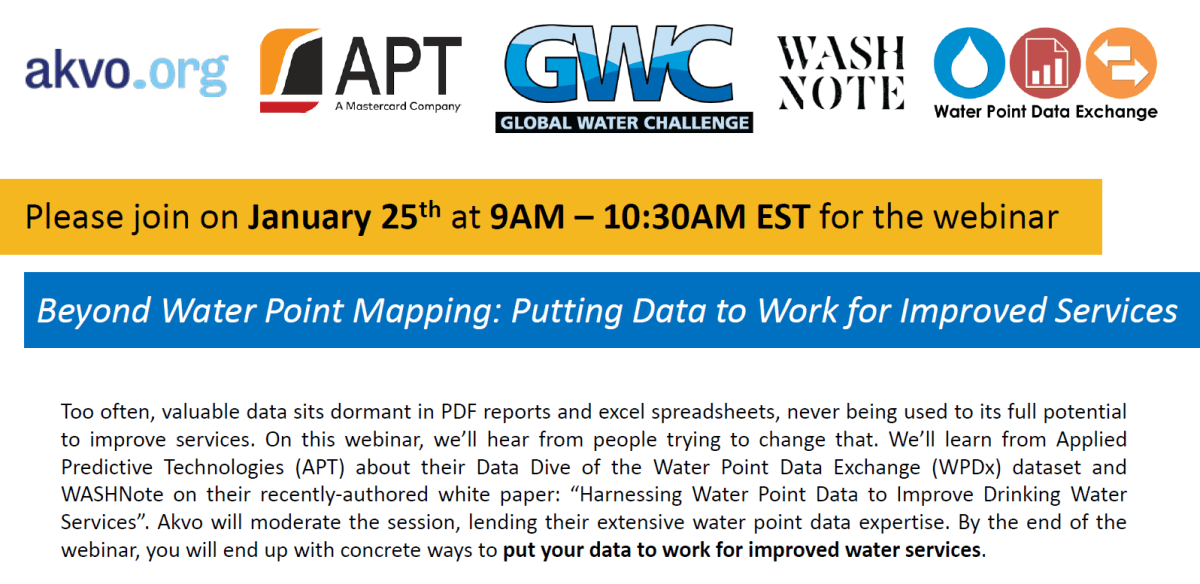
WPDx webinar: Beyond Water Point Mapping: Putting Data to Work for Improved Services

Too often, valuable data sits dormant in PDF reports and excel spreadsheets, never being used to its full potential to improve services.

Join this webinar and learn from people trying to change that. Joining Global Water Challenge will be Applied Predictive Technologies (APT) sharing findings from their Data Dive of the Water Point Data Exchange (WPDx) dataset and WASHNote addressing their recently-authored white paper: “Harnessing Water Point Data to Improve Drinking Water Services.” Akvo will moderate the session, lending their extensive water point data expertise.

By the end of the webinar, you will learn strategies to put your data to work for improved water services.

Register here