
Please have your say!
Author: RWSN Secretariat
RWSN is a global network of rural water supply professionals. Visit https://www.rural-water-supply.net/ to find out more
Apples and oranges: a comparative assessment in WASH

A few weeks ago, an interesting email discussion was held on “water point mapping” D-Group of the Rural Water Supply Network (RWSN). Part of the discussion focused on how much it costs to map or monitor all water systems in a country. Various figures were floating around in the discussion. But when looking at these in more detail, it was like comparing apples to oranges. Some of the costs mentioned had included the staff time of (local) government, others hadn’t, as they considered this to be a fixed cost; some referred only to a simple mapping of water points, others had done a more comprehensive collection of all kinds of data of the water points; some of the data were expressed in dollars per water point, others in local currency per person. So, no immediate sense could be made of the numbers. A former colleague once said: “an apple is…
View original post 1,100 more words
A Writeshop guide on output types and style
New resource to help those writing about WASH
WASHTech Burkina : le développement participatif d’un outil d’évaluation des technologies d’eau et d’assainissement
Add your thoughts here… (optional)


Des constats
Le secteur de l’eau et l’assainissement n’est pas à court de technologies nouvelles et émergentes, promues par le secteur privé ou les ONG et les bailleurs de fonds. Avant même d’être adoptées dans les stratégies nationales, ces technologies sont largement reprises par le secteur privé et intègrent nos villes et villages.
Conséquence : La contribution des nouvelles technologies pour l’atteinte des Objectifs du millénaire pour le développement (OMD) est insignifiante. Un des obstacles majeurs à la réalisation des objectifs du secteur apparaît être l’absence de systèmes pour évaluer le potentiel d’une technologie et le manque de capacité à mettre de nouvelles technologies appropriées à l’échelle de manière efficace. WashTech propose un outil innovant pour évaluer les technologies dans un contexte spécifique. D’une durée de 36 mois, WAHTech est un Projet de recherche sur un procédé innovant pour évaluer le potentiel et la viabilité d’un large éventail des technologies…
View original post 1,068 more words
The Stone prize: innovative approaches to sustainable water purification and supply
By Trupthi Basavaraj and Rachel Findlay,
New Philanthropy Capital
When confronted by the sheer scale of the issues facing the water sector in developing countries, it is hard not to feel a little bit powerless. Globally, 780 million people, amounting to 11% of the world’s population, use unsafe drinking water or have no water source at all, and it has become increasingly apparent that more traditional models of water delivery are not always the most viable solution. It is estimated, for example, that 40% of the pumps built in Africa are broken at any given point, and each pump can take up to a month to be repaired.
For the Stone Family Foundation, the answer is to identify and support water initiatives that harness the power of the private sector, as these have the potential to create and sustain impact. To this end, the Foundation established the £100,000 Stone Prize for Innovation and Entrepreneurship in Water, administered by NPC. After an 8 month process to create a shortlist from a pool of 179 applications across 39 countries, the Foundation recently announced its Prize winner: Dispensers for Safe Water (DSW) for its innovative Chlorine Dispenser System. The dispenser is filled with dilute chlorine and placed near a communal water source, allowing individuals to treat their water free of cost with the correct dose of chlorine.
Continue reading “The Stone prize: innovative approaches to sustainable water purification and supply”
Uganda Sector Review 2012: do we still see the forest through the trees?
Looking through GLAAS
by Johan Gély, Swiss Development Cooperation (SDC)
2nd UN-Water GLAAS Evaluation Meeting in Bern 2nd and 3rd October 2012
Background 
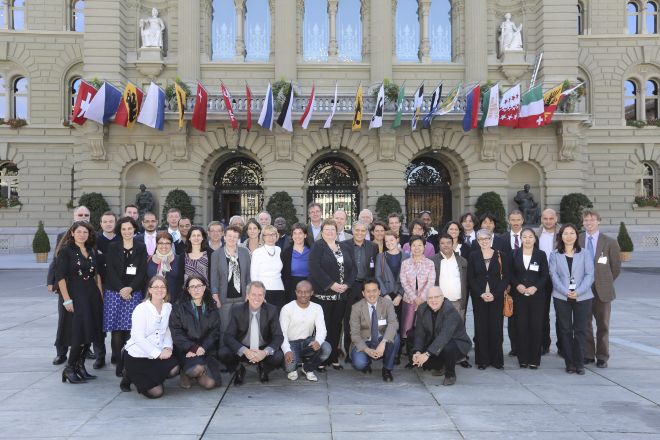
The UN-Water Global Analysis and Assessment of Sanitation and Drinking-water (GLAAS) monitors the inputs, and processes and their outputs (e.g. policies, investments, human resources) that influence the provision and sustainability of drinking-water, sanitation and hygiene (WASH) systems and services. Following publication of a proof-of-concept report in 2008, GLAAS published two full reports in 2010 and 2012 – the latter covering 74 countries and 24 external support agencies. GLAAS is generally acknowledged as having gained itself a specific niche within the global WASH monitoring landscape.
It is an important tool for the SDC Global program Water initiatives as it is part of an important and logical sequence of work/partnership which combine the global water and sanitation data acquisition (Joint Monitoring Program – JMP), the data analyze/assessment (GLAAS) and the sector global advocacy (Sanitation and Water for All – SWA).
Meeting Outcomes
1) It is a low cost and high quality global monitoring product and process.
2) It allows us to unify forces to lobby for a water goal in the Post 2015 goals.
3) Water Quality should be included in the future water goals and reported by JMP and GLAAS.
4) We should strengthen alignment with national monitoring systems.
5) We need to improve link with others global, regional and national monitoring systems.
6) The presence of new actors (from emerging states) should be reinforced in the future.
Documents
UN-Water GLAAS 2012 report – Approach and Main findings
UN-Water GLAAS – A brief history and rationale
For further information on GLAAS, please contact Bruce Gordon or Johan Gély.

Next week more than 200 practitioners and policy makers from government, civil society, private sector and donors will come together for the annual Joint Water and Environment Sector Review in Uganda to review progress and set-backs during the past year and discuss and decide on priorities for the coming year. For rural water Uganda is facing a situation where the expansion of coverage of rural water services is stagnating, functionality levels are not increasing and overall sector financing remains at its best stable.
View original post 526 more words
Experimenting with water service delivery

By Patrick Moriarty
Coming up with a convincing elevator pitch for our Sustainable Services at Scale (Triple-S) project has long been a challenge. Which, given the complexities of the rural water sector itself, is possibly not that surprising. Whether defining ourselves (at least in part) as a complexity informed water services development lab will help, remains to be seen – but for us it is progress!
View original post 1,239 more words
Next Post
Last week, we had our first Triple-S research seminar, discussing the first findings from the assessments of service provision around point sources in Ghana and Uganda. Although I had seen a sneak preview of some of the data, the consolidated results were shocking. After seeing them, I was tempted to declare community-based management (particularly of point sources) to be dead.
View original post 828 more words
 Rural Water Supply Network - blog