In Memoriam: Arun Mudgal – a great handpump guru, mentor and friend

Reflections from 3 past leaders of HTN/RWSN on the loss of great friend.

(1) Rupert Talbot, former Chair of the Handpump Technology Network (UNICEF – retired)
(2) Dr Peter Wurzel, former Chair of the Handpump Technology Network (UNICEF – retired)
(3) Erich Baumann, former Director of the HTN/RWSN Secretariat (Skat – retired)

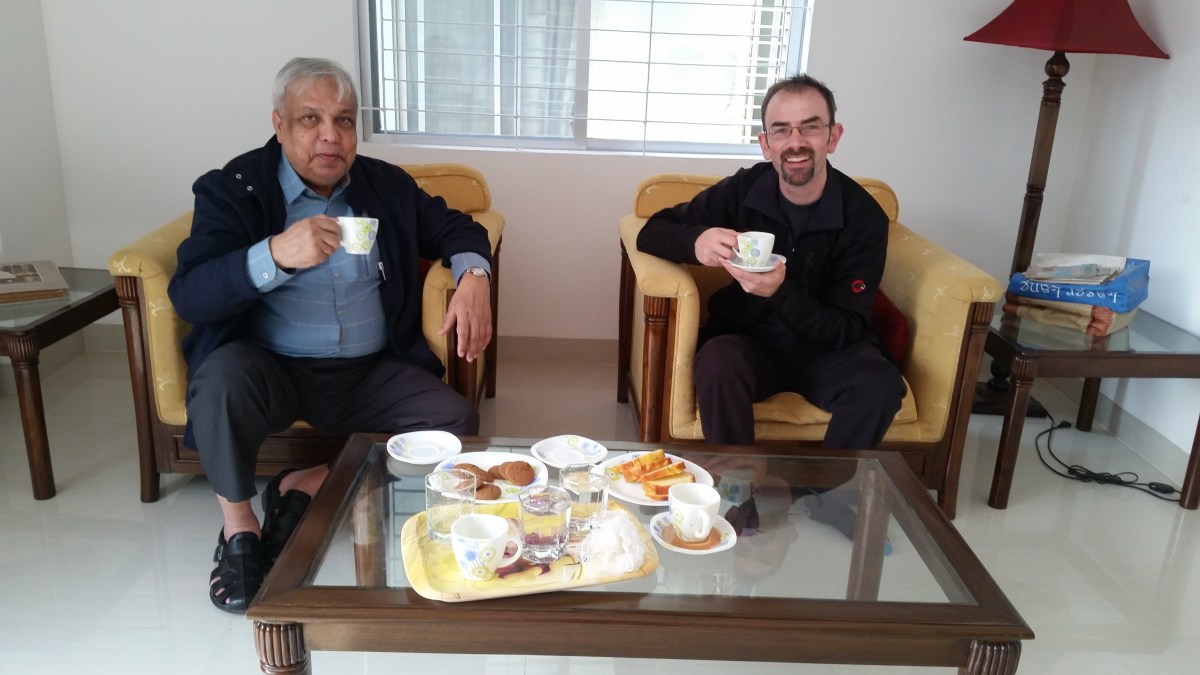
Rupert: “I am writing to let you know that Arun Mudgal died on September 13th after a long battle with Alzheimer’s.

“Although his many friends will surely regret his passing, those of us who visited him in recent times will be glad that he did not linger for longer; Alzheimer’s is a fearful illness.

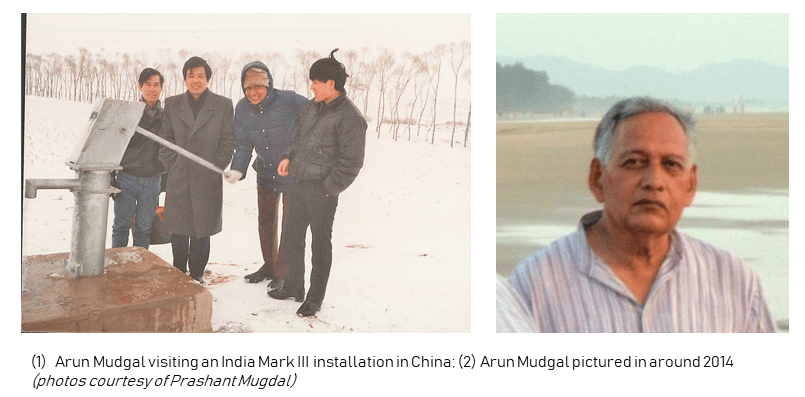
“Arun was a familiar face to many within the HTN/RWSN fraternity. He made an unparalleled contribution to hand pump development in India from the 1970s and was instrumental in putting the first India MK II and MK III hand pumps into production.

“I would argue that the Mark II simply would not have happened without Arun. At least, not in the form that we would recognise today. He was absolutely key at Richardson and Cruddas, the Government of India engineering company that manufactured the prototype Mark II pumps, field tested them in the deep bore wells of Coimbatore and closely monitored their performance, translating technical problems encountered in the field into pragmatic, engineering solutions; Arun was the conduit between Unicef field staff and the factory that first made the pump.

“It was his persona – his charm and calm disposition combined with astute engineering expertise and manufacturing know-how – that led to the mass production of the India MK II. The development of the pump is best summarised in the Skat/HTN Working Paper WP 01/97 : ‘India Hand Pump Revolution: Challenge and Change‘. Written by Arun, it is probably the most authentic account of how the MKII and Mark III hand pumps came about.

“Arun’s legacy is much more than the MkII and MkIII hand pumps, of course; in a career spanning some forty years, Arun also contributed to the development of the Afridev and the VLOM concept and he worked extensively on water quality issues, especially arsenic testing and treatment. His influence on rural water supply programmes stretches far beyond India’s borders.

“I and many others will miss his thoughtful insights into troublesome problems; we shall miss too, his companionship on those long field trips….”

Peter: “Arun was a dear and much admired friend. I had the privilege and pleasure to work with him in Mozambique and Ethiopia and we met several times over the years at handpump meetings. It was an education to talk handpumps with Arun and such was his towering knowledge and authority of handpump issues that his assertions on the topic were always received with little argument.

“But he was much more than a supreme handpump guru – he had an appealing, if somewhat serious, retiring and studious, personality. In essence a supremely nice guy. I shall remember his Arun as genuine and kind, humble, self-effacing with a quick mind who achieved much during a lifetime devoted to our sector and specifically handpumps – and even more specifically the India Mark II (though knew a thing or two about the Afridev too!).

“Farewell Arun – a friend and mentor to all who were fortunate enough to know you.”

Erich: “I do not know what to write. Even though Arun had in the last few years faded out of our life because of his illness. He was and will forever be remembered as the great friend and professional.

“A true handpump guru with many other qualities. I had the privilege to work with him for years very closely. We travelled several trips together and his input into the work was very valuable. As Peter rightly said also the Afridev development profited from his knowledge and experience. Look at the piston. But Arun did not a want to be put into the lime-light.

“One incident will stay with me for ever. Arun visited us in Switzerland and stayed in our house. Our youngest son had a bit of a rough time in school. During my next visit to India Arun gave me a small statue of Ganesh. He mentioned that Ganesh has a calming effect and if we would put the statue in my son’s room it might help him. He was not only a very rational engineer but also a believer.”

Arun leaves behind his wife Krishna, a son Prashant and a daughter Ankur.
UN-Water report: SDG6 on Water and Sanitation will not be achieved by 2030 at current rates of progress

UN-Water has released a new report on Water and Sanitation ahead of the High-level Political Forum for Sustanainable Development (HLPF) which presents, for each target, the latest data available for the Sustainable Development Goal (SDG) 6 global indicators. The report seeks to inform discussions among Member States during the HLPF (9 July -18 July 2018) in New York. The HLPF Forum will review progress especially on G6, G7, G11, G12, G15 and G17; you can see the Official Programme here.

The key message of this report is that the world will miss the SDG6 targets by 2030 at current rates of progress. It also highlights that only 50 percent of countries have comparable baseline estimates for most SDG 6 global indicators, making it difficult to track progress. It is essential to “harmonize methods and standards”, and establish a common understanding of how to assess Means of Implementation (MoI) across SDG 6. In addition to this report, UN-Water has also set up a webpage with examples of countries sharing their experiences.

RWSN had provided some comments on the draft report which was made available by UN-Water earlier this year. By and large these comments still hold – you can find out about what we said here and our take on how the report addresses sustainability of services, accountability, self-supply, capacity development, water and energy, groundwater and public participation.

So, what does the final report say? It compiles data and information available on the SDG6 Targets, including:

  • Target 6.1: Achieve access  to  safe  and  affordable  drinking  water: There are still 844 million people who lack access to basic water services, and 2.1 billion people who lack water that is accessible, available when needed and free from contamination. The report highlights that extending access to safe drinking water for all is a “huge challenge” that will not be achieved if there is no increase in “investment from governments and other sources” and a “strengthening in institutional arrangements” for managing and regulating drinking water.
  • Target 6.2: Achieve access to sanitation and hygiene and end open defecation: There are still 2.3 billion people who lack access to basic sanitation services, and 4.5 billion people who lack safely managed sanitation services. Only 27 per cent of the population in least developed countries has access to soap and water for handwashing. Extending universal access to sanitation and hygiene won’t be achieved if there is not an increase in “investment and a strengthening of the capacity of local and national authorities” for managing and regulating sanitation systems.
  • Target 6.3: Improve water quality, wastewater treatment and safe reuse: Freshwater pollution is prevalent and increasing in many parts of Latin America, Africa and Asia. The lack of water quality monitoring in many parts of the world does not allow for an exact global estimate of water pollution.
  • Target 6.4: Increase water-use efficiency and ensure freshwater supplies: Nowadays more than 2 billion people live in countries experiencing high water stress. The agriculture sector is the largest user of freshwater; it uses 70 per cent of global water withdrawals. In the report, some techniques to save water have been presented like “increasing productivity of food crops”, “improving water management practices and technologies”, “growing fewer water intensive crops in water scarce regions”, “reducing food loss and waste”, and “importing food grown from water rich countries”.
  • Target 6.5: Implement integrated   water   resources   management   (IWRM)   including    transboundary    cooperation: While all countries have at least started implementing various aspects of IWRM, only modest progress has been made in terms of implementing a fully integrated approach. The average national proportion of transboundary basins covered by an operational arrangement is only 59 per cent.
  • Target 6.6: Protect and restore water-related ecosystems: current baseline data of the indicator “do not allow for a proper picture of the state of freshwater ecosystems”, which is why further detailed data including “quantitative, geospatial and qualitative” data are necessary.

The report also looks at the targets related to the means of implementation of SDG6:

  • Target 6.a: Expand international cooperation and capacity-building: 80 per cent of Member States have insufficient finance to meet national WASH targets. The current indicator based on ODA (Official Development Assistance) does not reflect all elements of the target. That is why it is necessary to complement with additional information relating to “capacity development, human resources and other elements”.
  • Target 6.b: Support stakeholder participation: In order to empower marginalized groups and sustainable service delivery, “local communities have to participate in water and sanitation management”. But even if the current indicator monitors the existence of policies and procedures for local community participation, it does not show if “the participation is genuine or meaningful”. This links to the recent report published by our partners End Water Poverty,  Coalition Eau, Watershed Empowering Citizens Consortium, the Water Supply and Sanitation Collaborative Council (WSSCC) and with the support of Sanitation and Water for All (SWA), on accountability mechanisms for SDG6, and which was the focus of a recent RWSN webinar in English and Spanish.

In conclusion, the UN-Water report focuses on the enablers of the SDG6, highlighting that:

  • “Inequalities must be eliminated”. It is important to have data in order to identify disadvantage and provide services to groups like women, children, poor, indigenous people and rural communities.  You can find some recent RWSN webinars on Making Water Work for Women, and Making Rights Real for rural communities here.
  • “Private financing, promoting blended finance and microfinance” should be developed in order to optimize domestic and public finance. You can see a recent RWSN webinar on “grown up” finance for rural water here.

Photo credit: World Bank

#WorldWaterDay #WWF8 : Publication of the new RWSN Strategy 2018-2023

The 2015-2017 RWSN strategy came to an end last year, and the RWSN Theme Leads and Secretariat have been busy consulting members and partners to develop a new strategy for the period 2018-2023. We have received valuable ideas for the network through consultations with working groups, the 2017 RWSN member survey and evaluation of the network, and the 6-week open consultation to which we invited all RWSN members. We also hosted a webinar in November 2017 during which the RWSN Secretariat and Chair outlined the proposed changes to the existing strategy. Ideas and comments received from the network members and partners through the open consultation were incorporated into the RWSN Strategy in early 2018. The final version of the Strategy was approved by the RWSN Executive Steering Committee in March 2018.

The new RWSN strategy is now available for download here

Continue reading “#WorldWaterDay #WWF8 : Publication of the new RWSN Strategy 2018-2023”

In Memoriam: Hon. Maria Mutagamba

It is with great sadness that we have heard of the passing of the Honorable Maria Mutagamba, former Minister for Water & Environment, Uganda.

by Sean Furey, RWSN Secretariat

It is with great sadness that we have heard of the passing of the Honorable Maria Mutagamba on 24 June, at the age of 64. Mrs Mutagamba was an economist and politician, who according to Wikipedia:

…was born in Rakai District on 5 September 1952. She studied at St. Aloysius Senior Secondary School in Bwanda, Kalungu District for her O-Level studies (1967–1970). She then attended Mount Saint Mary’s College Namagunga in Mukono District for her A-Level education (1971–1972). She attended Makerere University from 1973 until 1976, graduating with a Bachelor of Arts in economics. She also held a Diploma in computer programming from the ICL Computer School in Nairobi, Kenya, obtained in 1980, and a certificate in executive leadership from the John F. Kennedy School of Government in Cambridge, Massachusetts, United States, obtained in 1997.[5] In 2013, she was presented with an honorary doctorates in law from the Canadian McMaster University.[6]

DSC_0177She served in various posts in the Government of Uganda, most recently as Minister for Tourism. However, she is best known to RWSN members as the State Minister for Water Resources, from 2000, and then Minister for Water and Environment between 2004 and 2012. During this period she served as President, African ministers’ council on water (AMCOW), (2004–2012).
Under her leadership, the Ministry of Water & Environment became internationally recognised as leading actor in African water management issues, with a capable civil service team and an open attitude to innovation and collaboration with international partners.  Annual processes of Joint Sector Reviews and Sector Performance reporting became the gold standard of improving coordination, reporting and accountability across the WASH and water resources sectors.

I had the pleasure of meeting her when she came to open the 6th RWSN Forum in 2011 – of which she was a great supporter – and then again at the 6th World Water Forum in Marseille. I was struck by how humble and thoughtful she was, yet also strong and with a keen intellect.  She had a particular passion for rainwater harvesting, which she saw as an opportunity that was being missed.

According to the New Vision and other news sources, she had been suffering poor health for some time and died of liver cancer.  Uganda has sadly lost a great water champion.

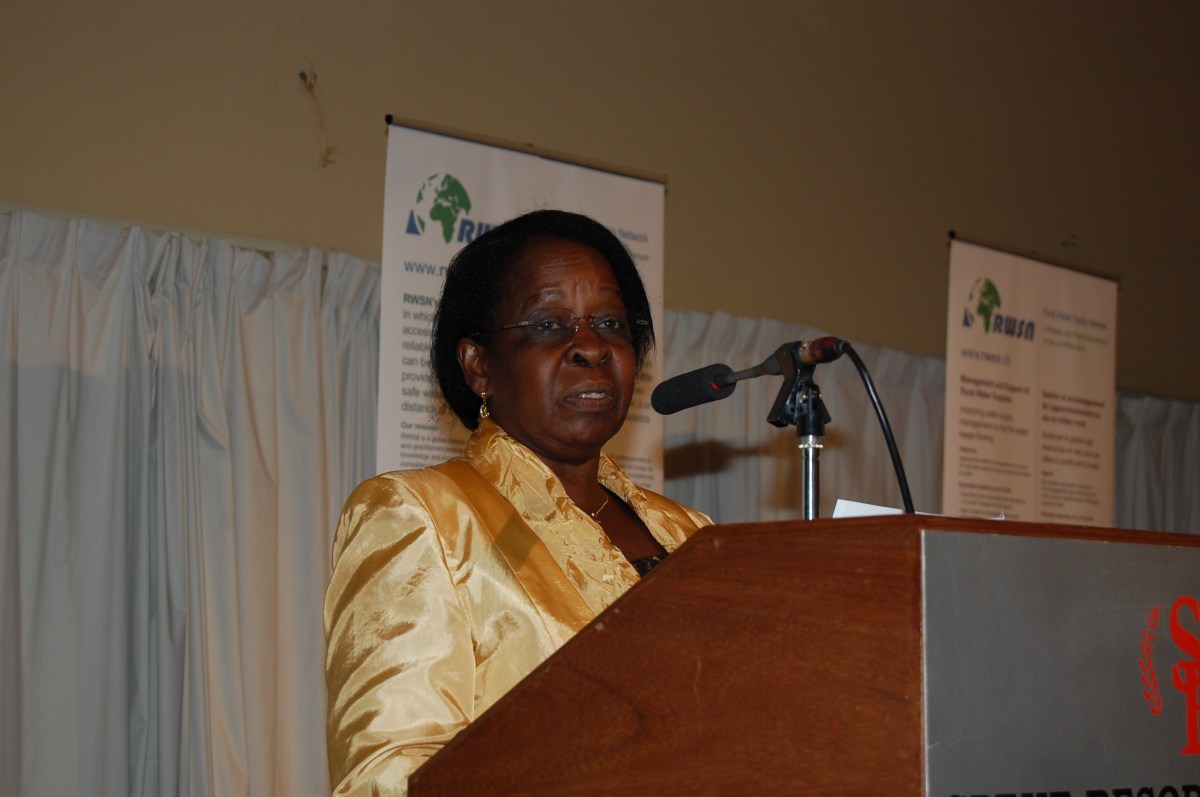
Photos: Hon. Maria Mutagamba opening the 6th RWSN Forum, Kampala, 2011


RWSN Evaluation & Strategy : have your say!

Dear members,

RWSN is your network and we really want to hear from you. Over the last years, the network has experienced explosive growth in both its membership and its activities. We are currently conducting an evaluation to inform RWSN’s strategy for 2018-2020 and would like to hear your thoughts.

What have you got out of RWSN? How can we make it easier for you to use the network to benefit your work in rural water supply?

We will share the RWSN online member survey in early July, and we also want to provide the space for other forms of feedback and suggestions. Please feel free to send us your thoughts as a comment to this blog in English, French or Spanish, or by email (ruralwater[at]skat.ch). We will monitor both of these platforms and will take your feedback into account. Your opinion really matters!


Chers collègues,

RWSN est votre réseau et nous aimerions vraiment vous entendre. Au cours des  dernières années, le réseau a vécu une croissance explosive à la fois de ses membres et de ses activités. Nous entreprenons actuellement une évaluation pour renseigner la stratégie RWSN de 2018-2020 et aimerions avoir votre opinion.

Qu’avez-vous retiré du RWSN ? Comment pouvons-nous rendre plus facile l’utilisation du réseau pour vous pour que cela bénéficie à votre travail sur l’approvisionnement en eau potable en milieu rural ?
Nous allons partager une enquête des membres du RWSN début juillet, et nous aimerions également vous donner la place pour d’autres formes de commentaires. Vous pouvez envoyer vos suggestions sous forme de commentaire en dessous de ce blog en anglais, français ou espagnol, ou par email (ruralwater[at]skat.ch). Nous veillerons à ce que les commentaires reçus sur ces deux plateformes soient pris en compte.  Vos opinions sont de grande importance pour nous.


Estimados colegas,

RWSN es su red y nos gustaría mucho contar con su apoyo. Como usted sabe, en los últimos años, la red ha experimentado un crecimiento extraordinario tanto en el número de miembroscomo en sus actividades. Actualmente, estamos llevando a cabo una evaluación para informar a la Estrategia RWSN 2018-2020 y nos gustaría saber su opinión.

En el marco de esta evaluación, nos gustaría conocer: Cuáles son los beneficios percibidos por los miembros gracias a su participación en RWSN y cómo podemos hacer que su participación en la red beneficie aún más el trabajo que se está realizando en lo que se refiere al suministro de agua en zonas rurales.

Por este motivo,  enviaremos una encuesta en línea a todos los miembros del RWSN, a la cual se podrá acceder a principios de julio. También nos gustaría ofrecerles un espacio para otro tipo de comentarios. Puede enviarnos sus sugerencias en forma de comentario al final de este blog en inglés, francés o español, o por correo electrónico (ruralwater [at] skat.ch). Nos aseguraremos de que los comentarios recibidos en estas dos plataformas sean considerados. ¡Sus opiniones son realmente importantes y le agradecemos de antemano su colaboración!

Proceedings of the 7th RWSN Forum published

We are delighted that the Proceedings of the 7th RWSN Forum are now available to download and to cite. We hope that this huge body of knowledge and experience will be used to help improve rural water services all over the world.

Suggested citation:

RWSN (2017) Proceedings of the 7th RWSN Forum “Water for All”, 29 Nov – 02 Dec 2016, Abidjan, Côte d’Ivoire, Rural Water Supply Network, Skat Foundation, St. Gallen Switzerland.

The most important stories in rural water supply // Les histoires d’approvisionnement en eau en milieu rural les plus importants

Making water work for women – inspiring stories from around the world

The reality in much of the world today is that collecting water for the home is a job done by women – so gender issues are central to everything we do in rural water supply – self-supply, pump design, borehole siting, tariff collection, water resource management, business models or using ICT to improve service delivery.

In this week’s webinar we have brought together more inspiring stories from Nicaragua, India and the World Bank.  We are taking ‘gender’ from being a tokenistic tick-box to a living, vibrant, practical core of every rural water service.

Join the us next Tuesday 23 May – it an opportunity to have your practical and policy questions answered from world class experts.

 Did you miss Part 1? Don’t worry. You can watch and listen to the inspiring experiences from Burkina Faso, India, Ethiopia and Bangladesh on the RWSN video channel:

/////

L’eau au service des femmes – des histoires inspirantes

La réalité dans beaucoup d’endroits dans le monde aujourd’hui est que l’approvisionnement en eau pour les besoins domestiques reste un travail porté par les femmes – donc les questions liées au genre sont au coeur de toutes les activités que nous entreprenons dans le secteur de l’eau rurale: auto-approvisionnement, conception des pompes, emplacement des forages, recouvrement des tariffs, gestion des ressources en eau, ou utiliser les TIC pour améliorer les services.

Le webinaire de la semaine permettra d’entendre des histoires intéressantes du Nicaragua, de l’Inde et de la Banque Mondiale. Nous souhaitons passer d’une compréhension de la notion de genre se bornant à cocher une case, pour mettre en avant les aspects vivants, pratiques et essentiels qui font partie de tous les services d’eau ruraux.

Joignez-vous à nous mardi prochain – ce sera l’occasion de poser vos questions sur la pratique et la politique à des experts du domaine.

Vous n’avez pas pu participer à la première partie de ce wébinaire? Vous pouvez écouter des expériences inspirantes du Burkina Faso, de l’Inde, de l’Ethiopie, et du Bangladesh sur la chaine viméo du RWSN:


In Memoriam: Abdul Motaleb

It is with great sadness that we have been informed that Mr Abdul Motaleb (61) passed away in the night of 30 April 2017.

Motaleb had over 36 years experience in the Water Supply and Environmental Sanitation Sector in Bangladesh and was widely liked and respected figure in the Bangladesh WASH sector.

photo: Abdul Motaleb and Sean Furey, in Dhaka, February 2017 (photo: Md. Nurul Osman – with thanks)

It is with great sadness that we have been informed that Mr Abdul Motaleb (61) passed away in the night of 30 April 2017.

Motaleb had over 36 years experience in the Water Supply and Environmental Sanitation Sector in Bangladesh and was widely liked and respected figure in the Bangladesh WASH sector.

He graduated from the Bangladesh University of Engineering and Technology (BUET). Dhaka in 1979 with a BSc in Water Resource Engineering and later in his career went on to gain a MSc in Sanitatary Engineering at the International Institute for Infrastructure, Hydraulic and Environmental Engineering (IHE) Delft, the Netherlands.

During his long career he worked for M/S Associated Consulting Engineers, the Department for Public Health Engineering (DPHE), King Abdul Aziz University, Jeddah, World Bank/UNDP, Swiss Agency for Development and Cooperation (SDC), Danish International Development Agency (DANIDA), and most recently the World Bank Group and as a freelance consultant.

Among his many works and achievements, it was on the topic of handpumps where he seemed to get most pleasure – from his involvement in the development of the Tara to his expertise with the Jibon Deepset and the No. 6 – handpumps on which tens of millions of people today in Bangladesh depend every day. He was a long standing member of HTN, later RWSN, and was an active contributor to the RWSN Groundwater group.

Abdul Motaleb inspecting a HYSAWA handpump installation near Khulna, SW Bangladesh, February 2017 (Photo: Sean Furey)

I had the pleasure of working with Motaleb from January onwards this year on an end-phase review assignment for SDC and we spent 10 intense days together in south-western coastal Bangladesh, with the staff of the HYSAWA Trust Fund.  He was utterly charming and humble, with a deep well of knowledge and experience. I could not have wished for a better colleague and in a very short space of time we became firm friends.

He will be greatly missed.

Sean Furey, RWSN Secretariat / Skat


Selected Publications

  • Technical Paper on Monitoring and Regeneration of Production Wells in Bangladesh. A paper presented by Abdul Motaleb (DPHE) and Drs. G.J.deWit (IWACO) at the seminar for Civil Engineering Division at the 34th Annual Convention of the Institute of Engineers, 1990 Dhaka Bangladesh.
  • Monitoring the Tara pump: An assessment of Functioning, Social Acceptability and O&M system. A report published by UNDP/World Bank Water and Sanitation Program RWSG-SA Dhaka
  • Quarterly Notes on Danida funded DPHE Handpump Training and Monitoring Program based on project implementation experiences published by UNDP/World Bank Water and Sanitation Program RWSG-SA Dhaka. Altogether 14 (Fourteen) HTMP Notes were prepared during 1993-1997.
  • Technology Development Never Stops-A story of Jibon Deepset Handpump Tubewell in Bangladesh. Paper presented in HTN Workshop on Civil Society and Government Partnership in Rural Water Supply, Hyderabad, India, 2000.
  • Village Organizations become Development Partners. Paper presented in 26th WEDC Conference, Dhaka 2000.
  • SODIS – An Arsenic Mitigation Option. Paper published in 26th WEDC Conference, Dhaka-2000.
  • SORAS –  A Simple Arsenic Removal Process. Paper published in 26th WEDC Conference, Dhaka-2000.
  • Total Sanitation Approach and Practice. A case study in Watsan Partnership Project (WPP). This paper presented in 19 AGUASAN WORKSHOP 2003 on This shit drama-Are there ways out? held in Switzerland organized by SKAT during June 23-27, 2003.
  • Arsenic Mitigation: Action Research Findings based on project implementation experiences in Watsan Partnership Project and published by Swiss Agency for Development and Cooperation (SDC) in Bangladesh in June 2003.