Why is Groundwater Data important?

by Dr Fabio Fussi, Università degli Studi di Milano-Bicocca

The role of groundwater data in rural water supply has changed markedly in over the last few year:

6th RWSN Forum in Kampala, 2011: Some pilot projects of groundwater data collection and organization is presented. Uganda is presenting its groundwater atlas, a promising example for other countries.

7th RWSN Forum in Abidjan,  2016: there were entire sessions dedicated to groundwater data collection, mapping, analysis and application, with presentation of country programs from national water institutions, some example of international projects to create continental or world groundwater database (e.g. the groundwater atlas of Africa from the British Geological Survey) and application of groundwater data analysis.

What has raised the interest up to this level? There are several factors:

  • Data collection has become easy, with IT tools available in portable devices and smartphones for water point mapping. The increased availability of information has allowed to use these data to take decision about groundwater development and monitoring.
  • Depletion of groundwater resources (both in quantity and quality) requires the definition of sustainable groundwater development strategies and monitoring the effectiveness and impact of their implementation.
  • International donors have an increased interest to support countries to create groundwater information system, and national water institutions have, in several cases, understood the importance to put effort in this.

This seems a promising path for the future to support an effective and sustainable use of groundwater. However there are critical factors that must be taken into consideration:

  1. An increasing amount of data are available, but still there is lack of control in their quality. National databases are full of information, but limited effort is spent to revise them and depurate from mistakes. If this aspect is not properly considered, the risk of incorrect interpretation is high, leading to the formulation of incorrect strategies.
  2. Despite of the huge amount of information and the availability of powerful tools to process it, the level of data analysis to deepen our understating of groundwater system and give a practical support for complex decisions seems still basic. At this time we need creativity, technical capacity and collaboration between decision makers and scientist to unlock the potential of massive groundwater databases.
  3. An unbelievable amount of information is available, held by national water authorities and organizations involved in groundwater development. Most of this information is in hard copy, almost unused, not yet transformed into numeric database. This task is huge and time consuming, but if we can support it, we avoid the risk to loose relevant data and in they can be easily used to take decisions.

In the coming years the effect of climate change and the increase in water needs (due to population growth and improved living conditions) will lead to a more intense exploitation of groundwater resources, whose feasibility and sustainability must be carefully evaluated by a detailed interpretation of reliable data.

Getting groundwater off the ground

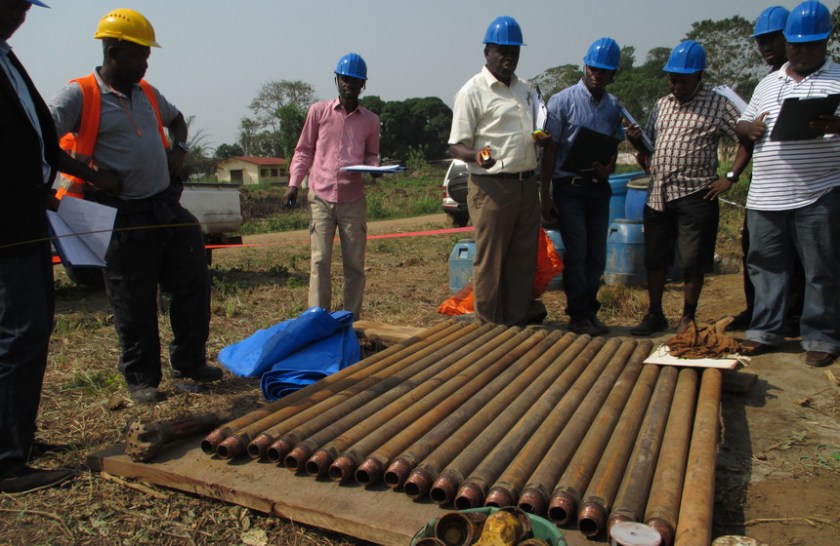
How do we  raise capacity for borehole drilling and its management globally? If everyone is to have access to safe and affordable drinking water by 2030, in line with the UN Sustainable Development Goals, detailed attention is required for the siting, drilling and installation of boreholes in every single project in every country. Alas, this is not always the case. The result is that many boreholes fail within a very short time.

RWSN members are telling us that they want more in-country training.  The article linked below provides some suggestions. Do you have ideas or incentives for government and private enterprises invest in skill development in the groundwater sector, and in the rural water sector at large?

To find out more:

http://www.geodrillinginternational.com/geodrilling/issue/1179329/getting-groundwater-ground

TrainingdrillingsupervisorsinSierraLeonein2014-860x560

New 2017 RWSN Webinar series (18th April – 13th June 2017)

ENG: RWSN is delighted to announce the first of the 2017 series of webinars (on-line seminars) on rural water supply, running every Tuesday from April 18th, 2017 until June 13th, 2017. This series includes 9 weekly sessions on topics, which were presented and debated during the 2016 RWSN Forum in Abidjan, and related to the RWSN themes. For instance, we will find out about local government superheroes and their role in realising the human right to water and sanitation, but also hear about emerging cross-cutting issues such as improving WASH services in protracted crises. Each session will be bilingual, with one webinar in English as well as another language (French or Spanish) as we are trying to cater for a wide and varied audience. The format includes 1-2 presentations, comments from discussants, and a Question & Answer session where all participants are invited to ask questions or make comments. For more details on the first 2017 series, please refer to the table below.
The webinars in English start at 2.30 pm Paris time/ 1.30 pm London time/ 8.30 am Washington DC time. You can check your local time here. To register for one or all of the webinars, and receive an invitation please click on the following link: http://bit.ly/2movPGM

*******

FR : Le RWSN a le plaisir de vous annoncer une nouvelle série de webinaires en 2017 (les séminaires en ligne) qui auront lieu les mardis, du 18 avril 2017 au 13 juin 2017. Cette série comprend 9 sessions hebdomadaires sur des sujets ayant été présentés et débattus lors du RWSN Forum à Abidjan en 2016, et correspondant aux thèmes RWSN. Par exemple, on apprendra le rôle des superhéros des gouvernements locaux pour la réalisation du droit à l’eau et à l’assainissement, mais on découvrira également des sujets transversaux émergeants tels que l’amélioration des services EAH dans les cas de crises prolongées. Chaque session sera bilingue, avec un webinaire en anglais et dans une autre langue (espagnol ou français) selon le sujet, nous souhaitons en effet toujours toucher le public le plus large dans toute sa diversité ! Les thèmes abordés sont le droit humain à l’eau et à l’assainissement, l’auto-approvisionnement, la durabilité des services et le cadre de référence d’applicabilité des technologies. Chaque session comprend 1 ou 2 présentations, des réactions de la part d’un ou plusieurs intervenants et une partie Questions/Réponses lors de laquelle tous les participant(e)s peuvent poser leurs questions ou réagir aux échanges. Vous trouverez le détail de cette première série de webinaires de 2017 dans le tableau ci-dessous.
Les webinaires en français sont à 11h heure de Paris/ 9h heure de Dakar. Pour vérifier l’horaire du webinaire, vous pouvez cliquer ici. Pour vous inscrire à l’un ou à tous les webinaires de cette série et recevoir une invitation, cliquez ici : http://bit.ly/2movPGM

*******
ES: Desde el secretariado del RWSN tenemos el gusto de anunciar la nueva serie de webinars (seminarios en linea), la cual se efectuará entre el 28 de abril y el 13 de junio del 2017. Esta serie comprende 9 sesiones (una sesión por semana) respecto a los temas discutidos en el Foro RWSN en Abidjan en 2016, los cuales corresponden con los ejes temáticos del RWSN. Por ejemplo, aprenderemos sobre el rol de los superhéroes de los gobiernos locales para la realización de los derechos al agua y a saneamiento, pero también descubriremos temas transversales como la mejora de los servicios en agua y saneamiento en crisis humanitarias prolongadas. Cada sesión se implementará en dos idiomas, con una sesión en inglés y la otra o en francés o en español según el tema – de esta forma esperamos poder alcanzar a un público amplio y diverso. El formato incluye, para cada sesión, 1-2 presentaciones en línea, un comentario de al menos una persona, y una sesión de Preguntas y Respuestas donde todos los participantes tendrán la oportunidad de hacer preguntas o comentarios. Para mayor información sobre la serie por favor hacer clic en el vínculo abajo.

Los webinars en español empiezan a la 16.30 (hora de Madrid)/ 09.30 (hora de la Ciudad de México). Se pueden verificar los horarios para su localidad aqui. Para inscribirse a uno o a todos los webinarios de esta serie, haga clic aquí: http://bit.ly/2movPGM

18 April Improving WASH services in protracted crises
18 avril Améliorer les services EAH dans les situations de crises prolongées

25 April Professional Water Well Drilling: Guidance for Ensuring Quality
25 avril Le forage de puits d’eau professionnel : des orientations pour une meilleure qualité

02 May Making rights real – human rights guidance for practitioners
2 mai Faire des droits une réalité – conseils pratiques sur les droits de l’homme pour les professionnels

09 May Making water work for women – inspiring experiences
9 mai Faire fonctionner l’eau pour les femmes : des expériences inspirantes (1ère partie)

16 May Tackling corruption in rural WASH
16 mai S’attaquer à la corruption dans l’eau, l’assainissement et l’hygiène en milieu rural

23. May Making water work for women – inspiring experiences II
23 mai Faire fonctionner l’eau pour les femmes : des expériences inspirantes (2ème partie)

30. May Household wells: A lifeline in Nigeria?
30 mai Les puits d’eau résidentiels: une bouée de sauvetage au Nigéria ?

06 Jun Country-led monitoring
06 juin Le suivi au niveau des pays
6 de junio Monitoreo a nivel de países

13 Jun Searching for universal sustainability metrics for rural water services
13 de junio Buscando maneras universales de medir la sostenibilidad para servicios rurales de agua potable


More Information

» Register

Obituary: Robin Temple Hazell (1927-2017)

by Dotun Adekile, Nigeria

I regret to inform you all that Robin Temple Hazell, one of the pioneers of systematic groundwater development in Africa, a member of the RWSN and a contributor to Dgroup discussions, passed away in his home, Bodmin, Cornwall on Sunday, 19th February, 2017. He would have been 90 years on 12th  March, 2017.

Continue reading “Obituary: Robin Temple Hazell (1927-2017)”

Groundwater Management into River Basin Organizations

A one-day training course in Dar es Salam, Tanzania Wednesday 20th, 2016.

 Background: Transboundary water management is of great importance to Africa as it has been emphasized in the African Water Vision 2025. Almost all Sub-Saharan African countries share at least one international river basin. In Africa there are about sixty transboundary lake and river basins and at least eighty transboundary aquifer basins. A training manual has been complied by a network of partners, including AGW-Net, ANBO, BGR, Cap-Net, IGRAC, IMAWESA, IWMI, IGRAC, and A4A – aqua for all in response to the needs expressed and is designed to help develop capacity on groundwater management within the basin organizations.

The Course: The 6th AWW (http://africawaterweek.com/6/) that takes place in Dar es Salaam (Tanzania) in July 18-22, 2016, will launch the manual, and at the same time implement a one-day training course on groundwater management. The course aims to: (1) promote sustainable groundwater resources management within the framework of IWRM in RBOs; (2) make groundwater resources in Africa more “visible” to water managers who are required to manage it sustainably; (3) raise awareness on the importance of groundwater resource to Africa, and especially in light of the growing impacts of climate change. Continue reading “Groundwater Management into River Basin Organizations”

“Your challenges are our challenges”, reflections from Oklahoma, USA

Today I write from Oklahoma, USA, having just come to the end of the two and a half day University of Oklahoma 4th biennial WaTER Conference.  I had the honour of being one of the keynote speakers at this event, which was attended by over 170 people from 27 countries. It has been an extremely worthwhile experience on many fronts.

There is a growing interest in water supply and sanitation in “developing nations” in the USA.  The Senator Paul Simon Water for the Poor Act 2005 seems be one of the catalysts for this change.  Over the past week I have engaged with numerous undergraduate and graduate students from the University of Oklahoma, Emory University, Mercer University and other US institutions. They are learning about the realities of millions without adequate water supply or sanitation as well as undertaking research. These students want to make a difference.

I was particularly touched by the opening speech of Dr Jim Chamberlain who reflected on the realities today in the USA, where there are people without adequate water supply.”your challenges are our challenges” he observed. He went on to mention common water quality and resource issues between here and other parts of the world.   And he was talking about Oklahoma today – a city that is expanding beyond the reach of its piped water supply network. I have learned about people in this State and more widely in the USA who are not connected to a piped water supply or sewerage system. They mostly rely on their own private boreholes, some hand dug wells, and septic tanks. What was particularly surprising though is that as in Lagos, Lusaka or Kampala, up-to-date statistics on the numbers of wells and population depending on them are lacking.  And private well regulation, including water quality testing falls between the cracks and is beyond the current remit of the US Environmental Protection Agency.

My keynote was entitled Sustainable Groundwater Development in Africa: More than Engineering. I tried to present an overview of some of the groundwater development opportunities and challenges of the African continent. The presentation was well received, in particular reflections on the diversity of the African continent, both above and below ground, as well as the size of Africa. Few people are aware that Africa is larger than the USA and China and a considerable part of Europe put together.

Dr David Sabatini of the Water and Technologies for Emerging Regions (WaTER) Centre asked all presenters to be mindful of a very broad audience, from anthropologists to engineers, from first year undergraduates to seasoned experts.  I tried my best, also aware that there would be people in the audience who had never been to Africa in their lives, alongside scholars and professionals from the continent.  And so we journeyed together from the phenomenal expansion of manual drilling in Nigeria and elsewhere, to the challenges of trying to escape poverty with irrigated agriculture to geology (including the continent’s mineral resources and resource curse), then onto hydrogeology, urban groundwater and finally a vision for future policy and implementation.

As a keynote speaker it was rather humbling to present the fact that the first continental estimates of the quantity of groundwater resources in African were only published three years ago; and to explain that very few African countries have good quality hydrogeological maps and studies. Having worked in rural water supply for seventeen years now, I scratch my head to find defendable reasons for the lack of organised and reliable drilling logs and groundwater data despite decades of development projects from the water decade through the MDGs.

However, I was relieved to present the work supported by UNICEF, WSP, UKAid and USAID over the past ten years to provide guidance for drilling in the form of documents and films; to share that UNICEF, together with WaterAid and Skat has an ongoing collaboration to try and raise the professionalism of both manual and mechanised drilling. And of course to recommend the ongoing UK-funded research to enable sustainable use of groundwater for the benefit of the poor – UPGro.

Undergraduate students ask very pertinent questions. The frankness of potential newcomers to the Water, Sanitation and Hygiene (WASH) and Water Resources sector is very refreshing and I hope that they will join in solving some of the problems that those of us who have been around a bit longer are struggling with. But to do that, they need to be able to work in this field. Care’s Peter Lochery and winner of the 2015 University of Oklahoma Water Prize, talked of the importance of being a connector, rather than a leader. And so I close this blog with some questions.

How can better connections be made? What can we all do to enable new talent, whether from the USA, Nigeria, or anywhere else, to flow into the Water, Sanitation and Hygiene (WASH) and Water Resources sector? Who can offer internships? What about apprenticeships or first jobs?  Where are the jobs? If we are to reach the Sustainable Development Goal targets for water supply we need an awful lot more skilled people – whether entrepreneurs, field staff, project managers or academics.  And we have to find ways of bringing them in to join us!  Do you have any tangible ideas? Or any offers for that matter?