A Tribute to Catarina de Albuquerque: A Legacy of Mandate and Momentum

Catarina de Albuquerque (1970–2025)

It is with heavy hearts that we pause, not to let grief diminish the force of her legacy, but to honor the fierce, unyielding presence of a foundational architect of human right to water. Catarina de Albuquerque (1970–2025) was a tireless expert who leveraged her wisdom, courage, and political will to change the world’s most basic equation.

Catarina’s career was a masterclass in strategic advocacy, dedicated to transforming an ethical concern into a concrete, legally binding global objective.

For us, her most monumental achievement was her brave assumption of the role as the first UN Special Rapporteur on the human right to safe drinking water and sanitation (2008–2014). This work culminated in the unwavering declaration of the 2010 resolution by the UN General Assembly, formally recognising access to water and sanitation as human rights. This was a critical shift, forged by her bold conviction, that moved the issue from a development challenge to a State obligation under the international human rights framework.

Catarina didn’t just advocate for recognition; she focused on accountability.

  • She ensured these rights were explicitly incorporated into the global development agenda, successfully driving their inclusion in Sustainable Development Goal 6 (SDG 6): “Ensure availability and sustainable management of water and sanitation for all.”
  • Her diplomatic force was also evident in her work presiding over the negotiations for the Optional Protocol to the International Covenant on Economic, Social and Cultural Rights (OP-ICESCR). This profound legal instrument created a mechanism for individuals to challenge human rights violations at the UN level, giving real teeth to economic and social rights.

As CEO of the Sanitation and Water for All – a UNICEF-hosted global partnership (SWA) partnership she continued to strategically mobilize high-level political will and financing, ensuring that policies prioritised the poorest and most marginalized, embodying the principle to leave no one behind.

For us, the Rural Water Supply Network (RWSN), especially the Leave No One Behind Theme, Catarina provided the intellectual architecture necessary to fulfill our mandate. She moved beyond theory to provide us with actionable tools for implementation, ensuring the human rights framework was specifically tailored for the rural frontiers where we operate. Her collaborations directly strengthened RWSN’s technical focus by embedding social accountability and equity into service delivery models.

  • Her influential work, such as the book On the Right Track: Good Practices in Realising the Rights to Water and Sanitation, provided the necessary guidance for countries to operationalize these rights, directly informing our approach to national policy engagement.
  • She actively engaged with RWSN partners, notably through joint events like the World Bank and RWSN Webinar on the Human Right to Water, demonstrating her enduring commitment to bridging high-level policy with grassroots, rural implementation.

This strategic alignment means our commitment to the forgotten is a globally recognised legal duty, a legacy of her unparalleled expertise.

Catarina’s life offers a potent vision for every generation that follows, proving that policy is the highest form of power.

  • To the Youth, she demonstrated that a deep, determined focus on law and strategic advocacy is the lever for world-altering results. You are not merely inheritors of problems; you are the architects of the future legal reality for water and sanitation. Your fresh perspective and moral clarity are essential to holding power accountable and securing human rights.
  • To the Women in Water, Catarina is the indisputable proof of what a courageous, intellectual, fiercely determined woman can achieve. She was the one who shattered the ceiling and demanded accountability, showing women how to transform technical expertise into unassailable rights-based mandates. Your leadership is non-negotiable; Wield your power and be bold in its assertion.
  • And to the Global South, she is a powerful, undeniable call. She is the proof that our rightful place is not just to benefit from global policy, but to lead, command, and enforce the international human rights framework that demands equity for our communities. Our local experience is the unshakeable moral anchor that must drive global social justice.

Catarina’s greatest gift was not the victory itself, but the enduring reminder that our work is never done. Her unwavering commitment lights the path ahead, and her words continue to set our highest standard:

“I encourage you to continue the critical work you are all doing in recognising water, sanitation and hygiene as fundamental for all.” – Catarina, 2020

We honour her memory not through sorrow, but through renewed purpose, transforming grief into greater effort, deeper dedication, and higher quality in all we do. Inspired by her fearless leadership and strategic brilliance, we celebrate the progress she secured and press forward, with determination and wisdom, until the shared vision of universal water access becomes a reality for everyone, everywhere.


Written by Euphresia l, RWSN Leave No One Behind theme co-Lead, with inputs from Dr Amita Bhakta PhD, Sandra van Soelen, and Temple Chukwuemeka Oraeki, LNOB co-Leads.

How three male allies are advancing gender equity in Kenya’s water sector

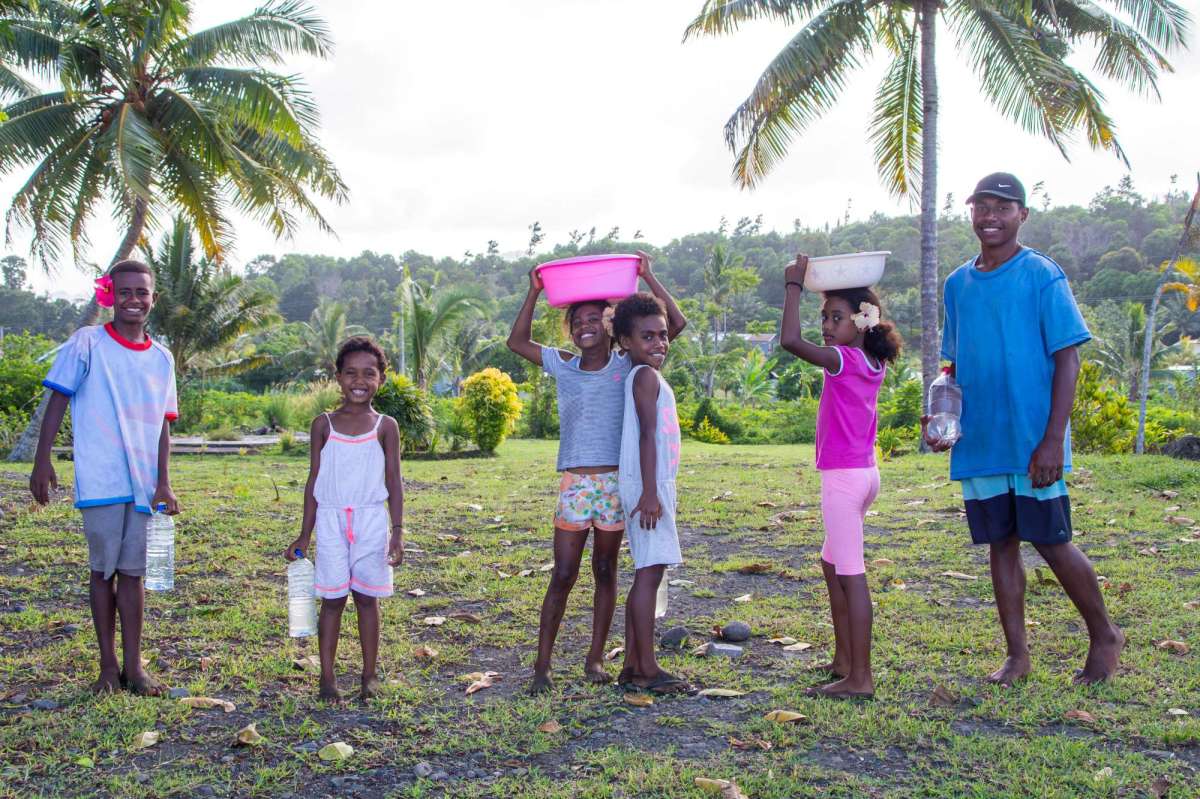
Featured photo: Daily, millions of girls and women in Kenya walk for water, losing time, safety, and opportunity. Photographer: Euphresia Luseka

Blog by Euphresia Luseka, co-lead of the RWSN Leave No-one Behind theme.

The views and opinions expressed in this blog post are those of the author. They do not necessarily reflect the views of the Rural Water Supply Network (RWSN) or its Executive Committee.

A Walk Before Dawn

At five in the morning, Busia County, Kenya is still wrapped in silence. But Jeruto is already walking. Fourteen years old, barefoot, a yellow jerrycan pressed into her hip. Three kilometres to water, three kilometres back.

She knows this path by heart. She also knows it is never safe. Men wait in the shadows. The price of water is sometimes not money but dignity. By the time she returns, the day has already slipped away; half her classes gone, her body exhausted, her hope dimmed.

“I was afraid,” she says. “But what choice did we have?”

This is the  reality of women and girls without drinking water supplies on the premises  every day stolen by the simple act of survival. And yet, here is the cruel paradox; when decisions are made about water, women are nowhere in the room. They carry the heaviest burden but hold the least power. The sector is still led by men.

That irrationality is finally being challenged. In western Kenya, three men, yes, men are ripping up the old rules of water and power. They are saying: enough. Not with platitudes, not with empty gender policies that gather dust, but with radical reforms that change who gets to sit at the table, who gets paid, who gets promoted, who gets heard.

And the truth they have stumbled into is this; Gender equity is not tokenism. It is infrastructure. It is resilience. It is the difference between a girl chained to a jerrycan and a girl being educated.

When Water Becomes Opportunity

The revolution begins small. For Jeruto, it started with the hum of a drilling rig. Just metres from her school gate, the Lake Victoria North Water Works Development Agency (LVNWWDA) sunk a borehole. Water surged from the ground, and with it, time, safety, and dignity returned to her life.

The 3 hours she once lost on the road became minutes. Within a year, girls’ local schools’ attendance had risen by nearly 30 percent.

For Joel Wamalwa, the agency’s CEO, this borehole was not just a piece of engineering. It was a revelation.

“Water unlocks education, strengthens health, reduces risks of violence, and frees women’s time for work and enterprise,” he says. “When women are included in planning and leadership, water systems become not only more equitable but more sustainable.”

Water, he insists, is not only a service. It is a multiplier.

Joel Wamalwa, CEO LVNWWDA says water is a Multiplier, Photographer: Euphresia Luseka

The Paradox of Exclusion

And yet, Joel has spent much of his career staring at a contradiction that borders on absurd. Women carry the heaviest weight of water scarcity rationing supplies, absorbing the stress of breakdowns, managing survival when systems fail. They are the first to wake, the last to sleep, the ones who walk the farthest.

But when utilities gather to make decisions on staffing, on budgets, on infrastructure women are almost invisible.

“We made choices about them without them,” he says quietly. “That was not only unjust. It was inefficient.”

The numbers from Mckinsey back him up. Utilities with gender-diverse leadership are 21 per cent more profitable. Boards with women deliver up to 95 per cent higher returns. For Joel, the conclusion is obvious: “Equity is not compliance. It’s not tokenism. It’s strategy.”

Continue reading “How three male allies are advancing gender equity in Kenya’s water sector”

GLOBAL DRIVERS AND PHENOMENA: ADVANCING GENDER MAINSTREAMING IN WASH

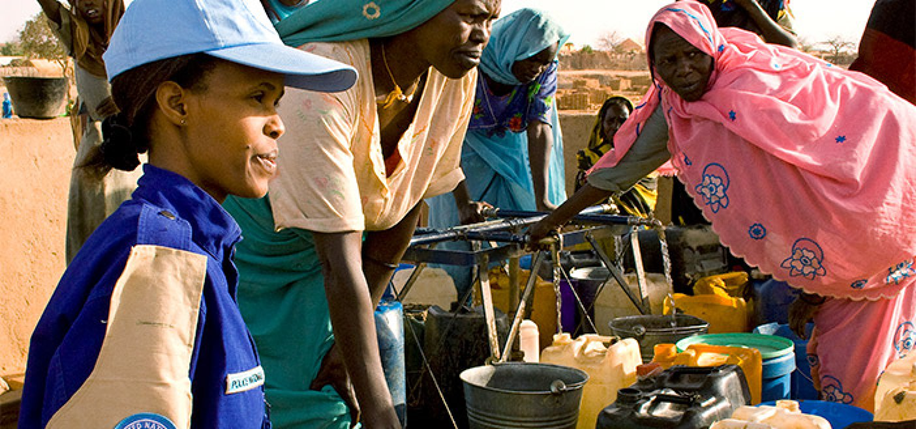
Photo 1. Female Peacekeeper overseeing water supply in Chad. Source:  Our Secure Future, accessed October 2024

Blog by Euphresia Luseka, co-lead of the RWSN Leave No-one Behind theme.

The UN WWDR 2026 shall serve as a vital resource, illustrating how global trends and phenomena are reshaping gender dynamics in societies around the world. The interplay between conflict, migration, and gender equity in WASH reveals stark realities. In regions afflicted by conflict and instability, women’s safety and access to essential services are severely compromised.

A poignant testimony from a woman in Gaza encapsulates this struggle: “We [women] cannot meet our simplest and most basic needs: eating well, drinking safe water, accessing a toilet, having sanitary pads, taking a shower, changing our clothes.”

The plight of women in conflict zones is further exacerbated by migration. Women and girls face an increased risk of sexual and gender-based violence during conflicts. Yet, amid these challenges, women remain indispensable agents of change—actively participating in peace-building, conflict resolution, and post-conflict reconstruction. This resilience highlights the need to recognize and harness women’s potential for positive transformation in their communities.

Migration and its intersection and climate change also alters traditional gender roles and expectations, as families adapt to new environments; it presents opportunities for economic independence and education, empowering them to challenge restrictive gender norms. Still Migrant women often encounter exploitation, discrimination, and limited access to resources, underscoring the urgent need to address these barriers.

Corruption emerges as another formidable barrier to WASH and gender equity. It restricts women’s access to essential services and undermines their participation in leadership and decision-making processes, as demonstrated in weaponisation of water.  U.N. Women has called for urgent action to protect Sudanese women and girls, emphasizing the need for accountability in addressing high levels of sexual violence and exploitation. “We cannot let Sudan become a forgotten crisis,” asserts U.N. Women’s Addou, highlighting the critical necessity for action in conflict-affected regions.

On my blog on Diversity in Water sector leadership I emphasise the concerning underrepresentation of women. A World Bank report highlights that less than 18% of the workforce in water utilities are women and that two-thirds of sanitation leaders are white according to a FLUSH LLC publication that I co-authored. This systemic inequity reflects deeper societal structures, suggesting that without diverse leadership, the water sector risks stagnation and failure in meeting SDG6 targets.

Continue reading “GLOBAL DRIVERS AND PHENOMENA: ADVANCING GENDER MAINSTREAMING IN WASH”

THE INTERSECTION OF WASH AND GENDER

Blog by Euphresia Luseka, co-lead of the RWSN Leave No-one Behind theme.

“Gender equality is a fundamental human right and an obvious question of equity and fairness. But it is also a necessary foundation for sustainable development and a peaceful, prosperous world.”
– Beate Trankmann, UNDP Resident Representative

However, the intersection of WASH reveals profound challenges that hinder the potential of women and girls in achieving equitable and sustainable development, within the realms of WASH. Cecilia Sharp, UNICEF Director of WASH and CEED, explains this by informing that “unsafe water, toilets, and handwashing at home robs girls of their potential, compromises their well-being, and perpetuates cycles of poverty.” She added, “responding to girls’ needs in the design and implementation of WASH programmes is critical to reaching universal access to WASH and achieving gender equality and empowerment.”

Since the emergence of gendered thinking in WASH in 1970s, the dialogue surrounding gender equity has evolved including a dedicated  SDG 5 that envisions a world where gender equality is achieved and all women and girls are empowered. It targets the eradication of discrimination and violence against women, child marriage and female genital mutilation, and the recognition of unpaid care work. Furthermore, it emphasizes the necessity for women’s participation in decision-making and access to sexual and reproductive health services.

Yet, five decades later, the promise of transformative models within policies and programs remains nascent.  This stagnation raises pressing questions about the efficacy of our current approaches and the urgency of progressive change.

The connection between WASH and gender equity remains tenuous.

This status is explained by the acknowledgement that while the importance of advancing WASH as a means to achieve SDG 5 is increasingly acknowledged in global discourse with even SDG 6.2 explicitly calling for paying special attention to the needs of women and girls, still a glaring omission persists: a lack of commonly agreed-upon indicators for the national and global monitoring of gender within WASH initiatives. This absence underscores a systemic failure that perpetuates gender inequalities, inhibiting the realization of SDG 6 targets.

Water Scarcity and Gender Inequality: Exploring the Hidden Costs of a Thirsty World

The intersection of WASH and gender unveils unique challenges that disproportionately burden women and girls. As demonstrated on Graph 2 below, Research reveals that when water sources are not easily accessible, women and girls aged 15 and older assume the primary responsibility for water collection in 70% of households—an alarming statistic that starkly contrasts with the 30% of households where men share this burden. This reality not only highlights the entrenched gender roles but also raises critical questions about the time and energy expended by women and girls, which could otherwise be invested in education, employment, or health.

Compared to men, women experience many negative WASH-related health outcomes, some of which have been disaggregated. Dr. Maria Neira, Director of the WHO’s Environment, Climate Change, and Health Department, informs, “Women and girls not only face WASH-related infectious diseases, like diarrhoea and acute respiratory infections, they face additional health risks because they are vulnerable to harassment, violence, and injury when they have to go outside the home to haul water or just to use the toilet.”  They also account for a higher number of disabilities adjusted life years (DALYs) caused by inadequate hygiene.

Graph 2 Average time spent collecting water by women, girls and boys, by country, selected surveys, 2012-2022 Source UNICEF and WHO, 2023

The gravity of these issues is further compounded by the fact that contaminated drinking water and poor sanitation can have dire consequences for maternal health, including complications during pregnancy and an increased incidence of reproductive tract infections. Despite the wealth of existing studies on health inequities related to WASH, there exists a significant research gap regarding the specific impacts of drinking water access on gender disparities. While some investigations have touched upon the broader issues of water fetching, sanitation, and sexual violence, the social, educational, and economic ramifications of inadequate access to safe drinking water for women remain largely underexplored.

This multifaceted vulnerability contributes to a staggering increase in mortality rates among women and girls.

Brightening the Horizon: Positive Trends in Gender Recognition in WASH Initiatives

“In the landscape of gender recognition, a nuanced narrative unfolds—one that, while acknowledging persistent challenges, also celebrates the transformative strides women are making within the water sector.”

The forthcoming UN WWDR 2026 stands as a beacon of hope, poised to spotlight the remarkable achievements of women in this vital field. By illuminating their contributions and sharing success stories, the report shall aim not just to honour past accomplishments but to ignite inspiration in future generations of women aspiring to carve out their own paths in WASH careers. This acknowledgment is not merely celebratory; it is a critical step toward fostering gender equity in a sector that has historically marginalized female voices.

Each March annually heralds the convening of the United Nations Commission on the Status of Women (CSW), a platform designed to evaluate the progress made since the Beijing Declaration and Platform for Action. Despite the stark realities of slow advancement in gender and WASH, some nations have emerged as exemplars of progress.

Senegal, for instance, has shown remarkable strides between 2015 and 2020, as highlighted in the 2022 SDG Gender Index by Equal Measures 2030. They improved on undernourishment (SDG2) and drinking water (SDG6). The Senegalese government, since adopting the Beijing Declaration, has actively championed gender equality. The introduction of a parity law for elected institutions in 2010 has positioned Senegal as a global leader, boasting one of the highest proportions of women parliamentarians in West Africa. This progressive move places Senegal fourth in Africa concerning gender parity in its legislative assembly. Complementing these efforts, the government has ratified several international conventions to bolster women’s rights and developed a National Strategy for Gender Equity (SNEEG 2016-2026), to ensure equitable participation of both genders in decision-making and access to resources.

Such positive trends in gender recognition in WASH, have spilled into the political arena particularly women’s activism; Hon. Anne Désirée Ouloto—dubbed ‘Maman Bulldozer’ lead transformative efforts in WASH initiatives in Côte d’Ivoire. Presiding over a monumental US$1.2 billion investment in sanitation and drainage in Greater Abidjan, her work exemplifies the profound impact of female leadership in WASH sector.

The landscape of advocacy and legal rights protecting women in WASH is also evolving. In Kenya, alongside legislators and WASH CSOs’, I have led concerted efforts to address the pernicious issue of sextortion in the water sector. Such advocacy is not only a legal necessity but a moral imperative, critical to achieving SDG5 on gender equality and SDG16.6 on accountable governance.

Moreover, Women are not just participating but breaking barriers, challenging norms and stepping into leadership roles, shaping policies, and driving change by making their voice heard. Indonesia’s Retno Marsudi, who serves as the first UN Special Envoy on Water, exemplifies the vital role women play in global discourse on water issues.

EMPOWERING PROGRESS: THE UN WWDR 2026 REPORT ELEVATES GENDER AND WATER DISCOURSE

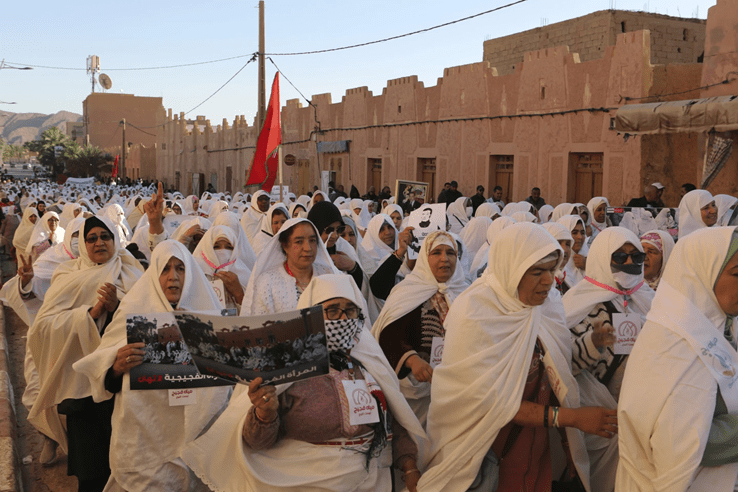
Featured photo: March 2024, Women in Figuig, Eastern Morocco marching during the biweekly protests against water privatisation. Source AP News.

Blog by Euphresia Luseka, co-lead of the RWSN Leave No-one Behind theme.

As the waves of time crash upon the shore of progress, a mighty force is rising. These waves carry the strength of female leaders, revolutionising the Water Sanitation and Hygiene (WASH) sector. To mark another milestone in the pursuit of a sustainable future, the upcoming United Nations World Water Development Report (UN WWDR 2026), will shine a spotlight on a critical yet oft-overlooked aspect of the global water crisis: the inextricable link between gender and water, illuminating a path towards a more sustainable and equitable future. UNWWDR 2026 is not merely an echo of problems, but an inspiring melody of change, empowerment, and sustainable future.

It is not just about women being disproportionately affected by lack of safe WASH access and representation in its management, but it is also about recognising the power of women as managers and catalysts for change in the WASH sector. From the pioneers in Indonesia like Retno Marsudi, UN 1st Special Envoy on Water, the indigenous Mexican women water stewards using ancient techniques passing them down to generations to preserve water in the drought-prone Oaxaca region to the relentless Figuig women of Morocco who marched in protest for several months to amplify water rights voices against water privatization and the ‘humming bird’ Nobel laureate Wangari Maathai from my country Kenya, on water catchment protection efforts, all serve as a powerful reminder that one person can create waves of change.

Water and Economic Poverty: How the Global Water Crisis Disproportionately Affects Women

The global water crisis is a crisis of inequalities disproportionately affecting women.

As we celebrate these and more trailblazing women in water leaders, the world inches closer to the 2030 deadline for achieving the Sustainable Development Goals (SDGs) with women still left behind. The United Nations’ Global Analysis and Assessment of Sanitation and Drinking Water (GLAAS) 2019 report reveals that a staggering 78% of countries have incorporated specific policies or strategies to promote gender equality in water and sanitation. On the other hand, the International Decade for Action (2018-2028) calls to address gender disparities in WASH access.

Alongside the progress, we also confront persistent gaps. Gaps that threaten to undermine our hard-won achievements, forming a path that recognizes the interconnected nature of WASH-related challenges and the need for inclusive solutions.

Terms like sex and gender may seem straightforward but their nuances hold profound implications for how we perceive and address WASH and gender issues. UNICEF defines Sex as the biological and physical differences between women and men while Gender as socially constructed differences in attributes and opportunities associated with being a woman, man, girl, or boy and to the social interactions and relations between women and men. Woman refers to biological females according to UNOHCR. In my view this affirms the gap in the context of WASH statistics where WASH data is often disaggregated by sex, but rarely disaggregated by gender.

Imagine a world where the simple act of accessing safe WASH does not dictate one’s ability to attend school, earn an income, or live a life free from danger. A world where our mothers, sisters, and daughters are not disproportionately burdened with the responsibility of fetching water, but are empowered managers and change agents in WASH initiatives. For more than two billion people around the globe, particularly women and girls, this is a distant reality. The latest stark metrics reveal a concerning reality: despite progress, millions of women and girls worldwide still lack access to safe WASH services, hindering their empowerment, health, and economic opportunities. This world, although still a distant reality, is one we must strive for, beginning with a deep understanding of the water-gender nexus.

Women are 2.5 times more likely to be responsible for water collection, yet they hold only 17% of the paid jobs in the water sector as confirmed by a Women for Water Partnerships Report. UN Women adds another layer of concern revealing that in 2022 a quarter of women globally lacked access to safely managed drinking water, and two-fifths lacked access to secure sanitation.

The gendered impact of inadequate WASH access is not just a reflection of biological differences, but a manifestation of socially constructed disparities. It serves as a stark reminder that water is not just a women’s issue – it’s a human issue and Graph 1 below illustrates these realities.

Graph 1 Proportion of households in which women, men, girls and boys are primarily responsible for water collection, by country, selected surveys where at least 10% of households collect water, 2012–2022 (%) Source UNICEF and WHO, 2023

UN Water’s dictum concurs and aptly captures that “Water is a human right, not a privilege,” this blog series embodies a bold commitment to upholding the rights of all.

The upcoming UN WWDR for 2026, aims to bridge this chasm by placing gender equity at the heart of WASH management and sustainability discussions. It stands as a pivotal blueprint for understanding the critical nexus between water and gender, presenting an urgent call to action for policymakers, practitioners, and stakeholders dedicated to fostering an inclusive, equitable, and water-secure world. By weaving together, a rich narrative of data, case studies, and expert insights, the report shall transcend mere enumeration of challenges to celebrate the resilience and ingenuity of women who are at the forefront of change within the WASH sector. It shall compellingly argue that embedding gender equality and social inclusion into water policy and practice is not just a moral imperative but a pragmatic necessity for achieving all SDGs especially SDG 5 and 6. Statistical evidence revealing the extensive failures of undervaluing women’s expertise in WASH management will be juxtaposed with success stories of women-led interventions that have illuminated pathways towards peace, prosperity, and sustainability. As the report critically examines the barriers that women and girls face in accessing safe WASH, it shall highlight the detrimental impacts of gender disparities in decision-making roles, pushing the narrative beyond mere awareness to active transformation. With a focus on fostering gender-responsive approaches in the WASH sector, the UN WWDR 2026 shall serve not only as a repository of insightful analysis but as a clarion call for disruptive change, intended to inspire dialogue and galvanize global commitment towards a future where equitable access to safe WASH is a universal reality.

#HearingTheUnheardHRWS Digital Campaign and Side-Event at the UN Water Conference 2023

Our friends from End Water Poverty, Water Integrity Network & partners invite you to join to this UN 2023 Water Conference side event Hearing the Unheard: the Human Right to Water and Sanitation‘ & its digital campaign #HearingTheUnheardHRWS which aims to amplify the call for global action to HRWS for the vulnerable groups.

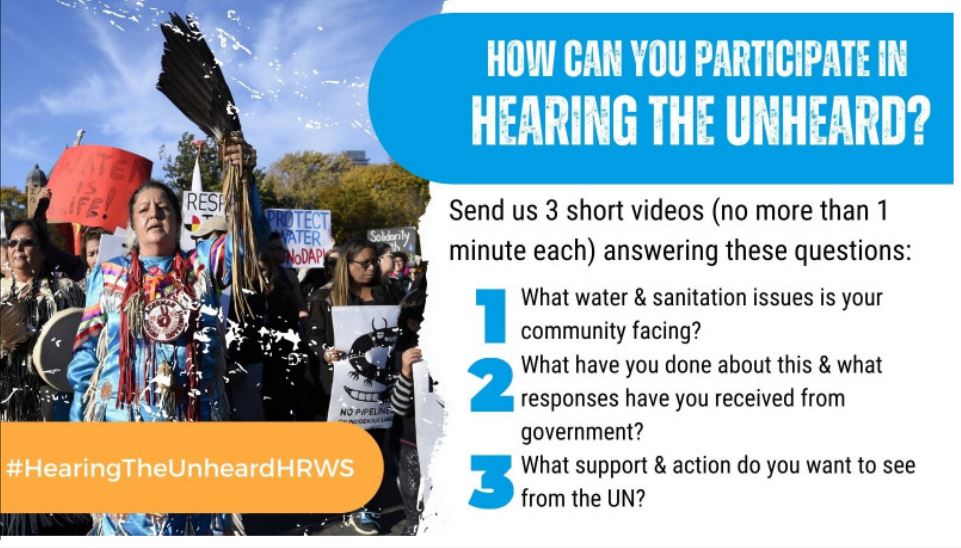
The goal of the campaign #HearingTheUnheardHRWS is to generate multi-stakeholder conversations; to raise awareness and gather key messages, opinions and recommendations that shall inform commitments, pledges, actions, initiatives and endeavours for vulnerable groups who are left behind towards realising HRWS. The campaign consists on sharing videos & live testimony of the experiences, agency and demands of marginalised groups from across the globe with responses from the Special Rapporteur, OHCHR and governments

 As provided by UN OHCR, groups in vulnerable situations include: Children and adolescents, Women and Girls, Indigenous peoples, LGBTI, Migrants Refugees Asylum seekers, Older persons, Persons with disabilities. 

We are handing over the mic to all WASH stakeholders to share their experiences, stories and views on improving WASH access for vulnerable groups. The campaign gives an opportunity for everyone to follow these experiences and views, get inspired by the vulnerable groups, reform champions, activists and advocates who are making a difference every single day, and find out how to can take action. 

How to participate in the digital campaign: 

The campaign requires original content in the form of shareable media, photographs, quotes, blog posts and videos, to promote the voices of vulnerable groups. This material will be shared through Twitter, LinkedIn and Facebook. If you are interested to participate please take this into account:

  1. Record A Short, Social Media-Friendly Video (Maximum 1 Minute) Or Take Photographs Or Share A Quote Or Write A Blog (Maximum 300 Words With A Photograph) Reflecting: 
  • Impacts: How does lack of (adequate, affordable, acceptable) water and sanitation affect your community/ group? 
  • Actions: What existing initiatives or actions have you taken to address this? 
  • Responses: What responses have you received from the government? 
  • Support: What support and action do you want to see from the international community/ UN?  

N.B. If you do not have a social media handle or profile, you can also send your content to equity@dgroups.org 

Side Event: Hearing the Unheard. the Human Right to Water and Sanitation

The side event session is hosted on March 23, 2023, 3:00PM-4:30PM EST Time in Hybrid mode. Registrations to participate in this side event of the UN 2023 Water Conference here

To learm more about this side event session and the organisations involved, please find hereunder the concept note on Hearing the Unheard: the Human Right to Water and Sanitation side event.


Multi-dimensional challenges of ensuring sustainable water supplies

Word from the RWSN Chair:
Louisa Gosling, WaterAid

Download the latest RWSN Update in English, French or Spanish

Dear RWSN colleagues, the 4 months since the last newsletter have been eventful for the RWSN.

It has become clear that covid-19 will be with us for a long time and that people need water to stay safe. But there is still no sign of the long term investment needed to ensure services are sustainable, while the social, economic and health pressures of the pandemic are making existing inequalities worse. 28 July marked the 10th anniversary of the recognition of water and sanitation as a human right by the UN General assembly.

In his statement to mark the anniversary, the UN special rapporteur concludes: “On the positive side, the international community is well aware that it has the obligation, both moral and legal, to ensure access to safe drinking water and to sanitation for all, without discrimination (…) However, without a swift and considerable increase in the efforts currently dedicated to water and sanitation, and a better understanding of the legal and policy changes required by a human rights-based approach to water and sanitation, the international community will not fulfill the ambitious promises it has made.”

The last RWSN webinar series focused on the human right to water as more practitioners are looking for ways to use human rights commitments to leverage progress.

On the positive side, the pandemic has generated a new urgency for agencies and practitioners to collaborate and work out solutions. RWSN has supported many discussions through webinars and online forums, its members bringing a large range of skills, experience and perspectives to the challenges posed by covid and climate change.

An important milestone was the conclusion of the UPGro research on groundwater in Africa, which has released a huge amount of valuable insights about the potential of groundwater and how to unlock it – especially for the poor. This is the result of a long collaboration between institutions in the global north and global south, with RWSN as knowledge broker. Meanwhile, hugely enriching discussions about decolonising WASH knowledge have erupted on the LNOB group, triggered by Black Lives Matter.

Institutionalised power imbalances between water experts from the south and the north and the different value placed on their expertise were exposed. These dynamics are damaging in themselves and ultimately compromise the viability of solutions developed. I encourage everyone to join this discussion and to challenge the systemic discrimination that limits the potential of collaborative learning.

The role of RWSN has never been more important in jointly tackling the multi-dimensional challenges of ensuring sustainable water supplies for rural populations.

¿Cuál es la situación jurídica del agua y el saneamiento como derechos humanos? Las respuestas a sus preguntas

El 28 de julio se cumple el décimo aniversario del reconocimiento de los derechos humanos al agua y al saneamiento. 10 años y 12 resoluciones más tarde, este blog responde a preguntas frecuentes sobre el estatus legal del agua y el saneamiento como derechos humanos en la legislación internacional y nacional.

El 28 de julio de 2020 se cumple el décimo aniversario del reconocimiento de los derechos humanos al agua y al saneamiento. 10 años y 12 resoluciones más tarde, este blog responde a preguntas frecuentes sobre el estatus legal del agua y el saneamiento como derechos humanos en la legislación internacional y nacional.

El 28 de julio de 2010, la Asamblea General de la ONU aprobó la resolución A/RES/64/292, que “reconoce que el derecho al agua potable y el saneamiento es un derecho humano esencial para el pleno disfrute de la vida y de todos los derechos humanos”. 122 Estados miembros de la ONU votaron a favor del texto y ninguno en contra; 41 se abstuvieron.

Continue reading “¿Cuál es la situación jurídica del agua y el saneamiento como derechos humanos? Las respuestas a sus preguntas”

Quel est le statut juridique de l’eau et de l’assainissement en tant que droits de l’homme ? Réponses à vos questions

Le 28 juillet marque le 10ème anniversaire de la reconnaissance des droits humains à l’eau et à l’assainissement. 10 ans et 12 résolutions plus tard, ce blog répond aux questions les plus courantes sur le statut juridique de l’eau et de l’assainissement en tant que droits humains dans le droit international et national.

Le 28 juillet 2020 marque le 10ème anniversaire de la reconnaissance des droits humains à l’eau et à l’assainissement. 10 ans et 12 résolutions plus tard, ce blog répond aux questions les plus courantes sur le statut juridique de l’eau et de l’assainissement en tant que droits humains dans le droit international et national.

Le 28 juillet 2010, l’Assemblée générale des Nations unies a adopté la résolution A/RES/64/292, qui « reconnaît que le droit à l’eau potable et à l’assainissement est un droit de l’homme, essentiel à la pleine jouissance de la vie et à l’exercice de tous les droits de l’homme ». 122 États membres de l’ONU ont voté pour le texte et aucun n’a voté contre ; 41 se sont abstenus.

Continue reading “Quel est le statut juridique de l’eau et de l’assainissement en tant que droits de l’homme ? Réponses à vos questions”

What is the legal status of water and sanitation as human rights? Your questions answered

28 July 2020 marks the 10th anniversary of the recognition of the human rights to water and sanitation. 10 years and 12 resolutions later, this blog answers common questions on the legal status of water and sanitation as human rights in international and national law.

On 28 July 2010, the UN General Assembly passed resolution A/RES/64/292, which “Recognizes the right to safe and clean drinking water and sanitation as a human right that is essential for the full enjoyment of life and all human rights”. 122 UN member states voted for the text and none against; 41 abstained.

Continue reading “What is the legal status of water and sanitation as human rights? Your questions answered”