Webinar 16.11.2016 / Webinar el día 16.11.2016 – “A tool for Monitoring the Scaling up of Water and Sanitation Technologies”

Texto en español más abajo

From the RWSN secretariat we herewith announce the latest webinar of our mini-series 2016, which will take place on 16.11.2016. The title of the event is “A tool for Monitoring the Scaling up of Water and Sanitation Technologies (TAF – Technology Applicability Framework)” and it will focus on the use of the TAF, which has been presented and discussed previously in this Dgroup. The session will take place in English (2-3 PM Central European Time, please check your local time here) and in Spanish (4-5 PM Central European Time, please check your local time here). We are happy to announce the two presenters and the titles of their presentations:

  • Joshua Briemberg, WaterAid, Nicaragua: TAF as a participative planning and monitoring tool
  • Younes Hassib, GIZ, Germany: Scaling up sanitation solutions in Afghanistan

After the two presentations, you will have the chance to ask questions and participate in the on-line Q&A session and discussion around this topic.

Please use this link in order to register for the sessions.

Recordings and presentations of previous sessions of this mini-series of webinars are available for download and viewing here.

Continue reading “Webinar 16.11.2016 / Webinar el día 16.11.2016 – “A tool for Monitoring the Scaling up of Water and Sanitation Technologies””

RWSN Update – September 2016


If you are having trouble reading this then download the more readable PDF version: ENGLISH / FRANÇAIS.

Pour les francophones – Si vous souhaitez recevoir le bulletin trimestriel en français, veuillez nous écrire un e-mail à ruralwater @ skat.ch intitulé Bulletin Trimestriel en français.

English

The late Ton Schouten: 1955 – 2016

The sudden loss of Ton Schouten in May 2016 came as a shock to many of us, and sitting here looking at his photo I find myself still not quite believing that he has left; thinking that he might just call, send a message, or that we may bump into each other in the corridor of a sector meeting.

We miss you Ton. I think that you would have gazed with eyes wide, stood with ears pricked at the farewell given to you by your family, friends and colleagues in Delft on the 30 May. We learned so much about other parts of your life; your rich and full life. A life of listening, of caring, of giving, of philosophising and of humour. You touched the hearts and minds of people in so many places, and from multiple walks of life. Thank you Ton. Thank you.

Patrick Moriaty (CEO, IRC) helped us to know more about Ton in his tribute, so allow me to borrow from him: Ton worked with IRC for more than 17 years, and was equally a leading figure in the WASH sector, a steadfast champion of the cause of sustainability and above all of an approach to development that was based on respect and support to national actors and institutions. During his time at IRC, Ton led Triple-S (Sustainable Services at Scale), RiPPLE and SMARTerWASH and supported IRC’s Ghana country team. Ton brought his original passion for film making to IRC, producing the Seventh Video in 2000, a compilation of lessons on community water management from Nepal, Pakistan, Cameroon, Kenya, Colombia and Guatemala. Ton later used clips for another video “What if?”, which illustrated the concepts behind the Triple-S initiative. Other significant works that Ton co-authored include “Doing things differently: stories about local water governance in Egypt, Jordan and Palestine” (2008) and “Community water, community management: from system to service in rural areas” (2003). In recent years Ton became a champion of sector monitoring as a critical building block for national ownership and sustainability. It was with great pride that he organised IRC’s 2013 international symposium on “Monitoring sustainable WASH service delivery” in Addis Ababa. The outputs of the symposium formed the basis for a state-of-the-art book on WASH monitoring, for which he was co-editor: “From infrastructure to services: trends in monitoring sustainable water, sanitation and hygiene services”.

Many RWSN members sent their condolences and wishes, which we passed onto IRC and Ton’s family. Thanks to all of you. There is an online condolence register on www.memori.nl/ton-schouten.

Ton’s departure as our chair has certainly been felt. However he has left his mark, fired us up with ideas, and so as we nominate a new chair in the coming months and move forwards, we will keep on carrying the bright torch that Ton handed us – particilarly of listening to RWSN members – and enabling you, the membership to engage more with one another and keep on improving water supply services in rural areas.


Dr Kerstin Danert, Director RWSN Secretariat


HEADLINES

Continue reading “RWSN Update – September 2016”

Handing over Self-supply


André Olschewski will be leaving Skat and handing over his role as Theme Leader for Accelerating Self-supply (ACCESS) to Matthias Saladin. André reflects on the last five years:

Dear all,

There is widespread recognition that many people particularly rural dwellers improve their water supplies with their own investments. This was barely part of the discourse when RWSN launched the Self-supply theme and term in 2004 under the leadership of Dr. Sally Sutton, supported by WSP and UNICEF. As with any innovations, taking the concept of Self-supply from the periphery towards mainstream development has not been simple or an easy journey.

Continue reading “Handing over Self-supply”

Make Bottled Water Available and Affordable

Guest Blog by Francis Mujuni, WASH Specialist@MCID

Francis Mujuni
Francis Mujuni, MCID, Uganda

Uganda with a population of 37 million people an annual population growth rate of 3.2% makes it one of the fastest growing countries in Africa (UBOS 2014)[1]. With such rate of growth compounded by high levels of poverty the country is unable to provide its people the required social amenities to live healthy and productive lives. With a per capita annual income of less than US$600, Uganda is still one of the world’s poorest countries where a quarter of its population lives on less than $1.25 a day[2].  Poor sanitation and lack of safe water costs Uganda an equivalent of $177 million a year. Total health expenditure as a percentage of GDP was in 2013 was about 9.8% with $21 million spent on healthcare due to poor sanitation and $147 lost due to premature death[3].

Continue reading “Make Bottled Water Available and Affordable”

RWSN Update – April 2016

The RWSN quarterly newsletter – April 2016

If you are having trouble reading this then download the more readable PDF version: ENGLISH / FRANÇAIS. Pour les francophones – Si vous souhaitez recevoir le bulletin trimestriel en français, veuillez nous écrire un e-mail à ruralwater @ skat.ch intitulé Bulletin Trimestriel en français.

WORD FROM THE CHAIR

Dear RWSN members and friends, dear colleagues,

Knowledge sharing and learning is critical to establishing and delivering water services that last. Advances in communications technology have made this easier than ever at a global scale. I hope that you have taken advantages of RWSN’s online discussions, webinars and publications – and we know from the feedback that you have given us, that you do value these exchanges.

However, even with such powerful online tools, nothing beats meeting people face-to-face. It is an opportunity to strengthen links with past and current collaborators, and hopefully find new partners for the work ahead. That is why the RWSN Forum is such an exciting opportunity for sharing.

The agenda is set by you, the members, and the contributions that you have submitted.  Complemented by regional pre-events in Peru and Thailand, the 7th RWSN Forum in November will be a truly global event – and it brings together people with a common purpose, which is expressed clearly in the RWSN Vision:

“of a world in which all rural people have access to a sustainable and reliable water supply which can be effectively managed to provide sufficient, affordable and safe water within a reasonable distance of the home.”

At the last Forum, way back in 2011, delegates agreed on the 10 Kampala Commitments.  The 7th Forum, this year, gives us an opportunity to reflect on these, the progress we have made, what needs to be done, and what we have learned. Do we still hold to the same principles, or has thinking and experience taken us in a new direction?

Be part of this conversation and I look forward to welcoming you to Abidjan on 29 November.


Ton Schouten, Chair

Continue reading “RWSN Update – April 2016”

Imagine there is access to improved water sources but people don’t use it? Imagine there is no water supply, what are people going to do?

 Blog on Self-supply by André Olschewski, Skat Foundation

Self-supply are incremental improvements to access and water quality which are financed by own investments. The Self-supply approach and many more interesting topics have been presented and discussed at WEDC Conference 2015 which took place last week in Loughborough, UK.

Apparently people’s needs and aspirations related to water supply and sanitation and hygiene (WASH) do not always match with the level of service provided by interventions of WASH programmes or to put it differently WASH programmes are not always designed and implemented in a way that they satisfy people needs and aspirations.

Continue reading “Imagine there is access to improved water sources but people don’t use it? Imagine there is no water supply, what are people going to do?”

Roll out of technology applicability tool in Tanzania to assure sustainable WASH services

Lack of proper operation and maintenance (O&M), lack of participatory planning procedures, lack of flexibility to apply different management models for water supplies and inappropriate technology choices are among key issues identified which hindered sustainable WASH services during the Water Sanitation Development Plan (WSDP) Tanzania. The results of the national water point mapping clearly highlights the fact that more than 30% of all water points are not working.

To overcome these issues the leading Ministry of Water (MoW) in Tanzania included various measures in the design of the 2nd phase of the WSDP.

Continue reading “Roll out of technology applicability tool in Tanzania to assure sustainable WASH services”

How to make Self–supply more tangible?

rope pump demo
Rope pump demonstration (A. Olschewski/Skat)

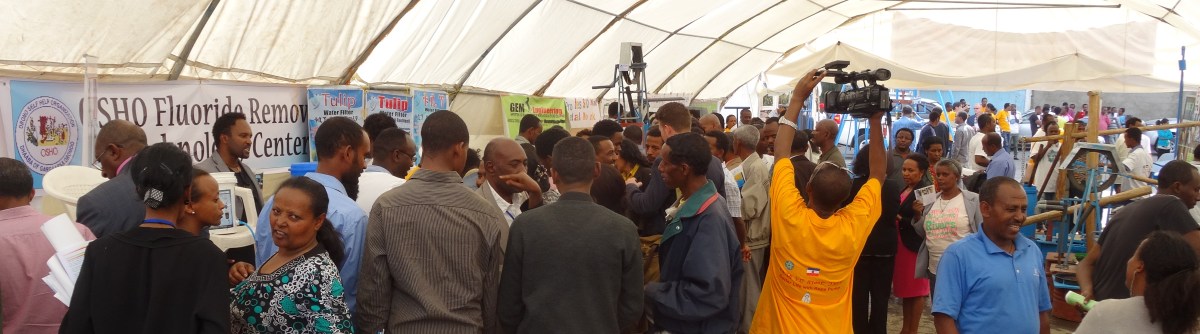
As part of the celebration of the World Water Day 2015 the rural water sector in Ethiopia organized a 3-day event on Self-supply (19th – 21st March) including a trade fair for producers of Self-supply technology and a 2-day seminar with inputs from international and national speakers. The fair hosted more than 20 local suppliers and producers which allowed potential clients to check technologies in detail, to speak to suppliers and compare products for e.g. water lifting, drilling, water treatment.

Suppliers were invited to to market themselves by giving a 3-minutes pitch to the public. A panel of experts gave feedback so that the brave pitchers could improve on their promotion in the future.

In the international seminar on 20th March, experiences from other countries on accelerating Self-supply were shared as well as the information on steps taken so far to roll out Self-supply in Ethiopia including linkages to small scale agriculture and the multiple use concept.

WHO presented results from various studies on water quality analysis of samples from improved and unimproved sources.It became obvious that the concept of improved/unimproved sources is not good for indicator of safe water supply. This perception was so far one of the key challenges addressed to accept Self-supply.

In the future WHO recommends enforcing its concept of Water Safety Plans and clearly promoted household water treatment for any water used for drinking water in rural areas. The Ethiopian water sector will develop ideas on how to establish and follow up water safety plans in Ethiopia which fit to the Self-supply context.

To attract more people similar fairs are planned for other towns in Ethiopia in the near future.

All slides of the international seminar on Self–supply (20th March) and some photos of the fair will be uploaded on the RWSN website.

My Water, My Business

activities as part of World Water Day 2015 events, 19-20 March 2015, Addis Ababa

Sustainable development of water requires fresh thinking and new innovation. Ethiopia is pioneering new approaches in water, sanitation and hygiene (WasH) that draw upon the resources of local people, communities and entrepreneurs to further improve water security, food security and wealth. ‘My Water, My Business’ is a series of linked events organised as part of the 2015 World Water Day celebrations to bring attention to these household-level efforts. The events will connect sector policy-makers, development partners, professionals and engaged local governments and communities. The overall message is that to complement the efforts of utilities, woredas and other traditional service providers, households can do a lot themselves to improve their water and sanitation facilities and related hygiene practices. You can improve your own water supply, sanitation and hygiene.

WaSH product fair starts Thursday 19 March

Continue reading “My Water, My Business”

RWSN Programme News – March 2015

UPGro – Unlocking the Potential of Groundwater for the Poor

UPGro – Unlocking the Potential of Groundwater for the Poor

Knowledge Brokers: Sean Furey, Kerstin Danert, Richard Carter, Bertha Camacho

UPGro – Unlocking the Potential for Groundwater for the Poor is seven year research programme that takes a social and natural science approach to enabling sustainable use of groundwater for the benefit of the poor. During 2013-14 there were 15 ‘Catalyst’ projects that are one year studies. This year a five ‘Consortium’ projects will get underway for the following 4-5 years. UPGro is funded by the United Kingdom through the Natural Environmental Research Council (NERC), the Economic and Social Research Council (ESRC) and the Department for International Development (DFID).

What happens when the wells run dry?

In the science journal, Nature, Professor Richard Taylor of the GroFutures UPGro project challenged readers to take groundwater depletion seriously put the case for why we need better science to understand complex recharge processes – before it is too late. His words echo that the World Economic Forum who place the Water Crisis as the number one risk, in terms of impact, facing the world today, and one of the most likely to occur.

Analysing groundwater storage changes in Benin & Burkina Faso

The Chronicles Consortium – a network of scientists collating and analysing multi-decadal groundwater-level records from across Africa under UPGro Groundwater Atlas with support from IRD – held a 3-day workshop from the 9th to 11th of February at the Laboratory of Applied Hydrology of the University of Abomey-Calavi (Benin) to examine long-term records of groundwater levels in Benin & Burkina Faso. Led by Professor Richard Taylor (UCL), Professor Moussa Boukari (University of Abomey-Calavi) and Dr. Jean-Michel Vouillamoz (IRD), participants included scientists from Burkina Faso (Dr. Youssouf Koussoubé, University of Ouagadougou) and Benin (Dr. Henri Totin, University of Parakou) as well as post-graduate students from the University of Abomey-Calavi.

The workshop focused on the use of long-term groundwater-level records (chronicles) to assess the responses of groundwater systems to climate variability and human activity (e.g. abstraction, land-use change, dam construction) in different aquifer environments and climate regimes. Key activities of the workshop included: (i) installation of automated water and air pressure dataloggers to enable high-frequency monitoring of groundwater storage responses, (ii) the evaluation of errors in long-term chronicles, and (iii) quantification of groundwater storage and discharge from recessionary trends in these chronicles. The chronicles provided excellent foci for critical discussion of current conceptual models of the operation of groundwater systems in Benin and Burkina Faso. Dr. Vouillamoz also presented new field determinations of groundwater storage co-efficients from the EU-GRIBA project to enable the quantification of groundwater storage changes from the chronicles.  The Chronicles Consortium plans to report on new evidence from collated long-term records and high-frequency monitoring at the 41st IAH Congress in Rome.

UPGro invited by UNICEF to present at the UN Zaragoza Conference

The UN-Water Annual Zaragoza Conferences serve UN-Water to prepare for World Water Day, which in 2015 will focus on “water and sustainable development” and celebrated the end of the International Decade for Action ‘Water for Life’, so it was especially important for taking stock of and learning from achievements as well as planning the next steps. In the theme “Academia contribution to the implementation of the Sustainable Development Goals related to water” on the 16th January, the was a session titled “Water, Sanitation and Hygiene (WASH): Tools for WASH implementation from an equity lens”, led by Jose Gesti-Canuto, with short presentations by three UPGro collaborators: John Chilton (IAH, Hidden Crisis), Sharon Velasquez-Orta (University of Newcastle, IN-GROUND) and Fabio Fussi (University of Milano-Bicocca, Remote Sensing for Manual Drilling)

Read more and find the presentations on the UPGro website

ODI event in London stirs up the groundwater debate

The Overseas Development Institute (ODI) hosted a 1-day event, just as the last RWSN newsletter was going to press. The day was packed with great presentations and discussion, not just from the UPGro researchers also much wider sharing about the role of groundwater science and knowledge management in tackling deeply ingrained poverty. Video recordings of the event are now available online on the ODI website.

New UPGro Publications

Publications, reports, papers and presentations from the UPGro studies can be found on the upgro.org website.

RAIN – Rainwater harvesting for rural water supply and food security

Co-ordinators: Robert Meerman (meerman @ rainfoundation.org), Hans Merton (hans @ merton.nl). Join the rainwater harvesting community on Dgroups: dgroups.org/rwsn/rainwater  and follow on twitter at @rainwater4food.

Event: Symposium on Rainwater Harvesting in Ethiopia

RAIN are proud to inform you that in collaboration with SEARNET and AFRHINET, we will organise an international symposium on: ‘Unlocking the potential of rainwater with adaptive strategies and impacts for upscaling the technology’

1-12 June 2015 – Addis Ababa, Ethiopia

In this symposium rainwater harvesting (RWH) will be assessed from three angles: Policy, Know-how and Training. The Policy angle will engage stakeholders from governments and INGOs and discuss how to incorporate RWH in policy frameworks, projects and programmes. The Know-how angle will gather academics and practitioners in writing about their projects and research. Finally, a practical training will take place most probably in the Dire Dawa area, which will focus on practicalities and discussions on various RWH/3R technologies.

Dates

High Level Policy Discussions: 1st – 2nd June 2015

Write-shop: 3rd – 5th June 2015

Practical Training: 8th – 12th June 2015

Information and registration

More information and details will come soon – but please find the first announcement here. We are looking forward to seeing you there – registration is now open!

Implementation: RAIN is expanding to Latin America

The ‘dry corridor’, that covers most of Honduras’ southern region, is highly vulnerable to climate change. Small-scale farmer families of the region depend on the availability of natural resources. However, they are the ones mostly affected by prolonged dry spells and water scarcity. This leads to a progressive increase in both the severity and the number of families affected by food insecurity. Remedy for these areas often stagnates, due to Honduras’ weak institutional structure, an elevated poverty rate and a high-risk security situation.
The Program for Communal Watershed Management of the Goascoran catchment (‘Programa de Gestion Comunitaria de Cuenca – PGCC’) seeks to alleviate this situation with:

  • Adequate Climate Change Adaptation and Disaster Risk Reduction measures and
  • Strengthening local governance structures for integrated catchment management.

The Swiss development Cooperation (SDC) chose a Consortium, comprised of IUCN, iDE, FUNDER and RAIN to act as a Facilitator in this change-process. The Goal is to empower communities to face more extreme weather conditions by improved resilience to climate change and better living conditions of the inhabitants of the Goascoran basin. This will be achieved through enhanced production capacities: introducing effective irrigation schemes, water harvesting techniques and better market access, for an institutionally backed sustainable use of natural resources. RAIN will provide monitoring and evaluation of the project, knowledge management and communication and technical advice on 3R (water recharge, retention, reuse) and MUS.
You can read more on “Crop and income diversification via rainwater reservoirs and drip irrigation and for smallholder farmers in Honduras” in Marai El Fassi’s blog.

Implementation: 3R – Recharge, Retention and Re-use

WUMP+3R, Nepal

HELVETAS Swiss Intercooperation Nepal, co-funded by RAIN, is implementing a program on the so-called WUMP (Water Use Master Plan) and 3R (Recharge, Retention and Re-use) in several villages in Dailekh district. The multiple year program includes the development and implementation of local water management plans including WASH, which are developed in close collaboration with the local government and communities. Due to the efforts of HELVETAS, Dullu was declared Open Defecation Free (ODF) on December 31 2014. For more information, please read the project update here. Another project update of HELVETAS Swiss Intercooperation Nepal of the project in Paduka can be found here.

3R in Bahasa, Indonesia

Timor Tengah Selatan, on the island of Timor is one of the most water stressed areas of the Indonesia.  On the 3rd November 2014 in So’e, 60 people gathered at the government office to discuss the need for Recharge (Mengisi Kembali), Retention (Penyimpanan) and Re use (Penggunaann Kembali) of water. Maarten Onneweer of RAIN presented the results of a project implemented earlier that year by Bina Swadaya Konsultans and used this as example on how to integrate 3R in the projects of the Partners for Resilience Alliance in Indonesia.
Bina Swadaya Konsultans implemented a number of cost effective water harvesting technologies, adapted to the local situation and making use of locally available materials. These interventions followed from an earlier advisory mission of RAIN end of 2013. Results could already be seen and the overall enthusiasm for 3R had definitely increased. Organisations are now translating relevant parts of the book “Water harvesting, guidelines to good practices” in Bahasa to support their technical staff. You can read the full news item here.

Publications

Rainwater Harvesting: harnessing the storm Briefing Note on the RAIN-RWSN webinar series 2014 (S. Furey, 2014)