
Equality, Non-Discrimination and Inclusion (ENDI)
Join at: dgroups.org/RWSN/equality_rwsn
Theme Leaders: Louisa Gosling, WaterAid (LouisaGosling @ wateraid.org)
Jane Wilbur, WaterAid (janewilbur @wateraid.org)
Join at: dgroups.org/RWSN/equality_rwsn
Theme Leaders: Louisa Gosling, WaterAid (LouisaGosling @ wateraid.org)
Jane Wilbur, WaterAid (janewilbur @wateraid.org)
À la demande générale, nous avons programmé une nouvelle série passionnante de wébinaires en ce début 2015. Ils auront lieu tous les mardi du 27 janvier au 31 mars inclus.
Back by popular demand, we have an exciting new series of webinars for early 2015, every Tuesday from 27 January to 31 March.
Plusieurs wébinaires sur la collecte des eaux de pluie sont également en cours de programmation par le RWSN et le Canal de l’Eau (TheWaterChannel) – nous vous tiendrons régulièrement informé(e)s à ce sujet.
There will also be more webinars on rainwater harvesting from RWSN and TheWaterChannel – look out for further announcements.
Continue reading “WÉBINAIRES – DÉBUT 2015: INSCRIVEZ-VOUS! WEBINARS – EARLY 2015: REGISTER NOW”
reblogged from www.rain4food.net
by Hans Merton, RAIN/Akvo
Mid 2013 we launched our Community of Practice on Rainwater Harvesting as a part of the Rainwater Harvesting for food Security programme, so with 1,5 year on the road it’s about time to look back and more important: where should we be heading to?
Where are we?
Continue reading “Our Rainwater Harvesting Community of Practice: towards our 2nd anniversary and beyond”

RWSN is not a formal organisation, more of a shared idea. In 1992, the network was founded as the Handpump Technology Network (HTN) with a narrow focus on…. handpump technology. 22 years on, and this small group of engineers from the Water & Sanitation Program of the World Bank, UNICEF, Skat and the Swiss Agency for Development and Cooperation (SDC) has become a much bigger family.
As of this morning we have 6,301 individual members, 23 RWSN Member Organisations (the newest are Yobe State Rural Water Supply and Sanitation Agency, Nigeria and the German-based NGO, Welthungerhilfe) and we have an active team of thematic leaders from Skat, WaterAid and IRC as well as a tremendously supportive Executive Committee.
So where now?

by Dr Kerstin Danert, Skat Foundation
In Lagos, a city of over 17 million people, water demands are mainly being met from tapping the groundwater that lies beneath the city. Boreholes provide water directly at people’s homes or business premises. Borehole construction is being paid for by householders and businesses themselves. Water vendors, selling water in jerry cans or trucks are also prolific. Given the limited reach of the piped infrastructure, much of the water vended is likely to also originate from below ground. In fact, exploitation of the large, relatively shallow aquifers that lie below Lagos is one of the main reasons that the city can continue to grow at all.
Continue reading “Manually Drilled Wells: Providing water in Nigeria’s Megacity of Lagos and beyond”

 The WASHTech Consortium is organising a webinar to introduce the WASHTech’s tools and launch the online resource base
Wednesday 11 December, 12.30-13.30 pm CET
Register here
Background
This webinar introduces two new tools that will help to select water, sanitation and hygiene (WASH) technologies that keep working. The first, the Technology Applicability Framework (TAF), has been extensively tested and is now available on www.washtechnologies.net. A second, complementary tool, the Technology Introduction Process (TIP) provides guidance on the roles and activities needed for successful scaling up of technologies.
The TAF manual, questionnaires, Technology Introduction Process guidelines and other key publications are provided as public domain and can be accessed through www.washtechnologies.net. This resource base also provides a platform for sharing experiences on the application of the TAF after completion of the WASHTech project in December 2013.
Programme
View original post 53 more words

This year I was fortunate enough to attend the ‘Water & Health Conference’ at UNC, North Carolina, USA again. I was running a side event on WASHTech, and my partner in crime was Andrew Armstrong, Water Missions’ community development programs manager who gave a great presentation on the experiences of Water Missions in introducing solar water pumping and water pre-payment systems in Uganda.
On Monday 21st October, after the conference, I was in Charleston, South Carolina, standing in large a naval dockyard surrounded by towering steel cranes and fat oil depot tanks. On one side of the sparse car park was a sizeable array of solar panels and opposite was long, low warehouse on which the name “Water Missions International” was emblazoned in precise, blue lettering.
I was shown around the Water Missions International facility by Andrew. There are 27 staff based in this location and numerous volunteers. The building acts an office, workshop, storage area and display area, the latter being open to groups to visit and find out about their work.
Water Missions was created in 1998 in the wake of Hurricane Mitch, which devastated much of Central America, particularly Honduras and Nicaragua. After running operations out of their environmental engineering firm for a few years, the founders sold their company in 2001 and set up the charity and today they work in Belize, Indonesia, Malawi, Mexico, Uganda, Haiti, Kenya, Tanzania, Peru and Honduras.
Continue reading “Visit to Water Missions – Deep South Innovators”
also visit the new TAF website: http://www.washtechnologies.net

A few months remain before the end of the WASHTech project in Burkina Faso. The project team composed of the Burkina Faso Offices of Intergovernmental Panafrican agency Water and Sanitation for Africa (WSA) of Water-Aid and IRC, steps on the accelerator to finalize the remaining activities before the end of the project in December 2013.
Among the key activities at the end of the project, there’s the organization of a national training workshop for actors in the WASH sector that will be driven by the the Department of Studies and Information one Water (DEIE). The objective of this workshop is to present the achievements of the project including tools Technology Assessment Framework (TAF) Technology Introduction Process (TIP) and strengthen their capacity to use these tools. The impacts of the project in Burkina Faso after three years of implementation will be presented. This national workshop is scheduled to take place in…
View original post 372 more words
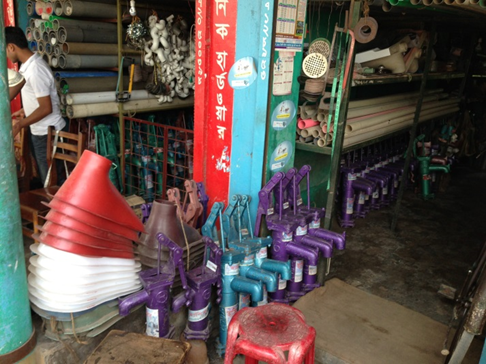
by Jonathan Annis is a sanitation and innovation specialist with the USAID-funded WASHplus project (www.washplus.org). His views do not represent those of USAID or the U.S. Government.
I recently traveled to southeastern Bangladesh to support WASHplus’s local implementing partner WaterAid as it begins a multi-year project in the coastal belt. The coastal belt is a marshy delta formed by Himalayan sediments transported thousands of miles by an extensive river network that settle as they reach the Bay of Bengal. Surface water is ubiquitous, and flooding—from tidal flows, excessive rainfall, or cyclones—is an annual event. I had never been in an environment so waterlogged. Continue reading “Self-Supply at Scale: Lessons from rural Bangladesh”
EMAS has been promoting low cost technologies for rural water supplies in Bolivia for over 30 years – with considerable success. EMAS technologies comprise manually drilled wells, a locally fabricated pump and rainwater harvesting technologies. EMAS are combining low-cost water supply solutions with a relatively high level of service at the household. Today RWSN publishes an independent assessment of the EMAS technologies. The authors, from the University of South Florida, undertook surveys, semi-structured interviews, sanitary inspections and functionality tests in 86 households.
Please visit http://www.rural-water-supply.net/fr/ressources/details/518 to download the publication.
EMAS is the Spanish acronym of the Mobile Water & Sanitation School in Bolivia. An organisation established, and run by Wolfgang Buchner for over 30 years. EMAS technologies are counted as contributing to the MDGs and SENSABA; the Bolivian national government agency responsible for rural water supply is a proponent of household water supply technologies in rural areas. Bolivia has a history of developing low-cost water supply technologies, particularly manual driller and handpumps. In fact, an estimated 20,000 manual drillers well systems are being used throughout the country.
The flexi-pump is a simple design comprising PVC, glass play marbles and rubber, thus allowing it to me fabricated by local technicians. The fact that the pump can collect water from significant depths to a tank above the ground is a key selling point. It is meant one to 6 families. The pump is reported to cost US$ 30 to 45 (excluding the drilling). As you start to ask questions about its longevity, the research found that only one of the pumps of the 79 surveyed was non-operational. It was noted that after 11 years of operation, some pumps were working less than optimally. Repairs can and are undertaken locally. Some people prefer the Baptist pump due to its higher flow rates.
Manual drilling comprises a combination of techniques, and can be undertaken by trained technicians. Relatively small diameters are drilled, and a polyester sleeve/sock is used to prevent fine materials from entering the pump. The researchers observed that the techniques were widely used by small business, with Reyes as an example of a small rural town where most of the population has a manually drilled borehole in their yard. Here, the drillers charge US$ 140 for drilling and completing a 15m well, including the EMAS or a similar pump. Although EMAS promotes the installation of an apron, many wells observed did not have this installed. Of the 75 wells surveyed, 73 were reliable, providing water for 12 months of the year
EMAS rainwater harvesting systems comprise below-ground or above ground storage tanks. Various sizes up to 7,000 litres are promoted. The below ground tanks use a cement sand mortar mix, whereas the above ground tanks are ferro-cement. Uptake to date has been rather limited, although the technology is now catching on in Cachilaya after several years of promotion.
In terms of finance, 63% of the systems surveyed were paid for fully by the households; 5% sing loans and 28% with partial subsidies from an implementing agency or local government. There are places, such as Somopai where poor families apparently cannot afford the wells. However, this is a topic which could be explored and researched further; to understand the reasons and options for such families. There are examples of labour exchange rather than cash payment for well construction.
EMAS has trained technicians from all over Bolivia in these technologies, and runs regular training courses, which can also be attended by people from overseas. EMAS has moved beyond Bolivia’s borders to other Central and Latin American countries, Africa and Asia. EMAS support typically consists of supporting in-country groups and organisations with training. However, technician training needs to be accompanied by promotion of the news technologies in order to bring about their adoption.
“Added value” is at the core of the EMAS concept. This means that water users can have a much higher level of service than they would with a community supply. Water is piped into taps in the house, and people can even have a shower and solar-heated water. How is this possible, you may ask? Well, the EMAS manual pump is able to lift water from below ground and up into an overhead tank, from which it can be distributed throughout the homestead. As people become accustomed to a high level of service, they are more likely to fix it when something breaks. The analogy with electricity supply is a good one – when you only use it for light you may just revert to a lantern when it stops working. However if the electricity is used also for a fridge, television and computer, which you are used to, you are more likely to value it and do something if the power fails. Not all households surveyed had chosen the added value option, but they have access to volumes of water within their homestead.
If you want to learn more about EMAS, please contact Wolfgang Buchner on: emasinternational@yahoo.es or visit http://www.emas-international.de/index.php?id=32&L=3
To learn more about the research, you can contact: Mike MacCarthy on mmaccarthy@mail.usf.edu
Should you wish to share your comments about the EMAS approach with other RWSN members, you can do so through the appropriate RWSN online discussion forum, e.g.:
Wishing you a productive and enjoyable weekend!

 Rural Water Supply Network - blog