a new phase of RWSN is on the way…..

2015 Theme Icons

RWSN is not a formal organisation, more of a shared idea. In 1992, the network was founded as the Handpump Technology Network (HTN) with a narrow focus on…. handpump technology. 22 years on, and this small group of engineers from the Water & Sanitation Program of the World Bank, UNICEF, Skat and the Swiss Agency for Development and Cooperation (SDC) has become a much bigger family.

As of this morning we have 6,301 individual members, 23 RWSN Member Organisations (the newest are Yobe State Rural Water Supply and Sanitation Agency, Nigeria and the German-based NGO, Welthungerhilfe) and we have an active team of thematic leaders from Skat, WaterAid and IRC as well as a tremendously supportive Executive Committee.

So where now?

Continue reading “a new phase of RWSN is on the way…..”

World Water Day – Is the Hand-pump dead?

WS13_Eritrea_25
Broken India Mk II in Eritrea (Skat)

In this short blog series on the successes of India Mark II, Afridev and Bush Pumps, however the challenges and set-backs that were encountered by these designs shouldn’t be discounted. Nor should it be overlooked that there are also successful proprietary designs, and self supply options like the EMAS Pump and the Rope Pump. However it is worth highlighting the heroic efforts of those people from all the different countries and organisations and what they achieved for rural water supplies worldwide.

In today’s debate, the humble hand-pump gets the part the villain: the rusting carcass in the corner of too many villages, or the subject of frightening statistics about how many are probably not in use at any one time, and how long they are out of service for. Many of the problems, framed in that weaselly catch-all “sustainability” have remained – doggedly – since the 1970s and before: pump manufacturing quality is often poor, boreholes are drilled badly, supply chains for spare parts fail, pump mechanic skills are lost, not enough money is collected to pay for the maintenance and replacement costs.

Continue reading “World Water Day – Is the Hand-pump dead?”

How three handpumps revolutionised Rural Water Supplies: the Zimbabwe Bush Pump

The Bush Pump has been serving the people of Zimbabwe for 80 years.How Three Handpumps Revolutionised Rural Water Supplies

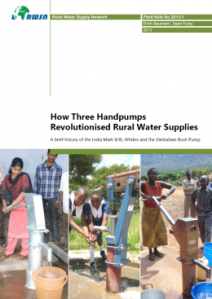
In the new publication “How Three Handpumps Revolutionised Rural Water Supplies” from RWSN, Erich Baumann explains how three handpumps, the India Mark II, the Afridev, and the Zimbabwe Bush Pump were developed and Sean Furey explores what lessons can be learned for scaling up WASH technologies today.

Unlike other handpumps used across the world, the Bush Pump has a long history. It was born in Zimbabwe in 1933, and designed by Tommy Murgatroyd, a Government Water Supply Officer in Matabeleland. Murgatroyd established the basic components of all later Bush Pumps – a wooden block, a strong pump stand and heavy-duty components.
Continue reading “How three handpumps revolutionised Rural Water Supplies: the Zimbabwe Bush Pump”

How three handpumps revolutionised Rural Water Supplies: the Afridev

1980 to 1990 was the International Decade of Water Supply and Sanitation and the greatest hand-pump project began.How Three Handpumps Revolutionised Rural Water Supply

In the new publication “How Three Handpumps Revolutionised Rural Water Supplies” from RWSN, Erich Baumann explains how three handpumps, the India Mark II, the Afridev, and the Zimbabwe Bush Pump were developed and Sean Furey explores what lessons can be learned for scaling up WASH technologies today.

As part of that UNDP and the World Bank established a joint Water & Sanitation Program (WSP, which still exists as part of the World Bank) and one of its flagship projects was the Hand-pump Project, led by Saul Arlosoroff, which rigorously tested all the hand-pumps around the world that they could get their hands on. Their final report “Community Water Supply: the Hand pump Option” (1987) is still the defining text in hand-pump literature.

The hand-pump project also defined Village Level Operation & Maintenance (VLOM), the concept of making hand-pumps easier to maintain by the users so that minor breakdowns could be repaired quickly.  The India Mark II was not a VLOM pump because it required specialist tools and some skill and strength to make repairs to the pump cylinder down in the borehole. This was addressed through a design revision, imaginatively called the India Mark III. However the hand-pump team throught they could still do better and so two handpump design projects began.

Continue reading “How three handpumps revolutionised Rural Water Supplies: the Afridev”

How three handpumps revolutionised Rural Water Supplies: the India Mark II

How Three Handpumps Revolutionised Rural Water Supply1974: UNICEF reviewed their water supply programme in India. The results were shocking: of the tens of thousands of wells drilled over the previous seven years, 75% were not supplying water.

In the new publication “How Three Handpumps Revolutionised Rural Water Supplies” from RWSN, Erich Baumann explains how three handpumps, the India Mark II, the Afridev, and the Zimbabwe Bush Pump were developed and Sean Furey explores what lessons can be learned for scaling up WASH technologies today.

In the mid 1960s, drought ravaged India, and the Government of India asked UNICEF for help with improving access to water through borehole drilling. In the following years, the emergency drilling campaign evolved into a broader national programme to improve rural water supplies, but the attention was focused on the drilling and the boreholes. No one gave the hand-pumps that went on them much thought. That all changed in 1974.

Continue reading “How three handpumps revolutionised Rural Water Supplies: the India Mark II”