Self-Supply at Scale: Lessons from rural Bangladesh

Image
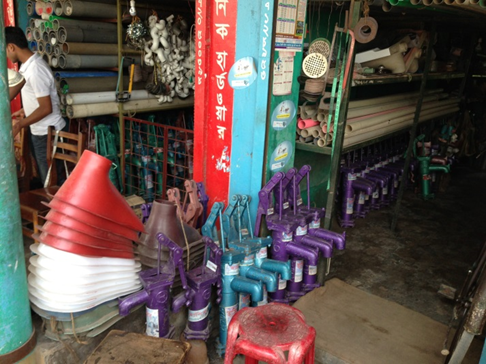
Shops like this one satisfy local demand for new pumps and replacement parts. Pumps, like ipods, come in a range of colors! (photo: J. Annis, 2013)

by Jonathan Annis is a sanitation and innovation specialist with the USAID-funded WASHplus project (www.washplus.org). His views do not represent those of USAID or the U.S. Government.

I recently traveled to southeastern Bangladesh to support WASHplus’s local implementing partner WaterAid as it begins a multi-year project in the coastal belt. The coastal belt is a marshy delta formed by Himalayan sediments transported thousands of miles by an extensive river network that settle as they reach the Bay of Bengal. Surface water is ubiquitous, and flooding—from tidal flows, excessive rainfall, or cyclones—is an annual event. I had never been in an environment so waterlogged.   Continue reading “Self-Supply at Scale: Lessons from rural Bangladesh”

World Water Day – Is the Hand-pump dead?

WS13_Eritrea_25
Broken India Mk II in Eritrea (Skat)

In this short blog series on the successes of India Mark II, Afridev and Bush Pumps, however the challenges and set-backs that were encountered by these designs shouldn’t be discounted. Nor should it be overlooked that there are also successful proprietary designs, and self supply options like the EMAS Pump and the Rope Pump. However it is worth highlighting the heroic efforts of those people from all the different countries and organisations and what they achieved for rural water supplies worldwide.

In today’s debate, the humble hand-pump gets the part the villain: the rusting carcass in the corner of too many villages, or the subject of frightening statistics about how many are probably not in use at any one time, and how long they are out of service for. Many of the problems, framed in that weaselly catch-all “sustainability” have remained – doggedly – since the 1970s and before: pump manufacturing quality is often poor, boreholes are drilled badly, supply chains for spare parts fail, pump mechanic skills are lost, not enough money is collected to pay for the maintenance and replacement costs.

Continue reading “World Water Day – Is the Hand-pump dead?”

How three handpumps revolutionised Rural Water Supplies: the Zimbabwe Bush Pump

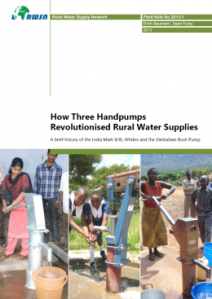
The Bush Pump has been serving the people of Zimbabwe for 80 years.How Three Handpumps Revolutionised Rural Water Supplies

In the new publication “How Three Handpumps Revolutionised Rural Water Supplies” from RWSN, Erich Baumann explains how three handpumps, the India Mark II, the Afridev, and the Zimbabwe Bush Pump were developed and Sean Furey explores what lessons can be learned for scaling up WASH technologies today.

Unlike other handpumps used across the world, the Bush Pump has a long history. It was born in Zimbabwe in 1933, and designed by Tommy Murgatroyd, a Government Water Supply Officer in Matabeleland. Murgatroyd established the basic components of all later Bush Pumps – a wooden block, a strong pump stand and heavy-duty components.
Continue reading “How three handpumps revolutionised Rural Water Supplies: the Zimbabwe Bush Pump”

How three handpumps revolutionised Rural Water Supplies: the Afridev

1980 to 1990 was the International Decade of Water Supply and Sanitation and the greatest hand-pump project began.How Three Handpumps Revolutionised Rural Water Supply

In the new publication “How Three Handpumps Revolutionised Rural Water Supplies” from RWSN, Erich Baumann explains how three handpumps, the India Mark II, the Afridev, and the Zimbabwe Bush Pump were developed and Sean Furey explores what lessons can be learned for scaling up WASH technologies today.

As part of that UNDP and the World Bank established a joint Water & Sanitation Program (WSP, which still exists as part of the World Bank) and one of its flagship projects was the Hand-pump Project, led by Saul Arlosoroff, which rigorously tested all the hand-pumps around the world that they could get their hands on. Their final report “Community Water Supply: the Hand pump Option” (1987) is still the defining text in hand-pump literature.

The hand-pump project also defined Village Level Operation & Maintenance (VLOM), the concept of making hand-pumps easier to maintain by the users so that minor breakdowns could be repaired quickly.  The India Mark II was not a VLOM pump because it required specialist tools and some skill and strength to make repairs to the pump cylinder down in the borehole. This was addressed through a design revision, imaginatively called the India Mark III. However the hand-pump team throught they could still do better and so two handpump design projects began.

Continue reading “How three handpumps revolutionised Rural Water Supplies: the Afridev”

How three handpumps revolutionised Rural Water Supplies: the India Mark II

How Three Handpumps Revolutionised Rural Water Supply1974: UNICEF reviewed their water supply programme in India. The results were shocking: of the tens of thousands of wells drilled over the previous seven years, 75% were not supplying water.

In the new publication “How Three Handpumps Revolutionised Rural Water Supplies” from RWSN, Erich Baumann explains how three handpumps, the India Mark II, the Afridev, and the Zimbabwe Bush Pump were developed and Sean Furey explores what lessons can be learned for scaling up WASH technologies today.

In the mid 1960s, drought ravaged India, and the Government of India asked UNICEF for help with improving access to water through borehole drilling. In the following years, the emergency drilling campaign evolved into a broader national programme to improve rural water supplies, but the attention was focused on the drilling and the boreholes. No one gave the hand-pumps that went on them much thought. That all changed in 1974.

Continue reading “How three handpumps revolutionised Rural Water Supplies: the India Mark II”

Realities of water well drilling in Africa: e-discussion highlights so far

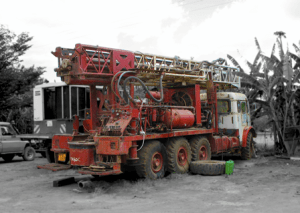
RWSN is currently hosting a 3 week discussion on ‘Cost Effective Boreholes’ as part of our Sustainable Groundwater Development Theme.  Here are some highlights so far:

It is very interesting to read the inputs so far from Kenya, Zambia, Sudan, Nigeria, Ethiopia and Uganda.

From the discussions so far, it seems that the Kenya and Ethiopia have established regulatory frameworks for water well drilling (thanks Chrispine and Tesfaye). In the Kenyan case, government regulation, which is limited by capacity constraints is augmented by the monitoring of activities by the drillers association. It will be interesting to hear more on this from Chrispine and others in Kenya. In contrast Zambia (thanks Daniel) lacks any regulation with respect to groundwater resources. There is thus no registration of boreholes in the country whatsoever and even drilling records must not be collected. Although a water resources management act was passed in Zambia 2011 it still awaits launch and implementation. Perhaps there are also others with ideas for Zambia. In Sudan, we hear from Harm Bouta about a very fragmented drilling sector with no strict regulations in place, but that there are other initiatives taking place in Sudan from which we could learn more.
Continue reading “Realities of water well drilling in Africa: e-discussion highlights so far”

Boreholes and trees – why drilling supervision matters

by Professor Richard Carter, Chair of RWSN [1]

About 1 billion people in rural areas rely on boreholes (mostly fitted with handpumps) for their water supply. Another 300 million in small towns and cities get their domestic water from boreholes.[2]

Image
(c) RWSN/Skat

What is a borehole?

Someone [3] once defined a tree as “a big plant with a stick up the middle”. Using this analogy, a borehole is “a long thin hole in the ground which produces water”. But of course just as trees are a bit more complicated than the definition would suggest, and just as trees come in all shapes and sizes, so too boreholes are more than ‘long thin holes …’. No two boreholes are quite the same.

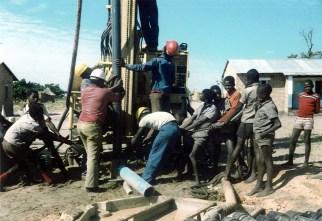
If I wish to plant a tree and get fruit or timber from it sometime in the future, then I need to choose the right species, plant it in the right place, and nurture it until it becomes established. So too if I want to construct a borehole which will deliver clean water over both the short-term and the long-term, I need to choose its location with care, design it properly and ensure that it is drilled and finished straight and true.

Continue reading “Boreholes and trees – why drilling supervision matters”