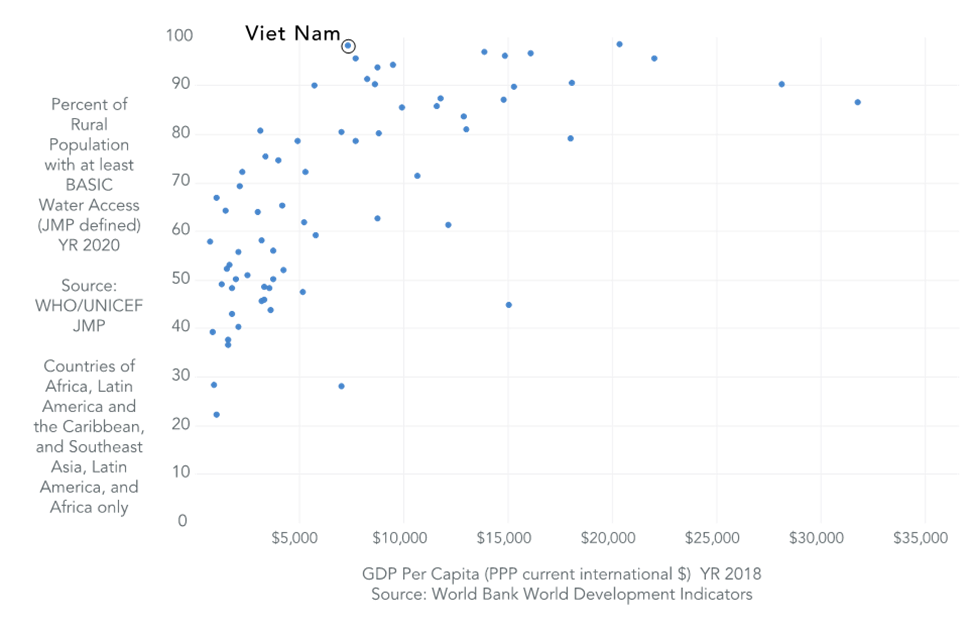
As of 2020, Vietnam had the highest levels of rural water coverage among any country of comparable economic level, with coverage equivalent to countries with two to three times its per capita Gross Domestic Product (GDP). We were curious: what was the contribution to this success by the billion dollar Asian Development Bank Water Sector Investment Fund (“the Fund”)?
de USAID Global Waters. La RWSN es miembro del consorcio de investigación REAL-Water
En 2020, Vietnam contaba con los niveles más altos de cobertura de agua rural entre cualquier país de nivel económico comparable, con una cobertura equivalente a la de países con dos o tres veces su Producto Interior Bruto (PIB) per cápita. Sentimos curiosidad: ¿cuál fue la contribución a este éxito del Fondo de Inversión en el Sector del Agua del Banco Asiático de Desarrollo, dotado con mil millones de dólares (“el Fondo”)?
Para responder a esta pregunta, invitamos a Hubert Jenny, antiguo miembro del Banco Asiático de Desarrollo (BAD) y actual consultor de UNICEF, a una conversación en el podcast de REAL-Water (disponible en inglés en Anchor, Spotify, y Apple Podcasts, entre otras plataformas).
As of 2020, Vietnam had the highest levels of rural water coverage among any country of comparable economic level, with coverage equivalent to countries with two to three times its per capita Gross Domestic Product (GDP). We were curious: what was the contribution to this success by the billion dollar Asian Development Bank Water Sector Investment Fund (“the Fund”)?
En 2020, le Vietnam avait les niveaux les plus élevés de couverture en eau en milieu rural parmi tous les pays de niveau économique comparable, avec une couverture équivalente aux pays ayant deux à trois fois son produit intérieur brut (PIB) par habitant. Nous étions curieux : quelle a été la contribution à ce succès du Fonds d’investissement pour le secteur de l’eau de la Banque asiatique de développement (“le Fonds”), doté d’un milliard de dollars ?
Pour répondre à cette question, nous avons invité Hubert Jenny, anciennement de la Banque asiatique de développement (ADB) et maintenant consultant pour l’UNICEF, pour une conversation sur le podcast REAL-Water (disponible en anglais sur Anchor, Spotify, and Apple Podcasts, parmi d’autres plateformes).
As of 2020, Vietnam had the highest levels of rural water coverage among any country of comparable economic level, with coverage equivalent to countries with two to three times its per capita Gross Domestic Product (GDP). We were curious: what was the contribution to this success by the billion dollar Asian Development Bank Water Sector Investment Fund (“the Fund”)?
from USAID Global Waters. RWSN is a member of the REAL-Water research consortium
As of 2020, Vietnam had the highest levels of rural water coverage among any country of comparable economic level, with coverage equivalent to countries with two to three times its per capita Gross Domestic Product (GDP). We were curious: what was the contribution to this success by the billion dollar Asian Development Bank Water Sector Investment Fund (“the Fund”)?
To answer this question, we invited Hubert Jenny, formerly of the Asian Development Bank (ADB) and now consulting for UNICEF, for a conversation on the REAL-Water podcast (available on Anchor, Spotify, and Apple Podcasts, among other platforms).
An estimated 50% of the global and 75% of the African population rely on groundwater for their drinking water supplies. This is likely to increase in the future, especially in the face of climate change.
Drilled water wells are vital to achieving universal, clean drinking water, with the sources safe, affordable, reliable and available. Services also need to be constructed in order to last. To achieve this, water wells, or boreholes must be drilled, developed and completed in a professional manner. Key elements of a professional drilling sector are procurement, contract management, siting, borehole design, construction, and supervision. Water resources must also be considered and long-term support is required to maintain water supply services.
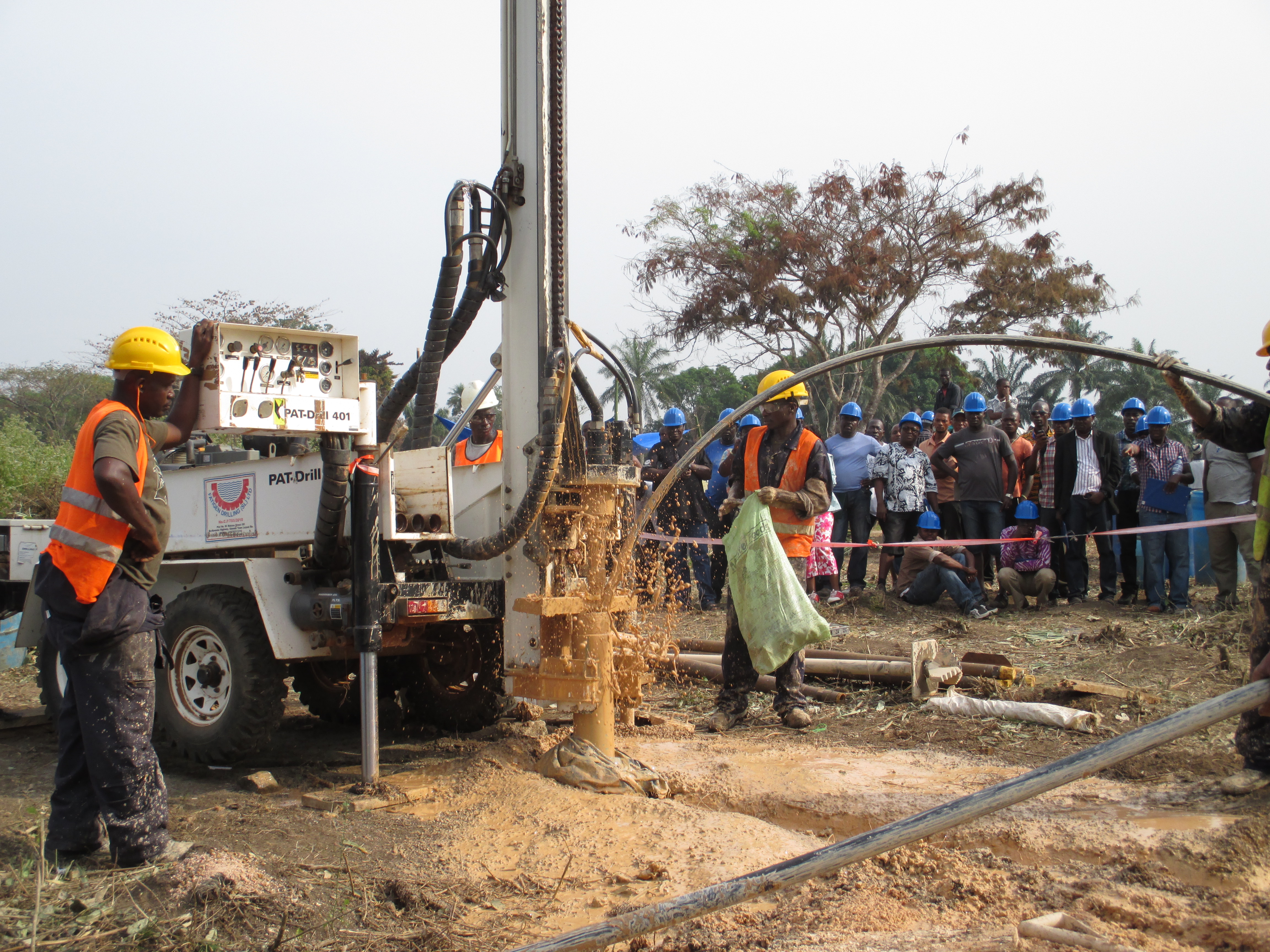
Drilling Supervision Course in Sierra Leone (source: Kerstin Danert)
This new online course on professional drilling management, will equip participants with knowledge on: groundwater information, siting, costing and pricing, procurement and contract management, borehole drilling and supervision and how professional water well drilling is affected by the wider regulatory framework and institutional environment. By the end of the course participants will:
Have an understanding of the key elements of a professional water well drilling sector including key reasons that boreholes fail, or perform poorly and why drilling supervision is important.
Recognise the value of groundwater data and know what constitutes good borehole siting.
Appreciate the importance of drilling supervision.
Have improved their knowledge of drilling procurement and contract management
Understand what constitutes a strong institutional framework (at national or state level) for borehole drilling, including driller licencing, borehole permits and drillers associations.
Course content – Groundwater Data and Siting – Procurement and Contract Management – Borehole Drilling and Supervision – Legal and Institutional Considerations – Actions to Raise Drilling Professionalism
The course is designed for professionals already engaged in the management of water well drilling, or those that expect to do so, with an emphasis on low– and middle–income countries. Target participants include government, NGO, UN and donor organisation staff, as well as those working in the private sector. Participants may be working in development or humanitarian aid/emergency contexts.
Interested applicants are welcome to apply between Tuesday, 10th May and Wednesday, 15th June 2022, with successful participants informed by 20th June. The course will start on Friday, 24th June and run up to the 29th October 2022. Application link: https://cap-net.org/pdm/
Currently, about half a billion people, in sub-Saharan Africa (SSA), equivalent to half of the population, rely on protected and unprotected groundwater point sources for their main drinking water supplies. With the expected increases in rainfall variability due to climate change, sustainable groundwater sources will be evermore important in supporting resilience in the future.
Access to safe, reliable water supplies in low-income countries, particularly in rural areas has been improved through handpumps, which provide a viable alternative to contaminated surface water, open wells and unprotected springs.
Three new reports from the ‘Stop the Rot’ initiative published in March 2022 examine handpump reliance, rapid corrosion, the quality of handpump components and supply chains in SSA. The research looked specifically at the main public domain handpumps – the India Mark Pump, and the Afridev Pump, and also drew on learnings from the Zimbabwe Bush Pump.
Using the most recent data published by the World Health Organization (WHO) and the United Nations Children’s Fund (UNICEF) through the Joint Monitoring Programme (JMP), the ‘Stop the Rot’ research estimates that almost 200 million people in SSA (18.5% of the total population) rely on handpumps to provide them with their main drinking water supply (Figure below). Further, an estimated 700,000 handpumps are in use in SSA. Meanwhile, 23% of the SSA population still rely on unsafe and distant water sources, of which many could benefit from a handpump. At least for a generation, if not much longer, handpumps are here to stay.
Estimated proportion of the total population relying on handpumps for their main drinking water supply
Despite their merits, criticism has been directed towards handpumps. Limited ability to transport large quantities of water, coupled with a lack of storage capacity at the home, means that water from handpumps is usually fetched on a daily basis. Handpumps have also made the headlines: in 2010, an estimated two out of three handpumps in SSA were working; a decade later it was estimated to have only improved to three out of four.
A handpump breaks down for a specific technical reason (such as the breakage of the chain, an O-ring failing or corroded riser pipes), but its repair depends on the ability of the users, often a community, to raise funds, organise a mechanic and source spare parts. In turn, these depend on other factors within the locality and country, including the available services support mechanisms by governments, NGOs and the private sector. When water services fail, there are negative impacts on health and other human development gains, not to mention the burden on users of finding alternative sources. These may be distant, overcrowded, or contaminated.
A sizeable drop in handpump functionality in the first one to two years after installation is a common occurrence, and represents a premature technical failure. Something went wrong with the engineering – such as the borehole siting, design and/or construction, pump quality or installation, or the pump use – or there was vandalism or theft. Alternatively, the installation may have been rejected by the users from the outset due to its location, or the appearance or taste of the water.
The series of three ‘Stop the Rot’ publications draw attention to rapid handpump corrosion, whereby aggressive groundwater destroys the galvanising layer and so galvanised iron (or poor-quality stainless steel) riser pipes and pump rods essentially rot in the ground at a very fast rate (see Figures below). The term ‘aggressive’ refers to the ability of the groundwater to corrode, disintegrate and deteriorate materials it is in contact with, and includes, but is not limited to acidity is one type of pump.
This phenomenon has been known about since the 1980s. However, this new study finds evidence of rapid corrosion in in at least 20 SSA countries. A related problem is the quality of handpump components. The research draws attention to long supply chains from manufacture to installation, shows that component quality is not consistent and that there is limited guidance on quality assurance, and that in many cases, procedures are lacking.
The study proposes the establishment of an action group of key organisations involved in Rural Water Supplies in SSA, and handpumps in particular, to join hands and take a lead in tackling the challenge. Many actions are needed at international, national and local level. These including raising awareness of the extent that handpumps are used in SSA, which will continue into the future. There is need for sensitization regarding the ongoing rapid corrosion issue, and how it can be addressed alongside incentives for doing so. There is also the need to invest in updating handpump specifications, improving quality assurance mechanisms and strengthening procurement procedures and practice.
The full set of research reports can be downloaded in English and French. There is also a 20 minute presentation available here, and a recording of the RWSN webinar involving the presentation and discussions is available here.
This is a shortened version of a blog that was originally published by PLOS Latitude.
Short reflection by Maimouna Diop, a Senegalese Young Water Professional who chaired Session 2a4 “Rural Water Supply Management Models” at the World Water Forum 2022, on behalf of RWSN.
Maimouna Diop, Ing. MBA, PMP
This forum is definitely the most impactful ever. Dakar has been the capital of water for 6 days.
Young people have been mobilized around the world to show their commitments. We will live through difficult times in the coming decades: resources will become scarce, demography will experience an exponential rise and funding will be difficult to mobilize due to the global crisis we are already experiencing. The expected action is therefore human and it is now. We must be at the heart of politics by investing ourselves intellectually and physically.
Just a quick reminder : issues related to water control and food security in Senegal were discussed 39 years ago, during a session at the National Assembly on April 14, 1983, with the late Minister Samba Yela Diop (May his soul rest in peace). It simply means that water security is nothing new and that our elders knew how to sound the alarm at an early stage. We have to be as benevolent as our elders to identify new challenges to be met in the coming years.
Understanding the issues related to water will ensure that appropriate decisions can be made and for future generations.
We need to act and now, because there is no green without blue and life is blue.
An estimated 75% of the African population relies on groundwater for their drinking water. Groundwater supports social and economic development and will become increasingly important in the face of climate change, droughts and floods. If groundwater is to provide reliable, safe and sustainable water supplies now and for future generations, the resource must be well-managed. This requires consideration of the entire system of policies & laws, strategies & guidance, monitoring & management as well as investments & projects. Those that manage and develop groundwater need to be equipped with appropriate skills and knowledge.
This new online course on groundwater resources management, launched in 2022 will provides participants with a comprehensive overview what impacts upon groundwater. Echoing the theme of the World Water Day 2022, this course will make the invisible visible.
Participants who successfully complete the course will have an awareness of the importance of groundwater, understand the need to preserve it and be equipped with basic knowledge to engage in the management of groundwater resources at national and transboundary levels.
Transboundary aquifers in Africa: Approaches and mechanisms
Course content – Characterisation of Aquifer Systems from a Management Perspective – Groundwater monitoring and data/information management & communication – Groundwater quality and source water protection – Groundwater regulation, licensing, allocation and institutions for aquifer management – Transboundary aquifers in Africa: Approaches and mechanisms
The online course is open to 250 participants from governments, NGOs, basin organisations, private sector, training organisations, academic organisations and donors. The course will start on Friday 29th April and run up to the 29th August. The application process is open to Tuesday 11th April 2022.
Successful participants will be informed by the 22nd April 2022.
We hope you all had a great start to 2022. The year is already going in full swing, and we would like to share some RWSN updates and upcoming events with you.
My name is Tommy Ka Kit Ngai and I am the Head of Water, Sanitation and Hygiene at WaterAid UK. At the RWSN Executive Steering Committee on 27 January, I was honoured to accept the role of RWSN Chair for the remainder of WaterAid’s tenure. I have been a RWSN member for about 10 years and have always been encouraged by the unwavering commitment of fellow RWSN members to collaborate and support each other in bringing sustainable and reliable water supplies to all rural people. Collectively, we have a world-leading, immense pool of knowledge and experience in rural WASH. I am thrilled to be here. I look forward to learning from and working alongside with all of you.
Thank you, Louisa Gosling and SDC
It is with much sadness that Louisa Gosling stepped down as Chair of RWSN due to health issues as of December 2021. We thank her so much for her great leadership and passion for the network, and in particular, she worked tirelessly with the Leave no One Behind theme and has been a great advocate of RWSN over the last ten years. We wish her strength and good health in her next chapter.
The Swiss Agency for Development and Cooperation (SDC)has supported this network since the beginning when we were founded as the Handpump Technology Network in 1992. Thanks to their steadfast partnership, RWSN has grown from a mailing list of a few dozen engineers to a diverse, global network of nearly 14,000 individuals and more than a hundred organisations in 167 countries. The RWSN Strategy, Roadmap and ongoing governance review are setting the network on an exciting new path and we will share more details in future updates. SDC’s strategic orientation is shifting and with it our modality of collaboration. We thank the SDC Global Programme Water for providing exceptional support over the last 30 years, and to Dr Daniel Maselli in particular who has been a great ally and guide over the last few years. Switzerland remains committed to improving global water security and we look forward to continuing our partnership in new ways.
Welcome to Ndeye Awa Diagne, Dr. Amita Bhakta, WHO and USAID – and “Data for Action”
Ms Ndeye Awa Diagne (“Awa”) has joined the RWSN executive committee. Awa is a Water and Sanitation Specialist at the World Bank in Washington DC, with 10 years experience, including 6 with the World Bank and 2 at the Société Nationale des Eaux du Sénégal. Her current responsibilities include managing the Bank’s internal community of practice on rural WASH. Linkedin
New Leave No One Behind (LNOB) theme co-lead Dr. Amita Bhakta. Amita is a Freelance Consultant in Water, Sanitation and Hygiene (WASH); Website: Amita Bhakta – Hidden WASH; LinkedIn
Welcome to our new RWSN project partners, USAID, who are funding REAL-Water, a five year research programme on rural water headed by Aquaya Institute with KNUST Ghana, ATREE, Safe Water Network, Aguaconsult and Water Mission.
We are delighted to be collaborating with WHO as they prepare to finalise and publish “Guidelines For Small Drinking-Water Supplies: Policy Guidance And Supporting Tools”. Look out for more updates later in the year!
Finally, the RWSN Theme “Monitoring and Mapping” will be changing its name to “Data for Action”; the change will be effective over the course of this year.
Upcoming events
On 22nd March we celebrate World Water Day. This year the theme is “Groundwater: making the invisible, visible”. You can take part in the celebration and raise awareness on groundwater by checking the website: https://www.worldwaterday.org/. There are many materials available for download to share with your community and networks, raising awareness on groundwater. RWSN also has a wealth of resources related to Groundwater, see below.
9th World Water Forum, Dakar – RWSN is delighted to be hosting French/English Session 2A4 on Rural Water Supply Management Models in Room 3 at 9am on 22 March. For those coming to the Dakar, we look forward to welcoming you to this great session, with interesting case studies from Morocco, Madagascar, Senegal, Ghana and Uptime and panellists including the Director General of Water from the Government of Spain. https://www.worldwaterforum.org/
RWSN resources related to Groundwater
Does your organisation drill boreholes, or perhaps fund others to drill? If so, check out the wealth of materials on borehole drilling on the RWSN website: https://tinyurl.com/waterdrilling
Do you want a quick, and easy introduction to borehole siting, supervision, procurement and drilling itself? If so, then watch these very short animated films (available in English and French): https://vimeo.com/channels/drilling
Want to know about how to unlock the potential of groundwater in Africa, then check out this short film: https://vimeo.com/582160363
Want to learn about professional drilling from other RWSN members and partners? There is an archive of presentations and webinars available here: https://vimeo.com/channels/1432819
New Groundwater Publications from RWSN and in collaboration with others
Dr Kerstin Danert, co-lead of Sustainable Groundwater Development Theme has been extremely busy over the last year and involved in lead and co-author roles on several key publications that will be published over the next month:
“Achievements and Lessons Learned in the Implementation of Groundwater Regulation in Zambia” / “Réalisations et enseignements tirés de la mise en oeuvre de la réglementation des eaux souterraines en Zambie” A collaborative publication with the Water Resources Management Authority of Zambia and UNICEF. Available here: https://www.rural-water-supply.net/en/resources/details/1040
“Stop the Rot: Action research on handpump corrosion and component quality in Sub-Saharan Africa”. A three-part RWSN research report will be available from the RWSN website by the end of March.
Guest blog by Leslie Morris-Iverson and St. John Day
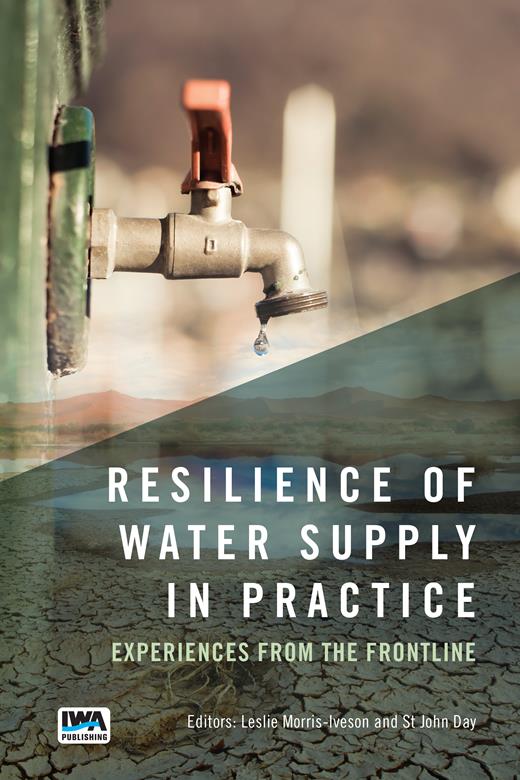
The protracted Covid-19 pandemic has restricted international travel, cancelled or shifted international conferences on-line and confined many of us to working from home. These changes, along with an awareness of growing and intersecting threats to water supply means it is increasingly important to hear the voices and learn from the experiences of practitioners who continue to work on the frontline. We have edited a book “Resilience of Water Supply in Practice: Experiences from the Frontline” (published at the end of 2021) to help us listen to those voices, people working for utilities, contractors, catchment organizations, or non-governmental authorities, on how they are implementing to address these increasingly complex resilience challenges.
Many service providers are striving to improve the resilience of their water supply services in some very challenging environments. This refers to improving or maintaining service levels, so they can resist, recover from and withstand multiple growing pressures and shocks, such as increased water demands, aged and crumbling infrastructure, environmental pressures (including climate change) and natural or human-made disasters.
In the book, we highlight there needs to be renewed focus on strengthening resilience to raise service levels and improve professional standards of service. If service levels decline or systems breakdown there will be little prospect of getting at least basic services to people, let alone the more ambitious target of safe, adequate and affordable water supply services for all.
To improve resilience, service providers need to imagine what a resilient water supply service will look like. They should conceptualise the key factors that underpin resilience and introduce approaches that will strengthen each component. They also need to ensure inter-linkages between these component parts. This requires detailed analysis of water resources, high quality infrastructure – fit for the local context, strong management arrangements and an adaptive or iterative approach so that learning, adjustments and improvements are continuous. This means decision-makers and service providers should be concerned with wider systems strengthening work, but at the same time they must also identify immediate actions and areas where they can achieve maximum impact. This is often referred to as ‘doing the right thing and doing it right’.
In the book we present several case studies from different contexts. It consists of eight different examples, contributed by different authors, all of whom are highly experienced in water supply service provision. Each case study brings a different context, challenge, experiences and some practical findings and conclusions. Examples range from: managing water demand in the United Kingdom, to the Cape Town water crisis, to rebuilding water supply services in Freetown; from the challenges of rural water supply in Eastern Sudan, Tajikistan and Iraq, to improving service levels in post emergency situations.
This network is devoted to the important issue of rural water supply. Over the past decade or so, there have been numerous studies highlighting underperformance and shortcomings in community-based maintenance approaches. In this book many of the challenges faced by utilities are highlighted, and, in our opinion, much work is required to improve service levels and increase customer satisfaction. One of the main challenges, as demonstrated in the Sierra Leone case study, is how to strengthen resilience in a systematic manner, when development projects are short term, projects are pre-conceived and often fail to address the most critical problems the utility is facing.
One of the main conclusions from the book is that resilience is being improved through an iterative and adaptive approach. Frontline operators often need to start by ‘doing what they can with what they have,’ while setting realistic and achievable targets. There must be a strong focus on ensuring interventions are relevant to the local context and implemented professionally to prevent reworking and excessive costs. In editing the book, the importance listening to service providers who really are on the frontline – has become ever apparent.
We would like to thank everyone who contributed to this book being published and for assisting in making the book open access.
Are we doing enough to make water, sanitation and hygiene services as inclusive as possible? Louisa Gosling shares her reflections on how far we have come, and what else we need to achieve.
I started working on equality, inclusion and rights in the water, sanitation and hygiene (WASH) sector in 2011. The challenge then, as it is now, was to do three things:
To raise awareness of inequalities and exclusion by encouraging people working on WASH to think about the different needs of different people and understand the barriers they face.
To develop the skills and confidence of WASH professionals.
To get WASH professionals to recognise the limits of their expertise so that they reach out to others who can help find solutions.






 Rural Water Supply Network - blog