Can Self-Supply Save the World?

Some highlights from the RWSN Forum and thoughts on 12 years of a learning journey, by Matthias Saladin, Skat

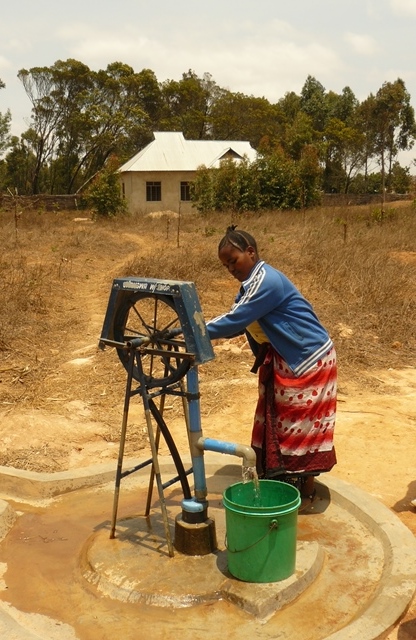
Of course the title is a rhetorical question – no one really expects one specific approach to transform the whole water sector, let alone save the world. Nevertheless, Self-supply as a concept is gaining traction and prominence in the sector as I witnessed during the 7th RWSN Forum, which took place from November 29 to December 02 in Abidjan. Just a couple of years ago, the term “Self-supply” did not even exist. In fact, it was coined within RWSN as part of a strategic planning exercise in 2004, where Self-supply was defined as one of the flagships of RWSN. Of course, people providing water for themselves (“Self-supply”) is a process which has been going on for millennia and all over the planet (for example, some 44 million people in the US today rely on Self-supply for their drinking water), but Self-supply as a term was born in 2004, and the idea that this approach can (and should) be fostered by specific activities and frameworks both by government and other actors still is relatively new to many people, even within the water sector.

In this blog entry, I would like to reflect on some aspects of this learning journey of the past 12 years, and I invite you to reply, discuss, disagree, criticize or support, whatever suits you best.

Flashlights on Self-supply at the 7th RWSN Forum

But first things first: The 7th RWSN Forum was a massive success, both in terms of participation and outreach, but also specifically for the Theme of Self-supply: I identified at least 7 sessions where papers related to Self-supply were presented, some of which I was not even aware of before the Forum. For example, Sara Marks of Eawag (Switzerland) presented some results of a study from Burkina Faso (feel free to read the respective paper and presentation) where they looked into the various benefits of a project implementing a (subsidized) Self-supply approach to facilitate multiple-use water services (MUS). Among other things, they found that the water of households who had invested in an upgraded private well and equipped it with a Rope Pump was of better quality than that of unimproved wells.

Meanwhile, session 6A was designed to provide an update on the “state of the art” in Self-supply, including an overview paper of André Olschewski, a case study from Sally Sutton on Self-supply in some African countries, an overview of how Self-supply can be accelerated in Ethiopia, and an example of how capacities in the private sector can be strengthened through SMART Centres (or watch the movie on the SMART Centre in Zambia here).

In several other sessions, specific aspects of Self-supply were analyzed in more detail, for example by Patrick Alubbe of water.org, who made a case for micro-credit as a scalable intervention who can help more people gaining access to higher level of drinking water services (see the paper of Gupta and Labh and Patrick’s presentation).

Making a Splash – and causing allergic reactions

Apart from this wide and deep presence of Self-supply in the thematic sessions, the concept also made a splash at key moments of the RWSN Forum: For example, it was prominently mentioned by the final remarks of Mr. Jonathan Kamkwalala, a senior manager of the World Bank, during the closing ceremony. Moreover, more than 150 people signed an informal “Call to action”, which suggests that Self-supply deserves more attention on behalf of governments, donors, civil society organizations, researchers, and other key players. The undersigned expressed a “strong interest in developing support for Self-supply within our own spheres of activity and urge all development partners to explore this approach and reach its considerable potential”. Given this strong support by a large number of people, I hope that we will see a lot of action in this field in the weeks and months to come – for example by starting to monitor and report on Self-supply within organizations, regions,  and eventually countries and globally. As we know, we do not manage what we do not measure, so measuring definitively would be a good start.

In spite of these highlights and an overall strong presence of Self-supply during the Forum, not everything is rosy in regard to Self-supply. On one hand, I observed that while many people recognize the important role Self-supply already plays and will have to play to reach the SDGs, with another group of people it creates almost allergic reactions. Having listened to some of these people, I think I identified three areas of conflict, which are related to three misconceptions around Self-supply:

1.       Self-supply means abandoning the poor.

2.       Self-supply means that government has no role to play.

3.       Self-supply is incompatible with the Human Rights to Water and Sanitation.

For the moment, I will only respond to the third misconception.  It can readily be clarified, simply by listening of the presentation of the UN Rapporteur on the Human Rights to Water and Sanitation during a webinar hosted by RWSN last year (e.g., read this summary), where he makes it clear that Self-supply is in line with the progressive realization of these Human Rights. And this hint also helps clarifying the first misconception: Self-supply does not imply abandoning the poor, but supporting them in a different way – rather than the government itself providing services, it facilitates and strengthens the private sector (and civil society organizations) to provide them. Thus, rather than abandoning the poor, what Supported Self-supply does is actually empower them and enable them to take on a more active role in moving up the ladder of water services.

Importantly, the Government has to play a role in Supported Self-supply – in fact, it is a crucial role consisting of several functions (adequate policy framework, building up capacities, oversight of the private sector, etc.), but this will be the topic of my next blog. So for the moment, I leave it there, confirming that the Government is a key actor in Supported Self-supply.

Striking a balance

Overall, the concept of Self-supply clearly has an important role to play if we want to provide some (even if it’s just basic) level of services to everyone – there simply is no alternative in reaching specific target groups, especially in the remote rural areas. However, we also have to be aware that Self-supply has its limitations, and that there are aspects related to Self-supply which have to be addressed with a lot of care (e.g., quality of the services installed, potential over-exploitation of water resources by private households). I also perceived that several people and organizations are looking for shiny examples of countries where Supported Self-supply was implemented at scale, which then could be replicated elsewhere (the “Blueprint Fallacy” which unfortunately is quite common in the water sector, particularly among global players).

However, at the moment there are only a few such examples (e.g. manual drilling in Nigeria/Lagos, Domestic Rainwater Harvesting in Thailand, the Upgraded Family Wells in Zimbabwe), and many of these cases refer to contexts where government services were weak or collapsing – which do not make for a good example for promotion, particularly with government agencies. With all due respect, but which government agency would like to copy the experience of Zimbabwe in the 1990s? Thus, the examples are not as shiny as we wish.

Nevertheless, the fact is that Self-supply actually took off in some places while government services, institutions and the whole economy was collapsing – a clear hint to the power of this approach, even under difficult conditions. But we also need to figure out how governments can foster the approach – that is, how to better Support Self-supply.

The way forward

In spite of all the progress made I think there still is a lot of work to be done both within RWSN and beyond. Here are just a few areas of work a group of “Self-Suppliers” identified during an informal conversation at the Forum:

  • Revisit the basic terms, definitions and concepts and make them more intuitive to understand.
  • Help people, particularly within government and funding agencies, understand better the key role government has to play to support Self-supply
  • In cooperation with research institutions, improve our understanding of the potential and limits of Self-supply, and the variety of benefits it can generate (not only in health, but also in productivity, income-generation, equality and non-discrimination, inclusiveness, well-being, cost-savings to government agencies, etc.).
  • Keep up the dialogue with people and organizations who think that Self-supply is a nightmare and should be hindered wherever possible. Their arguments will help us guide future research and for making a better case where and why Self-supply has a role to play.
  • Engage with actors (particularly non-profit organizations) who undermine existing and flourishing markets by giving away stuff for free. Giving away products and services for free is not Self-supply, does not build up capacity with anyone and damages existing supply chains.

Thus, looking back to the first 12 years of promoting Self-supply, I think we have come a long way. Given that before 2004 the term did not even exist, the change is truly remarkable – and RWSN was the lead agency of making this sea change in public awareness possible. At the same time, we still need to work on the fundaments, the walls and the windows of the Self-supply house, and we need to make them strong enough to keep growing in the coming 12 years and beyond. I hope that many of you will be part of this journey, and I invite you – as a small first step – to subscribe to the Dgroup on Accelerating Self-supply, which is a platform for discussion, exchange and mutual learning, and to contribute to the dialogue on that platform. I look forward to hearing from many of you there!

Onwards and Upwards,

Matthias

Quelques astuces pour une exploitation des eaux souterraines réussie: séminaire sponsorisé au 7ème Forum du RWSN, Abidjan

Vous exploitez des nappes phréatiques pour améliorer la desserte en eau des zones rurales? Venez participer à cette journée de séminaire et découvrir comment utiliser les eaux souterraines pour établir des systèmes salubres et durables d’approvisionnement en eau. Nous y aborderons nombre de sujets liés à l’exploitation des eaux souterraines, des informations et des données nous permettant de mieux comprendre ces ressources particulières aux technologies de construction des forages et des pompes solaires qui facilitent la mise en oeuvre d’un approvisionnement en eau efficace.

Quel intérêt ai-je à participer à ce séminaire?
Ce séminaire d’une journée – une approche intelligible de l’exploitation et de l’utilisation des eaux souterraines – dissipera certains des mystères qui entourent encore l’exploitation des eaux souterraines. Il vous fournira aussi des informations pratiques et utiles pour vous aider à mettre en place des systèmes d’approvisionnement en eaux souterraines efficaces.

Les eaux souterraines représentent 30% des réserves mondiales d’eau douce, et plus de 95% de l’eau douce non glacée disponible. Du fait de leur bonne qualité globale, de leur répartition géographique très étendue et de leur résilience aux fluctuations saisonnières (par rapport aux eaux de surface notamment), les eaux souterraines peuvent constituer une source d’approvisionnement en eau salubre, durable et bon marché pour de nombreuses communautés.

Les eaux souterraines sont parfois appelées des atouts cachés – elles se trouvent sous la surface donc il n’est pas facile de les voir ni de se les imaginer, et la multitude de facteurs qui influencent leurs formations et leurs évolutions (la géologie, la topographie, le climat, le type et l’utilisation des sols, et même les activités humaines) font que leur fonctionnement est souvent difficile à comprendre.

Qu’est-ce que je vais y apprendre?
Nous devons mieux comprendre les eaux souterraines si nous voulons les exploiter de façon sûre et durable. Or pour les comprendre nous avons besoin de données et d’informations fiables, qui sont souvent difficiles à trouver.

La première moitié de ce séminaire répondra donc aux questions suivantes:

  • Quelles sont les données et les informations nécessaires pour bien comprendre les eaux souterraines et pour les exploiter de façon durable?
  • Comment pouvons nous efficacement collecter et stocker des données sur les eaux souterraines afin de constituer une banque d’information d’excellente qualité qui soit accessible, pratique, bon marché, facile à gérer et utile pour les projets d’exploitation des eaux souterraines en cours et à venir?

Nous allons examiner les données obtenues à différentes échelles – depuis les initiatives internationales jusqu’aux données locales de sites spécifiques – et nous nous concentrerons sur le niveau national avec la présentation d’une part de l’Atlas des eaux souterraines en Afrique et d’autre part d’études de cas de dispositifs nationaux en Afrique de l’ouest de collecte et de stockage de données sur les eaux souterraines. Les participants auront l’opportunité de mentionner les problèmes et les enjeux liés aux données sur les eaux souterraines (la collecte, le stockage, la gestion et l’usage) qu’eux même rencontrent dans leur pratique professionnelle et nous essaierons de leur proposer des solutions pragmatiques pour l’avenir.

La deuxième moitié du séminaire sera consacrée aux aspects pratiques de l’exploitation des eaux souterraines pour montrer comment des solutions adéquates en terme de construction des forages, et de pompes et de distribution solaires peuvent créer les conditions d’un accès à une eau salubre rentable et durable pour celles et ceux qui en ont le plus besoin.

Nous présenterons comment certaines méthodes de construction et d’entretien des forages peuvent à la fois fournir un approvisionnement en eau potable dépourvu d’E. Coli et qui durera sur plusieurs générations, et contribuer à la protection des sources d’eaux souterraines. Les participants recevront également des outils et des conseils méthodologiques pour la rédaction des spécifications techniques des forages afin de s’assurer que les sources d’eaux souterraines soient salubres et durables.

De la construction des forages nous passerons ensuite aux technologies de pompage et de distribution solaires, en montrant que cela représente souvent une option avisée et viable pour la fourniture de services ruraux en eau potable, en particulier lorsque la mauvaise qualité des eaux souterraines ou qu’une forte densité et croissance démographique limitent les possibilités d’utiliser des forages équipés de pompes manuelles. Nous présenterons plusieurs études de cas allant des points d’eau isolés aux réseaux de distribution centralisés et ayant toutes de faibles taux d’échec et des coûts de cycle de vie très limités. Nous en tirerons une série d’enseignements sur la conception, la construction et la mise en œuvre des systèmes d’approvisionnement en eau fonctionnant à l’énergie solaire.

Qui devrait participer à ce séminaire?
Toute personne intéressée par les services en eau dans les zones rurales, et en particulier par les thèmes des eaux souterraines et de l’approvisionnement en eau. Nous espérons accueillir une grande variété de participants appartenant à différents types d’organisations et à différents niveaux de responsabilité – Etats, ONGs, secteur privé, praticiens et universitaires.

Qui présentera le séminaire?
Le séminaire est sponsorisé par le programme de recherche UPGro (Libérer le potentiel des eaux souterraines pour les populations pauvres) et Water Mission. Il sera présenté par plusieurs experts africains, européens et américains des eaux souterraines.

Quand et où aura-t-il lieu?
Vendredi 2 décembre, 7ème Forum du RWSN (salle Bamako), Abidjan, Côte d’Ivoire

Le séminaire sera présenté en anglais avec une traduction simultanée, et des facilitateurs francophones et anglophones seront présents tout au long de la journée.

Webinar 16.11.2016 / Webinar el día 16.11.2016 – “A tool for Monitoring the Scaling up of Water and Sanitation Technologies”

Texto en español más abajo

From the RWSN secretariat we herewith announce the latest webinar of our mini-series 2016, which will take place on 16.11.2016. The title of the event is “A tool for Monitoring the Scaling up of Water and Sanitation Technologies (TAF – Technology Applicability Framework)” and it will focus on the use of the TAF, which has been presented and discussed previously in this Dgroup. The session will take place in English (2-3 PM Central European Time, please check your local time here) and in Spanish (4-5 PM Central European Time, please check your local time here). We are happy to announce the two presenters and the titles of their presentations:

  • Joshua Briemberg, WaterAid, Nicaragua: TAF as a participative planning and monitoring tool
  • Younes Hassib, GIZ, Germany: Scaling up sanitation solutions in Afghanistan

After the two presentations, you will have the chance to ask questions and participate in the on-line Q&A session and discussion around this topic.

Please use this link in order to register for the sessions.

Recordings and presentations of previous sessions of this mini-series of webinars are available for download and viewing here.

Continue reading “Webinar 16.11.2016 / Webinar el día 16.11.2016 – “A tool for Monitoring the Scaling up of Water and Sanitation Technologies””

Call for Abstracts – Sri Lanka Water Conference

3rd Annual Research Symposium

The National Water Supply & Drainage Board

Ministry of City Planning and Water Supply

20th March, 2017

At The Bandaranaike Memorial International Conference Hall (BMICH), Colombo, Sri Lanka

CALL FOR ABSTRACTS

Web: http://www.waterboard.lk

Email: agmrnd@gmail.com

Deadline for Abstract Submission:

30th November 2016

Send Abstracts to: agmrnd@gmail.com

Local and international authors are invited to submit abstracts under the following conference themes.

  • Wastewater reuse / Wastewater for Future
  • Socio Economic Aspects of Water & Sanitation for Small Communities
  • Challenges in Reduction of Water Loss & Revenue Increase
  • New Trends in Wastewater Management
  • Challenges in Implementation of Wastewater Systems
  • Sustainable Sanitation Solutions for Small Communities
  • Future Trends of Water Supply
  • Business Efficiency in Drinking Water Supply and Wastewater Management

High quality abstracts, with the potential to generate new knowledge, related to completed/on-going studies or based on experience and prepared according to the brochure linked to the news headlines of www.waterboard.lk , would be selected for oral or poster presentations.

All presenters will be given free registration for participation. Further, a limited number of local sponsorships will be offered for foreign presenters.

For more details – Contact: Assistant General Manager (Research & Development),   +94112625196,   agmrnd@gmail.com

Visit http://www.waterboard.lk

RWSN Forum – 24 days to go – 24 jours restantes

Despite at times feeling overwhelmed by sending and receiving an unbelievable number of emails in preparing for the 7th RWSN Forum in Abidjan, Côte D’Ivoire from the 29th November to 2nd December, there is a wonder about the build-up to the event.  With just over three weeks to go (gulp), the efforts and team spirit of over 100 people who are preparing behind the scenes is tremendous.  Whether reviewers, authors, exhibitors, journalists, sponsored seminar organisers or session managers, not to mention the government of the Côte D’Ivoire, the Forum Task Force, communications and management teams – the collaboration and mutual support can be felt.  Thank you everyone!

We are delighted to have The Guardian Global Development Professionals Network as our media partner for the whole event, as well as a journalist from El Pais and two journalists from the Africa region.

So where do we stand at the moment? Well there will be 44 sessions, plus posters and thematic networking opportunities and an optional field trip over the four days. Over 230 people have now registered and paid. As we draw closer to the event itself, the number confirming their attendance is rising every day.  As with the 6th RWSN Forum, we anticipate plenty of late payments. And so we are still not sure whether we will be 350, 450 or over 500 participants in the end!

If you are still undecided, I urge you to join us if you can. For there will be plenty to learn and share and you will have the chance to interact with like-minded professionals striving to improve drinking water access to people living in rural communities and small towns. And remember that it is a bilingual English/French event.

For those attending, registration at the event itself will open on Monday 28th November at 8:30 and close at 21:30. If you can, please come in to venue – the Radisson Blu Abidjan Airport on the Monday to prevent queues on the Tuesday morning. Make sure to bring a photo ID such as your passport for our security check. The opening ceremony will start at 9am on Tuesday 29th November.

For those who are not able to attend, you can follow the event through the RWSN blog, twitter (@ruralwaternet and #RWSN7), the RWSN LinkedIn group and our Facebook page. Over the months that follow we shall endeavour to bring you the content and contacts from the forum through the RWSN website and subsequent publications and webinars. With so much experience and material at the face-to-face event we need to see how to work hand in hand, as a network to share everything widely.

Before I close, allow me to express my thanks the 16 sponsors of the RWSN Forum, for trusting that by bringing together so many people and providing a platform for vibrant exchange at the event, and all that goes with it, we can significantly contribute to Water for Everyone – the title of this Forum.

—–

Il y a des fois où on se sent complétement noyés dans la masse d’emails envoyés et reçu dans la préparation du 7ème Forum RWSN à Abidjan, Côte D’Ivoire qui aura lieu du 29 novembre au 2 décembre. Il y a des fois aussi où on est émerveillé par l’ampleur de cet évènement. Il nous reste à peu près 3 semaines avant le début du Forum, et les efforts et l’esprit d’équipe de la centaine de personnes impliquée dans la préparation du Forum est formidable. Que ce soit les évaluateurs, les auteurs, les exposants, les journalistes, les organisateurs de sessions ou de séminaires sponsorisés, ou le gouvernement de la Côte d’Ivoire, la Task Force du Forum, l’équipe de communication ou de gestion – nous apprécions énormément l’esprit de collaboration et de soutien mutuel. Merci à tous!

Nous sommes ravis d’annoncer que le Guardian Global Development Professionals Network  est notre partenaire média officiel pour l’évènement dans sa totalité, et que nous aurons également un journaliste de El Pais et deux journalistes de la région Afrique pendant toute la semaine.

Où en sommes nous à l’heure actuelle? Il y aura 44 sessions, ainsi que des posters et des sessions de networking thématiques, ainsi qu’une visite de terrain optionnelle pendant 4 jours. Plus de 220 personnes se sont déjà inscrits et ont payés. La date du Forum étant proche, le nombre de personnes confirmant leur participation augmente chaque jour. Comme lors du 6ème Forum RWSN, nous anticipons beaucoup d’inscriptions et de paiements de dernière minute. Et nous ne savons pas si nous aurons 350, 450 ou plus de 500 participants.

Si vous êtes toujours indécis, je vous invite à venir nous rejoindre si vous le pouvez. Il y a aura beaucoup à apprendre et à partager et vous aurez l’opportunité d’interagir avec des professionnels qui comme vous travaillent à améliorer l’accès à l’eau pour les communautés rurales et les petites villes. Et rappelez vous, c’est un évènement complétement bilingue en français et en anglais.

Pour ceux qui ont finalisé leurs inscriptions et paiements, vous pourrez récupérer vos badges à partir du lundi 28 novembre de 8h30 jusqu’à 21h30. Si vous pouvez, passez par le site du Forum le lundi (Radisson Blu Abidjan Airport) pour vous éviter de faire la queue le mardi matin. N’oubliez pas de prendre un document d’identité avec photo tel que votre passeport pour la sécurité. La cérémonie d’ouverture aura lieu à 9h le mardi 29 novembre pour ceux qui se seront inscrits.

Si vous ne pouvez pas venir, vous pourrez suivre l’évènement à travers le blog RWSN, Twitter (@ruralwaternet et #RWSN7), le groupe LinkedIn du RWSN et notre page Facebook. Au cours des prochains mois, nous vous tiendrons informés de ce que nous avons appris lors du Forum en termes de contenu et de contacts à travers le site du RWSN et les publications et webinars qui s’ensuivront. Avec tant d’expérience et de matériel à cet évènement en présentiel, nous devons voir comment nous pouvons continuer à avancer ensemble afin de tout partager dans le réseau.

Avant de conclure, laissez-moi remercier les 16 sponsors du Forum RWSN, pour nous faire confiance en rassemblant tant de personnes à travers une plateforme pour des échanges stimulants, et de faire en sorte que cet évènement, et tout ce qui va avec, contribue à donner de l’Eau pour Tous – le titre de ce Forum.

Sponsors – Gold – Or

Sponsors – Silver – Argent

Sponsors – Bronze – Bronze


Tips for Groundwater Success: A Sponsored Seminar at the 7th RWSN Forum, Abidjan

Kerstin Danert's avatarUPGro

Are you involved in groundwater development for rural water services? Come along to this one day seminar to learn more about how to develop groundwater for safe and sustainable water supplies. We will be discussing many aspects of groundwater development, from data and information that can help us understand groundwater resources, to technologies in borehole construction and solar pumping for the delivery of effective water supplies.

Why should I come to this seminar?

This one day seminar – An Understandable Approach to the Development and Use of Groundwater – aims to take some of the mystery out of groundwater development and provide useful, practical information to help you develop effective groundwater supplies.

Groundwater makes up almost 30% of the world’s freshwater reserves, and more than 95% of the available, unfrozen fresh water. Given its broad geographical distribution, general good quality, and resilience to seasonal fluctuations (as compared to…

View original post 630 more words

Update from the UN Special Rapporteur on Human Rights to Water and Sanitation

Hello all,

After what has been a prolonged period of absence for some members of the “friends list” to the mandate of the Special Rapporteur on the human rights to water and sanitation, I would like to touch base with you and renew my commitment to maintaining meaningful contact. As much time has passed, there is naturally a lot that could be shared. I will attempt to be selective and keep to key subjects that could be of your particular interest.

  1.     Recognition of human rights to water and sanitation

Firstly, the attentive among you may have recognized the change in my title. The General Assembly http://bit.ly/2drEiWH recognized the human rights to water and sanitation (plural) late last year in Resolution A/RES/70/169. More recently, the Human Rights Council also recognized the distinct rights in a new resolution http://bit.ly/2dPyVeY , meaning that my title has also changed accordingly to reflect the distinct rights. This is news to celebrate as I, like others http://bit.ly/2drFlpu , believe in the legal foundation and benefit of recognizing water and sanitation as two distinct but integrated rights.

Continue reading “Update from the UN Special Rapporteur on Human Rights to Water and Sanitation”

RWSN Forum Programme Announced Today! Le programme du Forum RWSN est annoncé aujourd’hui!

We are delighted to announce that the programme of the 7thRWSN Forum (29 Nov-2 Dec in Abidjan, Côte d’Ivoire) is now available.  As you can see, it is a very diverse programme, covering rural and small towns’ water access from policy, financial, practice and user perspectives – with contributions from over42 countries.  It is by bringing so much diversity, and many different players that this Forum is tackling the SDG challenge of Water for Everyone! The quality of contributions means that those attending will return home with new knowledge and new connections.

For more information see:   https://rwsn7.net/programme/

As our programme is just out now, we have also extended the deadline for regular registration to the 31st October 2016.  So those who have not yet managed to register and pay, please try to do so by the 31st October to benefit from the €600 fee.  Over 500 people have registered so far, with confirmations from over 130.  As with previous RWSN Forums, we expect a very diverse group to participate including government, private sector, NGO, donor, academia and civil society. You can register here.

Many people have been contacting us for sponsorship to attend the event.  Alas we have very limited funds as Forum organisers. However, we have prepared a help sheet for you to use within your organisation and with partners in trying to obtain assistance to attend.

—-

Veuillez nous excuser pour tous les emails en ce moment, mais nous sommes heureux de vous annoncer que le programme du7ème Forum RWSN (29 nov-2 déc à Abidjan, Côte d’Ivoire) est maintenant confirmé. Comme vous pouvez le voir, c’est un programme très divers, qui couvre les perspectives des usagers, des professionnels, des décideurs politiques et les aspects financiers de l’approvisionnement en eau en milieu rural et dans les petites villes – avec des contributions de plus de 42 pays. C’est en rassemblant un tel nombre d’acteurs et une telle diversité que le Forum envisage d’aborder le défi de l’ODD “L’eau pour tous”! La qualité des contributions reçues va permettre aux participants de rentrer chez eux ensuite avec de nouvelles connaissances et de nouvelles connections.

Pour plus d’informations, veuillez consulter: https://rwsn7-fr.net/programme/

Notre programme étant seulement paru maintenant, nous avons étendu la date limite pour les inscriptions au tarif normal jusqu’au 31 octobre 2016. Si vous ne vous êtes pas encore inscrit, vous avez jusqu’au 31 octobre pour bénéficier du tarif de 600 Euros. Environ 500 personnes se sont inscrits, avec plus de 130 personnes confirmées. Comme lors des Forums RWSN précédents, nous nous attendons à avoir un groupe divers de participants, y compris des membres du gouvernement,  du secteur privé, des ONG, des bailleurs de fonds, des chercheurs et de la société civile. Vous pouvez vous inscrire ici.

Beaucoup de personnes nous ont contacté pour pouvoir bénéficier d’un soutien financier pour participer à l’évènement. Hélas, nos moyens sont limités en tant qu’organisateurs du Forum. Cependant, nous avons préparé un guide que nous vous encourageons à utiliser auprès de votre organisation et avec vos partenaires pour obtenir un soutien pour votre participation.

Warm wishes et cordialement,

Kerstin

Dr. Kerstin Danert

Director – Secretariat

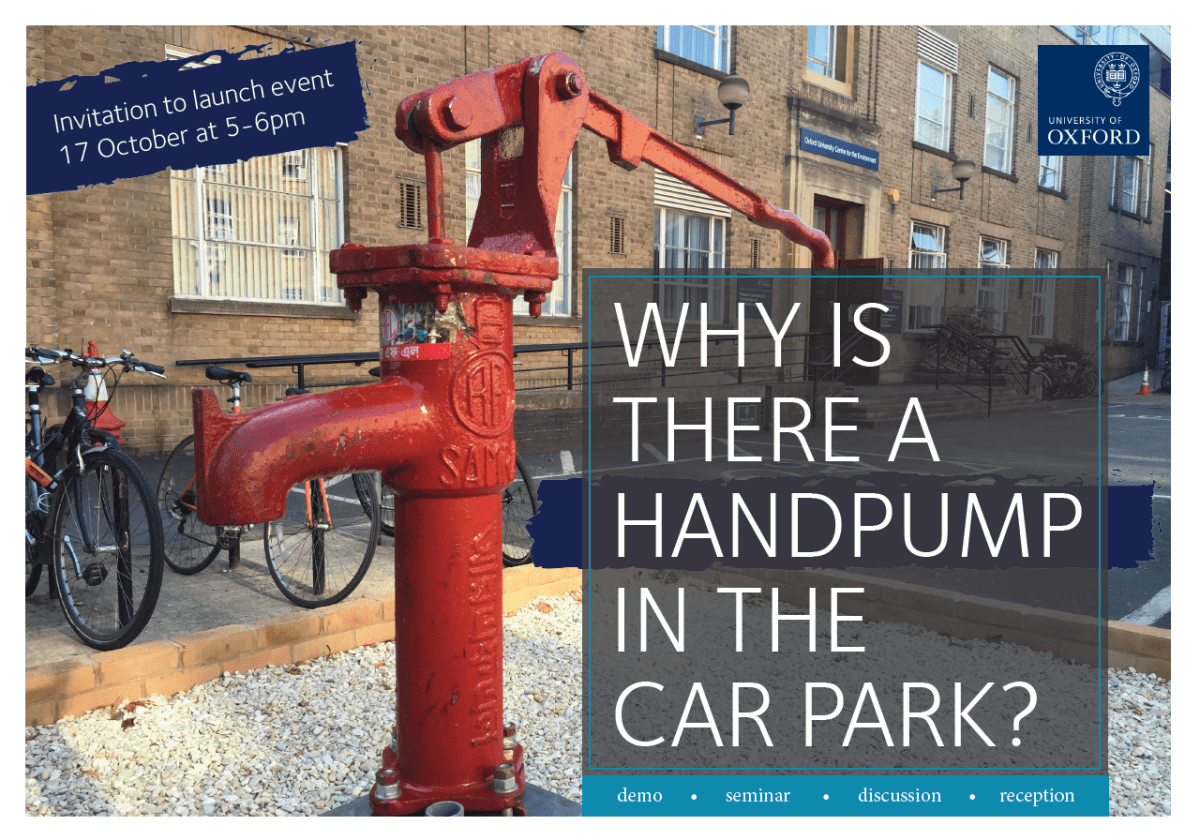
Why is there a handpump in the car park?

Invitation to launch event 17 October at 5-6pm

About the Smart Handpump

Delivering reliable drinking water to millions of rural people in Africa and Asia is an elusive and enduring global goal. A systematic information deficit on the performance of and demand for infrastructure investments limits policy design and development outcomes.

Since 2010, the ‘Smart Handpump’ project has been exploring new technologies, methods and models to understand and respond to this challenge. A mobile-enabled data transmitter provides foundational data on hourly water usage and failure events which has enabled the establishment of performance-based maintenance companies in Kenya that are improving handpump reliability by an order of magnitude.

The research is a collaboration between the School of Geography and the Environment and the Department of Engineering Science with a range of partners including government, international bodies such as UNICEF and the private sector. New research involves modelling the accelerometry data from the handpumps to predict aquifer depth.
We invite you to test the Smart Handpump in the car park and debate how the ‘accidental infrastructure’ of rural handpumps can spark bolder initiatives to deliver water security for millions of poor people in Africa and Asia.

17 October 2016 at 5-6pm
Hertbertson Room and the Car Park, School of Geography and the Environment, South Parks Road, Oxford, OX4 1LY

RWSN webinar: Participation: The key to gender equality in the human rights to water and sanitation?

Greetings/Buenos días (para el texto en castellano, por favor ver más abajo)

RWSN is delighted to announce the first two sessions of our mini-series of webinars (on-line seminars) on October 13, 2016. The first two sessions focus on the Human Rights to Water and Sanitation and will be take place both in English and in Spanish. Here is the more detailed information:

Topic: Participation: The key to gender equality in the human rights to water and sanitation?

Date: 13.10.2016

Time: 1.30 – 2.30 PM (Central European Time, CET – check this out in your local time zone here)

Speakers:

Léo Heller, Special Rapporteur to the UN on the Human Rights to Water and Sanitation

Mayra Gomez, Global Initiative for Economic, Social and Cultural Rights

Seema Kulkarni, Society for Promoting Participative Ecosystem Management (SOPPECOM), Pune India

The event will consist of three short presentations, followed by a Questions&Answer session where all participants are invited to ask questions or make comments. In order to participate, simply use the following link on the day of the webinar – it will take you to a “Skype for Business” session, where you first have to install a plug-in if you never used this platform before. It’s fast and free – after completing this process, you can join the session. We recommend you start this process about 30 minutes before the webinar starts.

https://meet.lync.com/skatconsulting/martinlaeng/D4JNC1YC

Feel free to pass on this message to others – there is no need to register for this event. At RWSN, we are looking forward to a wide and active participation.

//////

Buenos días

Es con mucho placer que RWSN está anunciando los primeros dos webinars de la mini-serie de otoño 2016, los cuales se efectuarán el 13 de octubre. La primera sesión en español enfocará en el tema de los Derechos Humanos al Agua y Saneamiento. A continuación estamos enviando la información detallada respecto a este evento:

Tema: Participación: ¿La clave para lograr la igualdad de género en el derecho humano a agua y saneamiento?

Fecha: 13.10.2016

Hora: 4.00 – 5.00 PM (Central European Time, CET – para conocer el horario en su zona local, por favor utilizar este  vínculo)

Presentadores:

Léo Heller, Relatador Especial ante Naciones Unidas respecto a los Derechos Humanos al Agua y Saneamiento, Brasil

Mery Quitón, consultora independiente, Bolivia

El evento consistirá de dos presentaciones y posteriormente los participantes tendrán la oportunidad de hacer preguntas o comentarios. Para participar, simplemente hay que hacer clic en el vínculo abajo – le llevará a un sitio de “Skype for Business”, donde tendrá que seguir las instrucciones para instalar el plug-in. Es un proceso rápido y fácil – posteriormente, podrá entrar al webinar. Recomendamos empezar este proceso unos 30 minutos antes de empezar el evento, para asegurar que todo funcione bien.

https://meet.lync.com/skatconsulting/martinlaeng/LM2ND2AY

Por favor, comparta este vínculo con otras personas que podrán estar interesadas – no hay necesidad de registrarse con anterioridad. Por parte de RWSN, nos hace mucha ilusión poder contar con una amplia y activa participación.