Zambia: Borehole Drilling Harming Ground Water

THE construction sector in Zambia is at an all-time high, with buildings springing up all around the country, particularly in urban areas.

It is a building rush cutting across commercial entities and private individuals who are investing heavily in picturesque houses.

This is a mark of how Zambians have learnt the advantages of becoming homeowners and, consequently, securing the future of their families.

Continue reading “Zambia: Borehole Drilling Harming Ground Water”

Investment in rural water supply delivers results – NEW RWSN briefing note on the new JMP report

jmp2015
Find out how rural water supplies have changed around the world since 1990

The Joint Monitoring Programme (JMP) of UNICEF and the World Health Organisation (WHO) have just released a new report: 25 Year Progress on Sanitation and Drinking Water – 2015 Update report and MDG Assessment

We have pulled together a 2-side briefing note that pulls out some of the headline figures and conclusion on rural water supply. Please download it from:

http://www.rural-water-supply.net/_ressources/documents/default/1-674-2-1435935827.pdf   (0.9 MB)

The new figures from JMP show that most countries have achieved substantial progress towards achieving universal access to water for their citizens.

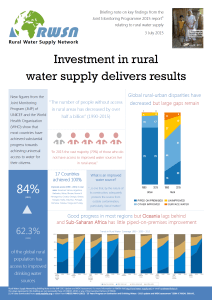
84% of people living in rural areas now have access to a safe water source in 2015 (up from 62% in 1990)

  • “The number of people without access in rural areas has decreased by over half a billion” (1990-2015)
  • 17 Countries achieved 100% improved access (1990 – 2015) in rural areas
  • Global rural-urban disparities have decreased but large gaps remain – 8 out of ten people without access to an improved water source live in rural areas
  • Good progress in most regions but Oceania lags behind and Sub-Saharan Africa has little piped-on-premises improvement

Find out more by downloading the briefing note – and guess which country made the biggest percentage gain in improved access for its rural population?  I almost guarantee it won’t what you expected!

http://www.rural-water-supply.net/_ressources/documents/default/1-674-2-1435935827.pdf

If you want to air your thoughts then join the discussion on our LinkedIn group: https://www.linkedin.com/grp/home?gid=3935951

A borehole that lasts for a lifetime

Groundwater is a valuable resource for communities, but accessing and maximising its potential can be difficult. Vincent Casey, WaterAid’s Technical Support Manager for Water Security, introduces a series of videos demonstrating good practice in borehole drilling.

Groundwater is a valuable resource for communities, but accessing and maximising its potential can be difficult. Vincent Casey, WaterAid’s Technical Support Manager for Water Security, introduces a series of videos demonstrating good practice in borehole drilling.

Good practice must be followed if groundwater development programmes are to reach their full potential. If certain steps are not taken, there is a high chance that boreholes will fail, investment will be wasted and people will remain un-served.

Continue reading “A borehole that lasts for a lifetime”

It all starts with knowing!

Dear Members,

There is a lot of attention for monitoring, and rightfully so. New Information and Communication Technologies (ICT) have opened great possibilities to collect data, store data and visualise data on mobile phones. Maybe some of you already have used mobile phones for data collection. New ICT has brought national scale sector monitoring within reach. It has been done in Liberia, countries in Central America, Ghana, Nigeria, Mali, Ethiopia and many others.

Continue reading “It all starts with knowing!”

A New Rural Water Partnership Between The U.S. And Tanzania

Guest announcement by Rebecca Gianotti, Ph.D., Consultant, Global Water Initiative, The Ohio State University

Deputy Vice Chancellor Shabaan Mlacha of the University of Dodoma signed a letter of intent with leaders at the Ohio State University to develop capacity building programs in rural Tanzania for the entrepreneurial sectors surrounding water (food, energy, health, sanitation).
1
Deputy Vice Chancellor Shabaan Mlacha of the University of Dodoma met with team members of the Global Water Initiative at Ohio State University as well as Tanzanian graduate students studying at Ohio State through another capacity building effort based at Sokoine University of Agriculture (Tanzania).

A new initiative at the Ohio State University that takes a systems approach to rural water development is launching pilot projects in Tanzania. Dubbed Wells to Wellness, the effort combines capacity building and tiered water point rehabilitation activities to provide scalable, sustainable systems solutions to water resource issues. In April, the university signed a letter of intent with the University of Dodoma in Tanzania to develop undergraduate programming that will strengthen the workforce in the entrepreneurial sectors surrounding water (food, energy, health, sanitation). The partnership between the two universities follows the announcement of a 55-MW solar array—the largest ever at a university—to be built by U.S.-based Hecate Energy at Dodoma in 2016. The new training and academic programs at the University of Dodoma will support both the budding renewable energy sector in rural Tanzania as well as a water point rehabilitation project also under Wells to Wellness. This effort will initially retrofit 125 inoperable wells as well as support health, sanitation and economic development with a systems approach incorporating a new franchising model for operations and maintenance as well as key collaborations with existing NGOs in Tanzania. Upon successful completion of the 125-well pilot, the Tanzanian government has provisionally committed to funding rehabilitation of thousands of additional wells by scaling up the model.
Continue reading “A New Rural Water Partnership Between The U.S. And Tanzania”

Innovations in Community Based Organisations, in Indonesia

So I’m at the Indonesia International Water Week 2015 and on the second day, the event has been split into six parallel streams:

  1. Sustainable Access to Safe Drinking Water
  2. Community Based Water Supply
  3. Domestic Wastewater Management
  4. Municipal Solid Waste Management and Domestic Wastewater
  5. Water Resources: Sinking Cities / Towards Better Implementation of IWRM
  6. Water Resources: Measuring Progress / Water Infrastructure & Water Resources Management

Continue reading “Innovations in Community Based Organisations, in Indonesia”

RWSN in Indonesia

So this week, I’m lucky enough to have been invited to present at the International Indonesia Water Week in Jakarta. RWSN is a global network, but many of you will have noticed the strong Africa-bias. That’s not necessarily a bad thing, but the challenges of delivering good quality rural water services are to be found everywhere – indeed the Pacific region is the where the biggest disparities between urban and rural are to be found [JMP].
Continue reading “RWSN in Indonesia”

Global Framework for Sharing Water Point Data Launched with Largest Ever Public Data Set

New Approach to Sharing Water Data Promises Improved Water Access around the World

Press Release by Brian Banks, Global Water Challenge

WASHINGTON | May 14, 2015 – Around the world, one in nine people lack access to safe water. While progress is being made, efforts have been limited by challenges in establishing a clear picture of water point access. Despite a growing trend of collecting data on water projects, there has previously been no consistent way to share this information among parties, making it difficult to fully understand the water challenges faced around the world.

Continue reading “Global Framework for Sharing Water Point Data Launched with Largest Ever Public Data Set”

Water taps and information gaps

An interesting blog post that has kicked off some interesting responses

Marc Gunther's avatarNonprofit Chronicles

wf_093014_Whatever_Glass_Hald_680x300If you’ve donated money to a water charity, congratulations. You’ve stepped up to try to solve one of the world’s most pressing problems–the fact that roughly 750 million people do not have access to clean water.

Has your donation made a lasting difference? That’s hard to know.

Big water charities point to numbers that, they say, demonstrate their impact. Since its founding in 2006, charity: water says it has funded 16,138 water projects. Water.org, in its latest annual report, says that in 2013 it completed 174 community-based water projects, constructed 73,081 toilets, established 66,632 household water connections and served 606,012 people with water and sanitation. In 2013-2014, Water Aid says it reached 2 million people with water and 3 million with sanitation.

But the charities, as a rule, do not report on how many of those projects are providing clean water a year, two or five years after…

View original post 2,496 more words