Blog on Self-supply by André Olschewski, Skat Foundation
Self-supply are incremental improvements to access and water quality which are financed by own investments. The Self-supply approach and many more interesting topics have been presented and discussed at WEDC Conference 2015 which took place last week in Loughborough, UK.
Apparently people’s needs and aspirations related to water supply and sanitation and hygiene (WASH) do not always match with the level of service provided by interventions of WASH programmes or to put it differently WASH programmes are not always designed and implemented in a way that they satisfy people needs and aspirations.
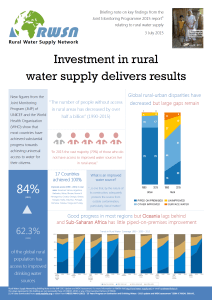
We have pulled together a 2-side briefing note that pulls out some of the headline figures and conclusion on rural water supply. Please download it from:
The new figures from JMP show that most countries have achieved substantial progress towards achieving universal access to water for their citizens.
84% of people living in rural areas now have access to a safe water source in 2015 (up from 62% in 1990)
“The number of people without access in rural areas has decreased by over half a billion” (1990-2015)
17 Countries achieved 100% improved access (1990 – 2015) in rural areas
Global rural-urban disparities have decreased but large gaps remain – 8 out of ten people without access to an improved water source live in rural areas
Good progress in most regions but Oceania lags behind and Sub-Saharan Africa has little piped-on-premises improvement
Find out more by downloading the briefing note – and guess which country made the biggest percentage gain in improved access for its rural population? I almost guarantee it won’t what you expected!
Groundwater is a valuable resource for communities, but accessing and maximising its potential can be difficult. Vincent Casey, WaterAid’s Technical Support Manager for Water Security, introduces a series of videos demonstrating good practice in borehole drilling.
Groundwater is a valuable resource for communities, but accessing and maximising its potential can be difficult. Vincent Casey, WaterAid’s Technical Support Manager for Water Security, introduces a series of videos demonstrating good practice in borehole drilling.
Good practice must be followed if groundwater development programmes are to reach their full potential. If certain steps are not taken, there is a high chance that boreholes will fail, investment will be wasted and people will remain un-served.
Vincent Casey, Technical Support Manager for Water Security
There is a lot of attention for monitoring, and rightfully so. New Information and Communication Technologies (ICT) have opened great possibilities to collect data, store data and visualise data on mobile phones. Maybe some of you already have used mobile phones for data collection. New ICT has brought national scale sector monitoring within reach. It has been done in Liberia, countries in Central America, Ghana, Nigeria, Mali, Ethiopia and many others.
Guest announcement by Rebecca Gianotti, Ph.D., Consultant, Global Water Initiative, The Ohio State University
Deputy Vice Chancellor Shabaan Mlacha of the University of Dodoma signed a letter of intent with leaders at the Ohio State University to develop capacity building programs in rural Tanzania for the entrepreneurial sectors surrounding water (food, energy, health, sanitation).Deputy Vice Chancellor Shabaan Mlacha of the University of Dodoma met with team members of the Global Water Initiative at Ohio State University as well as Tanzanian graduate students studying at Ohio State through another capacity building effort based at Sokoine University of Agriculture (Tanzania).
A new initiative at the Ohio State University that takes a systems approach to rural water development is launching pilot projects in Tanzania. Dubbed Wells to Wellness, the effort combines capacity building and tiered water point rehabilitation activities to provide scalable, sustainable systems solutions to water resource issues. In April, the university signed a letter of intent with the University of Dodoma in Tanzania to develop undergraduate programming that will strengthen the workforce in the entrepreneurial sectors surrounding water (food, energy, health, sanitation). The partnership between the two universities follows the announcement of a 55-MW solar array—the largest ever at a university—to be built by U.S.-based Hecate Energy at Dodoma in 2016. The new training and academic programs at the University of Dodoma will support both the budding renewable energy sector in rural Tanzania as well as a water point rehabilitation project also under Wells to Wellness. This effort will initially retrofit 125 inoperable wells as well as support health, sanitation and economic development with a systems approach incorporating a new franchising model for operations and maintenance as well as key collaborations with existing NGOs in Tanzania. Upon successful completion of the 125-well pilot, the Tanzanian government has provisionally committed to funding rehabilitation of thousands of additional wells by scaling up the model. Continue reading “A New Rural Water Partnership Between The U.S. And Tanzania”





 Rural Water Supply Network - blog