by Jochen Rudolph, African Development Bank (AfDB)
Through its Rural Water and Sanitation Initiative (RWSSI) the African Development Bank (AfDB) was the first donor to support the Senegalese initiative “PEPAM” (Programme Eau Potable et Assainissement du Millénaire) in 2004 and has maintained the close partnership ever since. Looking back at the PEPAM experience, we find that strong and sustained commitment to improving rural water supply and sanitation in Senegal has resulted in more facilities than were originally budgeted for being installed and, as a result, has improved the health and quality of life for a large number of beneficiary villages.
In previous years that I have attended the World Water Week in Stockholm I have never shed tears. This morning was the first time. Alongside the current media attention about Calais in France and the erection of fences to stop migration, or seeking of refuge in the UK, the people of Jordan face a situation on a completely different scale. Jordan’s problem deserves not only much more media attention, but also much more action – and not just short term action!
RWSN is at Stockholm World Water Week. We are at stand B9 and we have discussions and interviews with key experts going on all week. We will keep an up to date schedule here, so keep checking back here through the week.
Wednesday 26 Aug
9am “Future proofing rural water systems” with Susan Davies (Improve International)
1pm “Human Right to Water handbook in the SDG era” with Virgina Roaf and Hannah Neumeyer
2pm “Handpump standardisation” with Jess MacArthur, iDE
3:30pm “Solar pumps and prepayment systems” with Craig Williams and Andre, Water Missions International
Thursday 27 Aug
11am “T-GroUP: Groundwater for the urban poor” with Dr Jenny Grönwall (SIWI)
2pm “Reflections on household water treatment and universal water access” Maria Besteman (Basic Water Needs”
Blog on Self-supply by André Olschewski, Skat Foundation
Self-supply are incremental improvements to access and water quality which are financed by own investments. The Self-supply approach and many more interesting topics have been presented and discussed at WEDC Conference 2015 which took place last week in Loughborough, UK.
Apparently people’s needs and aspirations related to water supply and sanitation and hygiene (WASH) do not always match with the level of service provided by interventions of WASH programmes or to put it differently WASH programmes are not always designed and implemented in a way that they satisfy people needs and aspirations.
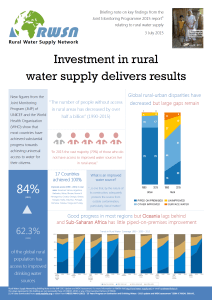
We have pulled together a 2-side briefing note that pulls out some of the headline figures and conclusion on rural water supply. Please download it from:
The new figures from JMP show that most countries have achieved substantial progress towards achieving universal access to water for their citizens.
84% of people living in rural areas now have access to a safe water source in 2015 (up from 62% in 1990)
“The number of people without access in rural areas has decreased by over half a billion” (1990-2015)
17 Countries achieved 100% improved access (1990 – 2015) in rural areas
Global rural-urban disparities have decreased but large gaps remain – 8 out of ten people without access to an improved water source live in rural areas
Good progress in most regions but Oceania lags behind and Sub-Saharan Africa has little piped-on-premises improvement
Find out more by downloading the briefing note – and guess which country made the biggest percentage gain in improved access for its rural population? I almost guarantee it won’t what you expected!



 Rural Water Supply Network - blog