Understanding the Technology Assessment Framework (TAF)

Update on WASHtech

awumbei's avatarWASHTech, THE project (2011-2013)

“Let’s invite WASHTECH to apply the TAF tool on this Household Water Treatment and Storage (HWTS) technology, the communities choices system, to determine whether it needs to be scaled up”. This came up at the 26th edition of the National Learning Alliance Platform meeting, which recently took place in Accra on theme, Household Water Treatment and Storage Strategy in Ghana.

Members of the WASHTech learning alliance at the meeting had to respond by further explaining and updating stakeholders on the project and the TAF. Abu Wumbei of the WASHTech Ghana team explained that the TAF was indeed a tool that could be used to assess the said HWTS technology, but that the tool was currently being tested on some selected technologies; and that these will enable the fine-tuning of the tool to suit the local situation and context. Thereafter, according to him, the tool will be in full operation; owned…

View original post 308 more words

Apples and oranges: a comparative assessment in WASH

Stef Smits's avatarwater services that last

A few weeks ago, an interesting email discussion was held on “water point mapping” D-Group of the Rural Water Supply Network (RWSN). Part of the discussion focused on how much it costs to map or monitor all water systems in a country. Various figures were floating around in the discussion. But when looking at these in more detail, it was like comparing apples to oranges. Some of the costs mentioned had included the staff time of (local) government, others hadn’t, as they considered this to be a fixed cost; some referred only to a simple mapping of water points, others had done a more comprehensive collection of all kinds of data of the water points; some of the data were expressed in dollars per water point, others in local currency per person. So, no immediate sense could be made of the numbers. A former colleague once said: “an apple is…

View original post 1,100 more words

Sustainable water services take ‘Water & Health’ Conference by storm

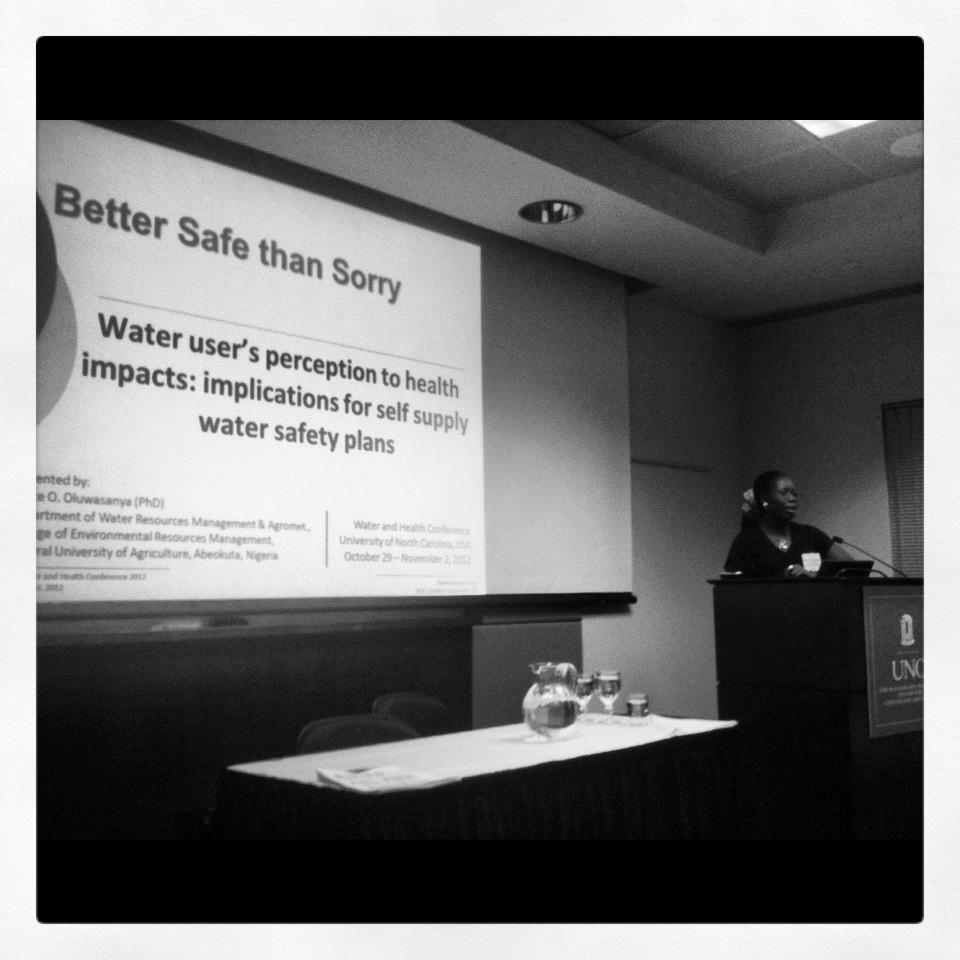
Dr Grace Oluwasanya, Federal University of Agriculture, Nigeria presenting on “Water User’s Perception to Health Impacts: Implications for Self Supply Water Safety Plans”

I was lucky enough to attend this year’s Water & Health Conference at the University of North Carolina. I was even luckier to make it as the skirts of Hurricane Sandy swept up the Atlantic coast before crashing into the American North East.

It was a great opportunity to meet, face-to-face, many RWSN members who have been communicating with online and meet a whole bunch of new people. It was really inspiring to hear their stories and find out more about their organisations and research. Here are just some of my highlights from the event:
Continue reading “Sustainable water services take ‘Water & Health’ Conference by storm”

Experimenting with water service delivery

editor's avatarwater services that last

By Patrick Moriarty

Coming up with a convincing elevator pitch for our Sustainable Services at Scale (Triple-S) project has long been a challenge.  Which, given the complexities of the rural water sector itself, is possibly not that surprising.  Whether defining ourselves (at least in part) as a complexity informed water services development lab will help, remains to be seen – but for us it is progress!

View original post 1,239 more words

FLOWing data

editor's avatarwater services that last

By Patrick Moriarty –

I mentioned some cool new outputs from IRC’s Ghana programme in my previous post.  These factsheets  present a rich picture of water services and their governance based on a total survey in our three Triple-S  focus districts in Ghana.

The fact sheets aren’t cool due to their content – which is actually rather depressing.  What is cool is the technology used for the data collection, the way in which the indicators we used were developed, and the impact that the factsheets are having.

View original post 462 more words

Allocation of funds for district level WASH programmes: What is the ideal formula?

editor's avatarwater services that last

By Lydia Mirembe and Deirdre Casella in Lira, Uganda  –

What started off as a commonplace lecture-like meeting in the Lira District Council Hall, ended up in a spirited discussion about a variety of issues around the delivery of water services in a decentralisation framework. Conditional grants for water and sanitation; mobile phones for water; as well as Hand Pump Mechanics Associations (HPMAs) were the key issues under consideration.

View original post 626 more words