Providing drinking water is not enough to end poverty

by Francis Mujuni, World Vision Uganda

Francis Mujuni, World Vision, Uganda

In his blog post, Henk Holtslag highlighted that muitple use of water is very critical in ending poverty. I have already shown in my earlier discussions that provision of safe drinking water is not enough. In the developing countries where agriculture employs the bulk of the poor people, availability of water for families, their animals and crops is very essential. When we talk of “provision” the quick question is by who? Self supply then becomes the ideal solution. But how many of our governments, Communities and development agencies are promoting this concept? Do they know much about it? Do they know it exist and it is very feasible?

Continue reading “Providing drinking water is not enough to end poverty”

Planning for impact

A very useful update on the Triple-S project

editor's avatarwater services that last

By Patrick Moriarty

Back in June and July of 2012, Triple-S underwent a mid-term assessment (MTA) by an excellent team led by Dr. Ben Ramalingam. The MTA was a hugely useful exercise, allowing the Triple-S team and our partners to take some time out from our day to day work to reflect on how we were doing. The MTA team held up a mirror to us as a project and process – in much the same way that Triple-S seeks to hold up a mirror to the rural water sector – allowing us to have a long hard look at ourselves.

View original post 397 more words

Making sanitation and water accessible to people with disabilities in Uganda

by James Kiyimba, WaterAid Uganda

Pascal Emalu is an old man and resident of Agwajua village, Aweelu parish, Morungatuny Sub County of Amuria district which is over 330 km North East of Kampala. He remembers when young, he was very swift and energetic, doing all his household chores with ease. At 63 years now, he finds problems in doing all what he used to do in his youth full stage.

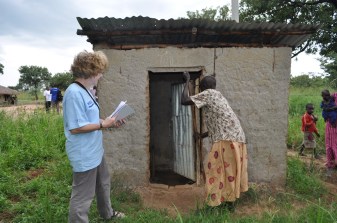
Ijan Janet Norah (old lady) demonstrating to Hazel Johns (WEDC) the challenges she goes through to use a pit latrine Photo: WaterAid / James Kiyimba

“Way back, I could not think of old age as a kind of disability. Now I am vulnerable, I face lots of challenges in squatting to use a latrine,” Pascal says.
Continue reading “Making sanitation and water accessible to people with disabilities in Uganda”

Assessing the potential of solar powered pumping for domestic water supply in Uganda

Update from Uganda on testing the Technology Applicability Framework (TAF) as part of the WASHtech project

sekumapter's avatarWASHTech, THE project (2011-2013)

In Kanungu district of south western Uganda, the Technology Applicability Framework  (TAF) work was used to assess the potential of solar powered water pumping in the country.The exercise involved representatives from the Ministry of Water and Environment, Technical Support Units (TSUs),Kanungu district local governments, local NGOs, research institutions, private sector enterprises and beneficially communities. The assessment was based on the following dimension: social acceptance of the technology in the community, environmental dimension, and affordability of the technology by community members, skills and knowhow.

Solar powered pumping for domestic supply has great potential in Uganda if the following issues are adequately addressed:

  • Scheme operators and beneficially communities should provide adequate security measures to protect solar panels from theft. In addition, communities using solar water powered pumps and bore holes should be able to access loans from banks or financial institutions for replacement of highly expensive scheme components in the event of…

View original post 126 more words

Promising solutions for Operations and Maintenance in rural Uganda

by Francis Mujuni, World Vision Uganda
One of the challenges facing the Water sector in rural areas in Uganda is the non-functionality of hand pumps due unaffordable hand pump spare parts and limited financial base for paying the hand pump mechanics (HPM) and hence a major hindrance in the  access to safe and clean water.
New Picture
Francis Mujuni,
Northern Region Coordinator,
Uganda Water Sanitation and Hygiene Project,
World Vision Uganda

Rural poverty, although not homogeneous, is deep and widespread. The widely cited “dollar-a-day” poverty measure conceals the fact that individuals in many rural Ugandan households handle cash sums much smaller than a dollar. Households and communities where income-generating opportunities are very limited simply cannot pay the tariffs required for hand pump operation and maintenance (O&M). Cash which is always scarce is used for very essential commodities like food and shelter but not for water which traditionally has always been seen as a “God given gift” to humanity to be enjoyed naturally by everyone, freely!
Continue reading “Promising solutions for Operations and Maintenance in rural Uganda”

Apples and oranges: a comparative assessment in WASH

Stef Smits's avatarwater services that last

A few weeks ago, an interesting email discussion was held on “water point mapping” D-Group of the Rural Water Supply Network (RWSN). Part of the discussion focused on how much it costs to map or monitor all water systems in a country. Various figures were floating around in the discussion. But when looking at these in more detail, it was like comparing apples to oranges. Some of the costs mentioned had included the staff time of (local) government, others hadn’t, as they considered this to be a fixed cost; some referred only to a simple mapping of water points, others had done a more comprehensive collection of all kinds of data of the water points; some of the data were expressed in dollars per water point, others in local currency per person. So, no immediate sense could be made of the numbers. A former colleague once said: “an apple is…

View original post 1,100 more words

lieshout's avatarwater services that last

Next week more than 200 practitioners and policy makers from government, civil society, private sector and donors will come together for the annual Joint Water and Environment Sector Review in Uganda to review progress and set-backs during the past year and discuss and decide on priorities for the coming year.  For rural water Uganda is facing a situation where the expansion of coverage of rural water services is stagnating, functionality levels are not increasing and overall sector financing remains at its best stable.

View original post 526 more words

Experimenting with water service delivery

editor's avatarwater services that last

By Patrick Moriarty

Coming up with a convincing elevator pitch for our Sustainable Services at Scale (Triple-S) project has long been a challenge.  Which, given the complexities of the rural water sector itself, is possibly not that surprising.  Whether defining ourselves (at least in part) as a complexity informed water services development lab will help, remains to be seen – but for us it is progress!

View original post 1,239 more words