This is a guest blog by Justine Olweny, a Ugandan WASH entrepreneur and resource centre founder. You can find out more about his activities here.
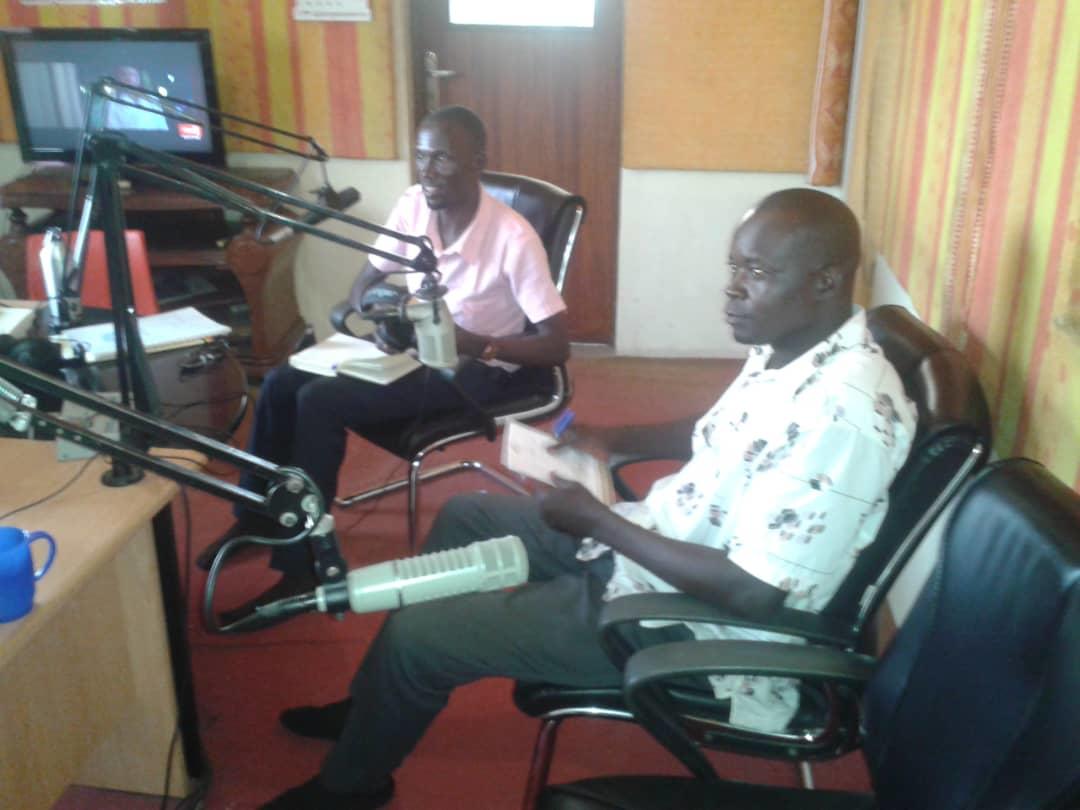
“YOT KOM LONYO” (meaning “Health is wealth”) is a WaSH campaign radio program talk show conducted every Thursday from 16:00–17:00 hours East African Time. It encourages the involvement of local entrepreneurs, school leaders, pupils, politician, district technocrats, and partner representatives on water, sanitation and hygiene (WaSH) promotion discussions. It has promoted the utilisation and ownership of WaSH products among the communities of Kitgum District.
The weekly talk show was started in September, 2018 and has so far covered 7 WaSH topics within 22 episodes.This involves the engagement of eight stakeholders within the region being represented in at least two sessions. This talk show was motivated by the need for community ownership in safe WaSH infrastructures created by difference agencies, including the government.
Mightyfire 91.5FM has a total coverage of about 1,500,000 listeners in Northern Uganda. It has made significant progress in reaching out to the majority of refugees from South Sudan in the local language Acholi, which is spoken by them. The intention was to prepare for the rainy season, which often leads to an increase in the prevalence of waterborne diseases, including cholera, through the production of short radio spots to promote hand-washing with soap before eating and boiling drinking water to avoid illness.
Improved pit toilets (DuraSan and the SaTo pan supported by the “Sanitation as a business” programme of Water for people Uganda) are being constructed by landlords, while demand for improved pit toilets has increased together with the services provided by the pit-emptying gulpers team of the Municipality.
The radio programme materials were developed in accordance with the context, with compelling radio programmes that engage listeners in good hygiene practices, and with references to Lifewater mWaSH and UNHCR WaSH manuals.
Learnings:
The materials and topics discussed are generated by the audience themselves, for example during a school Q&A session, and during interviews
The audience pay a lot of attention to jingles, and they memorise short spot messages instead of the entire radio talk show
It is very motivating for both parents, elders and pupils to listen to their recorded debate play over the radio.
What do you think? How can we create more WaSH service demand using media? Do you have any examples of good WaSH campaigns in the media, that have contributed to behavior change in WaSH? Please share your experiences below.
By Sara Ahrari (Simavi) RWSN Theme Leader for the Leave no one behind Theme.
Simavi’s Programme Manager, Sara Ahrari, moderated a side event during the UNC Water and Health Conference on 1 November 2018. This event was convened by Simavi, Wateraid, Rural Water Supply Network (RWSN),London School of Hygiene and Tropical Medicine (LSHTM) and World Vision (WV). The purpose of this section was to reflect jointly on “who are left behind” from “Use of” and “Participation in decision making processes related to” WASH services, “what are the barriers for their inclusion” and “what can be done and what roles can different WASH stakeholder play to accelerate their inclusion”.
The session started with a short introduction to “Leave No One Behind” Concept in the WASH sector. Afterwards the participants were divided into groups to focus on a specific scenario related to multiple exclusion factors facing by different personas. Initially 8 personas were defined (for elaborated description of the personas, please click here) but based on the number of participants and their interests only 6 personas were discussed in the groups.
The groups were asked to work through the following process to come to recommendations (in form of a pitch) on how “Leave No One Behind” can be reached for the persona in their scenario:
Illustrate using mind map technique draw the barriers faced by the persona as a group
Inspire list anything that inspires them as individuals (people, products, programmes, services, innovations, insights, etc.).
Selection come up with as many ideas/ solutions/ practical recommendation to address the barriers faced by the persona, then cluster all the ideas and select one idea as a group to further work on it
Sketching draw a storyboard using pictures representing the idea or recommendation, who will be impacted by the idea, what would be their experience, the way idea would be rolled out. Prepare your pitch.
Pitch The idea to the plenary in one minute.
After the group work a Ms. Ellen Greggio presented Wateraid experience on using Washington Indicators on disability in their monitoring including the challenges and insights that application of such tool might entail.
Key results of the group exercise
Group 1-Mariette: who lives on daily wages and is a member of WASH committee.
The mind mapping exercise had led to identification of poverty, no support at household when husband is away, time constrain, lack of community support and lack of government support as main barriers faced by Mariette. The selected solutions were:
Share responsibilities: train more members of the committee to be able to do repair work, make sure roles are divided properly and backed up.
Increase awareness among community members/users: to pay their WASH costs (which are affordable) so that the repair work can be paid for; other support in forms of other incentives (i.e. help with the children) and manage expectations
Create a safe platform for everyone to share the experiences and challenges.
An interesting discussion which took place during the group exercise was selection of the “right” person for the committee and “dividing the roles”. While very valid points, one should be careful that defining “right” as people who have time to participate can lead to “leaving those who can’t afford to participate behind”. Also when dividing the roles, it is important to make sure that dominating community role (namely men being the decision maker and women doing the work) will not influence the decision making process. The group pitch can be seen here.
Group 2- Sharon: A young girl living with HIV/AIDS who produces & sells low cost sanitary napkin.
The participants indicated that Sharon is disempowered due to stigma and lack of access to education, has limited voice, suffers from trauma due to loss of her parents and lack of institutionalized support for the poor. The suggested solutions included:
Improved access to WASH services: City authorities, utilities and local government need to ensure that proper pro-poor WASH policies and services are available, provide subsidized tariffs, access to affordable sanitation and hygienic products. Advocacy organisations can influence policies to ensure that this will take place.
Increased learning opportunities: NGOs, faith-based organisations or vocational training institutes can provide skill and entrepreneurship training as well as scholarships.
Enhanced link to social services: Government of NGOs can create youth homes, facilitate peer support and mentorship (female, people with HIV/AIDS and business mentorships).
Group 3- Maria: :A visually impaired girl who is sent out to city to live with her aunt in slum area and earn income through begging on streets.
The main barrier identified for this persona was her visual impairment which in her situation causes dependency on family and strangers for support, poverty, lack of accessible WASH service and transport, unsafe and non-trustworthy environment at home and outside, which leads to mental health problems feeling as a burden and stress.
The group concluded that if Maria can be provided access to school and kept at school, many of these barriers would be overcome. This means that schools need to have inclusive education as well as access to safe sanitation and water. Schools also can facilitate “Eye vision test” and promote measures for preventable visual impairments not to occur. There should be also safe transport to and from school. Also the care-givers (aunt or her family) need to be supported to have increased income. Depending on the country, public awareness raising needs to be done on right to education, children’s right and disability rights. Legal protection and safety nets supports need to be provided to families with people with disabilities. The people with disability also need to be empowered and equipped with skills and knowledge which allows them to live an independent life.
The final pitch of the group can be seen here.
Group 4- Bilegt: A nomad man whose source of water is diminishing and has no access to proper sanitation.
The group had identified the following barriers:
Environmental: harsh environment due to increased effect of climate change and scarcity of water resources.
Social/cultural: due to challenges, there is increased migration to the cities which for Bilegt it means losing “his sense of being” and social support system.
Political: limited political voice and influence of population, conflict with companies, no investment in hydrogeological survey.
Economic: limited access to financial resources, loss of traditional income generating activity.
Physical: difficulty of access due to mobility.
An integrated understanding of solutions, combining bottom-up (socially inclusive) and top-down (sustainable solutions) approaches would be needed according to the group to remove these barriers. The group pitch can be see here.
Group 5- Ruksana: A 15 years old girl without forearms who is pregnant with her 2nd child.
The group identified the main barriers faced by Ruksana to be poverty, lack of support from family or community members, lack of education/trainings, disability, limited availability and distance from water sources, insecure feeling when using the latrine, social stigma inside and outside, married as a child and child pregnancy. The solution thought by group were:
Technological: Accessible toilets with locks which can be operated by people with disability, technology to support mobility, household access to safe drinking water (i.e. through filters).
Services: Accessible education/skill building centres with appropriate courses and technology for people with disability, identification & support by local government, regular follow up/ home visit by government/community health workers, optional services to deliver safe water.
Health: family planning methods (cycle beads), regular home visits by health workers.
Social Engagement & awareness: Awareness raising among different stakeholders (community leaders, men, local government, etc.).
Economic development: Increased livelihood options at the community level.
The group identified access to water and family planning option as priority to improve Ruksana’s situation.
You can see the pitch the group presented here.
Group 6- Amin: A district engineer in charge of WASH service delivery with insufficient resources, needing to prioritise different areas within the district.
Amin’s challenges were found to be rooted in legal, financial, knowledge, political barriers at the national level and cultural, knowledge, communication and financial at the community level. Lack of transparency and proper coordination between these two levels were also identified as a barrier. The solutions suggested by the group were:
Encourage private sector financial investment.
Dedicated structural leadership support to district level staffs.
District management support in communication and planning.
Town halls communicating plans to the communities.
Capacity building at all levels.
Relationship building based on trust.
Cultivating demands and grassroots community planning.
Transfer of power & decision making rights from national to district and lower levels.
The side event had brought together participants from the different background and organisations, namely NGOs, knowledge institutes and government. As we have defined “Active contribution of the participants and lots of ideas not to leave anyone behind” as one of the success indicators for this event, we can say that it a very successful event thanks to the energetic and engaged participants.
We still hope to receive more stories of success (or constructive failures) and increased collaboration on “Leave No One Behind” and to “Reach the Furthest Behind First”. The conveners will continue to promote the dialogue on the topic in different platforms, in particular RWSN “Leave No One Behind” discussion group.
Participants’ feedback
Lena Bunzenmeyer, Global WASH Advisor, CAWST: “ I truly enjoyed the participatory session and I definitely learned a lot. It was by far my favourite session of the entire conference! Would it be possible to get a copy of the PowerPoint presentation that went along with the session? I’d like to bring it up at CAWST as an example of both participatory learning (we love learning new techniques from others!) and also how to approach the topic of inclusive WASH services. Thank you again for your excellent facilitation!”
Accountability is a new topic for the Leave no one behind Theme of RWSN, and one that is difficult to translate in other languages: there is no direct translation of accountability in French and Spanish, for instance – we translated it as ‘responsibility’. In the e-discussion, we initially defined social accountability as ‘an approach that refers to the extent and capacity of citizens to hold the state and service providers accountable, and make them responsive to needs of citizens and beneficiaries’. But through the e-discussion and in particular the webinar, we also heard of initiatives that seek to empower citizens to hold not only service providers (direct accountability) and governments (indirect accountability) for water services, but also donors.
So who should be held accountable for what?
The definition proposed by Catarina Fonseca of IRC, who presented some preliminary findings from a recent study during one of the RWSN webinars, is perhaps more appropriate: she defined accountability as ‘those who are responsible, accept responsibility for their actions and omissions and accept that they are called upon to give an account of why and how they have acted or failed to act.’
While accountability is often a bottom-up process in practice, with citizens and citizens’ organisations seeking to hold service providers, governments and donors to account, duty-bearers also have an obligation to put in place effective accountability mechanisms that lead to actionable change. The study Catarina presented showed that accountability mechanisms for SDG6 for service providers and governments are often not available in many countries, and that when they exist, they are not effective and not systematic due to the lack of financing, lack of monitoring data and reporting, and limited participation of civil society organisations.
What about donors’ accountability? According to Susan Davis from Improve International, most foundations do not prioritize evaluation of WASH projects post-implementations, which impedes learning and improving accountability for the end-users. Moreover, when they do conduct evaluations, they may not share the results – or have no incentive to share results showing poor performance of WASH services. Susan proposed a WASH donor accountability scorecard which would foster a culture of accountability and transparency through virtuous competition amongst donors to disclose the results of evaluations.
I’ve just returned from Liberia, where Kerstin Danert and I, together with Caesar Hall and Jenny Schmitzer are coaching, training and mentoring staff across from government agencies to prepare the first a Sector Performance Report (SPR) for Liberia. Ultimately, this this could become an annual report for the whole WASH sector across the country. It pulls together data from different sources and provides the evidence base for making decisions decisions and prioritising at the second annual Joint Sector Review (JSR) – a two day workshop of around 200 stakeholders that will happen at the beginning of May.
An Afridev handpump in central Monrovia, behind the Ministry of Education (photo: S. G. Furey, Skat, 2014)
The approach, in this form, was pioneered by the Ministry of Water & Environment in Uganda ten years ago. A decade later, it is the primary mechanism for coordinating WASH actors across government, NGOs and Development Partners, and for reporting activities, outcomes and priorities for the coming year in Uganda.
This is not an easy. It has been a challenging, but rewarding, process and it has been a long journey for Uganda, and Kerstin was there, coaching and cajoling for the first seven SPRs (SSOZI, D. and DANERT, K.,2012). For this reason, the Water and Sanitation Program (WSP) invited us to Liberia to support the government as they start on this long journey.
Similar to Uganda when it started, Liberia is now a decade clear of a long and often brutal civil war. The physical and government infrastructure, which was weak to begin with, was largely destroyed and the social scars still have a rawness. Liberia has a unique history in that it was founded by American freed slaves, but resentment between Americo-Liberians and those of indigenous descent added fuel to the fire of the brutal wars that took place between 1989-96 and 1999-2003.
The current president, H. E. Ellen Johnson Sirleaf, was the first woman to be elected as a head of state in Africa and she has been a unifying voice both at home and abroad. She is also the UN Goodwill Ambassador for Water, Sanitation and Hygiene (WASH) so the sector has a champion at the highest level.
However, responsibility and scarce resources for WASH are split between around nine different ministries and government agencies. Policy and strategy has been established, thanks to strong support from UNICEF, WSP and bi-laterals such as IrishAid,and USAID. There are also several other development partners in the country . However, implementation through government has been slow, for example the rural water division of the Ministry of Public Works has no budget for implementation for the current year. Stuff is happening: water and sanitations systems are being built and hygiene and CLTS is going on at quite a large scale, but it is NGOs, not government who are doing the spade work.
Is this a problem? Short term maybe not, because the needs of the people are great, but without a strong, capable government there can be no end to dependence on international aid funding international NGOs, neither of whom are directly accountable to the people or leadership of Liberia. We shouldn’t expect the private sector to ride the rescue either: where there is social and environmental responsibility, a fair, strong Government regulator is essential.
Information flows: so that stakeholders really know who is doing what, and where so that collaboration is improved and duplication avoided.
Writing: literacy, touch-typing, analytical thinking; articulating persuasive and logical arguments; self-critical review and proof reading.
Presentation: structure, content and timing, voice and body language, listening and responding.
These, and many other communication and analytical skills, seem so obvious that surely to consider them in the context of experienced, national government staff could be considered patronising. However, during the war they would have been less worried about using PowerpointPowerPoint and more worried about avoiding the likes of ‘General Butt Naked’ (CNN report). Fragile States are exactly that.
Mapping information flows in the Liberia WASH Sector with the National Water, Sanitation and Hygiene Promotion Committee (NWSHPC) – Abdul, Watara, Joseph, Kerstin (photo: S G Furey, Skat 2014)
While many of the staff we have met are knowledgeable and committed, there is need to build morale and confidence; so even they not only improve their reporting and analytical skills but also have the confidence to really commit them to paper.
So what’s the answer? Perhaps hire some international consultants to come in and write a thick report “for government”. WSP didn’t want us to do that and there was no way we going accept the task if that had been the case. The 2014 Liberia SPR will be written (mostly, though not entirely) by Liberians.
To achieve that, where capacities are low, and experience lacking we ran a four day writing course then followed up remotely, and in person, with each team of writers who were charged with creating thematic mini-reports on rural water, sanitation, hygiene, gender, urban water and sewerage, solid waste management and water resources.
This is a tough process for all involved. For the ministry staff, they have been chasing around bringing together the data and activity reports that are often scattered around their organisations or guarded. In certain cases, the process uncovered new data sources from Government officials – in particular the data collected through surveys and publishes by Liberia Institute of Statistics and Geo-Information Services (LSGIS).
For us it has been tough to resist the temptation to dive in and write it all for them. On occasion I give in where it was clear that the data analysis and presentation would take much more time than we had available and I couldn’t leave it. But as I write this, the writers were spending two days to review the entire report; and decide what to change.
However, the pleasure came from seeing the final product start to emerge and the shared sense of accomplishment.
So have we strengthened the capacity of the WASH sector to go it alone? No. Clearly not, and as I write this I still don’t know whether this approach will work, but the process so far as proved to be as valuable as, hopefully, the final report will be. The international community will still have a crucial role in tackling the chronic poverty found across Liberia, but that role needs to diminish with time as Liberian institutions take over.
From what I experienced, I saw the importance of education and mentoring to develop skills and confidence to discharge duties effectively, but that alone is not enough. Karwee Govego, Director of Rural Water, complained that their best staff get poached by NGOs. That ‘brain drain’ is inevitable as long as salaries and morale are low, management and mandates are disorganised, and career paths are determined by more than than merit.
Love it or hate it, government is essential; to build a strong, competent one in Liberia is going to take a lot of teamwork, hard graft and getting the basics right.
—-
Liberia is an active member of the Sanitation, Water for All (SWA) Partnership and will be presenting a new set of commitments at the High Level Meeting in Washington DC this month



 Rural Water Supply Network - blog