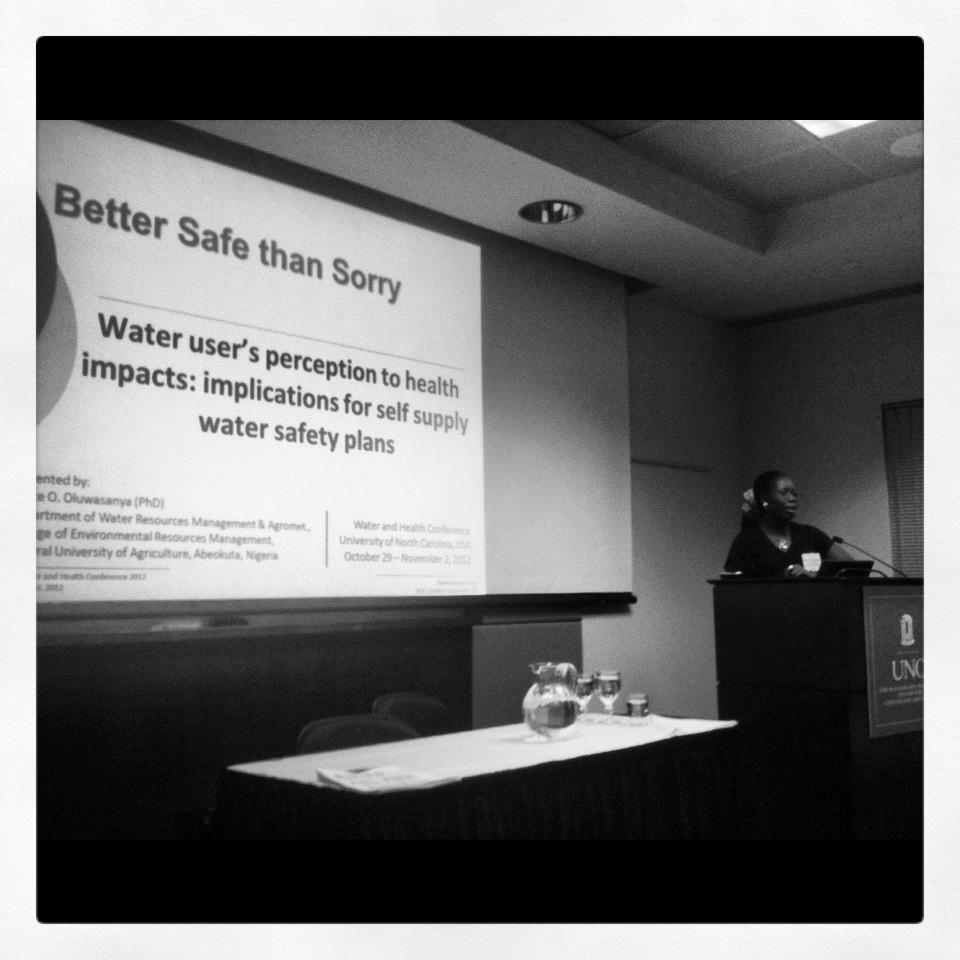
Dr Grace Oluwasanya, Federal University of Agriculture, Nigeria presenting on “Water User’s Perception to Health Impacts: Implications for Self Supply Water Safety Plans”
It was a great opportunity to meet, face-to-face, many RWSN members who have been communicating with online and meet a whole bunch of new people. It was really inspiring to hear their stories and find out more about their organisations and research. Here are just some of my highlights from the event: Continue reading “Sustainable water services take ‘Water & Health’ Conference by storm”
Coming up with a convincing elevator pitch for our Sustainable Services at Scale (Triple-S) project has long been a challenge. Which, given the complexities of the rural water sector itself, is possibly not that surprising. Whether defining ourselves (at least in part) as a complexity informed water services development lab will help, remains to be seen – but for us it is progress!
This blog is by Susan Davis, executive director of Improve International, an organization focused on promoting and facilitating independent evaluations of WASH programs to help the sector improve. She has more than 13 years of experience in international development and has evaluated WASH and other programs in 16 developing countries. Her first career (8 years in environmental consulting) involved projects like combining databases across the 10 US Environmental Protection Agency Regional offices, which is where her respect for unique identifiers was born.
What is a unique identifier?
You probably don’t think of it, but you use unique identifiers every day. In the US, your social security number is your unique identifier for the government (which is why if someone has it they can steal your identity). Your bank account number helps the bank track all information associated with you.
What is a physical unique identifier?
Well, your house has one – in the form of an address. Your car has one – the vehicle identification number. The license plate might count but it is too easily removed. My dog has an identification chip embedded between her shoulder blades because her license tag could easily come off with her collar. A physical unique identifier needs to be permanent – long lasting in tough conditions, and not easily removed. Continue reading “Why physical unique identifiers on water points will improve sustainable services”
As argued several times in this blog, post-construction support is one of the keys to sustainability of rural water supplies. One element of post-construction support is monitoring of aspects such as service levels and the performance of service providers, through which the support providers can better target their assistance. The last few years have seen a boom in efforts to set up information and monitoring systems of rural water supplies in many countries. Some were in first instance a one-off mapping exercise of all water points in a country; others were developed with the aim of regular updating for ongoing monitoring purposes. Particularly, cellphone technology has been instrumental in speeding up this process, as it is used in systems like FLOW (Field Level Operations Watch). A key question that comes back in the discussions on the topic (see for example the excellent discussion on the Rural Water Supply Network’s
RWSN is hosting two lively discussions about water point mapping (wpm), one on the RWSN LinkedIn group, and the other at the RWSN Dgroups space. This blog provides a summary of the LinkedIn discussion.
For those of you who are completely new to water point mapping, the next section gives a basic introduction (adapted from Mobile Phones and WPM).
Introduction to Water Point Mapping
Chadian women revert to drawing water manually, after pulley system fails. (c) Jean Claude Balcet
• Water point mapping is essentially about creating databases, or inventories, of individual water points (standposts, handpumps, etc.) The information can then be used for a variety of purposes: investment planning, advocacy, analysis of various sorts (e.g., most common reasons for non-functioning water points), and so forth. The data on physical locations can be used to create maps of water points, but all kinds of additional visualization and analysis (tables, charts, statistics, etc.) are possible .
• Technology has revolutionized water point mapping, and field surveys generally. Gone are the days of paper questionnaires, manual data entry, and monopoly control over how and when the data are analyzed. Instead, the data collector enters the information on a mobile phone, from which it can be uploaded into a database on the Internet, and analyzed by users located anywhere with Internet access, using software that makes it easy to analyze and present the data in a variety of ways.



 Rural Water Supply Network - blog