African Water and Sanitation Academy (AWASA): The International Resource Centre (IREC) of NWSC, Kampala, Uganda ; your Hub for Africa

AfWA RELEASE

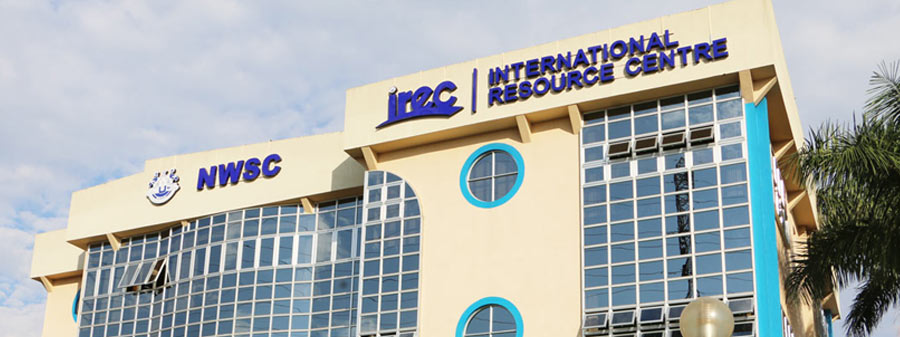
As part of the implementation of its Business Plan 2018-2022, the African Water Association (AfWA), will be structuring the coordination of all its training activities in the framework of the operationalization of the African Water and Sanitation Academy (AWASA). This will involve setting up a coordination hub headquartered at the International Resource Center (IREC) of the National Water and Sewerage Corporation (NWSC) in Kampala- Uganda, from which training shall be deployed in different Operational training centers managed by its members in the regions such as:

  • Rabat-Morocco, at ONEE’s International Institute for Electricity and Potable Water
  • Ouagadougou-Burkina Faso, at ONEA’s Training Center for Water Works; the National Office for Water and Sanitation
  • Kampala-Uganda, at International Resource Center (IREC) of National Water and Sewerage Corporation (NWSC)

Other centers are in the process of being identified.
To initiate the process of creating AWASA, AfWA Executive Board made the resolution, during the ordinary session held on July 19, 2018 in Kampala- Uganda, to set up a Working Committee led by Professor Hamanth KASAN, President of AfWA Programs Committee. This committee is expected to develop and coordinate all procedures to provide AWASA with an updated Business Plan, identify all partners including universities, centers of excellence in the water and sanitation sector in Africa and in the world, development partners/donors, African water organizations, etc. in order to ensure that AWASA Director’s recruitment process is initiated by December 2018, ensuring the start of AWASA activities by January 2019.

photo credit: NWSC/AfWA

Technovation Rush: Are developing countries ready?

by Takudzwa Noel Mushamba, WASH & Infrastructure Coordinator at Danish Refugee Council / Dansk Flygtningehjælp

re-posted from: https://www.linkedin.com/pulse/technovation-rush-developing-countries-ready-takudzwa-noel-mushamba/

Failure of technological innovation in the water and sanitation sector.
Across the globe there is growing momentum to address emerging and traditional threats to the water and sanitation sector through innovative technology. As a result, without thinking twice governments and practitioners have jumped on to the technology bandwagon. In the last decade there have been massive investments in technological innovation in the sector in developing countries. Furthermore, there are numerous articles that narrate how technology can help advance the water and sanitation sector in the developing world. There is no doubt there are some benefits emanating from the use of technology be it ICT or new technology introduced to operate and or manage water and sanitation systems. Regardless, the question is to what extent is the technology in question effective and is it introduced at right time?

Continue reading “Technovation Rush: Are developing countries ready?”

Vers des services d’eau durables en milieu rural en République Démocratique du Congo

par Gian Melloni, Maria Livia De Rubeis et Kristina Nilsson du Consortium WASH RDC

En 2013, l’idée que les communautés rurales payent pour les services en eau était relativement nouvelle en RDC : dans le secteur WASH il y avait le sentiment que le contexte était trop fragile pour que la gestion communautaire des services WASH ruraux soit efficace. Mais, avec des taux d’accès à l’eau très limités, une population en rapide croissance et des infrastructures hydriques très peu fonctionnelles, quelque chose devait bien changer.

Lorsque le Consortium WASH RDC a été inauguré la même année, il n’y avait pas beaucoup d’expériences passées dans le pays qui pourraient témoigner de la capacité et volonté des communautés rurales à payer pour l’eau. L’ambition du Consortium WASH RDC était donc élevée : cinq ONG internationales lançant un programme de six ans en appui aux communautés locales pour la gestion financièrement viable des services WASH dans la RDC rurale. Financé par UK-Aid, le Consortium WASH RDC réunit les compétences de son agence lead Concern Worldwide et d’ACF, ACTED, CRS et Solidarités International pour assister plus de 600 communautés rurales et 640000 personnes dans sept provinces du pays.

Cinq ans plus tard, avec une multitude de données désormais à notre disposition, nous avons voulu répondre à certaines questions clés : dans quelle mesure les communautés rurales appuyées par le Consortium réussissent-elles à gérer les services hydriques d’une manière financièrement autonome? Et qu’est-ce qui fait le succès d’une communauté?

Le Consortium WASH RDC a développé une méthodologie inspirée des « Life-Cycle Costs » de l’IRC, que nous avons appelé «l’Approche Economique». Nous aidons les communautés à développer des compétences managériales, financières et techniques pour que leurs infrastructures WASH restent fonctionnelles longtemps après la construction, en identifiant trois niveaux progressifs de succès (ou « Equilibres ») dans la couverture des coûts liés aux points d’eau au fil du temps :

RDC1
Figure 1. Les trois Equilibres utilisés par le Consortium WASH RDC

Notre objectif est que les communautés réunissent suffisamment de fonds pour couvrir au minimum les coûts de l’Equilibre 1, avec les communautés les plus engagées atteignant l’Equilibre 2 ou 3. Tels fonds sont collectés et gérés par des comités élus par les communautés et formés par le Consortium WASH RDC. Pour créer les conditions pour la réussite et éviter toute logique de « don gratuit », nous clarifions aux communautés dès le début que nous les appuyons avec l’installation du point d’eau seulement si elles démontrent leurs engagement et capacité à prendre en charge les coûts de gestion du point d’eau.

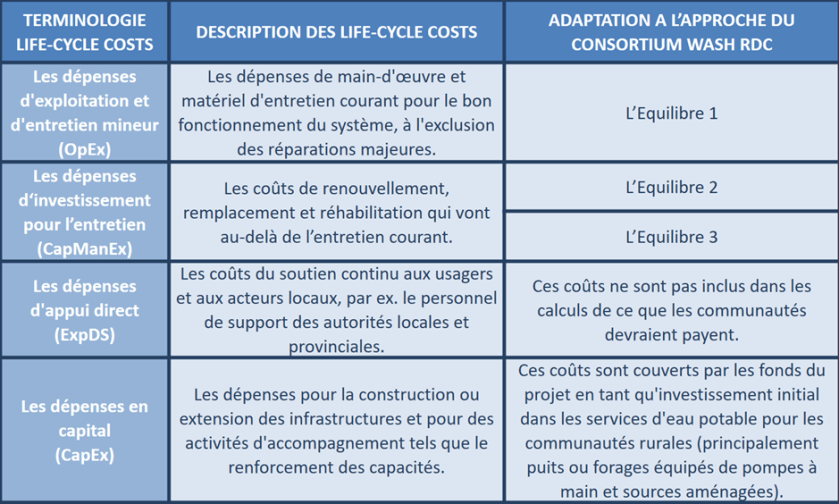
Les trois Equilibres d’Approche Economique ne correspondent pas exactement aux catégories des « Life-Cycle Costs », et certaines modifications ont été apportées en fonction du contexte de la RDC rurale. Le tableau ci-dessous montre une approximative conversion de ces principes en les Equilibres du Consortium WASH RDC :

RDC2
Figure 2. L’adaptation des « Life-Cycle Costs » par le Consortium WASH RDC

Et cette Approche Economique, fonctionne-t-elle? Au bout de cinq ans, nos données montrent qu’elle peut fonctionner même dans des contextes difficiles : jusqu’à présent, environ deux tiers des petites communautés rurales appuyées par le Consortium WASH RDC ont réussi à atteindre un certain degré d’autonomie financière et de pérennité. C’est-à-dire, elles ont atteint au moins l’Equilibre 1. Compte tenu des défis auxquels ces communautés (généralement d’autour de 1000 personnes) sont confrontées dans cet environnement, il s’agit d’un résultat provisoire encourageant.

Nous avons identifié des modèles opérationnels qui aident les comités WASH à atteindre ces Equilibres. Les comités qui ont choisi des sources de revenus diversifiées, en associant les contributions des ménages et les activités génératrices de revenus, réussissent nettement mieux que les comités qui ne comptent que sur les contributions des ménages. Les communautés souvent apprécient ce modèle et voient l’investissement dans des activités génératrices de revenus comme un moyen de protection contre le risque de détournement de fonds. Dans l’ensemble, les activités génératrices de revenus semblent bien s’intégrer dans la gestion communautaire des services WASH dans la RDC rurale.

Dans un contexte si fragile, une grande majorité des communautés décident d’identifier des personnes ou des groupes particulièrement vulnérables et de leur offrir l’exemption du paiement des frais communautaires d’eau. Les communautés qui adoptent cette pratique ne parviennent pas moins à atteindre l’autonomie financière que les communautés qui n’offrent pas d’exemptions. Il s’agit d’une constatation importante en particulier dans une prospective de développement sensible aux besoins des plus pauvres, soulignant que l’accès équitable à l’eau n’est pas en contradiction avec la pratique de payer pour l’eau ou avec le but de la pérennité des services.

Egalement, les communautés qui choisissent de rémunérer certains membres du comité d’eau semblent renforcer leur réussite dans l’atteinte des Equilibres d’autonomie financière les plus élevés. Par exemple, certaines communautés paient un petit montant à la personne qui enregistre les usagers ou qui s’occupe de la collecte des frais d’eau. Alors que jusqu’à présent seulement une minorité de communautés a adopté un tel système de rémunération, leur succès dans l’atteinte des Equilibres 2 et 3 suggère qu’une forme de gestion semi-professionnalisée peut devenir plus efficace que le pur bénévolat.

Tout cela montre que les acteurs de développement, même dans des contextes difficiles, peuvent et doivent concevoir des interventions WASH visant des services à long terme qui puissent aller au-delà des résultats immédiats. Egalement, les décideurs peuvent bien adopter le principe de non-gratuité du service hydrique, tout en conciliant la viabilité financière avec des politiques d’inclusion et en faveur des plus pauvres. A travers le Consortium WASH RDC, nous avons appris la leçon que les communautés rurales en RDC sont prêtes à s’engager pour surmonter leurs difficultés et à développer des capacités en gestion durable des services d’eau. Cela ne se produit pas facilement ou par hasard, mais grâce à une programmation soigneusement conçue et mise en œuvre qui valorise les communautés locales.


Photo : Un comité de gestion d’eau à Manono, Tanganyika, RDC, montre les cahiers comptables qu’il utilise pour suivre les coûts et les revenus du point d’eau communautaire. Source: Consortium WASH RDC, 2016.


Le Consortium WASH RDC est un programme de Concern Worldwide avec la participation d’ACF , ACTED , CRS et Solidarités International, financé par UK-Aid. Veuillez trouver plus d’infos en français et en anglais sur consortiumwashrdc.net. Gian Melloni est le directeur du Consortium WASH RDC et vous pouvez le contacter à gian.melloni@concern.net. Maria Livia De Rubeis est la responsable de communication, plaidoyer et apprentissage. Kristina Nilsson est la responsable du suivi et évaluation. Les opinions exprimées par les auteurs pourraient ne pas refléter les opinions de Concern Worldwide ou des autres organisations citées.

Tracing a path to sustainable rural water services in the Democratic Republic of the Congo

by Gian Melloni, Maria Livia De Rubeis, and  Kristina Nilsson of the DRC WASH Consortium 

In 2013, the idea of rural communities paying for water services was relatively new in DRC: there was a belief in the WASH sector that this context was too fragile for community management of WASH services to be possible.Yet with extremely low access rates, a fast-growing population, and especially poor functionality of water infrastructure, something needed to change.

When the DRC WASH Consortium started that same year, there was no past experience in the country which could confirm rural communities’ willingness or ability to pay for water. The DRC WASH Consortium’s ambitions were high: five INGOs launching a six year programme to support local communities in managing and financially sustaining WASH services in rural DRC. Funded by UK-aid, the DRC WASH Consortium gathered the know-how of lead agency Concern Worldwide with ACF, ACTED, CRS, and Solidarités International to work with more than 600 rural communities and 640,000 people across seven provinces.

Five years later, with a wealth of project data at our disposal, we wanted to answer some key questions: To what extent do Consortium-assisted rural communities succeed in managing their water services in a financially self-sufficient way? And what makes a community successful?

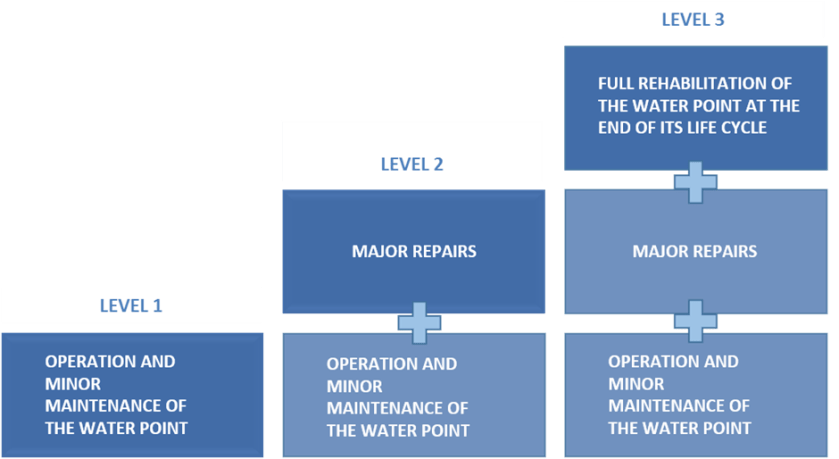
The DRC WASH Consortium developed a methodology inspired by IRC’s Life-Cycle Costs, which we call the “Economic Approach”. We support communities in developing managerial, financial and technical skills to keep their WASH infrastructure functioning long after construction, identifying three progressive levels of success in covering the costs associated with water points over time:

Figure 1 DRC
Figure 1. The three Levels used by the DRC WASH Consortium

The objective is that communities raise sufficient funds to cover Level 1 costs as a minimum, with the most committed communities reaching Levels 2 and 3. These funds are collected and managed by elected committees, trained by the DRC WASH Consortium. To lay the foundations for this success and to avoid expectations of handouts, we’ve said from the start: we will support communities by installing water points only if they prove their commitment and ability to take care of water point management costs afterwards.

Our three Economic Approach Levels do not exactly match with the Life-Cycle Costs categories, and some modifications have been made according to the context in rural DRC. Here you can see an approximate conversion table showing how the DRC WASH Consortium adapted these principles:

Figure 2 DRC
Figure 2. Adaptation of the Life-cycle costs by the DRC WASH Consortium.

And does this Economic Approach work? After five years, our program data shows it can, even in this difficult context: so far, about two thirds of the small rural communities assisted by the DRC WASH Consortium have succeeded in achieving a degree of financial self-sufficiency and sustainability –that is to say, have reached at least Level 1. Given the challenges these communities (typically of only around 1,000 people) in this fragile environment face, this is an encouraging provisional result.

We’ve identified some operational models which support WASH committees in reaching these Levels. Committees that have chosen diversified revenue streams, combining household collections with revenue-generating activities, are markedly more successful than committees relying only on collections. This approach is often welcomed by communities who see investments in revenue-generating activities as a means to protect finances against misappropriations. Overall, revenue-generating activities seem to fit well with community management of WASH services in rural DRC.

In such a fragile context, most communities choose to identify people or groups who may be particularly vulnerable and offer them exemptions from paying community water fees. Communities who do so are no less successful in reaching the Levels of financial self-sufficiency than communities who do not offer exemptions. This is an important finding particularly in light of pro-poor and needs-based principles of development, underlining that aiming for equitable access isn’t at odds with the practice of paying for water or the goal of sustainable services.

Communities opting to remunerate some water management committee members also seem to improve their success in reaching higher Levels of financial self-sufficiency. For example, some communities pay a minimal amount to someone who keeps records of water users or who collects payments. While so far a minority of communities have opted for these remuneration systems, their success in reaching especially Levels 2 and 3 suggests some form of semi-professionalised management can be more effective than pure volunteerism.

Overall, this shows that development actors even in difficult contexts can and should design WASH interventions to focus on longer-term services, looking beyond just immediate achievements. It shows policy-makers can embrace water service payments by users even while balancing financial viability of services with pro-poor and inclusive policies. We have learned through the DRC WASH Consortium that rural communities in DRC are willing to invest to overcome challenges and can develop the capacities to manage water services in a sustainable manner. This doesn’t come easily or by chance, but through carefully designed and implemented programming which empowers local communities.


Feature photo: A WASH management committee in Manono, Tanganyika province, DRC, looks at the financial records they keep to monitor costs and revenues for managing their community water point. Source: DRC WASH Consortium, 2016


The DRC WASH Consortium is a programme of Concern Worldwide in consortium with ACF, ACTED, CRS, and Solidarités International, and funded by UK-aid. More information – in both French and English – can be found at consortiumwashrdc.net. Gian Melloni is the Director of the DRC WASH Consortium and can be reached at gian.melloni (at) concern.net. Maria Livia De Rubeis is the Communication, Advocacy and Learning Manager. Kristina Nilsson is the Monitoring and Evaluation Manager. The views expressed by the authors may not reflect the views of Concern Worldwide or of any of the organisations mentioned.

Achieving Professional and Sustainable Drilling in Madagascar? Yes, we can!

Guest blog by Charles Serele, UNICEF Madagascar

As part of its Water, Sanitation and Hygiene (WASH) program in Madagascar, UNICEF is committed to supporting the Ministry of Water, Sanitation and Hygiene (MWSH) to build the capacity of the drilling sector. With this in mind, UNICEF organized a training on “Drilling Techniques and Supervision” in collaboration with the MWSH. The training targeted various stakeholders in the water sector, including government departments, drilling companies and consultancy firms who manage water supply projects, supervise or drill boreholes.

The training was held in Antananarivo (Madagascar) and organized in three different sessions of three days each, from February 7th to 23th, 2018. Fifty-four participants, including fifteen women attended the training course. The training was facilitated by Charles Serele, an experienced WASH Specialist from UNICEF Madagascar.

madagascar

To enhance individual knowledge and ensure sharing of experiences among participants, the overall approach used to deliver the course involved a mixture of lectures, interactive discussions, group exercises and presentation of drilling videos. Extensive reading materials from RWSN and UNICEF were shared along with exercises to be carried out by the participants.

The course participants actively engaged in the discussions and group activities. The training provided an opportunity to learn from each other and to reflect on what can be improved.

Course Modules

1.      Professionalization of the drilling sector

2.      Methods of borehole siting

3.      Construction of boreholes

4.      Supervision of boreholes

5.      Management of drilling data

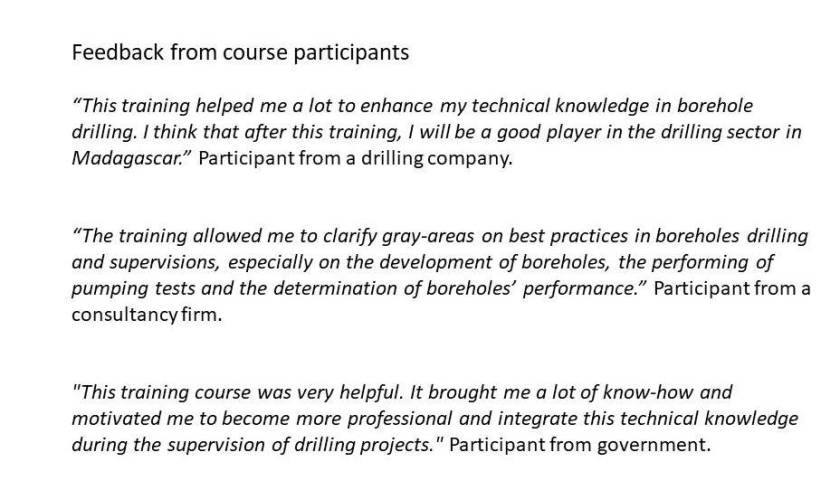
The course review showed that participants’ technical knowledge in borehole drilling and supervision greatly improved. Participants also expressed their satisfaction with the course content and the relevance of the topics that were covered.

Forty-five participants (83%), including fourteen women passed the evaluation test conducted on the last day of the training. During the official closing ceremony each successful participant received a poster on cost-effective boreholes, in addition to a certificate.

As a next step, a field-based training should be organized to better illustrate best practices in drilling professional and sustainable boreholes.

Feedback2

madagascar2

Additional resources


The training course was facilitated by Charles Serele, UNICEF Madagascar and organized under the supervision of the Chief of WASH, Silvia Gaya and with the support of the UNICEF WASH team. For additional information, contact UNICEF Madagascar on antananarivo@unicef.org.


Favouring Progress: Yemen’s Water Scarcity Dilemma of the 21st Century

Our RWSN Guest blogger Muna Omar takes a critical look at the issue of dwindling water supply in Yemen’s capital city

The population of Sana’a, the capital city of Yemen, depend on deep wells that are usually dug to a maximum depth of 200 meters for their drinking water. The wells draw on a cretaceous sandstone aquifer northeast and northwest of the city, with a third of the wells operated by the state-owned Sana’a Local Corporation for Water Supply and Sanitation drilled to 800 to 1,100 meters. The combined output the corporation’s wells barely meet 35% of needs of Sana’a growing population which includes displaced people, asylum seekers, refugees and other newcomers.

Public piped water delivery is once every 40 days to some houses, while others don’t receive piped water at all. Sana’a’s population is thus supplied either by small, privately owned networks, hundreds of mobile tankers and water from people’s own private wells. As water quality has degenerated, privately owned kiosks that use a water filtration method to purify poor-quality groundwater have spread in Sana’a and other towns. Many people rely on costly water that is provided by private wells supplying tankers. These tankers don’t really consider appropriate cleaning, so the quality of the water is questionable.

Despite the challenges with pumping due to a shortage of fuel and with rising prices, private well owners are trying to capture the remains of the valuable groundwater resources before their neighbours do. Coupled with the on-going war, drought sees Yemen facing a major water crisis. Water table data is based on old research which can be challenging to verify now. Given the data and the current severe situation as water use exceeds aquifer recharge, it is estimated that the water table drops by approximately 2-6 feet annually.

Although Sana’s groundwater is probably the best water in Yemen, it is considered below acceptable standards for human consumption as water infrastructure has been damaged by warplanes and the sanitation workers went on strike because they didn’t get their salary. The latter left plenty of garbage on the streets that led to contamination of drinking water supplies. Meanwhile wastewater began to leak out into irrigation canals and contaminate drinking water supplies. Inadequate attention to groundwater pollution has directly affected the quality of Sana’a’s drinking water supplies.

It Yemen, as a whole, it is estimated that about 14.5 million people don’t have sustainable access to clean drinking water. Inadequate water supply has affected the country with the worst outbreak of cholera in the human history. Over 1 million suspected cases of cholera have been reported in Yemen from 27 April 2017 to present day. Other water-borne diseases include a recent peak in diphtheria that reached 1,795 probable cases with 93 Associated Deaths and a case fatality rate (CFR) of 5.2% by 19 May 2018.

Yemen’s water problem is not only immediate with groundwater resources under pressure as never before to meet not only drinking water needs, but also demands for irrigation. In Yemen, the pressures of climate change, demographic change and the on-going conflict place an immense burden on professionals working in the country. The enormity of the urgent needs mean that water resources management is neglected, despite being absolutely essential for the future of Yemen’s population.

Sana’a groundwater resources are significantly depleted in many areas and acknowledged globally as one of the world’s scarcest water supplies. Sana’a may be the first capital city in the world to run out of water. Looking forwards, how can the country produce more food, raise farmer incomes and meet increase water demands if there is less water available?

Clearly, there are several interrelated aspects contributing to the current water crisis in Sana’a specifically and Yemen in general, and the population has to innovate to find solutions. Future supply options include pumping desalinated water from the Red Sea over a distance of 250 km, over 2,700 meter-high mountains into the capital, itself located at an altitude of 2,200 meters. However, the feasibly of this is questionable with the enormous pumping cost would push the price of water up to $10 per cubic meter. Other options to supply Sana’a from adjacent regions are fraught due to water rights.

Groundwater data is the critical foundation for water managers to both prevent problems and formulate solutions. Data is lacking in many of Yemen’s groundwater basins. Even heavily used basins have no record of how much groundwater was withdrawn and remains in the aquifers, where it was pumped from? Nor are adequate data available on groundwater quality or aquifer characteristics. Furthermore, while the drought and other cutbacks on surface water supplies are motivating groundwater users to drill new or deeper wells in increasing numbers despite the fact that well owners don’t know how their aquifer is doing and so can’t anticipate changes. There is lack of data on private wells.

Lack of groundwater data in Yemen is not the result of ignorance about its importance, but is rather the victim of chronic underfunding and politics, which have been exacerbated by the on-going conflict. The war has made it almost impossible to measure and manage groundwater development and secure its long-term sustainability.

Having just completed the online course on “Professional drilling management” led by Skat Foundation, UNICEF, and the United Nations Development Programme Cap-Net, I have learned about the need to develop our knowledge in this regard. The course highlighted important immediate and long-term actions for Yemen:

  • Raise awareness within Yemen of the groundwater issues faced by the country.
  • Find practical ways to better understand groundwater, regulate its extraction, introduce control mechanisms and engage with the local population to develop effective actions.
  • Build capacity of government, NGOs, consultants, policy makers and beneficiaries through training in groundwater management.
  • Invest in building rain-water harvesting facilities in rural areas so the people don’t have to walk miles to collect water.
  • Invest in re-building infrastructure alongside improving water resources management.

Muna Omar is an Ethiopian refugee and a young water professional, living and working in Sana’a, undertaking monitoring and evaluation of humanitarian programmes in the water, sanitation and hygiene (WASH), health and nutrition sectors such as a cholera-response project, and an executive assistant with a local NGO.

This article was first published in GeoDrilling International and is reproduced with permission and thanks.

Why getting ‘water affordability’ right matters – and how water diaries can be of help

re-posted from REACH

Dr Sonia Hoque, University of Oxford

Having access to 24/7 potable piped water in the comfort of our dwelling is a luxury that many of us take for granted. In the UK, an annual water and sewerage bill of £400 accounts for about 1% of the annual average household income of £40,000. This ‘safely managed’ water service, defined as having access to an improved source within one’s premises, is well within the widely established global affordability threshold of 3-5% of one’s household income. Estimating payments for water as a percentage of households monthly expenditures may adequately reflect ‘affordability’ in contexts where households have connections to piped water systems or rely on paid sources only.

Continue reading “Why getting ‘water affordability’ right matters – and how water diaries can be of help”

Responding to UN-Water SDG6 synthesis on water and sanitation

by Sean Furey, Skat Foundation/RWSN Secretariat Director

UN Water, the body that coordinates water issues across the United Nations, is currently running a consultation in its draft report: “SDG 6 Synthesis Report 2018 on Water and Sanitation”. You can read the report and add give your feedback. Below are some comments that I have posted in the dialogue section:

Continue reading “Responding to UN-Water SDG6 synthesis on water and sanitation”

Three common myths about solar-powered water pumping

By Andrew Armstrong (Water Mission), RWSN co-lead for Sustainable Groundwater Development

Solar pumping is the trendiest technology in rural water supply today. Policy-makers and practitioners are eager to better understand its benefits and limitations and the private sector is responding with a variety of product offerings. Much of this interest is motivated by the Sustainable Development Goal to increase water service levels in the most remote areas. A more compelling driver is that rural water users are willing to pay for service that is accessible near or within their homes. There is currently no more promising technology for meeting these expectations in off-grid settings than solar pumping. Despite this high interest and the fact that solar pumping technology has been around for decades, a great deal of misinformation is being propagated.

This post aims to address a few of the most common misconceptions.

Myth #1: Solar pumping is too complicated and not appropriate for remote, rural settings

The most common barrier to adoption of solar pumping is misunderstanding of its complexity and applicability. The technology is often avoided because of perceived technical and management challenges, which are in fact common to any rural water supply system. In reality, the design and installation processes associated with solar pumping are no more complicated than other motorized pumping schemes. Operation and maintenance is more straightforward than with handpumps and generator powered schemes which, as indicated in recent evaluations published by UNICEF and the Global Solar and Water Initiative, likely leads to higher functionality and reliability rates.

Solar pumps are applicable across the same head and flow profiles as grid- and generator-powered pumps, and most solar pumping equipment available today is essentially “plug and play”. External power backup for periods of low sunlight are rarely necessary if water demand is estimated and storage is sized appropriately. In addition, current off-the-shelf computer software tools simplify equipment selection and automatically consider daily and seasonal weather and solar irradiation fluctuations when estimating water outputs.

The high capital cost of solar pumping equipment often brings its large-scale applicability into question. However, the life-cycle cost benefits of solar pumping are well documented and are within and on the lower end  of IRC’s WASHCost benchmark ranges for piped schemes and boreholes fitted with handpumps. There is no fuel cost associated with solar pumps, and the cost of maintaining power generation equipment is greatly reduced because solar modules have no moving parts and long functional lifespans. Furthermore, the cost of solar modules, which represent the most expensive element of a solar pumping scheme, continues to decrease at a rapid rate.

graph1
Click here to read about the advantages of solar pumps compared to alternative technologies commonly utilized in remote, rural settings.

Myth #2: All solar powered water pumping equipment is created equal

Equipment manufacturers have taken advantage of demand and have flooded the market with solar pumping products of all varieties and price tags. Unfortunately, many are of poor quality and likely to fail in a fraction of the lifespan of higher priced, higher quality equipment. Low-quality products seldom come with warranties covering the first few years of operation during which failures are most likely to occur. Uninformed customers often fall into the trap of choosing cheaper equipment without considering that low-quality equipment fails quicker and costs more to maintain in the long-term. This results in solar pumping schemes which were expected to function for years failing and being abandoned after a few months in operation. The best way to guard against this is to stick with brands that have a proven track record for durability and reliability, even if it costs more up-front. It is also important to verify that products adhere to internationally-recognized certification and testing standards.

Another related challenge is that imitation spare parts for major brands are easier to find than authentic ones. Logos and barcodes can be forged such that it becomes difficult to detect if a part is counterfeit. This issue can be resolved by sourcing products from trusted dealers with good technical support capacity. The private sector can also have a positive influence on product quality. By providing local dealers with exclusive access to advanced training and support networks, major manufacturers can incentivize sales of quality equipment. In fact, some solar pumping suppliers such as Bluezone Malawi  are choosing to base their business model solely on high-quality products.

Myth #3: Scaling-up solar powered water pumping will lead to widescale depletion of groundwater aquifers

There is concern that solar pumps, because they can operate automatically whenever the sun shines, could pose a long-term threat to groundwater resources. It is true that exploitation of groundwater paired with low or misunderstood aquifer recharge can lead to potentially irreversible depletion, and there is a deficiency of good hydrogeological data in countries where the most interest is being placed on solar pumping. However, abstraction technology is just one of many factors that influence aquifer sustainability and solar pumping should not be devalued because of potential risks which can be mitigated. It is also important to note that the risk of groundwater depletion due to over abstraction with solar pumps depends on the application. Domestic supply withdrawals, in comparison to agriculture and protracted emergency applications, are likely to have negligible impacts.

Below are some actions that can be taken to mitigate the risk of groundwater depletion:

  • Proper borehole development and pump sizing to safe yield – Ensures solar pumps are physically incapable of depleting aquifers. A good resource for this is the RWSN/UNICEF Guidance Note on Professional Water Well Drilling. Simple control measures such as float valves and switches can also be employed to prevent wasting.
  • Better groundwater monitoring alerts authorities to potential risk areas. Many countries successfully employ remote monitoring systems (see, for example, the USGS’s National Groundwater Monitoring Network. Read more here.
  • Water pricing in the form of tariff collections and abstraction charges enables sustainable and equitable allocation of groundwater resources, but requires sound management built on transparency and accountability. Prepaid water metering technologies may also play a role.

Further resources

Resources are available to equip rural water professionals with knowledge and skills and stop the spread of misinformation about solar pumping. Of note:

In order to generate rich discussion and continue raising awareness of existing resources around solar pumping, the RWSN Sustainable Groundwater Development theme will host a three-week e-discussion from 28 May to 15 June 2018. For more information or to participate in the e-discussion, join the RWSN Sustainable Groundwater Development DGroup.

(Photo credits: Water Mission)


RWSN members’ inputs on social accountability are helping Human Rights Special Rapporteur report to UN General Assembly

RWSN Secretariat Director, Sean Furey, took part in a consultation meeting on accountability in relation to Human Rights to Water and Sanitation.

by Sean Furey, Skat/RWSN Secretariat

What does ‘accountability’ mean to you? When it comes to the Human Rights to Water and Sanitation what progress has been made to ensure that Duty Bearers (Governments) are accountable to their Rights Holders (Citizens)?

Such legalistic sounding terms can seem distant from the needs of family in rural Mongolia or fast-growing city in India, but the Human Rights to Water and Sanitation form the legal back-bone to which signatory governments (which is nearly all of them) have to comply.

Léo Heller, the UN Special Rapporteur of the Human Rights to Water & Sanitation, has been running an open consultation on his forthcoming report to the UN General Assembly, which is focusing on the principle of accountability. I was honoured to be invited to attend a meeting in Geneva on 14 & 15 May on behalf of RWSN.

Like his predecessor, Catarina de Albuquerque , Prof. Heller has been collaborating with the network to engage with rural water supply practitioners so that he can communicate the global issues to those working on national and local implementation and policy, and likewise learn from the those who working to making Human Rights a reality at a practical level. This included the recent e-discussion on Social Accountability.

In his draft report, Prof. Heller drew points from this discussion, particularly regarding the accountability of non-governmental organisations:

“Participants [of the RWSN e-discussion] discussed that accountability is enhanced when reducing dependence on external funds, and through ensuring meaningful participation of citizens in all process relating to water, sanitation and hygiene processes.”

The principle of accountability as a core human rights principle does not have a set and agreed definition. The three dimensions that were used to frame the discussion were:

  1. “Responsibility” which means “what” Duty Bearers are accountable for; “who” carries out the duties; and “how” those WASH service responsibilities are done.
  2. “Answerability” is need for public officials to communicate what they are doing and why and how decisions have been taken. This is important because governments, as the Duty Bearers, are required to demonstrate the “progressive realisation”, which means maximising available resources to ensure universal access to safe water, sanitation and hygiene.
  3. “Enforceability” is about making sure that there are the mechanisms in place to ensure that rules and laws are enforced, and that there is a fair and accessible means for complaints and conflict resolution.

A lot of the discussion focused on factors and barriers to effective accountability, such as corruption and the lack of protection for whistle-blowers. It was also highlighted that civil society, and civil society organisations (CSOs), have a vital role to play in holding governments to account – not least where responsibility has been delegated to private sector service providers, community management or self-supply.

In the wide-ranging discussion it was clearer that there are lots of threats to accountability, not least because it involves changing power dynamics, which will be resisted by those in power. Defining clear roles and responsibilities is critical for accountability, which is why those are who are to be held accountable have an interest to keep such things vague.

“The fight for Human Rights is against human wrongs”

For rural water supply – as for rural issues generally in low and middle-income countries – a key problem is that formal legal processes and agencies, such as courts and lawyers, are often physically distant, expensive and not trusted. So where does that leave traditional social or religious mechanisms for conflict resolution? Do those working to extend a rights based approach work with these structures (at the risk of entrenching existing discrimination) or try to extend legal and judicial mechanisms?

What is clear is that these issues around accountability, rights and justice are not unique or special for rural water supply, or even for WASH, so it was great that in this meeting we had representatives from outside the sector, who highlighted, for example, the strong links between the Human Rights for Water and Sanitation with other Rights, including housing, food and dignity.

To keep up to date with this discussion and for opportunities to submit your ideas and experiences, follow Léo on Twitter.

20180515_122720 (2)
UN Special Rapporteur, Léo Heller (centre) with representatives from WASH and human rights organisations and networks (including RWSN, SIWI, Water Integrity Network, KEWASNET, End Water Poverty, Coalition Eau and WSSCC)

To find out more have a look at these RWSN resources:

E-discussion synthesis & publications:

Webinar Recordings: